Mrs. Gable was dismissed in the study, at dusk, with the black book open on the desk between them — and the worst of it, for her, was that Lorenzo never raised his voice.
He did not need to. He had Ferro's boxes, and the agency's records, and a physiotherapist who had driven over that evening white-faced with two years of turned-away visits logged in his own diary, and a cardiologist's written statement, and a spiral notebook in a maid's handwriting that was worth more than all of it. Piece by piece, in his quiet, methodical voice, Lorenzo Moretti laid out the architecture of the neglect: the invoices signed for services never rendered — the nurse's hours padded, the therapy billed and refused at the gate, the specialist food budget that had quietly become, on paper, a very comfortable second income skimmed month after month from a helpless man's care. The refusals recorded in black ink to justify it all. The rota punishments for any girl who lingered too long in a corridor. The wall of paper she had built between a father and a son, brick by typed brick, and tended like a garden.
"Why?" Lorenzo asked at last. Not angrily. Almost gently. That was the moment, the staff who were listening outside the door agreed later, when Mrs. Gable finally became afraid — not of his fury, which she had prepared for, but of the discovery that there was something underneath the fury that she had not prepared for at all, something with no bottom to it. "He is an old man who cannot speak. He never harmed you. Why?"
Mrs. Gable sat very straight in the chair, in her immaculate black suit, with her hands folded, and for a long moment she seemed genuinely to search for the answer, as if she too were curious.
"Because it was easier," she said finally. "You have to understand, Mr. Moretti — a man like that, he takes so much time. The feeding, the turning, the— and the house had to run. Thirty-one staff. Your guests. Your standards. Something had to give, and it was going to be the thing that couldn't complain." She looked at the black book. "And the money — the money was simply there. He didn't need it. He didn't know. Nobody was ever going to—"
"Nobody was ever going to look," Lorenzo said.
"No," she agreed, with something almost like relief at being understood. "You weren't."
The silence after that went on for a long time.
"You will repay every cent," Lorenzo said at last. "Ferro has the figures. You will sign a statement, tonight, in full, for the police and for the agency — because I find I want this done in the light, Mrs. Gable, all of it, in the light, with lawyers. You will never work in service again; I will personally see to that, and I have a long reach and a longer memory. And you will do one more thing." He leaned forward. "You will be taken downstairs now, and you will stand in front of my father, and you will apologize to him. Not to me. To him. He will understand you. That's the thing you've never grasped. He understands everything. He's been in there the whole time, listening to you lie about him in the third person, in his own house."
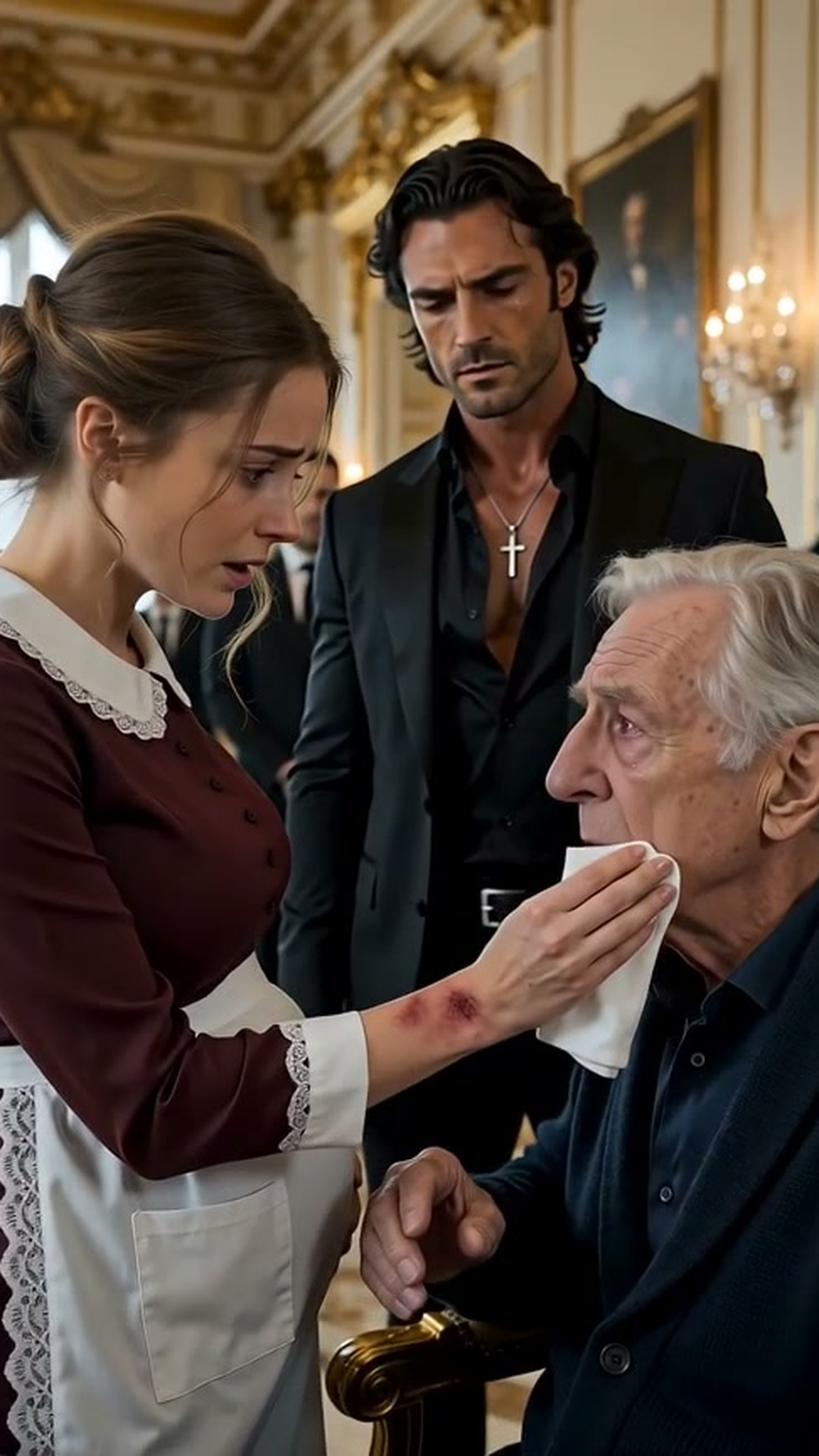
She did it. Of course she did it; there was never any question of refusal, with Ferro at the door like a weather system. In the day room, in front of the doctor and the staff Lorenzo had insisted should witness it, Mrs. Gable stood before the gold-framed chair and said, to Giovanni Moretti's face, that she was sorry.
The old man's eyes moved from her to his son, and stayed there, and expressed — with a clarity that everyone in the room felt like a hand on the chest — absolutely nothing for her at all. He did not rage. He did not forgive. He dismissed her from the universe of things that mattered, with the last weapon left to him: indifference, total and final. And then his eyes moved on, past her, to the doorway, searching — and found Nora, standing small and exhausted in her uniform with the notebook's work done, and his fingertip tapped against the arm of the chair, once, twice, in a rhythm the whole room had learned by now to recognize as the closest thing he had to a voice.
Again. Again. I am here.
Late that night, when the house had finally gone quiet and the lawyers' cars had rolled away down the long drive, Lorenzo went alone to the day room.
He had not been in it, truly in it, for two years — not as a son. He stood in the doorway and looked at it the way Salvatore must have looked: the chair angled at the wall, the painting of the harbor, the great broken television, the tray table scarred by a thousand set-down trays. The air smelled of nothing, which was its own indictment — a room a man lived his whole life in should smell of something.
Giovanni was awake. Of course he was awake; the night nurse — one of his own, a real one, hired that day, vetted by Dr. Anand with the ferocity of a border guard — had settled him and gone to make tea, and the old man's eyes found his son in the doorway and held him with the same undiminished attention he had given the pregnant maid across the gallery, six weeks and a lifetime ago.
Lorenzo crossed the room. He pulled the visitor's chair — the exhibit chair — around, so that it faced his father squarely, knee to knee, the way men sit when they have business that matters, and he sat down, and he took his father's hand onto his own knee where it could rest without effort.
"I am going to say some things," he said quietly, "and I know you can't answer, Papà, and I've decided that's no excuse anymore, because you can hear. You've always been able to hear. That's the part I—" He stopped. His jaw worked. When he went on, his voice was not steady, and he let it be unsteady, in that room, perhaps for the first time in his adult life.
"I stopped coming. Not because of the business. Because it hurt, and I was a coward about the hurting, and I paid other people to stand where I should have stood and I read their reports so I could call it love. She told me you were peaceful. She told me you slept. And all the while you were—" He looked at the disconnected bell, whose wire Ferro had found coiled neatly behind the skirting, tied with a ribbon of tape. "You were ringing a bell that went nowhere. For a year. In the dark."
Giovanni's fingertip moved against his son's knee. Once. Twice.
No. No.
"No?" Lorenzo's brow furrowed, decoding. "No — what, Papà. No, I'm not— no, it isn't my fault? Is that what you're—" A short, wrecked laugh escaped him. "You've been starved and robbed and left in the dark for two years, and your first word to me, your first actual word, is comfort?" His forehead came down, carefully, until it rested against his father's hand. "You see. You see, this is exactly— you were always—" He could not finish. The empire's whole vocabulary failed him, and in the ruins of it the old man's fingertip began, slowly, against his hair now where he knelt with his head bowed, to tap its small, deliberate rhythm.
Once. Once. Once.
I am here. I am here. I am here.
"I'm here too," Lorenzo said, into his father's hand, in the voice of a boy. "I'm here too, Papà. I swear it. I am here now."
That night, Lorenzo moved his father's rooms. Not the day room — the day room was a place of exile, and Lorenzo had finally understood it. He had the east salon, the sunniest room in the house, the one with the garden doors and the view down the lawn to the trees his father had planted the year Lorenzo was born, emptied of its antiques and made into a bedroom and sitting room both, with the great chair by the window and the family photographs — the real ones, dug out of the attic by Bruno at midnight, weeping unashamedly into his apron — arranged where Giovanni could actually see them. He hired, personally, interviewing every candidate himself in the study with Dr. Anand beside him, two full-time nurses who would live in and answer to the doctor and to no one else. He abolished the black book. He had it burned, in the end, in the study fire — all except the pages the lawyers needed — while Ferro watched and said nothing.
And he summoned Nora.
She came to the study at nine the next morning, sleepless, terrified, still half-expecting the agency and the police and the long fall out of the only safety she had found. She stood where Tessa had stood, with her hands folded over her belly, and Lorenzo Moretti looked at her across the desk for a long moment before he spoke.
"You kept a record," he said. "You knew it could destroy you. A girl in your position — forgive me, I know your position, I've read the notebook — a girl with nothing, and you kept it anyway. Why?"
"He couldn't," Nora said. Her voice was very small. "Somebody had to be able to say it, sir. He couldn't say it. So I wrote it down. That's all. It's not bravery, sir. It's just— he had nobody else who could hold a pencil."
Lorenzo was silent for a moment.
"From today," he said, "you are not a maid in this house. You are my father's companion — his reader, his—" he searched for the word and found, to his own visible surprise, the right one — "his friend. At a companion's salary, with a companion's rooms — the garden flat, not the attic — and Dr. Anand will arrange your own doctor, for the baby, at my expense, and your hours will be the hours he is awake and no more, and when the baby comes there will be leave, paid, and a position waiting. This is not charity," he said, as she began, predictably, to protest. "I have read your notebook, Miss—"
"Nora," she said faintly. "Just Nora."
"I have read your notebook, Nora. It is the most professional document anyone in my organization has produced all year." Something that was almost, almost a smile moved in his face and was gone. "Sit down. Please. You've been on your feet since five, and my father would never forgive me."
She sat. And then — because the world had turned upside down so many times in twenty-four hours that one more revolution hardly seemed worth resisting — Nora did the thing that she would dine out on, in a small way, for the rest of her life. She looked at the most feared man in New York, the man who had ended a woman's life's work the night before without raising his voice, and she said:
"He likes the racing results, sir. From the newspaper. And anything with butter. And he hates the carrots. And in the morning his swallowing is better, so the big feed should be the morning one. And the window — he likes the window open a little, even in winter, because of the trees. Your trees. He planted them."
Lorenzo Moretti wrote it down. All of it, in his own hand, on the study pad, like orders from a higher authority.
"He hates the carrots," he repeated, gravely, writing. "Since when does he hate carrots? He grew them. In '74 he grew carrots and made my mother—" He stopped. His pen stopped. For a moment the thirty-two-year-old empire, the suits, the bodyguards, the whole black apparatus of fear that the name Moretti carried up and down the Eastern Seaboard, simply fell away, and there was only a son at a desk, discovering his father again out of a maid's notebook, one small human fact at a time.
"Tell me the rest," he said. "All of it. Start from the beginning. I have—" He looked at the door, at the empire waiting beyond it, at the phone with its forty messages, and he did a thing he had not done in a decade: he reached over and turned the phone face-down on the desk.
"I have time," he said.