Winter turned, in the slow way of upstate winters, toward spring.
The Moretti estate changed — not its stones, not its fountains, but its weather. Staff who had walked its corridors like mice began, cautiously, to walk like people. The black book was gone and nothing had replaced it but a rota drawn up by the senior nurse, a redoubtable woman named Mrs. Okafor, who ran Giovanni's care the way Bruno ran his kitchen: as a sacred trust, with soup. The physiotherapist came twice a week and stayed, and Giovanni's right hand, that winter, won back a quarter of an inch, and then another, and the doctors used words like remarkable that Dr. Anand translated, dryly, as food, attention, and a reason.
Lorenzo came every day.
Not for long, at first — he was unlearning two years, and guilt is a heavier tutor than love — but every day: in the morning before the city, with the newspaper, reading the racing results aloud in a voice that grew steadier by the week; in the evening, when he could, simply sitting where his father's eyes could find him. He learned the language. One blink. Two blinks. Eyes right, the window, the trees. He learned that the swallow was better in the morning and the patience worse in the rain, that the carrots were an abomination and the butter a sacrament, that his father, at eighty-one, in the ruins of his body, had lost none whatsoever of his opinions.
And on the last Sunday of March, with the garden doors open to air that smelled of thawing earth, Giovanni Moretti did the thing that made Bruno drop a tray in the kitchen and Mrs. Okafor telephone Dr. Anand in a state of professional joy. His son was reading him the obituaries — they both liked the obituaries; it was a family trait — and Giovanni's hand, resting on the arm of the gold chair, lifted. Not tapped. Lifted — an inch, two inches, the whole wasted hand rising off the arm of the chair under its own power — and came to rest, trembling and sure, on top of his son's hand where it held the newspaper.
Lorenzo did not move. He barely breathed.
"Papà," he said at last, very quietly, and put his other hand over his father's to hold it there, the way you hold a bird. "I know. I know. I'm not going anywhere."
The fingertip pressed, once. Again.
I am here, it said. And Lorenzo, who finally understood the language, answered in it the only way he had ever needed to: he stayed.
Christmas came first, and with it, the thing Giovanni had been denied the year before and the year before that: a tree he could see, a table he was seated at, a room that arranged itself around him instead of past him. The staff ate in the dining hall that year, all of them, at the long table, with Bruno carving — a restoration Tessa had proposed in a whisper and Lorenzo had approved with a single nod, as if embarrassed it needed proposing. Giovanni, enthroned at the head in a new cardigan with a sprig of holly that Nora had pinned, entirely without authorization, to his lapel, watched the candles and the faces with an expression Salvatore described later as "a king reviewing a parade he personally paid for." When the pudding came, Nora fed him his small, safe share of it at his own pace, with the whole room slowing itself, without being asked, to the tempo of the old man's swallow. It took twenty minutes. Nobody watched the clock. The clock, that year, watched them.
In February there was a scare — a fever, a night of doctors and hushed corridors, Lorenzo standing at 3 a.m. in the east salon doorway in his coat over his pajamas, refusing the chair, refusing coffee, refusing, with a courtesy that terrified the night staff far more than shouting would have, to be anywhere else. Dr. Anand earned his fee that night, and by dawn the fever had broken, and Giovanni's eyes, opening on the winter light, found his son asleep in the visitor's chair with his head on the bed rail and one hand still, in sleep, holding the old man's wrist — as if, even dreaming, he was making sure the bell was answered.
"Don't tell him," Mrs. Okafor instructed the staff, dryly, adjusting the blanket over the most feared man in New York where he slept like a boy caught napping in church. "It would embarrass him. Men like that, they ration it. Being known."
Spring came in with the garden doors open. Anselmo, restored to favor and roses both, put a cutting from the chapel bush in a pot on Giovanni's window sill, where it rooted, against several laws of horticulture and probability, and lived. Nora's belly grew enormous and then, in May, she was moved — by order of a conspiracy consisting of Lorenzo, Mrs. Okafor, and Tessa, acting in flagrant disregard of her protests — off all duties entirely, and installed in the garden flat to rest, with a bell of her own by the sofa that was connected, that worked, that she rang exactly once, by accident, and was mortified about for a week.
Giovanni asked after her every day, in the language: eyes left, eyes right. Window. Girl. Baby. Coming? And Lorenzo, who relayed the bulletins with the gravity of a foreign office, reported back that the answer, as of the first week of June, was: soon.
Nora's daughter was born on a Tuesday in June, in the hospital Dr. Anand chose, with an obstetrician who had delivered half the grandchildren of the Eastern Seaboard and who pronounced her, professionally, perfect. Seven pounds one ounce. A head of dark hair. A cry, the nurses said, like a trumpet.
They named her Danielle, for a roofer with kind hands who had fallen off a scaffold and never met her; and when the name was written down, Nora sat in the hospital bed with the baby against her shoulder and cried for a while, for Daniel and for the card from her mother under the clothes in a suitcase she no longer owned, and for the two hundred and eleven dollars that had once been the entire distance between her and the street.
She had written to her mother in April. The letter had taken her a month to draft. I am safe, it said. I am valued. The baby is coming and we have a home, and his name will be in hers, and I think of you. Her mother had telephoned — an actual telephone call, the first in two years — and had cried, and had said the word grandmother to herself, experimentally, three times, like a woman trying on a coat she had not expected to be offered. She was coming in August. She was bringing, she said, a blanket she was knitting. It would not be finished. It would be brought anyway.
On the Sunday after Nora came home — home, to the garden flat with its door onto the terrace and its view of Giovanni's trees — there was a lunch in the dining hall of the Moretti estate.
It was not a grand affair. Bruno cooked, which meant it fed forty and served eight. Mrs. Okafor was there, and Salvatore Ricci, minus two fingers and plus a case of wine he had carried up the drive himself, refusing all help, at eighty-four, on principle. Tessa was there, promoted now to housekeeper — the youngest in the house's history, ruling a staff who adored her with a soft voice and a rota that accounted, first and above all, for rest. Ferro ate standing up, out of habit, by the door. And at the head of the great table, in the gold-framed chair that had been carried in like a throne and positioned by Lorenzo's own hands where the light fell and the whole room could be seen, sat Giovanni Moretti — in a new navy cardigan, with his nails done, his hair combed like a senator's, fed that morning at his own pace on buttered eggs and racing results, a king in the only court that had ever really mattered to him: a room where he was known.
Nora took her seat beside him — hers, by established custom, the seat at his right hand, where her hand could rest on the arm of his chair — with Danielle asleep in the crook of her other arm, three weeks old and entirely unimpressed by the Mafia.
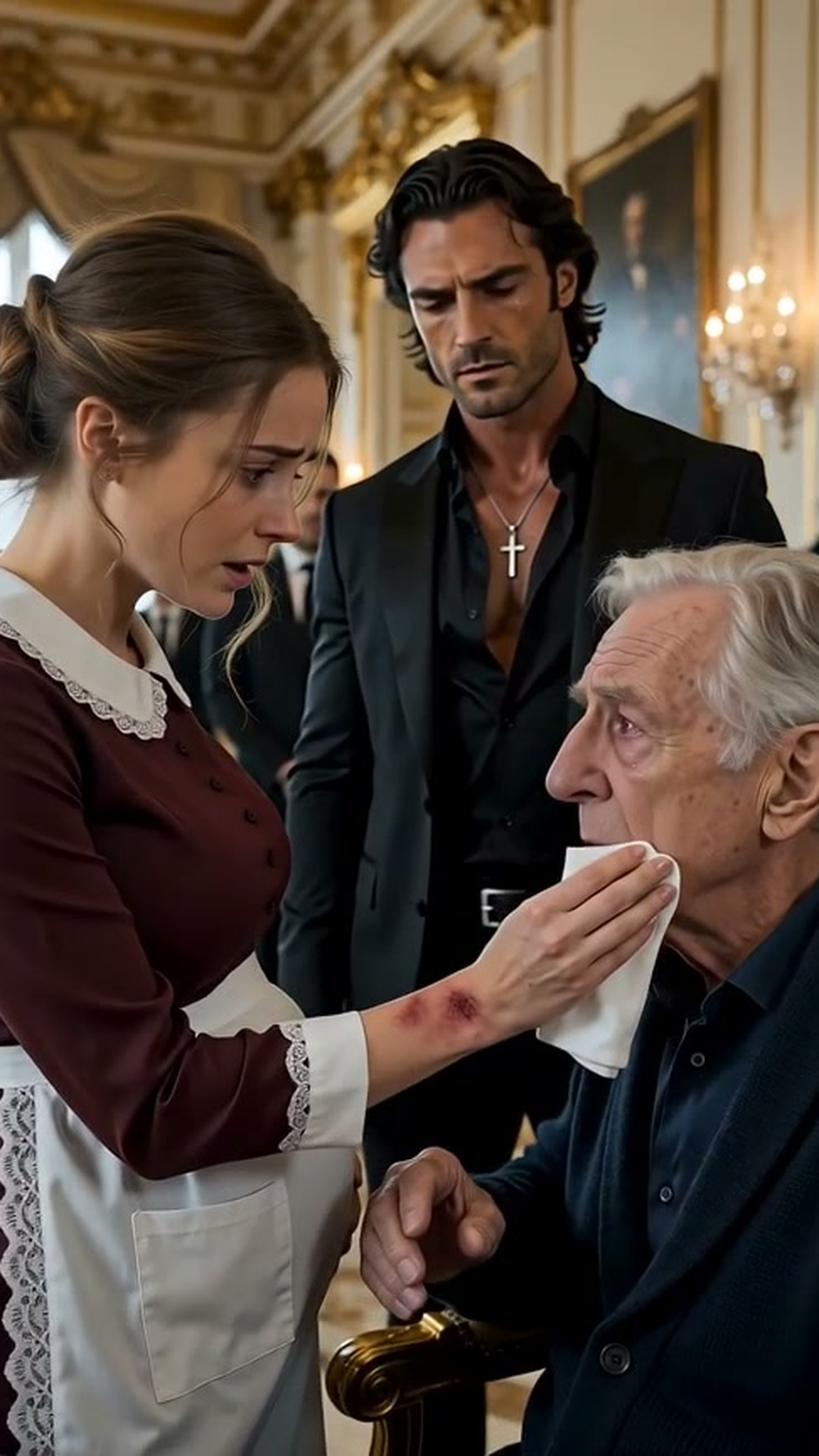
Lorenzo rose, at the head's other side, with a glass in his hand, and the room quieted. He was not a man for speeches. He looked at his father. He looked at the girl in the burgundy — no; not burgundy anymore; she did not wear the uniform now, and never would again — he looked at Nora, in her blue dress, with her daughter asleep against her, and at his father watching them both with tears standing in his eyes that nobody in that room any longer mistook for anything but what they were.
"To my father," Lorenzo said, "who built all of this out of nine dollars and a name." The glass rose. "And to the people who remind us what it was built for."
They drank. And Giovanni's hand moved on the arm of the chair — the small, hard-won movement that everyone at that table had learned to read as fluently as print — and Nora, laughing, translated for the room, for the record, for the last page of a notebook she no longer needed to hide:
"He says: eat," she said. "He says the food is getting cold, and in this house, from now on, nobody eats alone."
The christening was held in the estate chapel in July, because Giovanni had asked for it — in the language, over three mornings of patient construction, eyes and fingertip and the letter board Mrs. Okafor had introduced in the spring, on which his hand, that had once signed away waterfronts, now spelled with agonizing slowness and complete intolerance of error: C H A P E L. M I N E. G O D F A T H E R. It had not been phrased as a request. Very little Giovanni Moretti had ever communicated, in any medium, in eighty-two years, had been phrased as a request.
So the chapel was swept and flowered, the old font — dry since Lorenzo's own christening — was filled, and Nora carried her daughter down an aisle of perhaps twenty people to where Giovanni waited in the gold chair at the front, in his navy cardigan, with Salvatore Ricci on one side of him and Lorenzo on the other, both of them in suits, both of them crying without any attempt whatsoever at concealment, in a manner that would have ruined their reputations in three states if anyone present had been unwise enough to mention it.
The priest was young and clearly terrified, and acquitted himself beautifully. When the moment came, it was Lorenzo who lifted Danielle — carefully, with the two-handed, whole-forearm technique of a man defusing something precious — and held her where his father could see her and be seen by her, close over the font, while the water ran and the baby objected, briefly and with spirit, to the entire proceeding.
"Danielle Nora," the priest said, "I baptize you—"
Giovanni's hand moved. It rose — the full, hard-won two inches that were now its kingdom — off the arm of the chair, and came to rest against the baby's blanket, and stayed there, while the water splashed softly and the child's godfather, who could not speak, pronounced over her the only blessing his body had left him, in the language his family had all learned by then to read:
Once. Once. Once.
I am here. I am here. I am here.
"Yes," Nora whispered, steadying the blanket, steadying them all, with her hand over his. "We know, Don Giovanni. We're all here. That's the whole point of us, now. We're all here."
Outside the tall windows, the trees Giovanni Moretti had planted the year his son was born were coming into leaf, green as money, green as spring. And at the table, course by course, at the old man's own slow pace, with his daughter-by-kindness at his right hand and his granddaughter-by-love asleep beside him and his son across from him where his eyes could rest — the ignored old man of the Moretti house was fed, bite by bite, like royalty.
Like family.
THE END