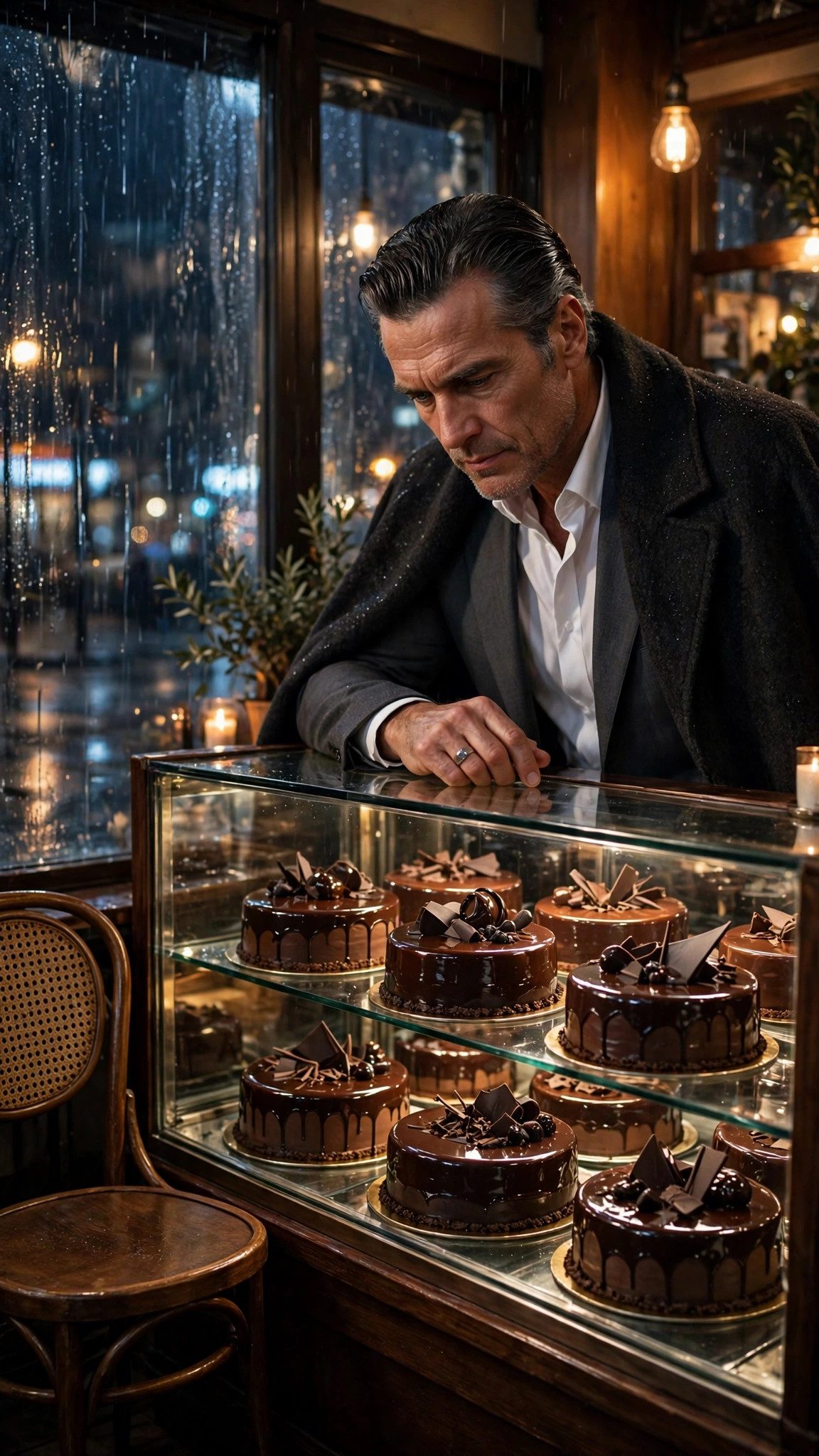
The rain had been falling since late afternoon, a thin, cold rain that turned the streets of the old neighborhood into black glass, and by seven o'clock in the evening it had settled into the kind of steady, patient downpour that made people hurry past shop windows without looking in. The little corner cafe on Maple Street glowed against the wet dark like a lantern. Its windows were fogged at the corners, its amber light spilling out onto the sidewalk in a warm pool, and inside, behind the glass display case, the chocolate cakes stood in neat rows like shining treasures.
Claraara Hart stood outside in the rain for a long time before she went in.
She was nine years old, small for her age, with dark hair pulled back into a low ponytail that had come half loose in the damp, and a coat that had once belonged to someone bigger — the sleeves rolled up at the wrists, the hem brushing her knees. Her shoes were scuffed at the toes. She had a bright smile when she chose to use it, the kind of smile that made strangers want to help her, but tonight she was not smiling. She was looking at the cakes.
She had counted her money three times on the walk from the hospital. She had four dollars and thirty-five cents, folded small in her pocket, warm from her hand. A fresh slice of chocolate cake cost six dollars. She knew that because she had asked last week, standing in this same spot, and the waiter had told her kindly, as if he were sorry. Four dollars and thirty-five cents was not six dollars. But the slice at the end of the row — the one with the frosting starting to crack at the edge, the one nobody had bought all day — that one was nearly expired. Nobody wanted it. And the things nobody wanted were the things she could afford.
She pushed the door open. A little bell rang above her head.
The cafe was quiet. Two old men sat at a table near the back, talking low over coffee. A woman in a grey coat read a newspaper by the window. The waiter, Antonio Marchetti, a man of fifty-four with a nervous, lined face and thinning grey hair, was wiping down the counter in his white shirt and black apron. He looked up when the bell rang, and his face changed — softened — the way it always did when he saw her.
"Claraara," he said. "You are out in this rain?"
"I was at the hospital," she said. She did not say more than that. She had learned, at nine years old, that grown-ups went quiet and strange when you told them about hospitals, and she did not like the way their eyes filled up. She walked to the display case instead and pressed her hands against the glass, just lightly, the way you would touch something precious.
"Please," she whispered, so softly that Antonio had to lean in to hear her, "can I have the slice of chocolate cake that's expired? My brother would love it. I don't need a fresh one. I can pay."
Antonio paused, the cloth still in his hand. Nobody had ever asked him for that. Who would want expired food? He looked at the slice at the end of the row, and then he looked at the little girl, and something in his chest tightened, because he knew this girl, and he knew her mother, and he knew the hospital three blocks away, and he knew the small boy in the children's ward who had not eaten a proper meal in weeks.
"Claraara," he began, gently, "your brother —"
"Your brother won't eat the expired cake, will he?"
The voice came from the corner table, low and calm, and it cut through the soft sounds of the cafe like a knife through cloth. Antonio went very still. The two old men at the back stopped talking. The woman with the newspaper lowered it an inch.
Gabriel Rossy sat in the corner booth, where he always sat when he came to this cafe, with his back to the wall and his face to the door. He was forty-eight years old, tall even sitting down, with a sharp jaw and cold grey eyes and dark hair slicked back, greying at the temples. He wore a charcoal tailored suit, a white shirt with no tie, and a dark overcoat draped over his shoulders like a cloak. His name had power in this neighborhood. Power that could freeze a room. The families that owned these little cafes, these little shops, they had all heard the whisper of who Gabriel Rossy was. A man who had built his power on the backs of other people's pain. A man you did not cross.
He had been watching the girl since she came in. He had watched her stand outside in the rain, counting her money. He had watched her press her hands to the glass. And something in her words — something in the small, plain way she had asked for the thing nobody wanted — had struck him, pierced through the cold composure of a feared mafia boss like a needle finding a crack in stone.
Claraara turned toward him. She did not look frightened. That was the first thing he noticed. Most people, when Gabriel Rossy spoke to them, looked frightened. This little girl looked at him with quiet eyes and a lonely smile, and she did not step back.
"No, sir," she said. "My brother won't need it."
"Won't need it," Gabriel repeated. He set his coffee cup down, slowly, precisely. "Why would you want an expired one? Why don't you buy her a fresh cake?" He said it to Antonio, but his eyes stayed on the girl. "Why would you want an expired one?"
Claraara glanced down at her shoes. The rain had darkened the leather at the toes. When she spoke again, her voice was even softer.
"My brother is three years old, sir. His name is Ethan. He is at the children's hospital, three blocks from here. He is very sick. The doctors say —" She stopped. She swallowed. She had practiced this sentence in her head on the walk over, and it still would not come out right. "He doesn't need a fresh cake. He only needs a taste. Just one taste of chocolate cake, before —" She stopped again, and this time she did not try to finish. She looked up at Gabriel, and her eyes were clear and dry, which was worse, somehow, than tears would have been. "I can pay," she said. "I have four dollars and thirty-five cents."
The cafe was silent. The rain drummed against the windows. Antonio stood frozen behind the counter with the cloth in his hand, and he did not dare to move, because he knew Gabriel Rossy, and he knew what happened to people who interrupted Gabriel Rossy, and he also knew this little girl, and he was caught between two fears and could not choose.
Gabriel rose from the booth. He was taller standing than Claraara had expected, and his overcoat fell from his shoulders in a dark sweep as he came toward the display case. He stopped beside her, looking down at the rows of chocolate cakes, and then he looked down at her.
"Do you miss your father?" he asked.
The question was so quiet, so sudden, that Claraara blinked. "Yes, sir," she said. "Every day."
"Do you like cake?"
"My father's the story of this city," she said, and her voice, small as it was, had a sudden strength in it, like a thin wire pulled taut. "He was a good man. He made the best chocolate cake on Maple Street. Everybody said so." She leaned in a little closer, and her quiet eyes did not waver. "But you are nothing like him."
Antonio made a small sound in his throat, a sound like a man swallowing a scream. The two old men at the back table had gone the color of paper. Gabriel Rossy stood perfectly still, looking down at the nine-year-old girl who had just told the most feared man in the neighborhood that he was nothing like her father, and for a long moment nobody in the cafe breathed.
Then Gabriel Rossy did something no one in that cafe had ever seen him do.
He smiled. Not the cold, thin smile he wore in meetings, the smile that made grown men check their exits. A real smile, small and startled, as if it had surprised him as much as it surprised everyone else.
"Do you make good chocolate cake?" he asked.
"I am good at making every cake," Claraara answered softly. "My father taught me. Before."
"Before," Gabriel repeated. He nodded slowly, as if he were filing the word away. He turned to Antonio. "Box the fresh one," he said. "The big slice. The one in the middle."
"Sir —" Antonio began.
"Box it," Gabriel said. "And the expired one too."
Antonio moved quickly then, his hands shaking only a little, and he boxed both slices with trembling care, tying the ribbon in a neat bow. Gabriel reached into his coat and set a folded bill on the counter without looking at it. It was far too much. Antonio did not argue. Nobody argued with Gabriel Rossy about money.
Gabriel picked up the box with the fresh slice and held it out to Claraara. "Then buy your brother a fresh cake instead," he said. His voice was low, and there was something in it that Claraara did not understand — a heaviness, a decision being made behind his eyes. "But understand — my revenge comes in a different way."
Claraara took the box with both hands, holding it carefully, like something that might break. "Thank you, sir," she said. She looked at the box, and then she looked up at him, and she smiled — the bright smile, the one that made strangers want to help her — and she said, "You can buy the cake, but who has the money to buy you?"
She did not wait for an answer. She turned and walked to the door, the box held tight against her chest, and the little bell rang above her head as she stepped back out into the rain.
Gabriel stood at the counter, watching her go. Through the window he could see her small figure crossing the street, the white box bright against her dark coat, hurrying toward the hospital three blocks away. The rain fell on her shoulders and she did not run. She walked, steady and unhurried, as if the rain were nothing, as if the whole wet dark city belonged to her for one evening.
"Marco," Gabriel said quietly, without turning around.
His bodyguard rose from the table by the door, a broad man in a black suit who had been so still that most people forgot he was there. "Boss."
"Follow her," Gabriel said. "Not close. Just make sure she gets to the hospital. And find out who she is. Her name. Her mother. Her brother. Everything."
Marco nodded and went out into the rain.
Gabriel stayed where he was, one hand resting on the counter, looking out the window at the empty street. Antonio stood behind the counter, afraid to speak, afraid to move, waiting for the storm that always followed when Gabriel Rossy went quiet like this.
"Antonio," Gabriel said at last, still looking out the window.
"Yes, sir."
"That girl's father. The baker. What was his name?"
Antonio swallowed. "Daniel Hart, sir. He had the little bakery two streets over. He died last year. A heart attack, they said."
"And the cafe owner's father owed me," Gabriel said. It was not a question. It was a statement, flat and cold, and Antonio felt the blood leave his face, because he understood then that Gabriel Rossy already knew, or was beginning to know, and the knowing was worse than the not knowing.
"Sir," Antonio whispered, "that debt destroyed this family."
Gabriel turned from the window then, slowly, and his grey eyes fixed on the waiter. "Did it?" he said. "Then you know who really —"
He stopped. He did not finish the sentence. He stood there in the warm amber light of the little cafe, with the rain drumming on the windows and the smell of chocolate and coffee in the air, and he thought about the little girl with her four dollars and thirty-five cents, and he thought about the man he had been on his way to kill that night, a man named Vincent Castellano's lieutenant, a man waiting in a warehouse two miles away with a gun in his coat and a price on Gabriel Rossy's head — and he understood, with a clarity that felt like ice water down his spine, that one of them was about to die that night.
Him, or the other man. And the girl with the cake had just changed which one it would be.
Gabriel stopped at the door with his hand on the handle, and he turned back. "Antonio. How long has that girl been coming here?"
Antonio swallowed. "Months, sir. Since her father died. She comes once a week, always after the hospital. She always asks for the cheapest thing on the shelf, and she always pays exact change, down to the last coin. She never asks for anything for herself. Not once."
"And her brother?"
"Three years old, sir. Leukemia. The doctors say he needs a transplant. The mother works nights, cleaning offices. They have nothing left, sir. Nothing at all."
Gabriel nodded slowly, and he looked at the display case, at the rows of chocolate cakes shining under the warm light, and he thought about a boy who had once stood outside a shop window on these same streets, counting coins that were never quite enough, and about how the world had answered that boy — not with kindness, but with a lesson about power. He had learned the lesson. He had lived it for thirty years. And now a nine-year-old girl had walked into his life and asked him, without knowing it, whether the lesson had been worth learning.
"Keep the cafe open," Gabriel said. "I will be back."
He took his overcoat from the booth and went out into the rain, and Antonio Marchetti stood behind the counter for a long time after the door closed, holding the cloth in his shaking hands, thinking about a debt, and a baker, and a little girl who had asked for the slice nobody wanted — and wondering, with a fear he could not name, what Gabriel Rossy would do next.