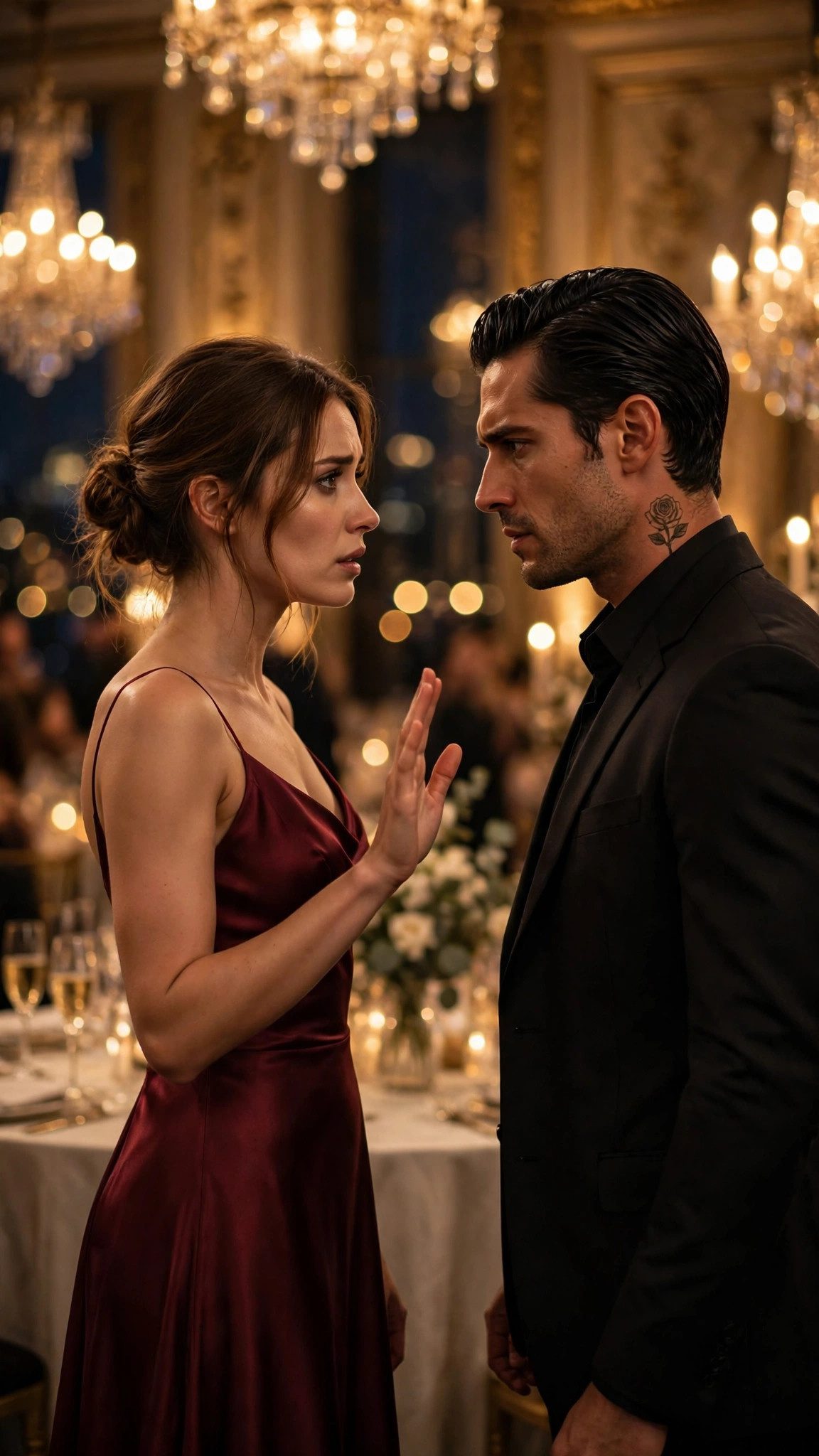
The morning after the gala, I woke up to silence.
No car outside my building. No coffee on the nurses' station. No note. No driver. No message. For the first time in six weeks, Gabriel Veseri had not decided anything for me — and the silence was louder than anything he had ever done.
I told myself this was what I had asked for. I had told him to stop deciding. I had told him to ask. And now he was doing what I had asked — he was giving me space, and letting me decide, and not acting at all.
It was terrible. I hated it. I stood in my kitchen, holding a mug of coffee I had made myself, and I thought: this is what I wanted. Why does it feel like he has already left?
At the hospital, the silence followed me. The other nurses were polite, and careful, and a little bit afraid to look at me. Rosa squeezed my arm when she saw me and said, "Are you all right?" and I said, "Yes," and we both knew I was lying.
Mr. Whitfield did not call me into his office. That was worse than being called in. It meant the board was deciding something about me, behind a closed door, without asking me — the same way Gabriel had always decided things about me, without asking.
At noon, Maya found me in the break room, staring at a sandwich I had not eaten.
"You're an idiot," she said, sitting down across from me. "Both of you are idiots. Do you know what he did last night, after you left?"
"What?"
"He stayed on the terrace for an hour," Maya said. "Alone. In the dark. One of the waiters told Rosa, and Rosa told me. He just stood there, looking out at the city. And then he went home. And this morning, he called the hospital administrator and he told them that if anyone so much as looks at you the wrong way, he will pull every dollar of his donation and take it to another hospital."
I stared at her. "He did what?"
"He protected you," Maya said. "In the only way he knows how. By deciding. By acting. By throwing his weight around. It's not the way you wanted, Hannah. But it's the way he loves you. And you have to decide whether that's enough, or whether you need him to learn a new way."
"I'm not asking him to be a different person," I said. "I'm asking him to ask me one question."
"Then go tell him that," Maya said. "Because right now, he's sitting in his apartment thinking you left him, and you're sitting here thinking he left you, and you're both wrong, and you're both too stubborn to pick up the phone."
She was right. She was always right. I finished my shift, and I was going to go to his apartment, and I was going to tell him exactly what I needed, in plain words, without pride and without fear.
I never got the chance.
My shift ended at 7 p.m. I walked out of the hospital into the parking lot, where the evening light was fading and the air smelled like rain, and I was reaching into my bag for my keys when a hand closed around my arm.
"Miss Mercer," a voice said. "Come with us. Quietly."
I turned. There were two of them. The driver from the black SUV — the shaved head, the scar through his eyebrow — and another man, bigger, with a dark jacket and a gun in his hand, held low, where no one else could see it.
"Let go of me," I said, and my voice was steady, because six years of trauma nursing had taught me that panic kills faster than anything else.
"Mr. Rinaldi wants to talk to you," the scarred man said. "That's all. A conversation. Get in the car."
"No."
The bigger man pressed the gun against my ribs, through my coat. "Get in the car, Miss Mercer. Don't make this difficult."
I thought about screaming. The parking lot was not empty — there were cars, and people, and a security guard at the gate. But the gun was against my ribs, and the men were calm, and I knew that calm men with guns were the most dangerous kind.
Then, from behind me, a voice said, "Let her go."
Enzo. He was standing at the edge of the parking lot, in the shadow of a pillar, with his hands at his sides, looking at the two men the way a man looks at a problem he has already decided how to solve.
"Walk away, old man," the scarred man said.
"No," Enzo said. And then he moved.
I have seen a lot of violence in the emergency department. I have seen what fists and knives and bullets do to the human body. But I had never seen a man like Enzo move before. He was fifty-five years old, with grey at his temples, and he moved like water — fast, smooth, unstoppable. The bigger man's gun was on the ground before I understood what had happened. The scarred man was on the ground beside it, holding his arm, gasping.
Enzo took my arm, gently. "Are you hurt, Miss Mercer?"
"No," I said. My voice was shaking now. "No, I'm all right."
"Good. Come with me. Mr. Veseri is on his way."
Gabriel arrived five minutes later. He came in the black sedan, and he got out before it had fully stopped, and he crossed the parking lot toward me, and his face was white — white with fear, white with rage, white with something I had never seen in him before.
He stopped in front of me. He looked at me the way he had looked at me in the trauma bay — head to toe, assessing damage, looking for blood.
"Are you hurt?" he asked.
"No."
"Did they touch you?"
"One of them grabbed my arm. That's all."
He closed his eyes. When he opened them, the fear was still there, but underneath it was something else — something cold and final, like a door closing.
"Rinaldi," he said. "He's done. Tonight."
"Gabriel, no." I grabbed his arm. "Don't. Don't go after him. That's what he wants. He wants you to do something that will put you in prison, or get you killed."
"He put his hands on you," Gabriel said, and his voice was very quiet. "He came to your hospital. He left a rose on your pillow. He sent men to take you from a parking lot. He is done, Hannah. Tonight. I will end this."
"Then end it the right way," I said. "Not with a gun. Not with your men. With the police. With evidence. You have the license plate. You have the intruder. You have the parking lot cameras. You have me, as a witness. End it so that it stays ended."
He looked at me for a long time. I could see the war inside him — the man who solved problems with power and fear, against the man who had spent six weeks learning, slowly, painfully, to listen to a nurse who asked him how he felt.
"All right," he said finally. "The right way. But if the police are too slow—"
"They won't be," I said. "Because I'm going to call them myself. Right now."
I called the police from the parking lot, with Gabriel standing beside me and Enzo watching the two men on the ground, and I gave my statement, calmly, clearly, the way I gave reports in the trauma bay. Names. Times. The license plate. The rose. The gun. The officer who came was young and thorough, and he took notes, and he took the gun, and he took the two men away in handcuffs.
And then Gabriel said, "There's one more thing. Rinaldi will be at the docks tonight. He has a shipment coming in — the one he needs my licenses for. If the police go now, they will catch him with it. With the cargo. With the men."
"How do you know that?" I asked.
"Because I have a man inside his organization," Gabriel said. "I have had one for two years. Rinaldi doesn't know. Tonight, at midnight, the shipment arrives at Pier 9. If your police are there, it ends."
It was a trap. I could see it. Rinaldi would be there, with his men, and Gabriel would be there, and the police would be there, and something would go wrong. Something always went wrong when powerful men arranged midnight meetings at docks.
"You're going, aren't you?" I said.
"Yes."
"Then I'm going with you."
"No, Hannah—"
"Yes," I said. "You don't get to decide this one, Gabriel. I'm a witness. I'm the person he tried to take. And I'm a nurse. If someone gets hurt tonight, they'll need me."
He looked at me, and I saw the argument die in his eyes before it reached his mouth. He had learned, finally, that some things were not his to decide.
"All right," he said. "You come with me. But you stay in the car. With Enzo. No matter what happens, you stay in the car."
"All right," I said. "I'll stay in the car."
I lied. I knew I was lying, and he knew I was lying, and neither of us said so. Because we both knew that if Gabriel Veseri got hurt that night, I would be the first person to reach him, and the only person who could keep him alive. The same way I had been the first time.
Pier 9 was dark and cold and smelled like diesel and salt water. The rain had started again, thin and steady, and the cranes stood against the sky like sleeping giants. Gabriel's car stopped at the edge of the dock, and Enzo turned in his seat and looked at me.
"Stay in the car, Miss Mercer," he said. "No matter what you hear. Mr. Veseri's orders."
"All right," I said. Again, I lied.
Gabriel got out of the car. He was wearing a black coat over his black suit, and his hair was slicked back, and in the dark, with the rain on his shoulders, he looked like a man walking into a storm he had been expecting for a long time.
I watched him walk toward the warehouse, toward the lights, toward the men waiting there. I watched Enzo get out and follow him at a distance. And I sat in the car, in the dark, with my hands clenched in my lap, and I waited.
It lasted four minutes. Four minutes of silence, and rain, and the sound of my own breathing. And then the silence broke.
A gunshot. Then another. Then shouting — men shouting in the dark, and the sound of running feet, and a crash of metal, and then more shouting, and then the wail of police sirens, coming closer, and closer, and closer.
I was out of the car before I knew I had moved. Enzo shouted my name. I didn't stop. I ran toward the warehouse, toward the lights, toward the shouting, and my nurse's hands were already reaching for gloves I didn't have, and my mind was already doing the work it had been trained to do: assess, stabilize, keep them alive until morning.
Gabriel was on the ground outside the warehouse, leaning against a crate, with his hand pressed to his left shoulder. Blood was coming through his fingers, dark and steady. His face was pale, but his eyes were open, and focused, and furious at his own body for failing him — the same way he had looked six weeks ago, in the trauma bay.
"You're hurt," I said, kneeling beside him.
"It's nothing," he said. "A graze. The bullet went through the shoulder. It missed everything important."
"Let me see." I pulled his hand away. The wound was clean — a through-and-through, the bullet had gone in the front of his shoulder and out the back, missing the bone, missing the artery. It was bleeding, but it was the kind of bleeding I knew how to stop.
"You're lucky," I said, pressing my scarf against the wound, hard. "An inch lower and it would have hit the artery. An inch to the right and it would have shattered the bone."
"I know," he said. "I was lucky the first time, too. The bullet missed my heart by an inch. I keep getting lucky."
"You keep getting shot," I said. "That's not luck. That's a problem."
He almost smiled. Even bleeding, in the rain, outside a warehouse at midnight, Gabriel Veseri almost smiled.
"Are you still breathing?" I asked him.
"Yes," he said.
"Good. Keep doing that."
The police came then — four cars, lights flashing, officers running toward the warehouse with their weapons drawn. I heard shouting inside, and then silence, and then the officers came out with Dominic Rinaldi in handcuffs, his grey suit wet with rain, his calm, pleasant face finally showing something other than a smile. He looked at Gabriel, bleeding on the ground, and he looked at me, kneeling beside him with my scarf pressed to his shoulder, and he said, "You got lucky, Veseri."
"No," Gabriel said. "I got a nurse."
The paramedics arrived. They took Gabriel on a gurney — the same way they had taken him six weeks ago, only this time I was the one holding his hand, and this time he was looking at me, and not at the ceiling.
"Stay with me," he said, as they lifted him.
"I'm not going anywhere," I said.
At the hospital, it was my turn to be the one waiting. I sat in the corridor outside the treatment room, in my wet clothes, with blood on my hands — his blood, this time, not a stranger's — and I waited while the doctors cleaned the wound and stitched it closed, and I thought about the first night, six weeks ago, when I had stood in the trauma bay with my hands in his blood and told myself it meant nothing.
It had never meant nothing. It had meant everything. From the first night, it had meant everything.
When they let me in to see him, he was sitting up in bed, a bandage across his shoulder, an IV in his arm, looking like a man who had been shot twice in six weeks and was already furious about the inconvenience of it.
"You're the nurse," he said.
"That's me," I said.
"How is the pain?"
"You're the one in the bed, Gabriel. I'm asking the questions."
He was quiet for a moment. Then he said, "It hurts. Not the shoulder. The waiting. I waited all day for you to call me, and you didn't. And I thought I had lost you. And that hurt more than the bullet."
I sat down beside his bed. I took his hand — the hand that had caught my wrist in the ballroom, and held it for one second, and let it go.
"I didn't call you," I said, "because I was afraid. I was afraid that if I called you, I would forgive you too easily. And I was afraid that if I didn't call you, I would lose you. And I didn't know which fear was worse."
"And now?"
"Now I know," I said. "Now I know that Rinaldi is in police custody, and his men are in police custody, and the shipment is seized, and the detective told me they have enough evidence to keep him in prison for a very long time. And I know that you went to the docks tonight knowing you might get shot, and you went anyway, because a man threatened me. And I know that you are lying in this bed, bleeding, because of me."
"Not because of you," he said. "For you. There's a difference."
I looked at him — really looked at him, the way I had looked at him in the break room, and on the terrace, and in the dark apartment where he couldn't sleep — and I saw the man underneath the power and the fear and the fourteen years of never asking. I saw a man who had finally learned that the most dangerous thing in the world was not a bullet, and not a rival, and not the silence. The most dangerous thing was loving someone and never asking them if they loved you back.
"Gabriel," I said. "When you're out of this bed — when you're healed, and Rinaldi is gone, and the board has forgotten my name — come and find me. Come alone. No car. No guards. No audience. And ask me."
"Ask you what?" he said.
"You'll know," I said. "When the time comes, you'll know."
He held my hand a little tighter. "All right," he said. "I will. I promise."
And for the first time in six weeks, I believed that he would. Because for the first time in fourteen years, Gabriel Veseri had made a promise that began with the word "I" — not a decision, not an order, not a plan. A promise. To me. And a promise, I was beginning to understand, was the closest thing to a question a man like him knew how to ask.