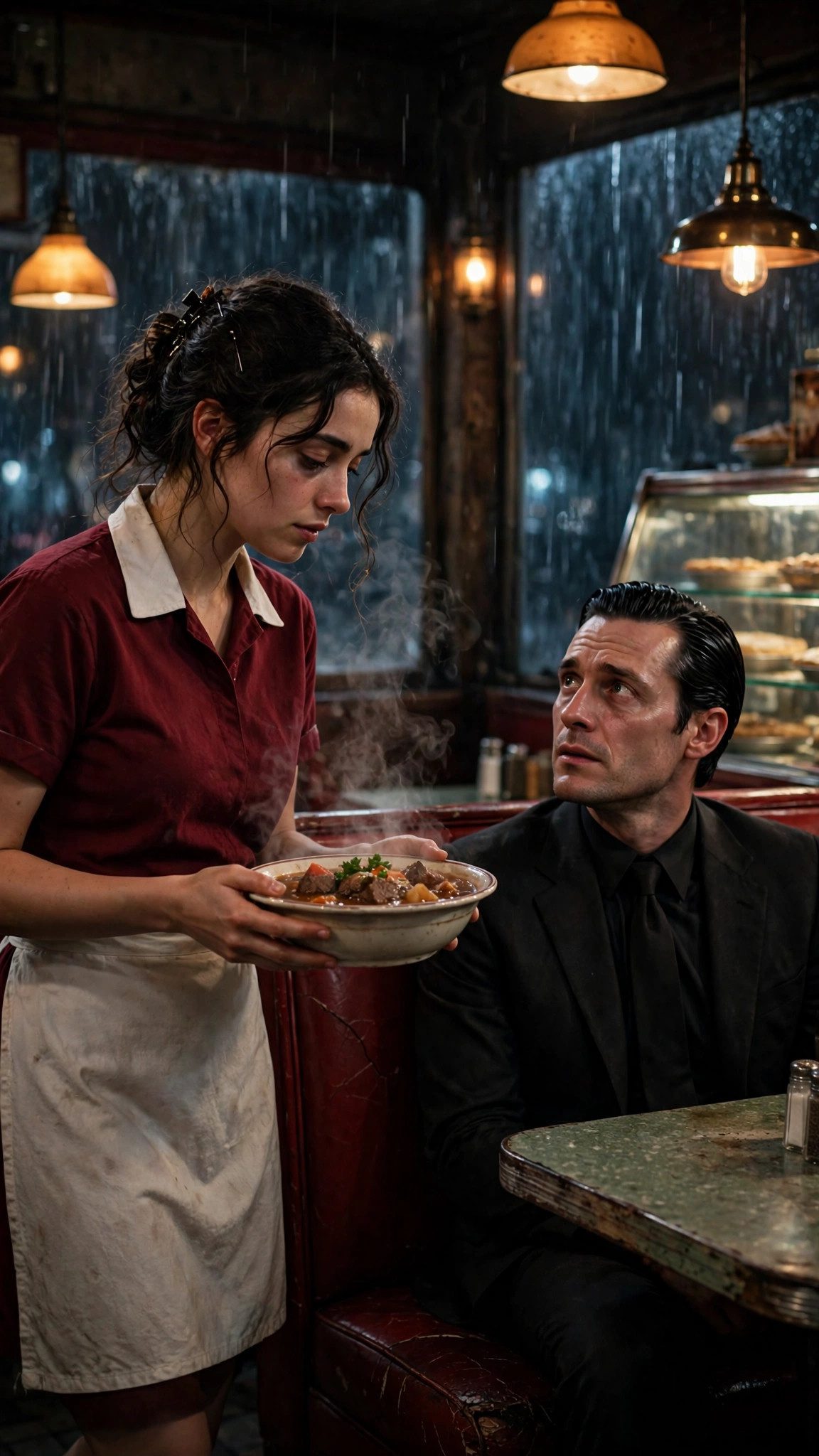
It happened on a Thursday, six nights after Gabriel first walked into Benny's Diner.
I remember it was a Thursday because Thursdays were delivery days. Every Thursday morning, a truck came to the diner with fresh ingredients — meat, vegetables, bread, milk — and Benny signed for it, and I helped carry the boxes into the kitchen. It was ordinary. It was routine. It was the most boring part of my week.
That Thursday, the delivery driver was different. He was a young man I had never seen before, with a baseball cap pulled low and a clipboard he kept checking, like he was nervous. He unloaded the boxes quickly, he did not make eye contact, and he left before Benny had finished signing the paperwork.
"He's new," Benny said, shrugging. "The regular guy called in sick."
I did not think anything of it. I carried the boxes into the kitchen. I put the chuck roast in the refrigerator. I put the potatoes and carrots in the bin. I put the bottle of red wine on the shelf. I did not notice that one of the boxes had been opened and resealed with tape that did not match. I did not notice that the seal on the broth carton was broken. I was tired. I had been up late studying for my nursing exams. I was thinking about Gabriel, and about Rosa, and about the photograph of the kitchen with the yellow curtains.
That night, Gabriel came at nine o'clock, the way he always did. He sat in the cracked red booth. He ordered the stracotto. I cooked it in the kitchen with the door open so Leo could watch, the way I always did. I used the chuck roast from the delivery. I used the potatoes and the carrots. I used the broth from the carton with the broken seal.
I did not know. I swear, I did not know.
I carried the bowl out myself. Five armed men watched every step. I placed the steaming stew in front of Gabriel. The aroma reached him. Thyme. Roasted garlic. A faint hint of cinnamon.
Gabriel picked up the spoon. His hand did not tremble anymore. He had eaten at my diner for six nights, and he was getting stronger, and the color was coming back to his face, and the emptiness was leaving his eyes.
He took one bite. He chewed. He swallowed.
And then he stopped. His face changed. Not the way it had changed the first night — not wonder, not grief. This was different. This was fear.
"Norah," he said, very quietly, "something is wrong with this."
"What do you mean?" I asked.
"It tastes —" He put the spoon down. His hand was shaking again. "It tastes bitter. At the back. Like almonds. Like —"
I knew that taste. I knew it from my nursing textbooks. Bitter almonds. Cyanide.
"Don't eat any more," I said, and my voice was suddenly very calm, the way it gets when I am in an emergency and my training takes over. "Gabriel, listen to me. Don't eat any more. Don't drink anything. Sit still."
Leo was already on his feet. "Boss? What's happening?"
"Call an ambulance," I said. "Now. Tell them suspected cyanide ingestion. Tell them he took one bite, maybe two. Tell them to bring oxygen."
Gabriel looked at me, and his eyes were wide, and his breathing was already changing — fast and shallow, the way it gets when the body is fighting something it cannot see.
"Norah," he said, "how do you know?"
"I'm studying to be a nurse," I said. "Bitter almonds. That's cyanide. One bite might not kill you, but we are not going to wait and find out."
Leo was already on the phone. Benny was standing frozen beside the pie display. The five armed men were looking at each other, and then at the kitchen, and then at me, and I could see the question in their eyes: did she do this? Did the waitress poison the boss?
"No," I said, loudly, so everyone could hear me. "I did not do this. I cooked with the delivery from this morning. The broth carton — the seal was broken. I didn't notice. Someone opened it before it got here."
Gabriel grabbed my wrist. His grip was strong, even now. "Norah. Look at me. Did you do this?"
I looked straight into his eyes. "No. I would never hurt you. Rosa taught me that recipe. Rosa taught me that food is how you love people. I would never poison food. Never."
He held my gaze for a long moment. And then he nodded, very slightly, and he let go of my wrist.
"I believe you," he said.
The ambulance came in seven minutes. Seven minutes that felt like seven hours. Gabriel's breathing got worse, and then it got better, and then it got worse again. I stayed beside him the whole time, talking to him, keeping him awake, telling him to breathe slowly, telling him to stay with me. I had never done this for real before — only in textbooks, only in practice exams. But my hands were steady, and my voice was steady, and I did not leave his side.
At the hospital, the doctors confirmed it: cyanide, a small dose, caught early. One more bite and it might have killed him. Two more bites and it would have.
Gabriel was in the hospital for two days. I visited him every day, after my shift, and I brought him soup from the diner — soup I had made myself, from ingredients I had bought myself, at a grocery store I had chosen myself, with Leo watching every step.
On the second day, Leo came to the hospital room with a folder in his hands, and his face was grim.
"We found it, boss," Leo said. "The delivery driver. He wasn't from the regular company. He was a temp, hired through an agency that doesn't exist. The agency's address is a mailbox in a strip mall. The phone number is dead. But we got his face on the diner's security camera, and one of our guys recognized him."
"Who is he?" Gabriel asked.
"His name is Danny Cole. He's a runner for Marcus Hale. He's been working for Marcus for three years. And Marcus —" Leo opened the folder — "Marcus has been meeting with Vincent Castellano. Twice a week, for the last month. At a warehouse on the docks. We have photographs."
Gabriel was quiet for a long time. Then he said, "Marcus poisoned Paulie."
"We think so, boss. The chef who died — his daughter told us someone had been threatening her. She said a man in a suit came to her school and told her that her father had to do something, or something bad would happen to her. She described Marcus."
"And my mother?" Gabriel asked, very quietly. "Did Marcus poison my mother too?"
Leo shook his head. "Marcus would have been a child when your mother died, boss. But Castellano — Castellano was around then. And Castellano had a reason to want your mother dead. She was the one person your father listened to. She was the one who told him not to go to war with the Castellanos. When she died, your father went to war anyway. And he lost."
Gabriel closed his eyes. "So Castellano poisoned my mother, twenty-six years ago. And now he's using Marcus to poison me. And Marcus is happy to help, because he wants my chair."
"That's what it looks like, boss."
Gabriel opened his eyes. "Then we end it. Tonight. Leo, I want Marcus brought to me. Not hurt. Not yet. I want him brought to me, and I want him to tell me everything, in his own words. And I want Castellano to know that I know."
"Boss," Leo said, "you're still in a hospital bed."
"Then bring him here," Gabriel said. "Bring him to the hospital. I don't care. I want to look him in the eye."
That night, they brought Marcus Hale to Gabriel's hospital room. Marcus was not handcuffed. He was not beaten. He walked in wearing his sharp suit, with his sharp smile, and he looked at Gabriel in the hospital bed, and he said, "Boss. I'm glad you're all right. I heard about the diner. Terrible thing."
Gabriel looked at him for a long moment. "Marcus," he said, "how long have you been working for Castellano?"
Marcus's smile did not change. "I don't know what you're talking about, boss."
"Let me ask you a different question," Gabriel said. "The night before Paulie died, you went to his house. You left an envelope on the table. What was in the envelope?"
Marcus was quiet for a moment. Then he said, "Money. For the chef's daughter. I was trying to help."
"You were threatening her," Gabriel said. "You told her father to poison Paulie, or his daughter would pay the price. And when the chef did what you told him, you let him die too. You didn't warn him. You didn't save him. You used him, and then you threw him away."
Marcus's smile faded. "You can't prove any of that."
"I don't need to prove it," Gabriel said. "I need you to tell me one thing, Marcus. Just one thing. When you poisoned the broth — when you sent that driver to my diner, to the one place in the city where I could eat — did you know that Norah would be the one to cook it? Did you know that she would be the one standing there when I took the bite?"
Marcus looked at me, standing in the corner of the hospital room, and for the first time, I saw something in his eyes that was not confidence. It was fear.
"I didn't know about her," Marcus said. "I didn't know about the waitress. I just knew about the diner. I knew you were eating there. I thought — I thought if I poisoned the food, you'd die, and nobody would know it was me, because it would look like the diner did it."
"And if Norah had eaten it first?" Gabriel asked. "If she had tasted it, the way a cook tastes her own food?"
Marcus said nothing.
Gabriel nodded slowly. "Take him away, Leo. Put him somewhere safe. He'll talk to the police when I'm ready. And Marcus —" he looked at the man who had tried to kill him — "you should know something. The woman you almost killed tonight is the reason I'm alive. And the woman who taught her that recipe is the reason I remember who I am. You tried to poison my food. But you forgot something."
"What's that?" Marcus asked.
"Food is not just food," Gabriel said. "Food is love. And love is the one thing you can't poison."
Leo took Marcus away. The room was quiet. Gabriel looked at me, and his eyes were tired, and his face was pale, but he was alive, and he was looking at me like I was the most important person in the world.
"Norah," he said, "I need you to do something for me. I need you to go home, and pack a bag, and come back here. I need you to stay where I can protect you. Because Castellano is still out there, and he knows about you now, and he will come for you."
I nodded. I was scared. But fear had never helped anyone survive.
And I had already survived one night in a diner with five armed men. I could survive this too.
Especially with Gabriel Hayes beside me.
The next morning, I went back to the hospital before my shift, because I could not stay away. Gabriel was sitting up in bed, looking pale but alert, arguing with the doctor about when he could leave. The doctor — a tired-looking woman in her fifties with kind eyes — was explaining that cyanide poisoning, even in a small dose, needed to be watched for at least forty-eight hours, and that the antidote had done its work but his body still needed rest.
"Forty-eight hours," Gabriel said. "I don't have forty-eight hours. I have a city to run."
"You have a body to keep alive," the doctor said, in the tone of a woman who had said the same thing to a hundred stubborn men. "And right now, the body wins."
My mother arrived an hour later, carrying a container of homemade soup and a look on her face that I knew very well — the look that said she was worried and angry at the same time, and that someone was going to hear about it. She took one look at Gabriel in the hospital bed, and she set the soup down on the table, and she said, "Young man, my daughter tells me you haven't been eating properly. That ends now. You're going to eat this soup, all of it, and you're going to tell me if it tastes right, because if it doesn't, I'll make it again."
Gabriel stared at her. Then he laughed — a real laugh, deep and surprised — and he said, "Yes, ma'am."
Leo came in that afternoon with news. Danny Cole, the delivery driver, had been arrested at a bus station on the edge of the city, with a one-way ticket in his pocket and a phone full of messages from Marcus Hale. The messages were careful — no names, no details — but the phone records showed the pattern, and the pattern was enough. Marcus had paid Danny five thousand dollars to swap the broth carton on the delivery truck. Five thousand dollars to poison a man who had once been his boss.
"And the chef's daughter?" Gabriel asked. "The one Marcus threatened?"
"Safe," Leo said. "We moved her and her mother to a hotel last night. She's going to testify, boss. She's scared, but she's going to do it."
Gabriel nodded slowly. "Good. Then we have everything we need. Marcus, Castellano, the driver, the chef's daughter. It's all connected now. It's all one story."
He looked at me, sitting in the chair beside his bed, holding his hand, and he said, very quietly, "Norah, if you hadn't recognized the taste — if you hadn't known about bitter almonds — I would be dead right now. You saved my life twice. Once with a bowl of stew, and once with a textbook."
I squeezed his hand. "That's what nurses do," I said. "We notice things. We stay. We don't leave."
"Then don't leave," Gabriel said. "Not tonight. Not ever."