One year later, Vincent Castellano was sentenced to life in federal prison, and the newspapers called it the end of an era, and for once, the newspapers were right.
The trial had taken nine months. I testified for three days, and Castellano's lawyers did everything Prosecutor Reyes had warned me they would do. They said I was a hired gun. They said I had a grudge. They said I had invented the pattern in my notebook because I wanted to be important. And then Reyes put my notebooks on the screen, and he put the bank records on the screen, and he put Marco's letter on the screen, and he put the photograph on the screen, and the lawyers stopped talking, and the jury stopped doubting, and Castellano sat at the defense table with his hands folded and his face like stone, and he did not say a word.
Marco testified too, from prison, in an orange jumpsuit, and he told the truth, all of it, the way he had told it to Leo in the study that night. He was sentenced to eight years. His wife visits him every Sunday. His daughter is in her second year of college. She wants to be a lawyer.
Aldo Ferrante took a deal and testified against his own boss. The attacker with the knife — Rocco — did the same. The Castellano family, which had stood for forty years, fell apart in nine months, the way a house falls apart when someone finally pulls out the beam that was holding up the roof.
And the Costello family went on. Not the way it had gone on before. Leo kept his word. The docks, the trucks, and the money were split three ways, and the men who ran them reported to Leo separately, and no one man held enough power to sell the family again. The legitimate businesses — the restaurants, the hotels, the shipping company — grew, and the other businesses, the ones that had made the family feared, shrank, year by year, until one day Leo looked at the books and said, "We are almost clean, Quinn. Almost. Give me five more years, and we will be."
I believed him. I had learned, over the past year, that when Leo Costello said he was going to do something, he did it. And when he said he was going to change, he changed.
My job changed too. I was no longer just a bodyguard. I was head of security for the whole family, and I ran it the way I had run my unit in the Army: with clear orders, with honest reports, and with the understanding that the most important thing I protected was not Leo's life, but the truth. Enzo became my second-in-command, and together we rebuilt the security of the estate from the ground up — new cameras, new procedures, new men, all of them chosen because they were loyal, not because they were afraid.
And Leo — Leo changed most of all. The man I had met in the club, the man who had looked at me like I was an answer to a question, was still there. But the iron control had softened, just a little, in the places where it needed to soften. He laughed more. He slept better. He went to the garden in the evenings, and he walked between the hedges, and sometimes he asked me to walk with him, and we talked about ordinary things — the weather, the roses, the new chef in the kitchen who burned everything she touched — and for a few minutes, we were not a mafia boss and his bodyguard. We were just two people, walking in a garden, in the dark, with the city humming beyond the walls.
My mother came to the estate for dinner one Sunday, and she sat at Leo's table, and she ate his food, and she looked at him the way mothers look at men who might be important to their daughters, and afterward, on the drive home, she said, "He's a good man, Quinn. I can see it. And he looks at you the way your father used to look at me."
"Mom," I said. "He's a mafia boss."
"He's a man who was dying, and you stood in front of the gun," she said. "That's all I need to know."
On the anniversary of the gala — one year to the day since I had stepped between Leo and a gun — Leo asked me to meet him in the garden at sunset. I went, in my black blazer, because it was the uniform I had worn on the day he hired me, and because some part of me understood, before he said a word, what he was going to ask.
He was standing by the old oak tree, the one at the far end of the garden, and he was holding something in his hand. Not a ring. Not yet. A small box, wooden, worn at the edges, the kind of box a man keeps something precious in.
"My father gave me this," he said, "on the day I took the chair. He said, 'Leo, a man who cannot trust anyone will die alone. A man who trusts the wrong person will die sooner. So find the one person you can trust with your life, and hold onto them, and never let go.' I have spent six years looking for that person. And then one night, in a nightclub, I saw a woman take down a man with a gun, and I knew."
He opened the box. Inside was a silver locket, old and plain, with a photograph inside it — a young man in an Army uniform, smiling at a camera that no longer existed. My brother. Danny.
"I asked your mother for it," Leo said quietly. "She gave it to me. She said you carried it for two years after he died, and then you put it away, because it hurt too much to carry it anymore. Quinn, I don't want you to carry it anymore. I want you to know that you don't have to carry it alone. Not the grief. Not the guilt. Not any of it. Not anymore."
I took the locket, and my hands were shaking, and I looked at Danny's photograph, and I thought about the day I buried him in the rain, and about the promise I had made to myself that day, and about the woman I had been then — a soldier who believed she could protect anyone except the one person she loved most.
And I thought about the woman I was now. A woman who had stood between a man and death, and had lived, and had built something out of the ruins of a family that had almost destroyed itself.
"Leo," I said, and my voice was shaking, and I did not try to steady it. "Yes. To whatever you're asking. Yes."
He smiled then — the real smile, the one that reaches a man's eyes — and he took the locket from my hand, and he put it around my neck, and he said, "I'm not asking you to marry me tonight, Quinn. I'm asking you to stay. For another year. And another. And another. Until one day, when we're both old, and the family is clean, and the garden is still here, you'll look at me and you'll say, 'I stayed.' That's all I'm asking."
"Then I'll stay," I said. "I'll stay."
We were married six months later, in the garden, under the old oak tree, with my mother crying in the front row and Enzo standing beside Leo as his best man, and the string quartet playing the same soft, forgettable music they had played on the night of the gala — only this time, nobody was listening to it because they were all watching us, and the music did not stop in the middle of a note, and no one came through the door with a knife.
I did not wear white. I wore black — a fitted black blazer, a black top, and black trousers — because it was the uniform I had worn on the day Leo hired me, and because it was the uniform I had worn on the night I stood between him and a gun, and because some things you do not change just because the occasion changes. Leo wore his black suit with the open-collar black shirt, the way he had worn it on the first day I met him, and when the officiant asked if I took this man, I said yes before he had even finished the question, and the whole garden laughed, and my mother cried harder, and Enzo wiped his eyes and pretended he had something in them.
After the ceremony, we danced under the oak tree, just the two of us, while the guests watched from the terrace, and Leo held me close, and he said, very quietly, so only I could hear, "Do you remember the first thing I ever said to you?"
"'You are hired,'" I said.
"And the second thing?" he asked.
"'You work for me now,'" I said.
"And now?" he asked. "What do I say now?"
"You say, 'I love you,'" I said. "And I say it back."
He did. And I did. And the string quartet played on, and the sun went down over the garden, and for the first time in my life, I understood what it meant to belong somewhere — not because someone had hired me, or because someone needed me, but because someone had chosen me, and I had chosen him back.
Three months after the wedding, I started the foundation.
I called it the Danny Quinn Fund, after my brother, and its purpose was simple: it helped the families of soldiers who came home wounded, or did not come home at all. It paid for hospital bills. It paid for rent. It paid for the things that no one thinks about until the day they need them and discover that no one is there to pay. Leo funded it with money from the family's legitimate businesses — the restaurants, the hotels, the shipping company — and he put my name on the papers as its director, and he told the board of directors, in his quiet, certain voice, "My wife runs this. What she says, goes."
The first family we helped was a young widow in the south of the city, whose husband had been killed overseas, leaving her with two small children and a mortgage she could not pay. I went to her house myself, and I sat at her kitchen table, and I told her about Danny, and I told her that the fund would pay the mortgage for a year, and she cried, and I cried, and her little boy — he was four years old, with his father's eyes — climbed into my lap and fell asleep there, and I sat very still, holding him, and I thought about the day I buried my brother in the rain, and about the promise I had made to myself that day, and I understood, finally, what the promise had really been.
It had never been about protecting strangers. It had been about making sure that no one else had to feel what I felt that day. And now, at last, I was doing it.
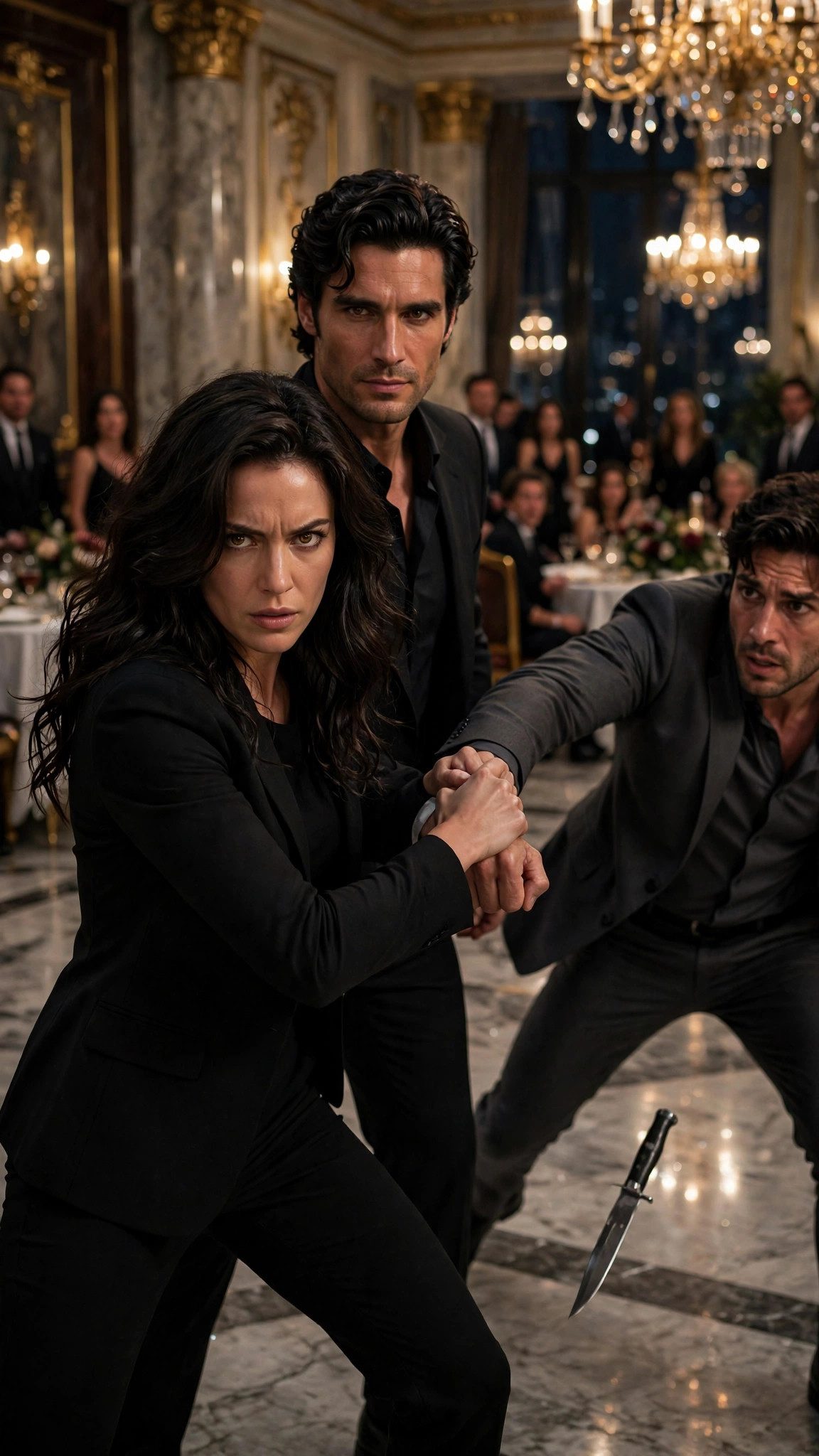
On the first anniversary of the gala — the night that had changed everything — Leo and I went back to the grand hall, just the two of us, and we stood in the middle of the polished marble floor, under the golden chandeliers, in the place where I had caught a man's wrist and stepped in front of a gun, and Leo took my hand, and he said, "One year ago tonight, you stood between me and death. Tonight, I want you to know something. I have spent my whole life building an empire. And in one night, you taught me that an empire is worth nothing if there is no one in it worth protecting. You are the reason this family is still standing, Quinn. Not me. You."
I looked at him, and I thought about everything that had happened since the night I walked into that nightclub — the gun, the black car, the garden, the notebooks, the warehouse, the photograph, the trial, the wedding, the foundation — and I thought about how strange it was, that a woman who had been hired from nowhere had become the center of a family that had stood for forty years.
"Leo," I said, "do you remember what Marco said to me on my first day? He said loyalty is earned, not hired."
"And was he right?" Leo asked.
"He was right about the words," I said. "He was wrong about everything else. Loyalty isn't earned, Leo. It's chosen. Every day. By the person who gives it. I chose you on the night of the gala. And I choose you again tonight. And I will choose you again tomorrow. That's what loyalty is. Not a debt. A choice."
Leo and I still walk in the garden in the evenings, and we talk about ordinary things, and sometimes we talk about Danny, and about Leo's father, and about the men we have lost and the family we have saved. And sometimes, on quiet evenings, Leo takes my hand, and he looks at me, and he says, "Do you remember the night you stepped in front of that gun?"
And I say, "I remember."
And he says, "I will never forget it. No one has ever done that for me before. No one ever will again. Because you are the woman who stood between me and death, Quinn. And you are the woman who stayed."
And I hold his hand, and I think about a nightclub, and a gun, and a black car, and a man who said, "You are hired," and I think about how the most dangerous thing about Leo Costello was never the empire he built, or the enemies who wanted it.
It was the way he looked at a woman from nowhere and saw, in her, the one person in the world he could trust with his life.
Marco sent a letter from prison. It said, "I was wrong about you, Quinn. You were never the enemy. You were the only one who saw the truth, and the only one brave enough to say it. Take care of him. He needs you more than he knows."
I keep that letter in my notebook, next to the photograph of the parking garage, and the matchbook, and the bank records, and the letter in Marco's handwriting. Not because I need the proof anymore. But because I never want to forget what it cost to find the truth — and what it meant to stand by it, when standing by it meant standing in front of a gun.
Leo and I still walk in the garden in the evenings, and we talk about ordinary things, and sometimes we talk about Danny, and about Leo's father, and about the men we have lost and the family we have saved. And sometimes, on quiet evenings, Leo takes my hand, and he looks at me, and he says, "Do you remember the night you stepped in front of that gun?"
And I say, "I remember."
And he says, "I will never forget it. No one has ever done that for me before. No one ever will again. Because you are the woman who stood between me and death, Quinn. And you are the woman who stayed."
And I hold his hand, and I think about a nightclub, and a gun, and a black car, and a man who said, "You are hired," and I think about how the most dangerous thing about Leo Costello was never the empire he built, or the enemies who wanted it.
It was the way he looked at a woman from nowhere and saw, in her, the one person in the world he could trust with his life.
The End.
THE END