Enzo's voice on the phone was calm, which frightened me more than shouting would have. Enzo Marchetti was never calm when something went wrong. He was loud. He was furious. He was the kind of man who broke furniture when he was angry. Calm meant he was past anger. Calm meant something had gone very wrong indeed.
"Nico is hurt," Enzo said. "Not badly. A graze. A bullet along the ribs. He will live. But Arthur is gone. He ran. He took the car and he ran, and we do not know where he went. And Castellano's men knew we were coming. They knew the room. They knew the exits. They knew everything. Someone told them, and it was not just Arthur. Arthur had help."
Sofia put the phone on speaker so I could hear. I stood in the kitchen with my hands on the counter, listening to Enzo's calm voice, and I felt the floor tilt under my feet.
"How did they know?" I asked.
"Because Arthur is not the only mole," Enzo said. "There is another one. Inside the house. Someone who has been listening. Someone close."
The listening device. My office. My desk. I had found it three weeks ago and left it there. But if Arthur had planted it, and Arthur was gone, then who was listening now?
"Norah," Enzo said. "I need you to listen to me very carefully. Do not leave the house. Do not open the door for anyone. Not the guards. Not the police. Not anyone. Sofia stays with you. I am sending two of my own men, men I trust with my life, and they will be there in twenty minutes. Until then, you lock every door, and you do not trust anyone you have not seen with your own eyes in the last hour."
"Where is Nico?" I asked.
"On his way home," Enzo said. "He is coming now. He is hurt, but he is coming. Stay where you are. Do not move."
The phone went dead. Sofia looked at me. I looked at Sofia. And in the silence of the kitchen, I heard something I had never heard before in Nico's house. A sound from upstairs. A door closing. Softly. Carefully. Like someone who did not want to be heard.
Sofia's hand went to her waist, where I knew she carried a gun. She had shown it to me that morning, casually, the way other women show you a photograph of their children. "Just in case," she had said. "I hope I never need it."
"Upstairs," I whispered. "Someone is upstairs."
Sofia nodded. She moved toward the stairs, silent on the marble, her gun in her hand, and I followed her, because I could not stay in the kitchen alone, and because my legs would not let me sit still, and because for the first time in three years, I was not going to hide behind Nico's walls and wait for someone else to save me.
We went up the stairs together. The hallway was dark. The doors were all closed. My room. Nico's room. The guest room. The study. And then I saw it. The study door was open, just a crack, and there was light coming through it, thin and yellow, and I could hear the sound of paper. Someone was going through Nico's desk.
Sofia raised her hand. Stop. She moved toward the study, one step at a time, and I stayed behind her, my heart pounding so loudly I was sure whoever was in there could hear it.
She pushed the door open with her foot. The gun was up. Her voice was steady.
"Do not move."
The man at Nico's desk froze. He was not a stranger. He was not one of Castellano's men. He was a man I had seen every day for three years, a man who had poured my coffee and carried my bags and opened doors for me.
It was Marcus Hale, Nico's driver. The quiet one. The one who never spoke unless spoken to. The one who knew every route Nico ever took, every place Nico ever went, every time Nico ever left the house.
"Marcus," I said. "What are you doing?"
He turned slowly, his hands up, and his face was gray, and his eyes were wet, and he looked like a man who had been caught doing something he had prayed no one would ever see.
"They have my daughter," he said. "Castellano's men took her three weeks ago. They said if I did not tell them everything, if I did not plant the device and report Nico's movements, they would kill her. She is nineteen. She is in college. She has done nothing. I did what I had to do. I am sorry. I am so sorry."
The listening device. It had not been Arthur's. It had been Marcus's. Arthur had been the one who told Castellano about me, but Marcus had been the one who listened, who reported, who made sure Castellano knew where I was every hour of every day.
And now Marcus was in Nico's study, going through his desk, looking for the one thing Castellano wanted more than anything. The ledger. The book Nico kept in his desk drawer, the book with every name, every deal, every secret his family had kept for thirty years. The book that could destroy Castellano, or destroy Nico, depending on whose hands it fell into.
"Where is your daughter?" Sofia asked. Her gun did not waver.
"I do not know," Marcus said. "They move her every few days. A warehouse. A motel. I get a photograph every morning, to prove she is alive. This morning's photograph was taken in a parking garage. I do not know which one. I do not know where. I just know she is alive, and if I stop helping them, she will not be."
I looked at Marcus Hale, and I saw a man who had done a terrible thing for a reason I understood completely. He had chosen his daughter over me. Any father would. Any parent would. I could not hate him for it, even though his choice had nearly gotten me killed.
"Put the ledger down," Sofia said. "Step away from the desk."
Marcus did. He put the small black book down on the desk, and he stepped back, and he put his hands on his head, and he started to cry, quietly, the way a man cries when he has been holding it in for weeks.
"They are coming tonight," Marcus said. "Castellano's men. They are coming to the house. Arthur told them the Meridian was a trap, and they knew, and they let Nico walk into it, and while Nico was at the Meridian, they were coming here. For you, Norah. For the woman at his table. They will be here in less than an hour. I was supposed to unlock the gate. I was supposed to turn off the alarm. I was supposed to make it easy for them. But I could not do it. Not after the roses. Not after I saw what they did to the coffee shop. I came here to take the ledger instead. To give them the ledger and beg them to leave you alone. To beg them to give me my daughter back."
Sofia lowered her gun, just a little. "You are going to help us now," she said. "You are going to tell us everything. How many men. When. Where they are coming from. And then you are going to help us stop them. Because if you do, Nico will help you find your daughter. I promise you that. Nico Moretti does not forget a debt, and he does not forget a man who helps him when it matters."
Marcus nodded. He wiped his face with his sleeve. He told us everything. Four men. Coming through the garden, through the gap in the hedges, the same gap I had squeezed through on the night I ran. They would come at midnight, when the guards changed shifts, when the house was quiet. They would come for me. They would not stop until they had me, or until someone stopped them.
It was eleven o'clock. We had one hour.
Sofia moved fast. She called Enzo. She told him about Marcus, about the four men, about the gap in the hedges. Enzo said his men were already on their way, and Nico was ten minutes out, and we were to lock ourselves in Nico's room and not come out until he told us to.
But I did not go to Nico's room. I went to the garden.
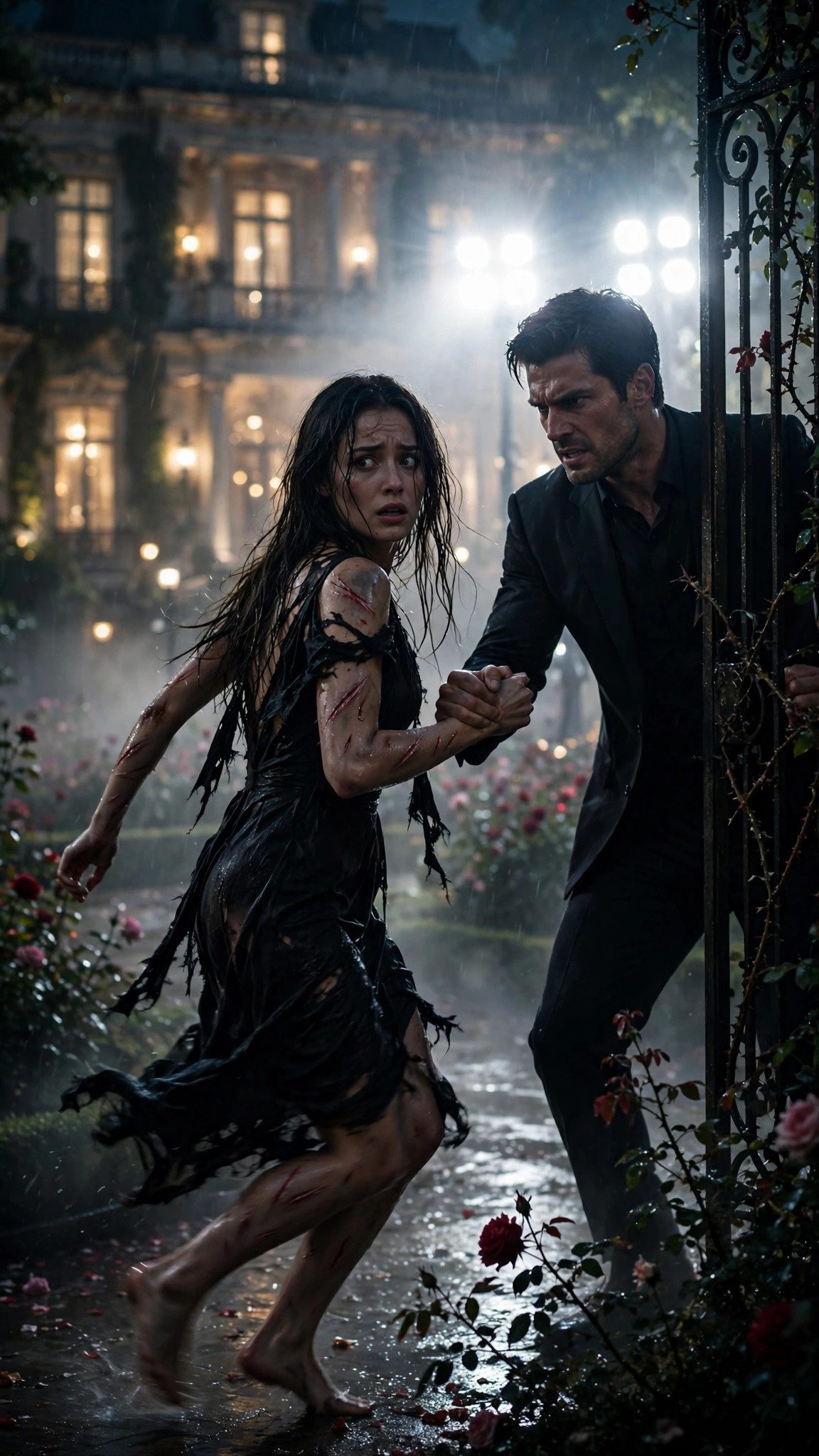
I know it sounds insane. I know it sounds like the stupidest thing a woman who had already run once could do. But I had spent three years being protected, and I had spent a month being hidden, and I had spent a night running barefoot through the roses, and I was done. Done hiding. Done waiting. Done being the woman at the table who needed a soldier to take her bullets.
Sofia followed me. Of course she did. She was a soldier, and soldiers do not let civilians walk into danger alone. Marcus followed us too, because he had a daughter to save, and because he had finally chosen a side.
We stood in the garden, in the dark, among the roses, and we waited. The floodlights were off. The alarm was on. The guards were at the gate, and Enzo's men were coming, and Nico was coming, and somewhere beyond the hedges, four men were walking toward us with guns and orders to take me alive or dead.
At midnight, exactly, the first man came through the gap.
He did not see us. He was looking at the house, at the windows, at the doors, the way a man looks at a target. He had a gun in his hand. He took two steps into the garden.
And then Sofia stepped out from behind the roses, and she said, in a voice as calm as Enzo's had been on the phone, "Drop it."
He did not drop it. He raised it. And Sofia shot him. Once. In the shoulder. He went down, screaming, and the other three came through the gap behind him, and the garden erupted.
I do not remember all of it. I remember the sound. I remember the floodlights snapping on, all of them, white and blinding. I remember the alarm. I remember Nico's voice, shouting my name, and I remember turning and seeing him running across the garden toward me, his shirt soaked with blood from the graze on his ribs, his face white with fury and fear.
I remember the second man raising his gun toward Nico, and I remember moving without thinking, the way I had moved in the hotel ballroom three years ago, catching a falling tray, and I remember grabbing a garden spade from the soil beside me and swinging it, hard, into the man's wrist. The gun went flying. The man went down. Sofia was on him in a second.
I remember the third man running, and Enzo's men arriving, and the shouting, and the sirens in the distance, and I remember Nico reaching me, and pulling me against him, and holding me so tightly I could not breathe, and saying my name over and over again, like a prayer.
"Norah. Norah. Norah."
"I am here," I said. "I am here. I am not going anywhere."
And for the first time in three years, I meant it. Not because I was trapped. Not because I had nowhere else to go. Because I had chosen it. In the garden, in the dark, with blood on the roses and sirens in the distance, I had chosen to stay. I had chosen him. And that choice, finally, was mine.
The minutes after the garden went quiet were the strangest of my life. The floodlights were still on, white and merciless, and the roses were scattered across the lawn, and the men on the ground were groaning, and Enzo's men were moving through the garden with their guns up, checking every shadow, and I was standing in the middle of it all with a garden spade in my hand, shaking so hard I could barely hold it.
Nico took the spade from me, gently, the way you take a knife from a child, and he put it down in the grass, and he looked at my hands, at the dirt under my nails, at the scratch on my wrist where a thorn had caught me, and he said, "You are hurt."
"I am fine," I said. "You are the one bleeding."
He looked down at his shirt, at the dark stain spreading across his ribs, as if he had forgotten it was there. "It is nothing," he said. "A graze. Enzo already looked at it. It will heal."
"It is not nothing," I said. "You were shot at a hotel, and then you ran across a garden to get to me, and you are standing here telling me it is nothing. Sit down, Nico. Let someone look at you."
He sat. On the steps of the house, with the blanket the paramedics had given me around his shoulders instead of mine, and he let a young paramedic with shaking hands clean the graze on his ribs, and he did not flinch, not once, and he kept his eyes on me the whole time, as if he were afraid that if he looked away, I would disappear.
The police came, and then the FBI, and Agent Daniel Reyes took my statement in the kitchen, at the table where Sofia and I had eaten pancakes that morning. He was patient. He asked me to tell it slowly. He asked me about the gap in the hedges, and the spade, and the second man, and the gun that had gone flying. He wrote everything down in a small notebook, and when I was finished, he said, "You did well tonight, Ms. Bennett. Most people freeze. You did not freeze."
"I was not brave," I said. "I was angry. There is a difference."
"Anger is a kind of bravery," Reyes said. "The useful kind."
Outside, they were loading the four men into ambulances. One of them, the first one, the one Sofia had shot in the shoulder, was shouting something in Italian, and Enzo was standing over him, translating for a detective, his face like stone.
"They were paid fifty thousand each," Enzo said, when he came inside. "Fifty thousand to take Norah. Alive, if possible. Dead, if necessary. Castellano paid them through a shell company. Arthur set it up. We have the account numbers now. We have everything."
Nico nodded. He did not say anything. He just took my hand, and he held it, and he did not let go, not when the detectives asked him questions, not when the paramedics finished with his ribs, not when the sun came up over the garden and the roses looked, impossibly, like they had never been disturbed at all.
At dawn, Sofia came and sat with us on the steps. She had a bandage on her cheek and a bruise on her arm, and she was holding a cup of coffee, black, the way I drank it, the way she had learned to drink it.
"Well," she said. "That was a night."
"Yes," I said. "It was."
"Do you know what I was thinking," Sofia said, "when the first man came through the gap? I was thinking about my brother. About Marco. About pancakes on a Sunday. And I was thinking, not this time. Not this woman. Not tonight. And then I shot him, and I felt nothing at all, and that frightened me more than the shooting did."
"You felt nothing because you were doing your job," Nico said. "That is what training does. It takes the feeling away until later. The feeling will come later. When it does, you will not be alone."
Sofia nodded. She drank her coffee. The sun came up. And the three of us sat on the steps of the house, in the morning light, and for the first time in weeks, no one was afraid.