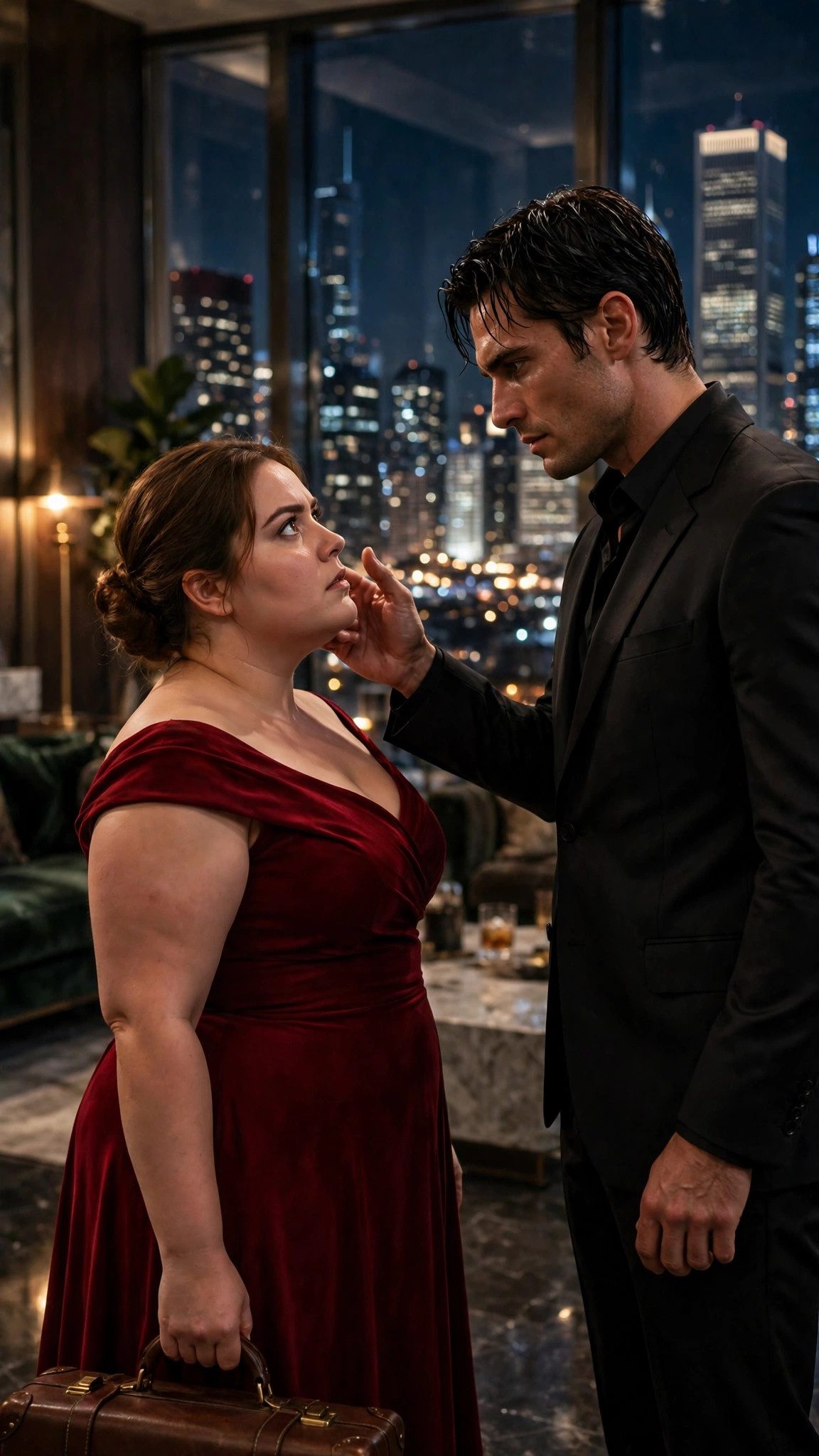
The next morning, Charlotte woke up in her narrow bed in the staff quarters, and for one confused second, she thought she had dreamed the whole thing — the dress, the dinner, the photograph, the vote, the terrace, the confession in the dark living room — and then she opened her eyes and saw the red dress hanging on her closet door, glowing in the morning light like a coal that had never gone out, and she knew it had all been real.
She got up and took a shower, and washed her hair, and put on the dress again, and this time she did not need Mrs. Alvarez to help her. She did it herself, zipping it up the back with steady hands, pinning her hair up the way Mrs. Alvarez had shown her, putting on the pearl earrings Mrs. Alvarez had lent her and deciding, right then, that she was never giving them back, because Mrs. Alvarez would pretend to be annoyed and would secretly be pleased.
Mrs. Alvarez was waiting for her in the kitchen when she came upstairs, and she took one look at Charlotte in the red dress and said, "Well. So. It is done, then."
"What is done?" Charlotte asked, smiling.
"You know what is done," Mrs. Alvarez said, and she sniffed, and she turned away to fuss with a pot that did not need fussing, because Mrs. Alvarez did not cry in front of anyone, ever. "He came to my room last night, after he drove you home. He knocked on my door at one o'clock in the morning, and he said, 'Mrs. Alvarez, I need your advice,' and do you know what I told him? I told him, if you hurt that girl, I will quit, and I will tell the whole city what kind of man you are. And he said, 'I will not hurt her. I love her.' And I said, 'Good. Then do not mess it up.'"
Charlotte laughed, and hugged Mrs. Alvarez, hard, and Mrs. Alvarez let her, for exactly three seconds, and then she patted her on the back and said, "Enough. Go. Your mother is waiting. And Charlotte—"
"Yes?"
"Wear the dress," Mrs. Alvarez said. "Wear it like you were born in it. And when you come back, you will not be sleeping in the staff quarters anymore. I have already moved your things to the guest room upstairs. The one with the big window. Do not argue. It is done."
Charlotte did not argue. She hugged Mrs. Alvarez once more, and then she went down to the garage, where Roman was waiting beside the black car, in a dark suit, holding a bouquet of flowers so big he could barely see over it, looking nervous in a way she had never seen him nervous before.
"Are these for my mother?" she asked.
"They are for your mother," he said. "And these—" he reached into the car and took out a smaller bouquet, white roses, "—are for you. I did not know what kind you liked. I asked Mrs. Alvarez. She said white roses, because you are… she said you are pure of heart. I think she is right."
Charlotte took the white roses, and she buried her face in them for a moment, breathing in their cool, clean scent, and then she looked at him, standing there in the garage in a suit with flowers in his hands, the most dangerous man in Chicago, nervous about meeting her mother, and she thought her heart might burst.
"You look beautiful," he said, and his voice was rough. "You look like you were born in that dress."
"I was," she said. "I just did not know it until you chose it for me."
They drove to Cicero together, through the morning streets, past the bakery on Cermak where her mother bought the pan dulce, past the park where Charlotte had played as a little girl, past the school where she had learned to read, and with every mile, Charlotte felt the past falling away behind her and the future opening up in front of her, wide and bright and red as a dress.
Her mother was waiting on the front porch of the little house when they pulled up, and Angela was exactly as Charlotte remembered her: fifty-eight years old, small and fierce, with grey in her hair and flour on her apron and her hands on her hips, looking at the black car with suspicion and at the man getting out of it with even more suspicion.
And then she saw Charlotte, stepping out of the car in the red dress, and her hands flew to her mouth, and her eyes went wide, and she said, in a voice that shook, "Mija. Oh, mija. Look at you."
Charlotte went up the steps, and her mother took her face in her hands, and looked at her, really looked at her, the way only a mother can, and said, "You are glowing. You are glowing like the sun. Is this him? Is this the kind one?"
"This is him, Mama," Charlotte said, and she took Roman's hand and pulled him forward. "This is Roman. Roman Rossi. He is the one I told you about. He is kind. And he is brave. And he loves me."
Angela looked at Roman. She looked at him the way a mother looks at a man who wants her daughter — up and down, once, twice, missing nothing — and then she said, "You are very tall. And very serious. Do you make my daughter laugh?"
Roman, who had faced down armed men and rival families and his own uncle without flinching, stood on a porch in Cicero in front of a fifty-eight-year-old woman in a flour-dusted apron, and said, very seriously, "I am learning to, Mrs. Angela. She makes me laugh. I am trying to return the favor."
Angela nodded, slowly, as if this were a reasonable answer, and then she said, "Come inside. I made pan dulce. And I want to hear everything. Every single thing. Do not leave anything out."
So they went inside, into the little house where Charlotte had grown up, with its small kitchen and its worn furniture and its photographs on the walls, and Angela served them pan dulce on her good plates, and coffee in her good cups, and she listened while Charlotte told her everything — the penthouse, the dress, the dinner, the photograph, the vote, the terrace, the confession — and Angela listened without interrupting, her hands folded on the table, her eyes moving between her daughter and this tall, dark, serious man, and when Charlotte finished, Angela was quiet for a long time.
And then she stood up, and she walked around the table, and she took Roman's face in her hands, the way she had taken Charlotte's face on the porch, and she looked into his eyes, and she said, "You heard my daughter whisper that she needed someone, and you did not laugh at her. You bought her a dress. You stood beside her when men tried to shame her. You drove her here to meet me. You are a good man, Roman Rossi. I do not care what anyone else says about you. I can see it in your eyes. You love my daughter. And my daughter loves you. That is enough for me."
She let go of his face, and she sat back down, and she picked up her coffee, and she said, very calmly, "Now. When is the wedding?"
Charlotte choked on her pan dulce. Roman went very still. Angela looked at both of them, innocently, and said, "What? I am a mother. I am allowed to ask."
Roman looked at Charlotte. Charlotte looked at Roman. And then Roman stood up, slowly, and he walked around the table, and he knelt down on one knee on the worn kitchen floor of the little house in Cicero, in front of Charlotte and her mother and the pan dulce and the good plates, and he took Charlotte's hand in his, and he said, "Charlotte. I did not plan this. I did not bring a ring. I did not rehearse anything. But your mother asked, and I am going to answer her, and I am going to answer you, right here, right now, the way I should have answered you last night."
He took a breath, and his dark eyes were steady on hers, and his voice was low and certain.
"Will you marry me? Not because I need a date. Not because I need a wife for show. Because I love you. Because you are the bravest person I have ever known. Because you told the truth to a room full of dangerous men and you did not flinch. Because you make me want to be a better man than I have ever been. Will you marry me, Charlotte? Will you be mine, for real, for the rest of our lives?"
Charlotte looked at him, kneeling on her mother's kitchen floor in his dark suit, with no ring and no plan and nothing but the truth in his eyes, and she thought about the red dress, and the penthouse, and the dinner, and the photograph, and the vote, and the terrace, and the confession, and she thought about eleven months of being invisible and one night of being seen, and she thought about her mother's voice on the phone, bright and excited, and she thought about the lie she had told, and how it had brought her here, to this moment, to this man, to this question.
And she said, "Yes."
Her mother burst into tears. Roman stood up and pulled Charlotte into his arms, and he held her, there in the little kitchen in Cicero, with the pan dulce on the table and the photographs on the walls, and he kissed her, gently, for the first time, and it was soft and warm and perfect, and Charlotte thought, this is what it feels like. This is what it feels like to be chosen. Not for one night. Not for show. For real. For the rest of our lives.
They stayed for dinner. Angela cooked enough food for ten people, the way mothers do, and Benito called from the penthouse to say that Mrs. Alvarez had made a cake, and Lauren called to scream with excitement, and Roman ate three helpings of everything and told Angela she was the best cook he had ever met, and Angela told him he was a flatterer and then served him a fourth helping, and Charlotte sat between them, in the red dress, watching the two people she loved most in the world fall in love with each other, and she thought about how strange and wonderful life was, that a whispered lie in a kitchen could lead to all of this.
That night, driving back to Chicago, Roman reached across the seat and took her hand, and he said, "I have one more thing to tell you."
"What is it?" she asked.
"The dress," he said. "I want you to keep it. Not in a closet. Not for special occasions. I want you to wear it whenever you want. And I want you to know that I did not choose it because I wanted you to look like someone else. I chose it because I saw you, Charlotte, the real you, and I wanted the whole world to see you the way I see you."
She squeezed his hand, and she looked out at the city glittering through the windows, and she said, "I know. I knew it the moment I put it on. It was never a costume, Roman. It was me. It was always me. You just helped me see it."
Six months later, they were married in the garden of the Moretti estate, under the same oak tree where Charlotte had once stood trembling in a red dress, and she wore the red dress again, because it was hers, and because it was the dress he had chosen for her, and because it was the dress she had worn when she told the truth and did not flinch.
Her mother cried through the whole ceremony. Mrs. Alvarez cried, too, and pretended she had something in her eye. Benito danced with Lauren. Marco gave a toast, and he said that Charlotte had taught him what courage looked like, and that he was proud to call her his family. And Roman, standing at the altar in a black suit with a black shirt, looked at her the way he had looked at her that first night in the living room, like she was a puzzle he had finally solved, and he said, in front of everyone, "I chose you. I will always choose you."
And Charlotte, standing in the red dress with the sun on her face and the people she loved all around her, thought about the maid she had been, invisible in a penthouse, mopping floors and folding shirts and whispering that she needed a boyfriend by tomorrow, and she thought about the woman she had become, standing in a garden in a red dress, married to a man who saw her, truly saw her, and she understood, finally, what the dress had always meant.
It was never about the dress. It was about being seen. It was about being chosen. It was about a man who looked at a maid and saw a queen, and a woman who looked at a mafia boss and saw a man who needed someone to stand beside him, and two people who decided, together, to never be invisible again.
Charlotte Rossi wore the red dress to her wedding. She wore it to Sunday dinner at the penthouse, where she sat at the head of the table now, beside her husband, not behind him. She wore it to Cicero, to visit her mother, who kept it in a place of honor in her closet for the days when Charlotte came to stay. And years later, when her own daughter asked her about the dress, Charlotte would take it out of the closet, and hold it up, and tell her the story, and she would say the same thing her mother had once said to her.
No one can make you small unless you let them. And the right person will never try.
The End.
THE END