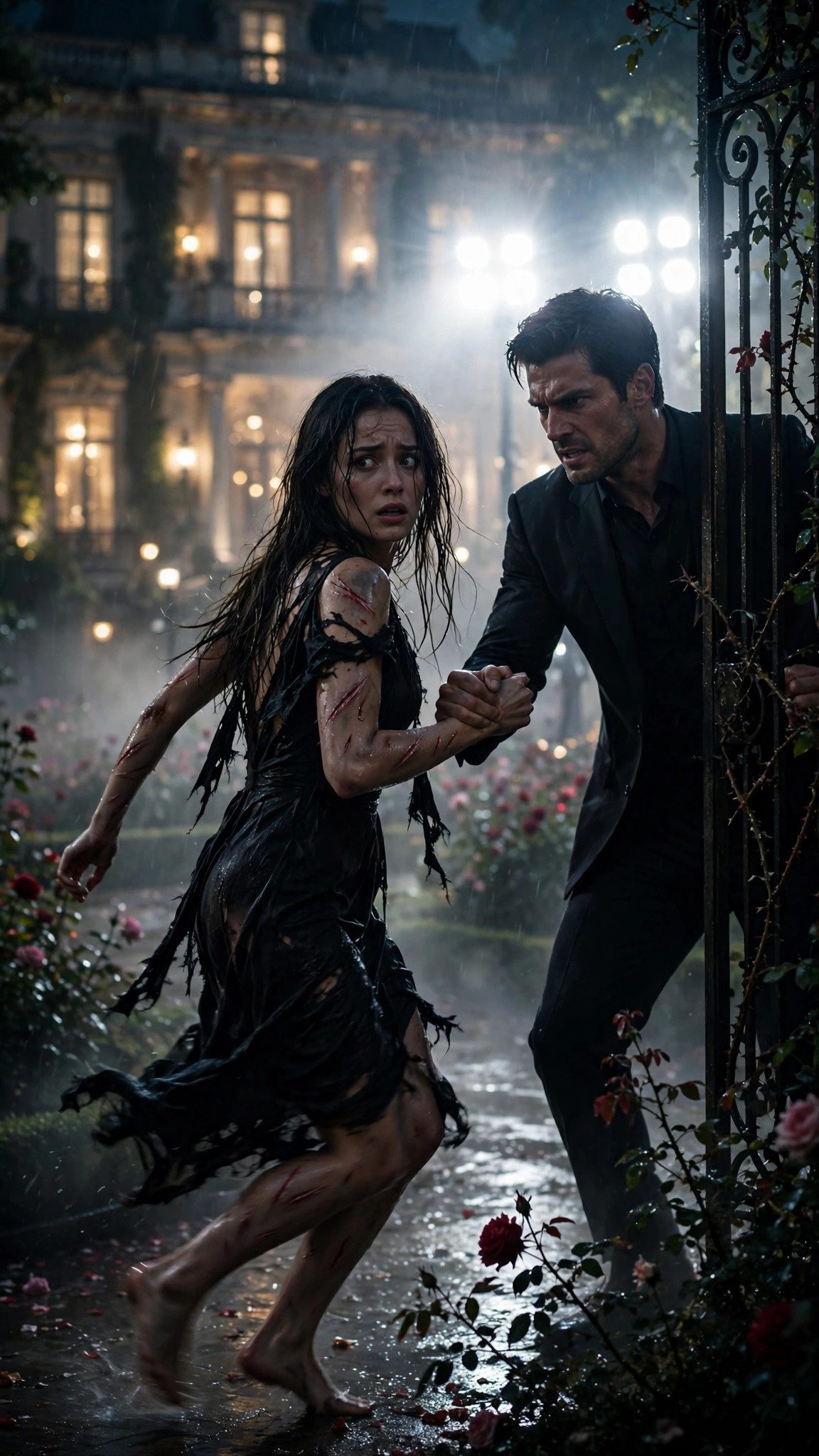
The police came. The FBI came. The garden was full of lights and uniforms and men with cameras, and I sat on the steps of the house with a blanket around my shoulders, watching them carry the four men away, watching them photograph the gap in the hedges, watching them bag the guns and the spade I had swung like a weapon.
Nico sat beside me. His shirt was soaked with blood, but he would not let the paramedics touch him until they had looked at me first. He kept saying it, over and over, like a man repeating a prayer. "Check her first. Check her first." They checked me. I was fine. Scratched. Bruised. Shaking. But fine.
Sofia was fine too. She had a cut on her cheek and a bruise on her arm, and she was giving a statement to a detective like she was ordering coffee. Calm. Precise. A soldier.
Marcus Hale was in handcuffs, sitting in the back of a police car, and he was crying, and I went to him, because someone had to, and I knelt beside the car, and I said, "We will find your daughter. I promise you. Nico will find her. You helped us tonight. That matters. That will matter."
He looked at me through the window, and he said, "Thank you," and I believed him when he said it, and I believed, too, that he had meant every word of his apology.
Enzo found Arthur that night. Not in the city. In a motel forty miles away, with a suitcase full of cash and a passport with a false name. Arthur had been running to Mexico. He did not get far. Enzo brought him back, and he brought him to the house, and he brought him to Nico, and Nico looked at him the way he had looked at him in the study that night, cold and casual, like he was discussing the weather.
Except this time, Arthur was the one who was afraid.
"I want the truth," Nico said. "All of it. From the beginning. How long. How much. What you told him. All of it."
And Arthur told him. He told him about Atlantic City. About the card table. About the two hundred thousand dollars. About Castellano's offer. About the first piece of information he sold, which was my name. About the second, which was my schedule. About the third, which was the layout of the house. About the listening device, which Marcus had planted on Arthur's orders. About the roses at the coffee shop, which Arthur had ordered as a message. About the Meridian, which Arthur had warned Castellano about, so that Castellano's men would be waiting, and Nico would walk into a trap, and while Nico was bleeding in a hotel, Castellano's men would come for me.
"I did it for the money," Arthur said. "At first. And then I did it because I was afraid. Castellano said if I stopped, he would tell you what I had done. And I knew what you do to traitors, Nico. I knew. So I kept going. I kept selling. I kept lying. And every time I did, I told myself it was the last time. But it was never the last time."
Nico listened to all of it without moving. Without speaking. Without blinking. And when Arthur was finished, Nico said, "You sold the woman I love to a man who wanted her dead. You sold her name. You sold her schedule. You sold the sound of her voice in her own office. You sold her for two hundred thousand dollars at a card table. And you want me to understand."
"I want you to kill me quickly," Arthur said. "That is all I want. I know what I deserve."
Nico was quiet for a long time. Then he said, "I am not going to kill you, Arthur. I am going to do something worse. I am going to let you live with what you did. I am going to hand you to the FBI, and you are going to tell them everything you told me, and you are going to testify against Castellano, and you are going to spend the rest of your life in a cell, thinking about the woman you sold and the man you betrayed. That is your punishment. Not death. Memory."
Arthur wept. I had never seen a grown man weep like that. Not with noise. With silence. With his shoulders shaking and his face in his hands, like a man who had finally understood the size of what he had done.
The FBI took him that night. Agent Daniel Reyes, a tall man with tired eyes and a voice like gravel, took Arthur's statement himself, and he took the ledger from Nico's desk, and he took Marcus's statement, and he took Sofia's statement, and he took mine. He was thorough. He was patient. He was the kind of man who had done this a hundred times before, and who knew that the difference between a case and a conviction was a witness who told the truth.
Three days later, they arrested Vincent Castellano. At his own house. At dawn. In front of his wife and his children. The ledger was enough. Arthur's testimony was enough. The photographs Marcus had been sent, the ones of his daughter, were enough to prove the kidnapping. Castellano went quietly, which surprised everyone, until Agent Reyes told us why.
"He knew it was over," Reyes said. "He knew Arthur had talked. He knew the ledger was gone. He knew the girl was found."
Emma Hale was nineteen years old, a sophomore in college, studying to be a nurse. They had taken her from a parking lot outside her dormitory, three weeks before, in broad daylight, and they had moved her seven times since then. A warehouse. A motel. A basement. A parking garage. Each time, Marcus received a photograph in the morning, to prove she was alive, and each time, he did what they asked, because what else could a father do?
The FBI found her in a motel outside the city, in a room with a broken lock and a television that did not work, guarded by one man who fell asleep on the job. She was unharmed. She was terrified. She had not eaten properly in days. When Agent Reyes told her she was free, she did not believe him at first. She thought it was another trick. Then she saw Nico standing in the doorway of the motel room, and she did not know who he was, but she saw the way he looked at her, the way a man looks at something he has sworn to protect, and she started to cry, and she did not stop until she was in her father's arms.
Nico brought her home himself. He drove her to the police station, and he waited in the hallway while Marcus held his daughter, and he said nothing at all, because there was nothing to say. Later, Marcus told me that Nico had put a hand on his shoulder, just for a moment, and had said, "She is safe now. No one will ever touch her again. That is my promise. Not as your boss. As a man who knows what it is to be afraid of losing someone you love."
Marcus was charged. He pleaded guilty. He testified against Castellano. He received a reduced sentence, three years, and Nico paid for his daughter's college, all four years, in full, in advance, because that was the kind of man Nico Moretti was when no one was watching. The kind of man who paid for a traitor's daughter's education because the girl had done nothing wrong.
On the fourth day after the garden, Nico came to my room. My room, not his. He knocked, which he had never done before, and he waited for me to say come in, which I did, and he sat down on the edge of my bed, and he looked at me, and he said, "I owe you a conversation. The one I promised you. The real one."
"Then talk," I said.
He talked. He told me everything, from the beginning, without performances, without locked doors. He told me about the phone call from Enzo's source. About the moment he understood that Castellano had chosen me as his target. About the night he sat in his study and decided that the only way to save me was to break my heart first. About the way he had practiced the words, the cruel words, the ones about forgetting my name by Friday, until he could say them without his voice breaking. About the way he had seen my shadow under the door and known I was listening, and known he had to keep going, and known that every word was cutting me, and that he could not stop.
He told me about Sofia. About how he had gone to her himself, and asked her, and how she had said yes without hesitating, because she had been waiting eight years for a man like Castellano to look at her and see a target.
He told me about the plan. About the false information he had fed Arthur. About the Meridian, which he had known was a trap, and walked into anyway, because he needed Arthur to believe he was winning, and because he needed Castellano's men to be looking at the hotel while Enzo's men were watching the house.
He told me about the choice he had promised me. The real one. The one he owed me.
"Here it is," he said. "A passport, in a new name, if you want it. Money. Enough to live anywhere in the world, for the rest of your life, without ever working again. A house, if you want it. A new life, if you want it. No conditions. No strings. No one will follow you. No one will come after you. You will be free, Norah. Completely free. That is one choice."
He paused. He took a breath. I had never seen Nico Moretti nervous before. Not in a meeting. Not in a fight. Not in a garden full of gunmen. But he was nervous now, and his hands were shaking, just a little, and I realized that this, more than any of it, was the bravest thing he had ever done.
"And the other choice," he said, "is to stay. Not as my assistant. Not as my woman. Not as something I own, or something I protect, or something I keep. As my partner. As the woman who stood in a garden with a spade and saved my life. As the woman I love, who is free to leave, and who chooses, every day, to stay. That is the other choice. And I will not ask you to make it now. I will not ask you to make it tomorrow. Take as long as you need. The passport will be on the dresser. The money will be in the account. The door will be unlocked. Whenever you are ready, either way, I will respect it."
He stood up. He walked to the door. He stopped, with his hand on the handle, and he said, without turning around, "For what it is worth, Norah, I have never said those words to anyone before. The words about forgetting your name. I practiced them for an hour, and I hated every second of it. And if I could take them back, I would. But I cannot. So all I can do is tell you the truth. Your name is the only name I have ever been afraid to lose."
He left. The door stayed open. The passport was on the dresser, exactly where he said it would be. A new name. A new life. Freedom, in a small blue booklet.
I sat on my bed for a long time, looking at it. I thought about the hotel ballroom. About the falling tray. About three years at his table. About the keyhole. About the roses tearing my arms. About the garden, and the spade, and the sirens, and the way he had said my name over and over again like a prayer.
And I thought about what I had told him that night in his office, in the dark, with the listening device in his hand. That I was not replaceable. That no one is. That protection is not love, and control is not caring, and that the difference between being owned and being chosen is everything.
I picked up the passport. I opened it. I looked at the photograph of a woman with my face and a name I did not recognize. And then I put it down, and I walked out of my room, and down the hall, and I knocked on Nico's door, and I waited for him to say come in.
"Yes?" he said.
I opened the door. He was standing by the window, looking out at the garden, at the roses, at the gap in the hedges that had been repaired that morning with new wood and fresh thorns.
"I have made my choice," I said.
He turned around. He looked at me. He did not speak. He just waited, the way he had waited in the garden, the way he had waited in my room, patient and still, until I was ready.
"I am staying," I said. "Not because you need me. Not because you protected me. Not because I have nowhere else to go. I am staying because I choose you. Because I love you. Because you are the man who practiced cruelty for an hour to keep me alive, and then came to my room and offered me my freedom, and meant it. That is the man I choose. That is the man I love."
Nico crossed the room in three steps, and he took my face in his hands, and he kissed me, and for the first time in three years, it did not feel like protection. It did not feel like control. It felt like a choice. His choice. My choice. Ours.
"I love you, Norah Bennett," he said. "I will never call you replaceable again. Not as a performance. Not as a lie. Not ever. You are the only irreplaceable thing in my life."
And I believed him. This time, I believed him completely.