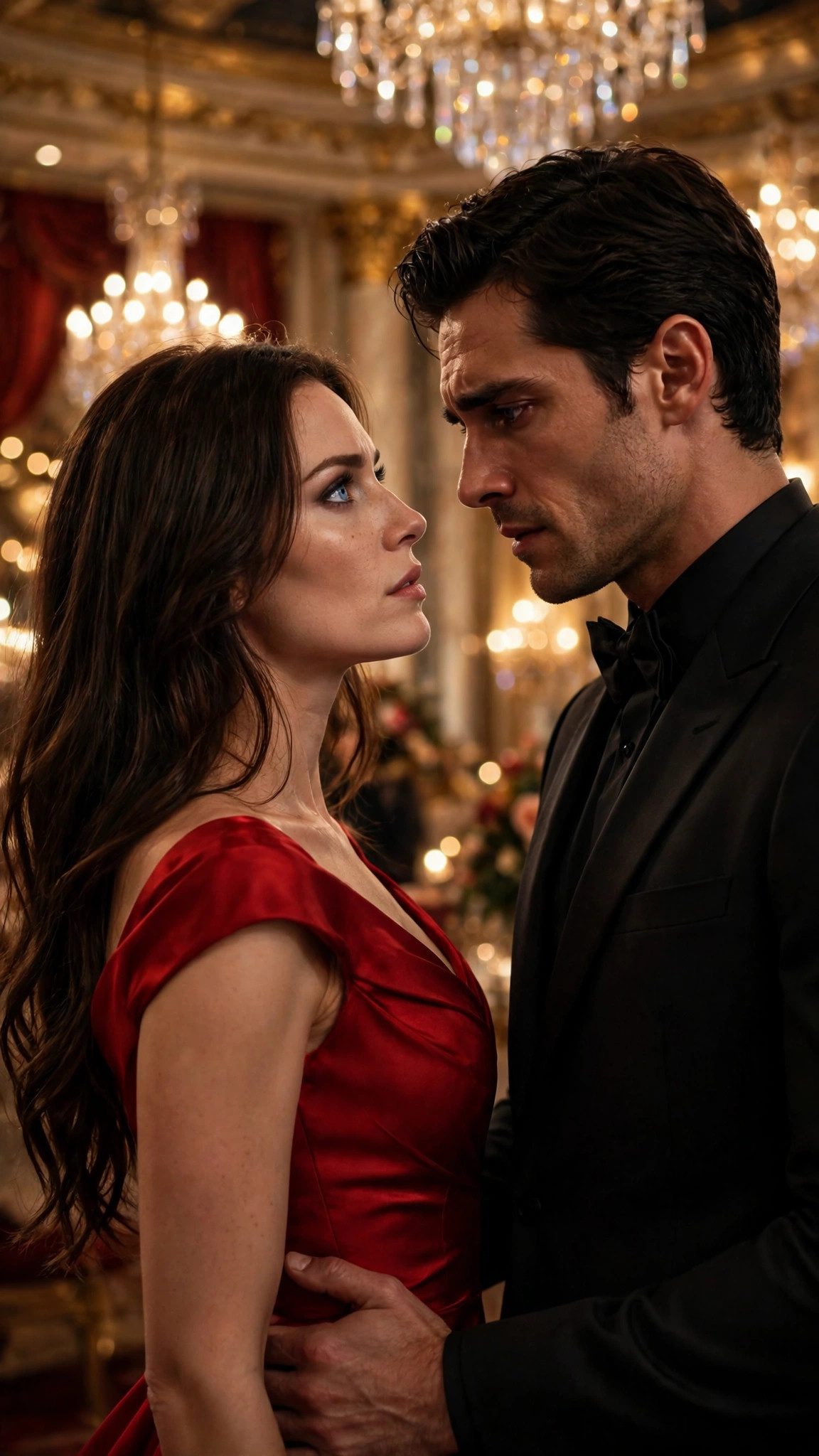
We were married three months later, in Rosa's garden, under the roses.
It was a small wedding. Forty people, not four hundred. No ballroom, no chandeliers, no photographers from gossip sites. Just the people who mattered: my mother and father, Maya in a blue dress that made her cry before the ceremony even started, Rosa in the front row with a handkerchief already in her hand, Enzo standing beside Luca, looking prouder than any best man I had ever seen.
My father walked me down the aisle.
He had recovered. Not completely — he tired more easily now, and he carried a little pillbox in his pocket, and my mother watched him the way a hawk watches a field — but he was there, and he was strong, and when he took my arm at the top of the garden path, he leaned down and whispered in my ear:
"Remember what I told you in the hospital, baby girl. Find someone better than Ryan. Well." He looked ahead, at Luca waiting for me under the roses in a black suit, his face lit up like the sun coming out. "You found him."
"Dad," I said, and my voice wobbled.
"Don't cry," he said. "You'll ruin your makeup. Your mother will kill me."
I laughed, and I cried a little anyway, and my father walked me down the aisle, and every step felt like walking out of one life and into another.
Luca took my hands, and the minister — a kind-faced man Rosa had known for forty years — asked us to speak our vows.
Luca went first. He had written them himself, on a piece of paper he kept folded in his jacket pocket, and his hands shook a little when he unfolded it, which made me love him even more, because Luca Moretti never shook.
"Claire," he said, "I met you in a parking garage, and I offered you revenge. You took my offer, and you turned it into something I never expected. You turned it into a home. You turned it into laughter in my kitchen. You turned it into my aunt's approval, which is harder to earn than any business deal I have ever closed. You turned it into a future."
He looked at me, and his eyes were bright.
"I promise you this: I will never ask you to be smaller. I will never make you feel inadequate for being brilliant. I will never leave, and I will never lie to you. Whatever comes — and in my world, things will come — we will face it together. You are my wife. You are my family. You are my forever."
Then it was my turn.
"Luca," I said, "a year ago, my husband left me for my best friend, and I thought my life was over. I thought I would never trust anyone again. I thought I would never be happy again. And then a man I barely knew stood in my parking garage and asked me to help him get revenge, and I said yes, because I was angry, and because I was hurt, and because I had nothing left to lose."
I squeezed his hands.
"But somewhere between the gala and the garden, the revenge became something else. It became Sunday dinners. It became terrible pasta. It became a man who stands between me and the world and asks for nothing in return. Luca, you did not save me. I saved myself. But you were there, holding the door open, and that made all the difference."
I took a breath, and I said the words I had been waiting my whole life to say to the right man.
"I promise you this: I will be your partner. Not your possession. Not your revenge. Your partner. In everything. For as long as we both shall live."
Rosa cried. My mother cried. Maya cried so hard she had to sit down. Even Enzo, who had seen everything in his fifty years with the family, wiped his eyes with the back of his hand and pretended it was allergies.
We kissed under the roses, and the garden erupted, and my father shouted something about grandchildren that made everyone laugh, and for one perfect moment, the whole world was gold and green and full of people I loved.
The reception was in Rosa's backyard, with long tables and string lights and more food than forty people could ever eat. Luca danced with me to the same slow song from the gala, and this time, there were no photographers, no audience, no revenge. Just the two of us, moving slowly under the lights, while Rosa clapped along off-beat and my father pretended not to cry.
"You know," Luca said, as we danced, "a year ago, I thought I would die alone in a big empty house, married to a name."
"And now?" I asked.
"Now I have a wife who is smarter than me, braver than me, and a much better cook than me," he said. "And I have a garden full of roses. And I have a future. I have everything."
Later that night, after the last guest had gone and the string lights were still glowing, Luca and I sat on the terrace of our house — our house now, the warm one with the bookshelves and his mother's photograph — and we talked about the future the way people talk about it when they finally believe it is real.
The family was changing. Luca had announced it the week before the wedding, standing in front of his cousins and his captains and Enzo, telling them that the Moretti family was going legitimate. All of it. The hotels, the restaurants, the construction company — clean, legal, above board. The old ways were over. Anyone who wanted to stay was welcome. Anyone who wanted to leave could leave with his blessing and a severance that would keep them comfortable for a year.
Half of them had stayed. Enzo had been the first to shake his hand.
"It won't be easy," Luca said that night on the terrace. "Falcone's people will test us. The old world doesn't let go quietly."
"Then we'll hold on tighter," I said, and I took his hand. "Together."
He smiled, and he kissed my knuckles, one by one, the way he had started doing, a habit I had come to love more than I could say.
We honeymooned in Positano, on the Amalfi Coast, in a small white house above a sea so blue it did not look real.
Luca had never taken a real holiday in his life. He did not know how to do nothing. On the first day, he checked his phone forty times before lunch. On the second day, twenty. On the third day, I took his phone, put it in the safe, and told him he could have it back when we got home.
"What am I supposed to do all day?" he asked, genuinely bewildered.
"Nothing," I said. "You are supposed to do nothing, with me, in Italy."
So we did nothing. We ate long lunches. We walked the steep streets. We swam in the sea. We sat on our terrace in the evenings and watched the sun go down over the water, and Luca learned, slowly, day by day, how to be still. How to be a man on holiday with his wife, instead of a man running an empire.
On our last night, we sat on the terrace with a bottle of wine, and he said, "I have been thinking about what my mother would say if she could see this. Me, in Italy, doing nothing, with a beautiful wife."
"What would she say?" I asked.
"She would say: finally," he said. "Finally, my son learned to live."
When we came home, life did what life does: it went on, but better. I went back to work, and three months after the wedding, my boss called me into his office and offered me a promotion — vice president of accounts, the youngest VP in the firm's history.
"You're the best closer we have," he said. "And frankly, Claire, you have been different this year. Happier. Sharper. Whatever you're doing, keep doing it."
I accepted, and I did not apologize for it, and I did not make myself smaller for it. Luca took me out to dinner that night to celebrate, and he raised his glass and said, "To my wife. Too successful, too confident, too capable. And mine."
Our daughter was born on a clear morning in October, in the same hospital where my father had had his heart attack, in a room full of flowers from Rosa's garden.
Isabella Moretti. Seven pounds, four ounces, with dark hair like her father's and blue eyes like mine, and a grip so strong the nurse laughed when she wrapped her tiny fingers around Luca's thumb and refused to let go.
Luca held her for the first time with tears running down his face, and he whispered to her, in Italian, words I did not understand but felt in my chest anyway. Then he looked up at me, and he said, "She has your eyes."
"She has your stubbornness," I said. "She's been kicking me for three weeks straight."
My father came to the hospital that afternoon, walking slowly with his cane, my mother fussing beside him. He stood at the foot of the bed, looking at his granddaughter, and he cried — openly, unashamedly, the way only a man who has nearly died can cry at the sight of a new life.
"Well, baby girl," he said, looking at me, "you kept your promise. You found someone better than Ryan. And now look." He touched Isabella's tiny hand with one finger. "Now look what you built."
Rosa came the next day with four hand-knitted blankets and a pot of soup and a lecture about how I needed to rest, and Enzo came with a teddy bear the size of a small child, and Maya came with pickles and ice cream and a card that said *Congratulations, Mama* in glittery letters.
That night, in the quiet hospital room, with Isabella asleep in the bassinet beside my bed and Luca asleep in the chair with his hand resting on my blanket, I lay awake for a while, thinking about everything that had brought me here.
The stairwell. The letter. The heart attack. The parking garage. The black card. The red dress. The dance. The photograph in the envelope. The terrible pasta. The kiss on the terrace. The roses.
Every step of it. Every terrible, wonderful step.
Two years later, on a Tuesday afternoon at 3:17, my phone rang.
I was sitting at my desk, in the same office, in the same glass conference room where my life had split in half. On my desk, beside my laptop, was a photograph of Isabella on her first birthday, covered in cake, laughing so hard her whole face scrunched up. Rosa had knitted her a new blanket for the occasion. My father had built her a little wooden rocking horse, in his garage, complaining the whole time about the instructions.
I looked at the phone. Luca's name on the screen.
"Hello?" I said.
"Claire," he said, and his voice was warm and deep, the voice I had fallen asleep to every night for two years. "I just wanted to tell you something."
"What?"
"I love you," he said. "I know I tell you every morning. But I wanted to tell you at 3:17, on a Tuesday, because that is the exact moment, two years ago, that my life split in half too. And I wanted you to know that I would live that day a thousand times over, just to end up here. With you. With our daughter."
Our daughter. Isabella. One year old, at home with Rosa, probably covered in flour from helping her great-aunt bake, probably asking for her father in the two-word sentences she had just learned.
"I love you too," I said, and I looked at the photograph on my desk, at her cake-covered face, and I smiled. "Come home soon. Your daughter has been asking for you all day. She learned a new word this morning. Guess what it is."
"What?"
"Papa," I said. "She said Papa. Clear as anything."
There was a silence on the other end of the line, and then Luca laughed, a deep, delighted sound that made my whole chest warm.
"I am already on my way," he said.
I hung up, and I sat in the glass conference room, and I looked out at the city, at the lights and the towers and the desert beyond, and I thought about the woman I had been a year ago, sitting on concrete steps in a stairwell, crying over a photograph of her husband and her best friend.
I wished I could tell her what I knew now.
That betrayal is not the end of a story. It is the beginning of a different one. That the worst day of your life can be the first day of your real life, if you are brave enough to walk through it. That revenge, done right, doesn't destroy you. It frees you. And that sometimes — if you are very lucky, and very brave — the revenge becomes something else entirely.
It becomes Sunday dinners and terrible pasta and a garden full of roses. It becomes a man who holds the door open while you save yourself. It becomes a little girl with dark hair and blue eyes, learning to say Papa in a house full of love.
It becomes forever.
My name is Claire Moretti, and at 3:17 on a Tuesday afternoon, two years ago, my life split in half.
And then, piece by piece, with the help of a man I never expected and a love I never saw coming, I put it back together again.
Better than it was before. Stronger than it was before. Because this time, it was built on truth — on two people who chose each other with open eyes, who had seen each other at their worst and loved each other anyway, who had walked through fire and come out the other side holding hands.
Forever.
The End.
THE END