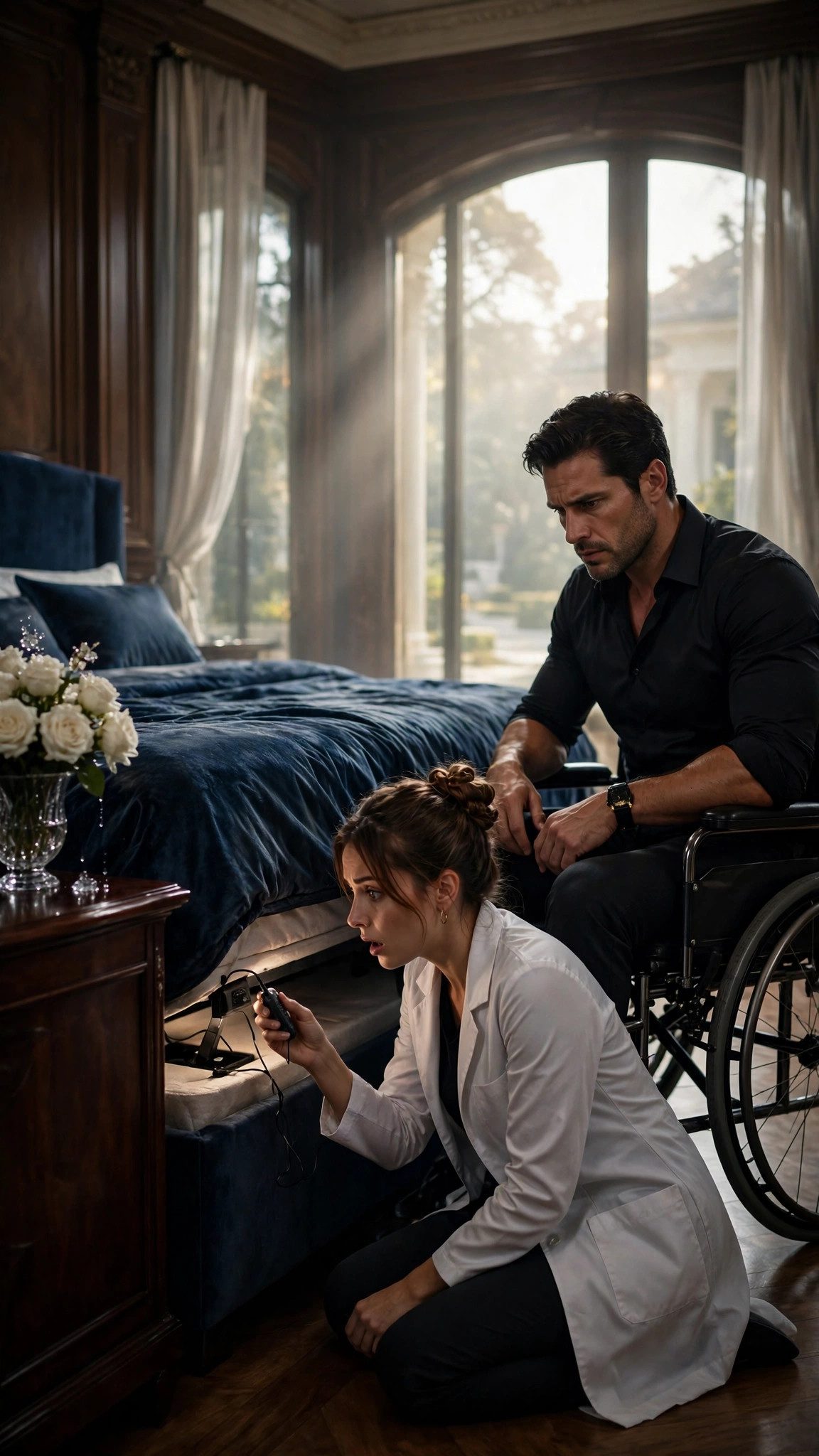
The thing beneath the mattress was the size of a matchbox, and it was listening.
Tessa Morgan found it on a Tuesday morning, six months after the bullet, while she was changing the sheets in the second-floor master suite of Vincent Corvino's Gold Coast mansion. She had one hand under the mattress, smoothing the fitted sheet over the corner, when her fingers brushed something hard and flat that did not belong to a bed.
She stopped.
Vincent watched her from his wheelchair beside the bed. He had learned to read people the way other men read newspapers, and the change in Tessa's face told him everything before she said a word. The color drained from her cheeks. Her jaw tightened. Her hand, which had been moving with the quick, careless efficiency of a woman who had changed a thousand beds, went very still.
"Vincent," she whispered.
She lifted the object out and held it up between two fingers. It was a listening device. Small, black, rectangular, with a seam along one side where it had been pressed deep between the mattress and the bed frame, so deep that only a hand changing the sheets would ever find it.
Vincent did not speak. He stared at the little black rectangle as if it were a snake coiled on his bed, and the fragments came flooding back to him all at once, the way memories do when a single object unlocks a door you thought you had sealed.
He remembered the way Lauren's perfect hand had frozen on a small glass vial that morning, her fingers trembling, while she argued that she had only broken a phone.
He remembered the man beside the elevator, who had smiled and promised, "It's just the coffee guy," when Vincent asked who he was.
He remembered the disconnected call from Lauren's watch, the line going dead in the middle of her sentence, and the way she had laughed it off a second too late.
Below the device, caught inside the seam of the mattress, was an envelope. Tessa's fingers curled cautiously around it and pulled it free.
Inside was a photograph.
It showed Vincent standing outside a restaurant, beneath the awning, moments before he walked toward the car where a shooter was waiting for him. The photograph had been taken from across the street, from a parked car, from a distance that meant the photographer had known exactly where he would be and exactly when.
A note was clipped to the photograph. The handwriting was not Lauren's. It was small and neat and furious.
"He trusts you. Don't let that change."
Vincent felt something far worse than anger. Anger he understood. Anger was a tool, a weapon, a thing he had carried in his pocket since he was sixteen years old. This was something colder and heavier. It was the feeling of a floor giving way under a chair he had been sitting in for years.
He felt betrayed.
Tessa waited for him to speak. She stood beside the bed with the photograph in one hand and the listening device in the other, and she did not soften her voice the way everyone else in this house did. That was why Vincent trusted her. Tessa Morgan never softened anything. She said what she saw, and she saw everything.
Vincent waited a long moment. Then he nodded once, and Tessa handed him another envelope. It was thicker than the first. She lifted the flap and opened it, and inside was a payment receipt for fifty thousand dollars.
The signature at the bottom was Lauren's.
The recipient was a name Vincent recognized.
His jaw stiffened. His hands, the strong hands that had built an empire and held a motorcycle steady through a Chicago winter, curled into fists on the armrests of his wheelchair.
Tessa stopped at the edge of the bed. She placed a careful hand on the envelope, as if it might bite her, and pulled out a third object.
It was a photograph of a woman Vincent had never seen. Except once. In a courtroom, during his trial, years earlier. She had sat in the gallery every day, in the third row, wearing black, her face half hidden behind a veil of gray hair. He had never learned her name. He had never asked.
Her face was cut off in this photograph, cropped just below the eyes, as if the person who took it had wanted to hide her and identify her at the same time.
A note was attached to the back. The same small, neat, furious handwriting.
"SHE DIDN'T HIRE THE SHOOTER."
"ASK HER WHO DID."
Vincent sat in his wheelchair beside the enormous bed in the second-floor master suite of his Gold Coast mansion, and he looked at the three objects laid out on the white sheets like evidence on a courtroom table. A listening device. A photograph of himself about to be shot. A receipt for fifty thousand dollars with his wife's signature on it. And a photograph of a woman he had seen once, years ago, in a courtroom, with a note telling him that his wife was innocent and that he should ask her who was guilty.
Outside the tall windows, the morning light fell across the lake in long, clean lines. Inside the room, the air smelled of expensive wood, fresh flowers, medication, and the faint sterile scent of the equipment the nurses left after their visits. White roses stood in a crystal vase near Vincent's bed. Lauren replaced them every three days, as though fresh white roses could disguise the fact that she barely spoke to him anymore.
Vincent thought about the woman who had once climbed onto the back of his motorcycle wearing a red silk dress and laughing at the city lights. He thought about the way she had wrapped her arms around his waist and pressed her cheek against his back, and how the whole city had seemed to belong to them that night.
He wished he could see her again.
But the woman who lived in this house now was someone else. She moved quietly. She spoke softly. She brought roses and left them like offerings at a grave.
Tessa was still standing beside the bed, watching him. She had not moved. She had not spoken. She was waiting for the order, the way a soldier waits for an order, and Vincent understood suddenly that this was the moment everything would change. Whatever he said next would decide whether his marriage survived the morning.
He could call his men. He could have Lauren brought to him and demand the truth with a gun on the table. That was the old way. That was the way his father had taught him, the way the empire had always worked. Fear first. Questions later.
But the note said, "ASK HER WHO DID." Not "punish her." Not "destroy her." Ask her.
And Tessa, who never softened her voice for anyone, said quietly, "Whatever you're about to do, don't do it angry. Angry men miss things."
Vincent looked at her. Then he looked at the receipt with Lauren's signature on it, and at the photograph of the woman from the courtroom, and at the little black device that had been listening to him sleep for God knew how long.
"Find out who planted the device," he said. His voice was low and steady, the voice of a man who had just decided something. "Don't tell anyone. Not my men. Not the housekeeper. Not Lauren. Just you and me, for now."
Tessa nodded once, the way she always did when a patient gave her an order she agreed with.
"And Tessa," Vincent said.
"Yes?"
"If someone has been listening to this room for months, then someone knows everything. Every word Lauren and I have said. Every word the doctors have said. Every word you have said." He paused. "That means the person who shot me is not finished. They are still here. Or they are still watching."
Tessa's face did not change. She had seen worse things than this in hospital wards, and she had learned not to flinch.
"Then we should be careful," she said.
"Yes," Vincent said. "We should be very careful."
He wheeled himself to the window and looked out at the lake. Six months ago, a bullet had shattered his spine in a restaurant parking lot, and he had believed that was the worst thing that would ever happen to him. He had been wrong. Losing the use of his legs had been terrible. But this — this slow, quiet discovery that his own bedroom had been bugged, that his wife had paid fifty thousand dollars to someone he knew, that a stranger from a courtroom years ago was somehow connected to the bullet that put him in this chair — this was worse.
Because a bullet you could see coming, even if only for a second. This had been happening in the dark, for months, while he slept, while he healed, while he trusted the people closest to him.
And the worst part was that he did not know who to trust anymore.
He thought about Lauren, upstairs, getting ready for her charity meeting. He thought about the way her hand had frozen on the vial. He thought about the disconnected call. He thought about the roses, replaced every three days, bright and perfect and meaningless.
He thought about the note. "SHE DIDN'T HIRE THE SHOOTER. ASK HER WHO DID."
Someone out there knew the truth. Someone had left that note for him, knowing he would find it, knowing he would read it, knowing he would have to choose between rage and patience.
Vincent Corvino had spent thirty-four years choosing rage. It had built him an empire. It had also put him in a wheelchair.
Today, for the first time in his life, he chose patience.
"Tuesday," he said to Tessa, without turning from the window. "Lauren said she needed to attend a charity meeting this morning. Find out if there really is a charity meeting. And find out who the man by the elevator is. The coffee guy."
Tessa nodded. She gathered the listening device, the photograph, the receipt, and the third photograph, and she put them carefully into a plain white envelope. She did not ask what he planned to do with them. She did not need to ask.
"Vincent," she said, at the door.
"Yes?"
"For what it's worth," she said, "I don't think your wife hired the shooter."
Vincent turned his wheelchair around slowly and looked at her.
"Why not?"
"Because a woman who hires a shooter doesn't bring white roses every three days," Tessa said. "A woman who hires a shooter doesn't stay. She leaves. Your wife is still here. She's scared, not guilty. There's a difference. You should learn it before you lose her."
She left the room, and Vincent sat alone beside the enormous bed, in the second-floor master suite of his Gold Coast mansion, with the morning light falling across the lake and the smell of white roses in the air.
He had six months of anger in him. He had six months of pain and humiliation and helplessness. He had a bullet in his spine and a bug under his mattress and a wife who barely spoke to him.
But he also had a note. And a nurse who told the truth. And a decision to make.
He would ask Lauren who hired the shooter.
And he would find out the truth, whatever it cost him.
After Tessa left, Vincent sat alone in the room for a long time, and the silence of the house pressed in on him from every side. He had lived in this mansion for nine years, and he had never once felt alone in it. There had always been someone in the next room, someone on the stairs, someone in the kitchen, someone guarding the door. An empire does not leave its king alone.
But now he was alone, and the aloneness felt like a kind of truth. All those people, all those guards and drivers and housekeepers, and someone had still managed to put a listening device under his mattress. Someone had still managed to photograph him outside a restaurant. Someone had still managed to watch him for months without him ever knowing.
He wheeled himself to the dresser and opened the top drawer. Inside, beneath a stack of folded shirts, was a small wooden box his father had given him on his twenty-first birthday. Antonio Corvino had carved it himself, out of a single piece of walnut, and inside it were three things: a silver coin from the year the family came to America, a photograph of his mother, and a small brass key that opened nothing Vincent had ever found.
Vincent took the box out and set it on the dresser. He opened it and looked at the photograph of his mother. She had died when he was nineteen, of a sudden illness that the doctors never fully explained, and Vincent had never forgiven the world for taking her. He had built the empire partly to prove that the world could not take anything else from him. It could not take his father. It could not take his name. It could not take his life.
But the world had taken his legs. And now it was trying to take his wife.
He thought about Rosa, the housekeeper, who had worked in the mansion for twenty years and who had cried when Vincent came home from the hospital. Rosa had made his favorite soup every day for a month. Rosa had changed his bandages when the nurses were late. Rosa had prayed for him every night, and Vincent knew it because he had heard her through the open door of her room, her voice low and steady, asking God to heal the young master.
Could Rosa be part of this? Vincent did not want to think it. But the listening device had been under his mattress, in his bedroom, in the most private room in the house. Whoever had planted it had access. Whoever had planted it knew the house. Whoever had planted it knew when the room was empty.
Upstairs, he could hear Lauren moving around. The soft sound of a drawer opening. The quiet click of a closet door. She was getting ready for her charity meeting, or pretending to. Vincent listened to those sounds, and he wondered how many of them were real and how many of them were a performance for whoever was listening.
He picked up the phone on the nightstand and called Daniel Hart. The old lawyer answered on the third ring, and Vincent told him he needed to come to his house that afternoon. He did not say why. He did not need to. Daniel Hart had known Vincent since he was a boy, and he knew the sound of a man who had found something terrible under his bed.
When he hung up, Vincent sat in his wheelchair and looked at the white roses in the crystal vase. Lauren replaced them every three days. She had replaced them yesterday. They were fresh and white and perfect, and they smelled of nothing at all.
He thought about the note again. "SHE DIDN'T HIRE THE SHOOTER. ASK HER WHO DID."
Someone had left that note for him. Someone who knew the truth. Someone who wanted him to find it. And Vincent understood, sitting alone in his bedroom with a wooden box and a photograph of his dead mother, that whoever had written that note was either his greatest ally or his most dangerous enemy.
Either way, he was going to find them. And he was going to find the truth. Because the truth was the only thing that could save his marriage, and his marriage was the only thing that could save him.