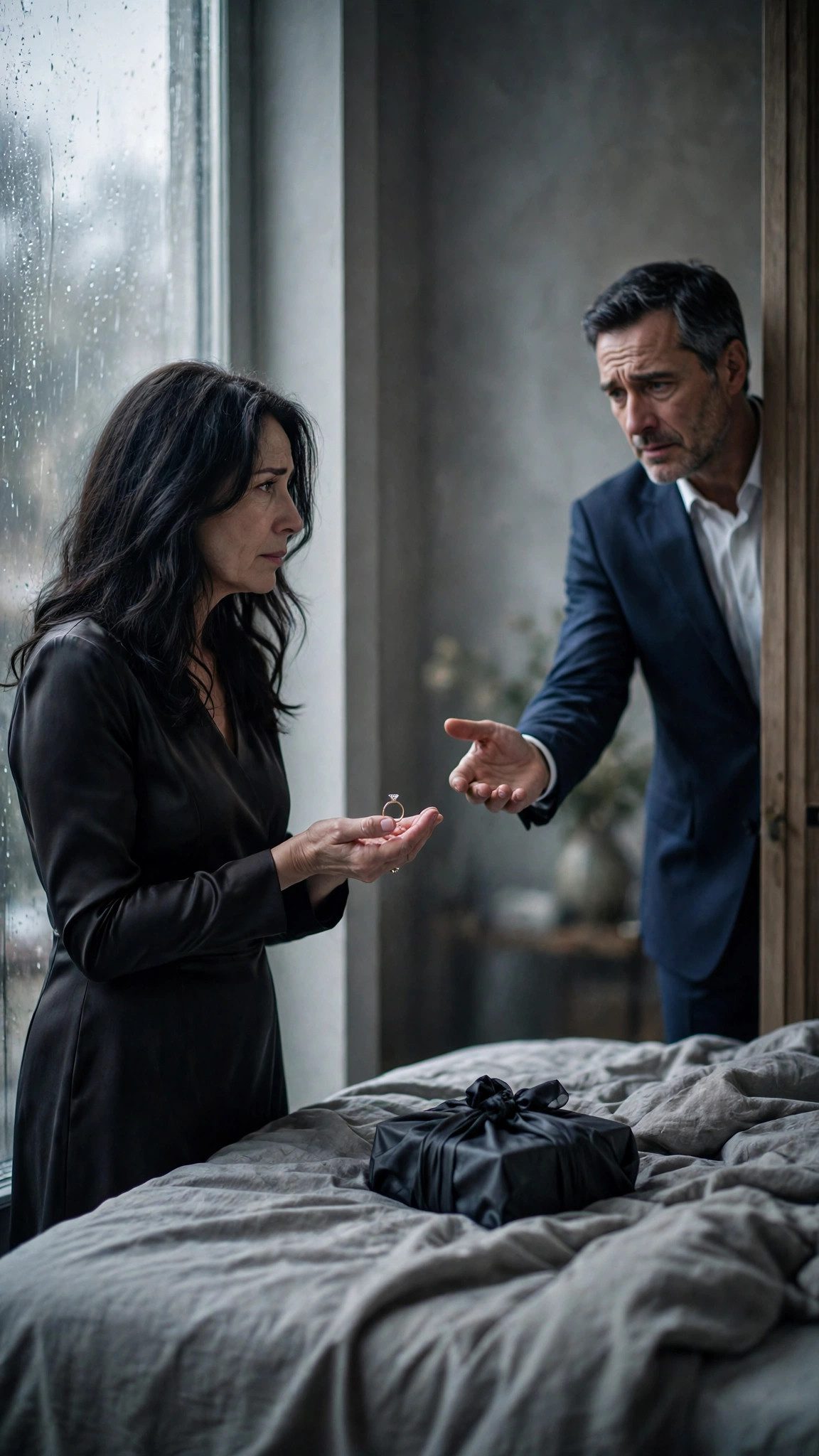
After the morning of my forty-eighth birthday, after Declan told me about Victoria and the baby and the bloodlines, after he gave me back my grandmother's ring and sat down in the chair by the window and began to tell me the truth, I did something I had not done in four years.
I stopped believing him.
Not all at once. Not in anger. I simply made a decision, the way a doctor makes a decision in an emergency room: I would listen to everything he said, and I would verify all of it myself. I would not take his word for anything anymore. Not about Victoria. Not about the council. Not about the ledger. Not about Boston. I would find out the truth the way I found out everything else in my life — by looking, by asking, by refusing to accept a diagnosis until I had seen the evidence with my own eyes.
Declan told me his story in pieces, over three days, in the house that no longer felt like mine. He told me about the family council, led by his uncle Aldo Mercer, a man I had met twice in four years and had disliked both times. Aldo was seventy-one, with white hair and cold eyes, and he believed in the old law the way other men believe in religion. The old law said that the head of the family must produce an heir, a bloodline, a voice for the future. A boss without an heir was a dead boss. A boss without an heir could not leave. A boss without an heir could not protect his family, because the moment his enemies smelled weakness, they would come.
Declan told me that Aldo had found out about his plan to leave, about the ledger, about the offshore accounts and the trucking companies and the quiet legitimizing of the family business. And Aldo had given him a choice. Produce an heir, or lose everything. Produce an heir, or watch Castellano burn the family to the ground. Produce an heir, or watch Sarah Hamilton die in a car accident that no one would ever investigate.
"Victoria was the council's choice," Declan said. "She comes from a loyal family. Her father served mine for thirty years. The arrangement was made before I ever agreed to it. I was told, not asked."
"And you agreed," I said.
"I agreed because the alternative was your funeral," he said. "I agreed because I had already lost a son, and I was not going to lose you."
I listened. I wrote nothing down. I nodded in the right places. And then, when he went to his study to take a phone call, I went to mine, and I began to work.
The first thing I did was call Helen. I told her everything Declan had told me, and she listened, and then she said, "Sarah, I have known you for twenty-six years, and I have never once known you to take a man's word for a diagnosis. Go and find the patient. Go and see Victoria yourself."
Victoria Hale lived in a small apartment above a bakery on the east side of the city, and I knew the address because I had seen it once, on a piece of paper in Declan's study, and I had memorized it without knowing why. I drove there on a Tuesday morning, in the rain, and I sat in my car across the street for twenty minutes, telling myself to turn around, telling myself that this was madness, telling myself that a doctor did not stalk her husband's mistress.
And then I got out of the car, and I crossed the street, and I knocked on her door.
Victoria opened it herself. She was twenty-nine, with dark blonde hair pulled back into a neat knot, and she was wearing a simple gray dress, and she was beautiful in the cool, efficient way I remembered, but up close she looked tired. There were shadows under her eyes. Her hands were clasped in front of her, the way a person clasps their hands when they are holding themselves together.
"Mrs. Mercer," she said. She did not sound surprised. She sounded like a woman who had been expecting me for a long time.
"May I come in?" I asked.
She stepped aside, and I walked into a small, clean apartment that smelled of bread from the bakery below and of the lavender soap she used. There were no photographs on the walls. There were no flowers. There was a single chair by the window, and a small table with a teapot on it, and a bookshelf filled with medical textbooks, which surprised me so much that I stopped and stared.
"You are a nurse," I said. It was not a question. I recognized the textbooks. I had owned the same ones.
"I was," she said. "Before I went to work for Mr. Mercer. I trained as a nurse. I worked in the oncology ward for three years."
"Why did you leave?"
"Because my father owed the Mercer family money," she said simply, and she poured tea with steady hands, and she did not look at me when she said it. "My father drove a truck for them for thirty years. When he died, the debt did not die with him. Mr. Mercer offered me a job. Personal assistant. Good pay. The debt would be forgiven, slowly, over time. I took it. I did not have a choice."
I sat down across from her, and I looked at her, really looked at her, and I saw what Declan had not told me. I saw a young woman who was trapped. I saw a woman who had been used, the way I had been used, by the same family, by the same old law, by the same men who believed that women's lives were currency.
"Tell me about the baby," I said.
She put her hand on her stomach, gently, protectively, and for the first time since I had walked in, her face softened.
"I did not plan this," she said. "No one planned this. The council chose me. They told me it was an honor. They told me I would be taken care of. They told me the child would be the heir, and that I would be the mother of the heir, and that I would never have to worry about anything again. And I believed them, because I wanted to believe them, because I was tired of being afraid."
"And Declan?" I asked. "What is he to you?"
"Mr. Mercer is kind to me," she said, and her voice was careful, the way a person speaks when they are choosing every word. "He is not cruel. He has never raised his voice to me. He has never touched me except —" She stopped. She looked down at her hands. "He has never touched me except the one time the council required. And after that, he never touched me again. He brings me groceries. He asks about my health. He paid for my doctor. He is a good man, Mrs. Mercer. I know what he did to you. I know what this looks like. But he is not the villain in this story."
"Then who is?" I asked.
"The council," she said. "My uncle Aldo. The old law. Vincent Castellano, who has been waiting for years for the Mercer family to show weakness. They are the villains. Mr. Mercer and I are just the people they used."
I believed her. I believed her the way I had believed Declan, and I hated that I believed her, because believing her meant that the world was more complicated than I had wanted it to be, and that the man I had married was not a monster, and that the woman I had come to confront was not a monster either, and that the real monsters were men I had barely met, men who made decisions about women's lives in rooms I had never been invited into.
"Victoria," I said, "I need to ask you something, and I need you to tell me the truth. Did Declan ever tell you that he loved you?"
She laughed, and the laugh was bitter, and it was the first real sound I had heard from her.
"No," she said. "He never once told me he loved me. He told me he was sorry. He tells me that every time he comes here. He is sorry. He is sorry for the arrangement. He is sorry for the baby. He is sorry for you. He is a man who is sorry about everything, Mrs. Mercer, and he does not know how to fix any of it."
I stayed for an hour. We drank tea. We talked about nursing, about the oncology ward, about the patients we had both lost. We talked about her father, and about my grandmother, and about the ring, and when I told her about the ring, about how Declan had taken it from me on my wedding day and locked it away, and how he had given it back to me on my forty-eighth birthday, she went very quiet, and then she said, "He kept it in the safe in his study. I have seen the safe. He opens it every night before he goes to sleep, Mrs. Mercer. He looks at that ring every night. I do not know why, but he does."
I left her apartment with more questions than answers, and I drove to the hospital, and I sat in my office, and I thought about what I had learned. Declan had told me the truth about the council. Victoria had told me the truth about the arrangement. But there was something neither of them had told me, something I could feel the way a doctor feels a tumor beneath the skin, something large and dark and growing.
I called Marcus.
Marcus Mercer was the only person in Declan's family I trusted, and I trusted him because he had looked me in the eye, seven years ago, in a hospital bed with a bullet wound in his chest, and he had said, "Tell the doctor I owe her my life," and he had meant it. Marcus had never lied to me. Not once. Not about anything.
"Marcus," I said, when he answered, "I need you to tell me the truth about Aldo, and about the council, and about what really happened in Boston."
There was a long silence on the other end of the line, and then Marcus said, "Sarah, where are you?"
"At the hospital."
"Stay there," he said. "I am coming to you. And Sarah — do not tell Declan you called me. Not yet."
He arrived an hour later, and he looked older than I remembered, and tireder, and he sat down across from me in my office, and he closed the door, and he told me the thing that neither Declan nor Victoria had told me.
"Aldo is not working for the family," Marcus said. "Aldo is working for Castellano. He has been selling our routes to Vincent Castellano for two years. The bloodline law, the council, the heir — all of it is a performance. Aldo does not care about an heir. Aldo cares about the money Castellano is paying him. And the moment Declan produces an heir, Aldo will use the child as leverage to take the family for himself."
I sat very still, and I listened, and I understood, finally, that the ledger was not just Declan's way out. The ledger was evidence. The ledger named every payment, every route, every meeting. And somewhere in that ledger was the proof that Aldo Mercer had betrayed his own family.
"Does Declan know?" I asked.
"No," Marcus said. "Declan thinks Aldo is a true believer. He thinks the old law is the problem. He does not know that the old law is just a mask for a theft."
"Then we have to tell him," I said.
"No," Marcus said, and he leaned forward, and his voice was low and urgent. "Not yet. If we tell Declan now, he will go to Aldo, and Aldo will deny it, and the council will close ranks, and we will lose our only chance. We need proof. We need the ledger. And the ledger is in Declan's safe, and only Declan knows the combination."
I thought about the safe in Declan's study. I thought about the ring, wrapped in dark silk, locked inside it. I thought about the nights Declan spent standing in front of that safe, looking at my grandmother's ring, and I understood, finally, what he had been looking at. He had not been looking at the ring. He had been looking at the ledger. He had been looking at the way out, and he had not known how to use it.
"Then I will get the ledger," I said.
Marcus stared at me. "Sarah, that safe is in Declan's study. He will never give you the combination."
"He will not have to," I said. "I am his wife. I live in that house. And I am a doctor, Marcus. I know how to stay calm when the world collapses. And I know how to open a door that someone does not want me to open."
Marcus was quiet for a long moment, and then he nodded slowly, and he said, "Your grandmother would be proud of you."
"My grandmother," I said, "would tell me to take back what is mine."
And that was the moment I stopped being the wife who waited, and became the woman who acted.
That night, I went home, and I found Declan in the study, standing in front of the safe, exactly the way Victoria had described. He did not hear me come in. He was staring at the steel door with his hands at his sides, and his shoulders were bent, and he looked like a man praying in front of an altar.
I watched him for a long time, and I thought about everything I had learned that day. I thought about Victoria, in her small apartment above the bakery, with her medical textbooks and her steady hands. I thought about Marcus, and the bullet in his chest, and the debt he owed me. I thought about Aldo, and Castellano, and the routes being sold in the dark. And I thought about the safe, and the ledger inside it, and the ring wrapped in dark silk, and I understood that the safe held two things: the evidence that could destroy Aldo, and the symbol of everything I had lost.
Declan turned, and he saw me standing in the doorway, and for a moment neither of us spoke.
"Sarah," he said quietly. "You went to see her."
It was not a question. He knew. Of course he knew. Declan Mercer knew everything that happened in his city, and he had probably known the moment I knocked on Victoria's door.
"Yes," I said. "I went to see her. And I went to see Marcus. And I know about Aldo, Declan. I know he is selling our routes to Castellano. I know the bloodline law is a mask. I know the council is not protecting the family. I know all of it."
He stared at me, and his face went pale, and then, slowly, he nodded.
"Then you know more than I did," he said. "Marcus told you."
"Marcus told me," I said. "And Victoria told me the rest. And now I am going to tell you something, Declan. I am not going to walk away. Not yet. Not until Aldo is finished. Not until Victoria and her baby are safe. Not until this family is free of the old law. I am a doctor, and I do not walk out of an operating room in the middle of a surgery. And this family is my patient now."
He looked at me for a long moment, and then he did something I had not expected. He smiled. It was a small smile, and it was tired, and it was the first real smile I had seen from him since my birthday.
"Your grandmother," he said, "would be proud of you."
"Do not talk about my grandmother," I said, but my voice was not as hard as I wanted it to be. "Not yet. Not until you have earned the right."
He nodded, and he turned back to the safe, and he put his hand on the steel door, and he said, "The combination is the date we met, Sarah. The night of the fundraiser. I have never changed it. I never will."
And then he walked out of the study, and he left me alone with the safe, and with the knowledge that the way into it had been my own history all along.