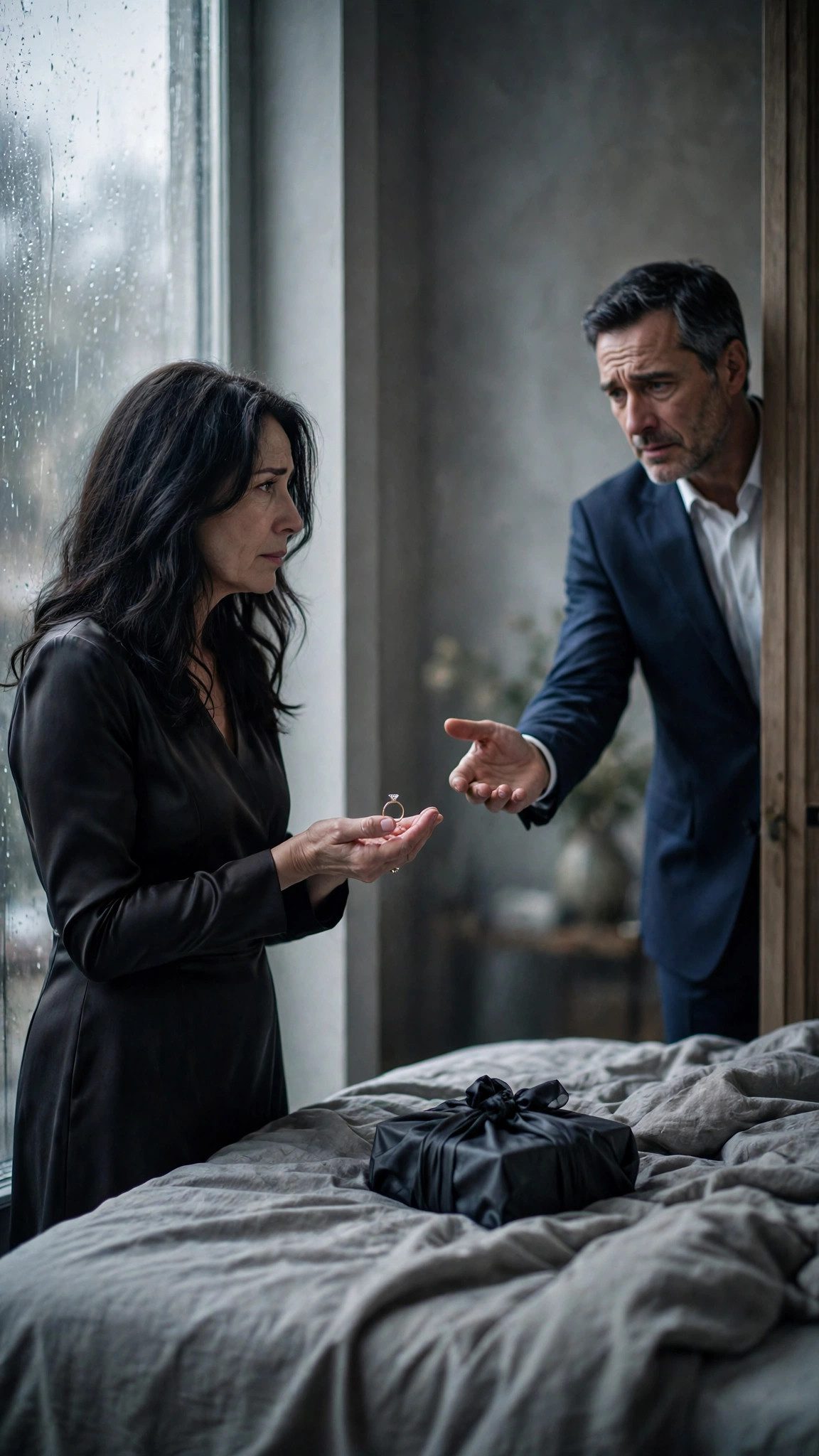
I opened the safe the next morning, while Declan was in the city, and my hands did not shake, because my hands never shook, not even then.
The combination was the date we met. The night of the fundraiser. October the fourteenth. I turned the dial, and I heard the lock click, and I pulled the steel door open, and there they were, side by side, the two things that had defined my marriage: the ledger, bound in black leather, and my grandmother's ring, wrapped in dark silk.
I took out the ring first. I held it in my palm, and it was warm, though it had been locked in cold steel for four years, and I thought about my grandmother, about the war, about the invasion, about the crossing of an ocean with a ring sewn into a coat pocket. I thought about how she had sold everything else she owned to keep us fed, but she had never sold the ring. "This ring is our family," she used to tell me. "As long as we have this ring, we have each other."
I put the ring in my pocket. And then I took out the ledger, and I sat down at Declan's desk, and I opened it, and I began to read.
The ledger was not what I expected. I had imagined a book of crimes, a record of violence, a list of the terrible things Declan Mercer had done to build his empire. And some of that was there, in the early pages, in a handwriting I recognized as his father's, and then his own: the debts, the routes, the warehouses, the men who had been paid and the men who had been silenced. But as the pages went on, the handwriting changed, and so did the story.
Declan had been keeping two sets of books. The first was the family's business, the old business, the docks and the trucks and the quiet arrangements with politicians who pretended never to have met him. The second was something else entirely. It was a record of an exit.
Page after page, in Declan's careful hand, I read the story of a man who had spent four years trying to buy his way out of his own life. Cash moved offshore, not to hide it, but to protect it, to put it somewhere the family could not reach. Trucking companies purchased, one by one, not to expand the empire, but to legitimize it, to turn the family's dirty money into clean businesses with real employees and real tax returns. Debts collected and forgiven. Old enemies paid off and sent away. A house in Maine, bought under a company name I had never heard of, with a garden, and a porch, and a view of the sea.
He had been building us a way out. He had been building it for four years, quietly, patiently, the way a man builds a boat in his basement, piece by piece, knowing that one day he will need it to escape a flood.
And then I found the pages about Aldo.
They were near the back of the ledger, written in a different ink, in a hurry, with the letters pressed hard into the paper. Payments. Dates. Routes. The names of the men Aldo had sold to Castellano. The amounts Castellano had paid him. Two years of betrayal, recorded in Declan's own hand, because Declan had known. He had known for two years that his uncle was selling the family to its greatest enemy, and he had written it all down, and he had done nothing, because he had been waiting. Waiting for the right moment. Waiting for proof that would stand up in front of the council. Waiting for a way to use it without starting a war that would burn the city down.
And then I found the last pages, and I understood everything.
The last pages were about me.
There were entries about my hospital, about the new monitors for the children's ward, paid for quietly, through a foundation, with no name attached. There were entries about Helen's mother, about the specialist in Boston, about the surgery that had saved her life, paid for the same way. There were entries about my colleagues, about the young resident whose student loans had been forgiven, about the nurse whose mortgage had been paid off, about the families of patients who had received money they never asked for and never knew where it came from.
And there was an entry about James. About our son. A single line, in Declan's handwriting, pressed so hard into the paper that it had nearly torn through: "James Mercer. Five months. I will never forgive myself for not being there."
I sat at that desk for a long time, with the ledger open in front of me, and I cried. I cried for James. I cried for the winter in Boston. I cried for the four years I had spent believing that my husband did not love me, when he had been loving me the only way he knew how — quietly, secretly, from a distance, the way a man who has never been loved properly loves someone.
When Declan came home that evening, I was still sitting at his desk, with the ledger open, and the ring in my pocket, and my eyes red from crying, and he stopped in the doorway, and he looked at me, and he did not speak.
"You knew about Aldo," I said. "You knew for two years."
"Yes," he said.
"And you did nothing."
"I was waiting," he said. "I was waiting for the moment when I could use it without starting a war. I was waiting for the moment when I could protect you, and Marcus, and the family, all at once. I have been waiting for four years, Sarah. I am tired of waiting."
"Then stop waiting," I said, and I stood up, and I held out the ledger, and I put it in his hands. "Use it. Use it now. Call the council. Call them tonight. Tell them what Aldo has done. Show them the ledger. End this."
He looked down at the ledger, and then he looked at me, and his face was pale, and his hands were shaking, and I realized that Declan Mercer, the most feared man in the city, was afraid. Not of Aldo. Not of Castellano. Not of the council. He was afraid of me. He was afraid that I would leave him. He was afraid that I had already left him, in my heart, and that no ledger, no confession, no amount of truth would ever bring me back.
"Declan," I said, and my voice was steady, because I was a doctor, and doctors do not break, not even now. "I am not leaving. Not tonight. Not until this is finished. But I need you to understand something. I need you to understand that what you did — the arrangement with Victoria, the baby, the bloodlines — was wrong. It was wrong even if you did it to protect me. It was wrong because you decided for me. You decided what my life was worth. You decided what I could survive. You never asked me. You never once asked me what I wanted."
"I know," he said, and his voice broke, and the break in it was the most human sound I had ever heard from him. "I know. I have known it every day for a year. I am sorry, Sarah. I am sorry I failed you. I am sorry I was not the man you deserved. I am sorry I was the man I was."
I looked at him, and I thought about the fundraiser, and the navy suit, and the man who had listened to me the way no one had ever listened to me before. I thought about the wedding, and the ring, and the dark silk, and the promise. I thought about James, and the empty nursery, and the winter in Boston. I thought about Victoria, in her small apartment above the bakery, with her hand on her stomach. And I thought about my grandmother, who had crossed an ocean with a ring sewn into her coat pocket, and who had never let anyone take it from her.
"Then be a different man," I said. "Starting tonight. Starting now. Call the council. Show them the ledger. And then, when Aldo is finished, we will talk about us. About Victoria. About the baby. About the ring. About everything. But first, we finish this."
He nodded slowly, and he took out his phone, and he made the call, and I stood beside him, and I held his hand, and for the first time in four years, I felt like his wife again. Not his possession. Not his secret. Not his debt. His wife. His partner. His equal.
The council would meet the next night. Aldo would be there. Castellano's men would be watching. And Marcus would be waiting, with the evidence, and with the men he trusted, and with a plan that depended on all of us doing exactly what we had agreed to do.
I went to bed that night with my grandmother's ring in my pocket, and I lay awake for a long time, listening to Declan breathe beside me, and I thought about the ledger, and about the names in it, about my family, my friends, my partners, my old colleagues, all written in that book, not because Declan had threatened them, but because he had protected them.
And I understood, finally, that the ledger was not a record of crimes. It was a record of love. A strange, dark, dangerous kind of love, but love nonetheless. And it was my job now to make sure that love did not destroy us all.
The next morning, before the council met, I did two things. The first was to go back to Victoria. The second was to call Helen. Both of them deserved to know what was about to happen, and both of them deserved a choice in it, because I had learned, finally, that the worst thing Declan had done was not the betrayal itself. The worst thing he had done was deciding for other people. I was not going to make the same mistake.
Victoria opened her door before I knocked. She had been waiting by the window, watching the street, the way a person watches for news that will change their life.
"Mrs. Mercer," she said. "You came back."
"I came back," I said, "because I need to ask you something, and because you deserve to be asked, not told."
I told her everything. About the ledger. About Aldo. About Castellano. About the council meeting that night, and about the plan Marcus and Declan and I had made. And then I asked her the question I had come to ask.
"Victoria," I said, "will you come to the council tonight, and tell them the truth? Will you tell them that the arrangement was Aldo's, not Declan's? Will you tell them that you were used, the way I was used? I will not force you. If you say no, I will understand, and I will protect you anyway. But if you say yes, you will change everything. You will be the reason the old law falls."
She was quiet for a long time, and she looked down at her hands, and then she put one hand on her stomach, and she said, "My baby will be born into this family. I have thought about that every day since I found out I was pregnant. I have thought about what kind of family it will be. A family that uses women, or a family that protects them. I want it to be the second kind. I want my child to grow up in a family where a woman's life is not currency."
"Then come tonight," I said. "Come and help me build that family."
She nodded, slowly, and then she did something I did not expect. She took my hand, and she held it, and her hand was warm, and steady, and strong.
"Thank you," she said. "Thank you for asking me. No one has ever asked me anything before. They have only ever told me."
I drove from Victoria's apartment to the hospital, and I found Helen in her office, and I told her everything too, and Helen listened, and then she stood up, and she closed her door, and she said, "Sarah Hamilton, I have known you for twenty-six years, and I have never been prouder of you than I am right now. You are about to walk into a room full of dangerous men and tell them that their law is a lie. Do you understand what you are doing?"
"I understand," I said.
"Then I am coming with you," she said.
"Helen, no. It is too dangerous."
"Sarah," she said, and her voice was the voice she used in the emergency room, the voice that did not accept argument, "I was there the night Marcus Mercer was carried into our emergency room with a bullet in his chest. I was there when you held his heart in your hands and brought him back to life. I was there when Declan Mercer stood at the foot of that bed and decided to marry you. I have been there for all of it. I am not going to stop being there now."
I cried then, properly cried, for the first time since my birthday, and Helen held me, and she did not tell me it would be all right, because Helen never lied to me, and she said, "It will be hard. But you will survive it. You always survive it. That is what you do."
That afternoon, I went home, and I stood in the nursery for a long time, in the chair beside the empty wooden crib, and I thought about James. I thought about the five months I had carried him, and about the ultrasound, and about the pale blue walls, and about the tiny clothes I had bought and never used. And I thought about the baby Victoria was carrying, a baby who would be born into a family at war, a baby who deserved better than that, a baby who deserved a family that would protect him.
I took my grandmother's ring out of my pocket, and I held it up to the light, and it caught the sun through the nursery window, and it sparkled, and I thought about my grandmother, about the war, about the invasion, about the crossing of an ocean. I thought about how she had sold everything she owned to keep us fed, but she had never sold the ring. "This ring is our family," she used to tell me. "As long as we have this ring, we have each other."
I understood her then, in a way I never had before. The ring was not about the diamond. The ring was about the promise. The promise that no matter what happened, no matter how hard the world became, family would protect family. And I had a family now, a strange, broken, complicated family — a husband who had betrayed me, a brother-in-law who owed me his life, a young woman carrying my husband's child, a best friend who would walk into danger beside me — and it was my job to protect them all.
I put the ring back in my pocket, and I went downstairs, and I found Declan in the study, and I told him about Victoria, and about Helen, and about the plan, and he listened, and when I finished, he looked at me for a long moment, and then he said, "You are braver than I am, Sarah. You have always been braver than I am."
"No," I said. "I am just a doctor. And doctors do not walk out of an operating room in the middle of a surgery."
He took my hand, and he held it, and for the first time in a long time, his hand did not shake, and neither did mine.
"Tonight," he said, "we finish this. Together."
"Together," I said.
And I meant it.