The council met in the back room of a restaurant that had belonged to the Mercer family for forty years, a room with no windows and a single long table, and a chandelier that cast more shadow than light. I had never been in that room before. Women were not invited to the council. Women were not even told that the council existed. I knew that, and I went anyway.
Declan went in first. Then Marcus. Then me. Then Victoria, who walked in with her head high and her hand on her stomach, and Helen, who walked beside her like a bodyguard, which, in a way, she was.
Aldo Mercer was already seated at the head of the table, with his white hair and his cold eyes, and around him sat the other men of the council — six of them, all older, all in dark suits, all with the faces of men who had spent their lives making decisions about other people's lives. They looked up when we walked in, and the room went silent, and I could feel the weight of their stares, and I did not look away.
"What is this?" Aldo said, and his voice was calm, and that calm was the most dangerous sound in the room. "Declan, why have you brought women into this room? This is a council. This is not a place for women."
"These women," Declan said, and his voice was steady, and I was proud of him in that moment, prouder than I had been in years, "are the reason this council exists. And they are the reason it is about to change."
Aldo laughed. It was a short, cold laugh, and it did not reach his eyes.
"Change?" he said. "The old law does not change, Declan. The old law has kept this family alive for three generations. A boss without an heir is a dead boss. You know this. You agreed to it. You produced an heir. The law is satisfied. Now sit down, and let us discuss the future."
"The future," I said, and my voice carried across the room, clear and steady, the voice I used in the emergency room when I needed everyone to listen, "is what I am here to discuss, Mr. Mercer. And the future does not belong to you."
Aldo turned his cold eyes on me, and he looked at me the way a man looks at an insect that has wandered onto his table.
"Mrs. Mercer," he said, "you do not speak in this room."
"I speak wherever I choose to speak," I said. "I am a doctor. I have held life and death in my hands at the same time. I am not afraid of you. I am not afraid of this room. And I am not afraid of the old law, because I have read your ledger, Mr. Mercer, and I know what the old law really is."
The room went very still. Aldo's face did not change, but something in his eyes did, a flicker, a crack, the way ice cracks on a river in spring.
"I do not know what you are talking about," he said.
"Then let me explain it to you," I said, and Declan set the ledger on the table, and he opened it to the pages near the back, and he slid it across the polished wood toward Aldo, and the sound of the leather on the wood was the loudest sound in the room.
"Two years," Declan said. "Two years of payments. Two years of routes. Two years of meetings with Vincent Castellano. Two years of selling our family to our greatest enemy, while you stood in this room and preached about bloodlines and the old law. The old law was never about an heir, Aldo. The old law was about you. It was always about you."
Aldo looked down at the ledger, and he did not touch it, and for a long moment no one spoke, and then one of the other council members, an old man named Frank DeLuca, who had been Declan's father's closest friend, reached out with a shaking hand, and he turned a page, and then another page, and then he looked up at Aldo, and his face was gray.
"Is this true?" Frank asked.
Aldo did not answer. He stood up slowly, and he buttoned his jacket, and he looked around the room, at the men who had followed him for years, and he said, "Declan has lost his mind. His wife has poisoned him against his own family. This ledger is a forgery. This whole meeting is a disgrace."
And then Victoria spoke.
I had not expected her to speak first. I had expected Declan to speak, or Marcus, or me. But Victoria stood up, and she put her hand on her stomach, and she looked at Aldo, and her voice was calm and clear, and it filled the room.
"Mr. Mercer," she said, "you told me it was an honor. You told me I would be taken care of. You told me the child would be the heir, and that I would be the mother of the heir, and that I would never have to worry about anything again. You did not tell me that you were selling the family to Vincent Castellano. You did not tell me that the arrangement was a mask for a theft. You did not tell me that the baby I am carrying would be born into a family that its own uncle was destroying."
Aldo stared at her, and his face went white, and then red, and then white again.
"You were paid," he said. "You were given a home. You were given security. You have no right to speak here."
"I have every right," Victoria said. "I am carrying the heir you demanded. And I am telling this council that the heir will not be born into a family ruled by a thief. If you want my child, Mr. Mercer, then you will have to answer for what you have done first."
The room erupted. Men stood up. Voices rose. Frank DeLuca was shouting. Another council member was pounding the table. Marcus had moved to stand between Aldo and the door, and his hand was inside his jacket, and I understood, with a cold clarity, that this was the moment when everything could go wrong, when the room could turn violent, when the council could become a bloodbath.
And then Declan spoke, and his voice cut through the noise like a scalpel.
"Enough," he said.
The room went silent. Every man in it turned to look at him, and I saw, in that moment, why half the city trembled when Declan Mercer made a phone call. It was not his size. It was not his suit. It was not his money. It was the stillness. The absolute, terrifying stillness of a man who has already decided what he is going to do, and who will not be moved.
"Aldo Mercer," Declan said, "you are finished. The ledger goes to the council tonight. The ledger goes to the men you betrayed. And tomorrow, the ledger goes to the police, unless you leave this city tonight and never come back. You will not take the family. You will not take the routes. You will not take my child, or my wife, or my brother. You are done."
Aldo looked at him for a long moment, and then he looked at me, and then he looked at Victoria, and I saw something in his eyes that I had not expected to see. It was not anger. It was not defiance. It was fear. The old man was afraid, and in his fear, he was suddenly small, and ordinary, and human.
"You cannot do this," he said, but his voice was shaking now. "The family needs me. Castellano —"
"Castellano," Marcus said, stepping forward, "has already been told. His men were arrested an hour ago, at the docks, with the shipment Aldo promised them. The police have the ledger. The police have the recordings. The police have everything. Aldo, you are finished. The only question left is whether you walk out of this room, or whether you are carried out of it."
Aldo stood there for a long moment, and then he unbuttoned his jacket, and he sat down, heavily, in his chair, and he put his head in his hands, and he said nothing at all.
Frank DeLuca stood up, slowly, and he looked around the room, at the other council members, and he said, "The old law is dead. It died tonight. From this moment on, this family is led by Declan Mercer, and Declan Mercer alone. And if anyone in this room disagrees, they can leave with Aldo."
No one left. No one spoke. The room was silent, and the silence was the sound of a family changing, the sound of an old world ending and a new one beginning.
Declan turned to me, and he took my hand, and he held it, and his hand was steady, and so was mine, and Victoria was standing beside us, with her hand on her stomach, and Helen was standing behind us, and Marcus was standing at the door, and I looked around that windowless room, at the men who had ruled my husband's life for four years, and I understood that we had won.
Not because we were stronger. Not because we were richer. But because we had told the truth, and the truth, in the end, was stronger than the old law.
We left the restaurant together, all five of us, into the cold night air, and the city was quiet, and the rain had stopped, and the stars were out, and I took a deep breath, and I felt, for the first time in four years, like I could breathe.
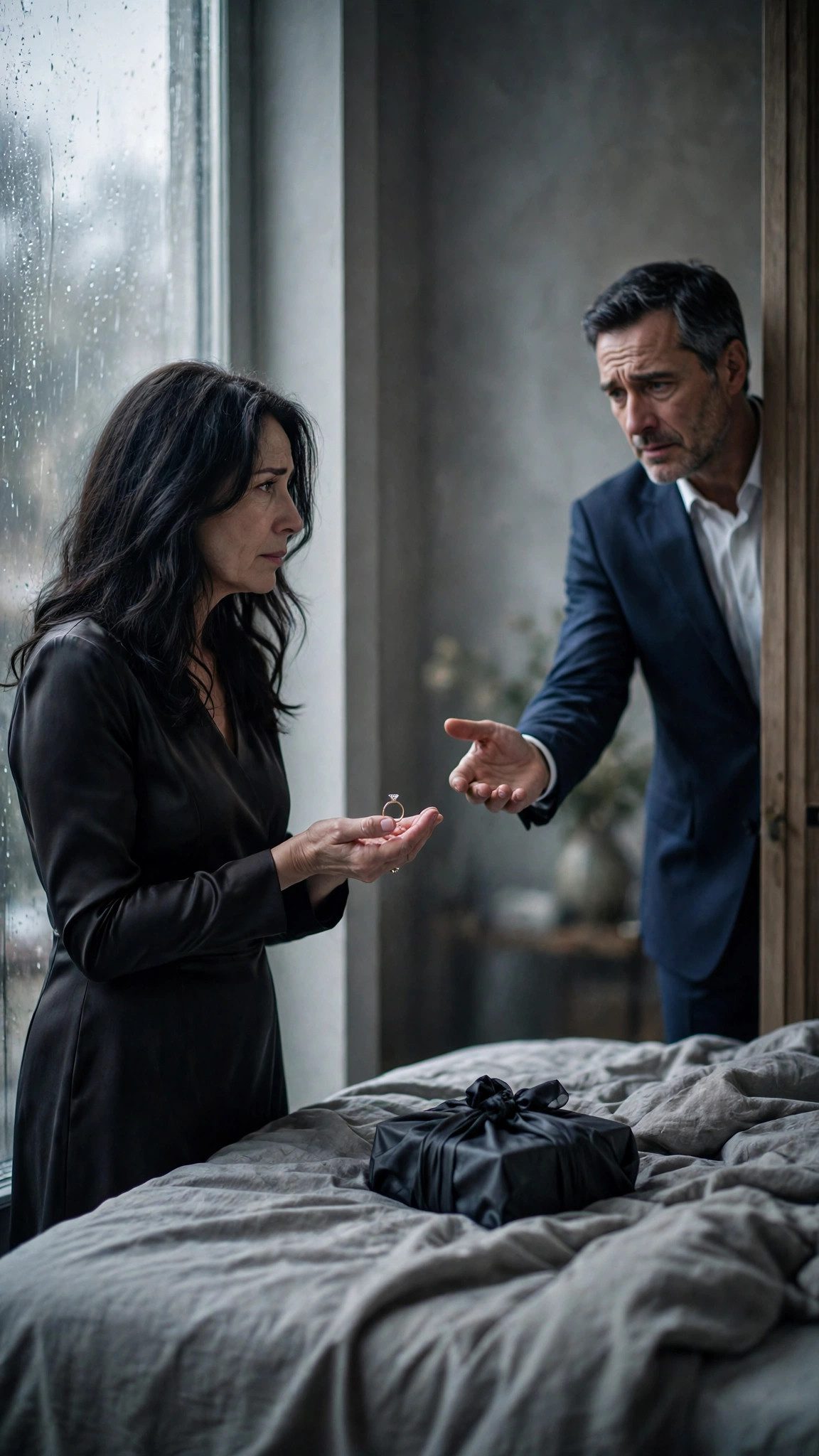
But there was still one thing left to do. One promise left to keep. One ring left to return.
And that would happen tomorrow, at the hospital fundraiser, in memory of my grandmother, in front of the whole city.
We did not go straight home that night. We went to Victoria's apartment, all of us, and we sat in her small living room, with the smell of bread from the bakery below, and we drank tea, and we talked about what would happen next, because Victoria deserved to know, and because Victoria deserved to choose.
"The baby will be a Mercer," Declan said, and his voice was gentle, the way it had been when he first spoke to me at the fundraiser, all those years ago. "The baby will be my heir, if that is what you want. The baby will be protected. The baby will be loved. And you, Victoria, will be family. Not a servant. Not an arrangement. Family. That is my promise to you, and I do not break my promises anymore."
Victoria looked at him for a long moment, and then she looked at me, and then she put her hand on her stomach, and she said, "I want my child to know his mother. I want my child to know that I chose this. I want my child to grow up in a house where women are asked, not told. If you can promise me that, Mr. Mercer, then I will stay."
"I promise," Declan said.
"And I promise too," I said, and I took her hand, and I held it, and I meant it. "I will be there when the baby is born, Victoria. I am a doctor. I will be there, and I will make sure that both of you are safe. And after that, I will be the child's godmother, if you will let me. I lost a son, Victoria. I know what it is to lose a child. I will not let this child grow up without love."
She cried then, quietly, and I held her hand, and Helen made more tea, and Marcus stood by the window, watching the street, and Declan sat beside me, and for a while none of us spoke, and the silence was not the silence of fear. It was the silence of a family being born.
Later, when we finally went home, Declan and I sat in the garden, in the chairs he had bought for me the first summer we lived in the house, and we looked up at the stars, and we talked, really talked, for the first time in four years.
"I have been thinking about Boston," he said. "About the winter I left you there. I told you it was business, and it was, in a way, but it was not the whole truth. The whole truth is that Castellano's men were in the city, and they knew where you worked, and they knew what time you came home, and I was afraid. I was afraid that if I stayed, they would use you against me. So I sent you to Boston, where I thought you would be safe, and I stayed behind to fight a war you did not know existed. I thought I was protecting you. I understand now that I was abandoning you. And I am sorry. I am sorry for Boston. I am sorry for the baby. I am sorry for all of it."
I listened, and I thought about the winter in Boston, and about the six months I had spent alone in the big house on the hill, and about the phone calls that grew shorter, and about the night I flew to Boston and stood outside in the cold and watched him through a window, and I understood, finally, that he had been fighting a war, and that I had been fighting a different war, and that neither of us had known how to tell the other.
"I forgive you," I said, and I meant it, and it surprised me how much I meant it. "Not because what you did was right. It was not right. But because I understand now why you did it. And because you are here now, and you are telling me the truth, and that is enough. That is where we start."
He took my hand, and he held it, and we sat in the garden until the stars faded, and the sky began to lighten, and the birds began to sing, and I thought about my grandmother, and about the ring in my pocket, and about the fundraiser the next day, and about the promise I had made to myself on the morning of my forty-eighth birthday.
I had promised myself that I would not walk away until I knew the whole truth. Now I knew the whole truth. And the truth was this: my husband was not a monster. He was a man who had made terrible choices for reasons he believed were right, and who was trying, finally, to make better ones. And I was not a victim. I was a doctor. I was a woman who had held life and death in her hands and had not shaken. And I was going to decide for myself what happened next.
The next morning, I woke early, and I went to the hospital, and I walked through the children's ward, past the new monitors Declan had paid for, past the rooms where I had saved lives and lost them, and I thought about the fundraiser that night, in memory of my grandmother, and about what I was going to do there.
Helen found me in my office, and she sat down across from me, and she said, "Are you ready for tonight?"
"No," I said. "But I am going to do it anyway."
"Good," she said. "That is what brave people do. They do it anyway."
She was right. And that night, at the fundraiser, in front of the whole city, I would do the bravest thing I had ever done. I would take back what was mine.