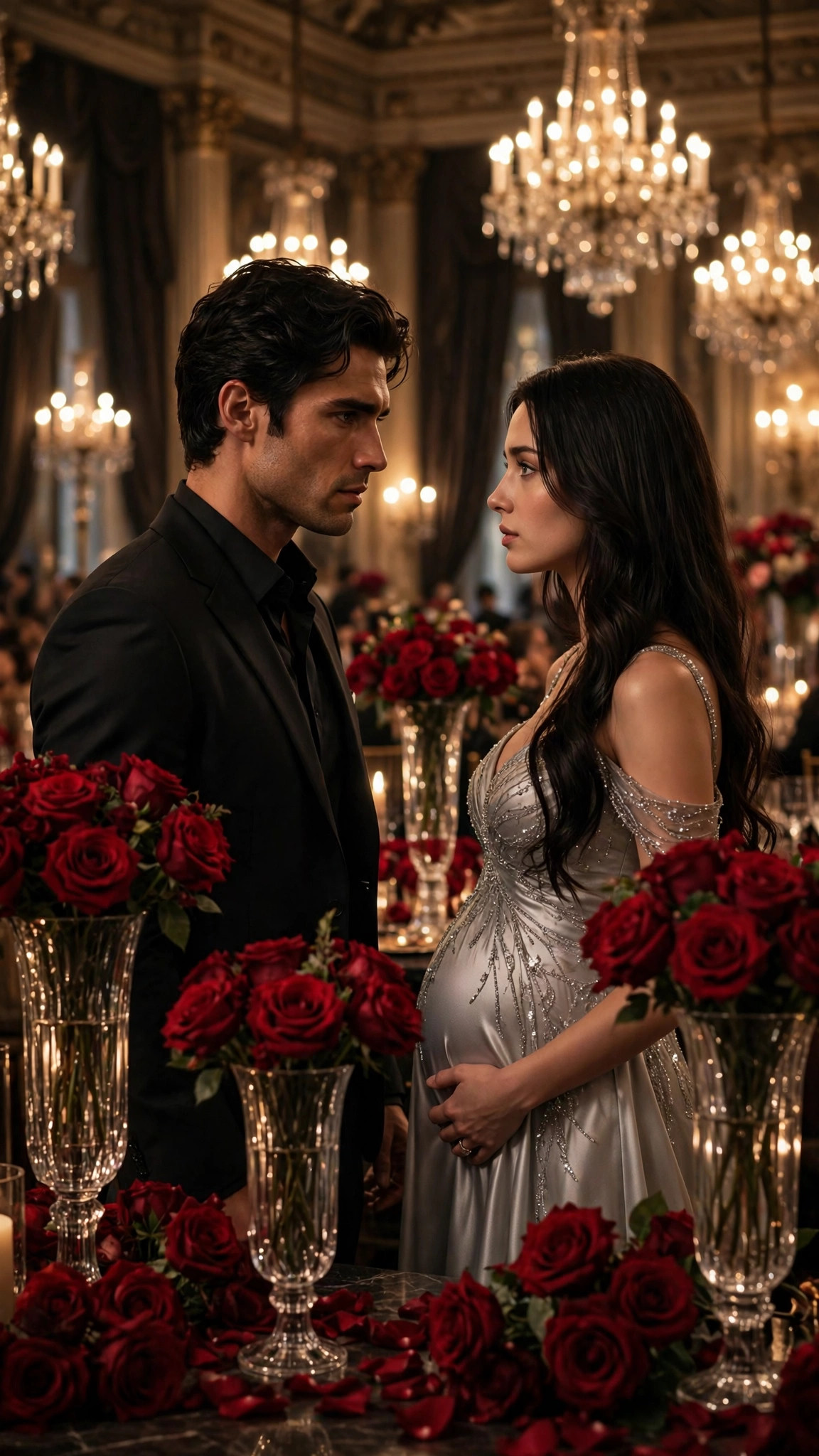
Vincent Moretti had buried his wife three years ago, and he still set a place for her at every table he sat down to, in his head, where no one could see it and no one could take it away from him.
It was a charity gala at the Drake, the kind of room where Chicago pretended it had no blood on its hands. Crystal chandeliers threw warm light across white tablecloths. A string quartet played something soft near the bar. Men in black tie talked about hospital wings and tax deductions, and women in gowns that cost more than most people's cars drifted between the tables like slow, bright fish. Vincent stood near the stage with a glass of water in his hand — he never drank at these things anymore — and spoke to a local reporter about the small remodeling company his firm had sponsored for a family in Chicago, because that was the kind of sentence that sounded good in a newspaper and kept the other kind of sentences out of it.
He was halfway through explaining the foundation's new scholarship when the scent reached him.
Roses. Red roses, heavy and sweet, cut through the perfume and the champagne and the cigar smoke drifting in from the terrace. For three years, the smell of red roses had been the smell of the cemetery on Sundays, of the cold marble under his palm, of the name carved into stone that he had paid for with money that could buy anything except the one thing he wanted. His voice stopped in the middle of a word. The reporter frowned and leaned closer, asking if he was all right, and Vincent did not answer her, because across the crowded room, past the tables and the waiters and the glittering people who did not matter, a woman in a silver gown had just turned her head, and the whole world narrowed to the shape of her face.
She had long dark hair, the way Anna's had been, falling past her shoulders in a dark wave. She had Anna's thoughtful gray eyes. She had Anna's face — the same face he had kissed goodbye on the morning of the last flight, the same face he had searched for in the wreckage and the hospital lists and the morgue photographs until his men had gently taken the papers out of his hands and told him to stop.
For one terrible, hopeful second, Vincent thought grief had finally broken his mind and conjured a perfect illusion out of flowers and lamplight.
Then the woman's hand moved, and he saw it rest lightly on her pregnant belly, and his heart, which he had believed was a dead thing kept beating only by habit, slammed so hard against his ribs that he was sure the reporter could hear it.
Anna Bennett Moretti was alive.
She was standing twenty feet away from him in a silver evening gown, very much alive, very much pregnant, and very much looking at him with an expression he could not read. His glass slipped in his hand. He caught it before it fell, water sloshing over his fingers, and he set it down on the nearest table without looking, the way a man sets down something he has already forgotten.
"Vincent," the woman said. Her voice carried clearly through the room, soft and steady, and it was Anna's voice, the voice that had said his name ten thousand times in their kitchen and their bed and their car, and it cut him open in a way no knife ever had. "I'm waiting for someone."
He moved before he knew he was moving, crossing the floor between the tables, past startled guests who stepped aside, past the reporter calling his name, past everything. "Anna?" he whispered when he reached her, and the word came out broken, a ruin of a word. "Anna?"
She turned slowly, and he saw it then, in the hollow of her throat, between two delicate sentences that she had not spoken yet: a thin scar across the middle of her neck, pale against her skin, barely visible under the light. A scar he had never seen before. A scar that had not existed on the morning she left him.
"We need to talk," he said.
"No," she replied, and her voice was calm in a way that frightened him more than shouting would have. "I'm not going to help you."
His eyes shifted to the man in the chair next to her. The man was looking back at him, his eyes wide with shock, a hand resting on the table near Anna's elbow, protective and familiar and wrong. Vincent had never seen him before in his life, and he hated him instantly, the way a drowning man hates the shore for being so far away.
"Where have you been?" Vincent asked. He could hear his own voice shaking, and he did not care who heard it. "Anna, where have you been?"
"Around," Anna said. She lifted her chin, and for a moment he saw the girl she had been at twenty-two, stubborn and unafraid, standing in his office doorway with a folder in her hand and no fear in her eyes. "Maybe I should think about moving on."
"You can't talk about this here, Vincent. This isn't the time or place." The man beside her stood up then, and Vincent saw that he was tall and well-dressed, with kind brown eyes and graying temples, the kind of man who had never once in his life had to choose which woman to save from a burning plane.
"Where is my child?" Vincent asked, and the question tore out of him before he could stop it, because there was a child, there had always been a child, a baby who had moved beneath Anna's hand on the morning of the flight, a baby he had buried in a tiny white coffin beside his wife's empty grave. "Anna, where is my child?"
"What makes you think this is your child?" Anna said, and her hand moved again, resting on her belly, and she looked at her unborn child with a tenderness that made Vincent feel like an intruder in his own life, trying to memorize him, as if the baby might disappear if she looked away.
The man beside her shifted and glanced at her, and she turned away from Vincent, closing the distance between them, and then — God help him — she put her hand in the man's hand, and they began to dance, right there on the edge of the ballroom floor, while the quartet played something slow and the whole room watched the most feared man in Chicago stand frozen with his hands empty at his sides.
Anna was about to tell him everything. He could see it in her face, the words crowding behind her eyes, and then one sentence disappeared from her mind, and she turned to the man she was dancing with and asked, "What's wrong with you?"
And at that same moment, it was revealed that the man sitting beside her was her own husband.
Vincent stopped breathing.
Her husband. Anna had a husband. Anna, his wife, the woman he had buried and grieved and dreamed about every night for three years, had a husband who was not him, and a child in her belly who was not his, and a life that had gone on without him while he laid roses on an empty grave every Sunday and told himself that love meant never letting go.
The music ended. The dancers drifted apart. Anna's husband — her husband — put a hand at the small of her back and guided her toward the terrace doors, and Anna looked back over her shoulder once, just once, and her gray eyes met Vincent's across the room, and in that look there was everything: the fire, the smoke, the choice he had made, and the price of it, written plainly on her face.
Then she was gone, and the roses were still blooming on every table, red and heavy and sweet, and Vincent stood alone in the middle of the ballroom with the whole of Chicago watching him, and he understood, with a clarity that felt like a second explosion, that the last three years of his life had been built on a lie, and that the woman he had buried had been alive all along, and that the only thing standing between him and the truth was the question he had been too afraid to ask.
Where had she been? And why had she let him believe she was dead?
He did not know the answers yet. But he knew one thing with absolute certainty, the way he had known it on the runway three years ago when the smoke began to fill the cabin: he was not going to lose her a second time. Not to another man. Not to her silence. Not to anything in this world or the next.
He set down his glass, straightened his jacket, and followed her out onto the terrace, into the cold Chicago night, where the roses from the ballroom could not follow, and where the truth, at last, would have nowhere left to hide.
Three years earlier, on the morning of the last flight, Anna Bennett Moretti had woken up in their Lake Shore Drive penthouse with her hand on her stomach and a secret folded into her palm like a prayer.
She was seven months pregnant, and the baby had been moving all night, small fists and feet pressing against her ribs, reminding her that there were two heartbeats in her body now and that both of them belonged to the man sleeping beside her. She had the ultrasound photograph in her purse — the small gray image where the baby's profile showed clearly, a nose, a chin, a hand curled near its face — and she had planned to surprise Vincent with it after his board meeting failed, or succeeded, whichever it was. He had been distant for weeks, buried in work, in the family business, in the endless negotiations that came with being Vincent Moretti, and she had decided that morning that she would not wait for the perfect moment anymore. The perfect moment was now. It was always now.
She left the terminal three hours earlier than she needed to, hoping to surprise him. She knew his schedule the way wives know their husbands' schedules: the board meeting at nine, the car at eleven, the private jet to Miami at noon for a charity event he had not wanted to attend. She had the driver take her to the private airfield instead of the office, and she waited in the lounge with her hand on her stomach, watching the tarmac through the glass, rehearsing the words in her head. Look, Vincent. Look at our baby. Look at what we made.
She did not know that Sophia Carter was already there.
Sophia was sitting in the front seat of the lounge, blonde and beautiful and composed, speaking in a low voice to someone on her phone, and Anna's heart sank when she saw her, because she knew that name the way wives know the names that came before them. Sophia Carter. Vincent's first love. The woman he had once planned to marry, before she disappeared from Chicago years earlier, before Anna, before the baby, before everything. And now she was here, on the day of Vincent's flight to Miami, holding a boarding pass for his jet, and Vincent had not told Anna any of it. He had not told her what was happening. He had not told her that his first love was flying with him to Miami while his pregnant wife waited at home with an ultrasound in her purse.
Anna stood in the doorway of the lounge with her broken shoe catching on the carpet, and she waited for Vincent to notice her. She waited for her husband to see her standing there, seven months pregnant, holding their baby's photograph, and to explain. She waited for him to choose, the way she had always believed he would choose her, because Vincent Moretti was one of the most powerful men in Chicago, feared and wealthy and accustomed to controlling every crisis around him, and despite everything surrounding his dangerous world, Anna had never doubted one thing: when it truly mattered, her husband would choose her.
She believed that with the same certainty she felt standing at the top of the private jet stairs, her hand on her stomach while their baby moved beneath it, while the engines warmed up and the flight attendant smiled and told her to take any seat she liked, and she chose the seat near the rear, by the window, where she could watch the city fall away beneath them.
Then she heard something. Her heart pounded in her chest. A loud explosion ripped through the front of the plane, sending the entire aircraft shaking, and panic erupted instantly, and the flight attendants and the other passengers froze, their faces turning white, and Anna clutched the overhead handle as her broken shoe caught on the carpet and she knew, with a terrible clarity, that she was in trouble.
Smoke filled the cabin. Someone was screaming. Sophia moved first, rising from her seat with her hand pressed to her mouth, her voice sharp with terror. "The cargo hold is on fire. There's no time."
"Anna, hold on," Vincent said from the doorway, and his voice was the voice she loved, low and steady, the voice that had promised her a hundred times that he would always come back for her. She forced her arm out of the aisle and pointed toward the rear door, the nearest exit, the way out, and before he could say anything else, Sophia grabbed his arm.
She held on to him tightly, her eyes filling with tears. "Take me first," she pleaded. "I'm scared."
Vincent hesitated for only a second. Anna watched his eyes move from Sophia's face to hers, then back again. She saw the calculation happen behind his eyes, the terrible arithmetic of a man who loved two women and could only carry one, and in that second she understood that everything she had believed about her husband was about to be tested in the most brutal way a belief can be tested: by fire.
He chose.
Anna watched his arm wrap around Sophia and guide her toward the nearest doorway, away from the smoke, away from the fire, away from her. "Vincent!" Anna screamed. "Don't leave me!" He did not turn back. He did not look at her. He carried Sophia Carter out of the burning plane and into the sunlight, and Anna was left alone in the smoke with her hand on her stomach and her baby moving beneath it, and the last thing she thought, before the world went white and then black, was that she had been wrong about everything, and that the man she loved had chosen, and that his choice had a name, and that name was not hers.