The explosion came from the front of the plane, from the cargo hold, and it was not the kind of explosion Anna had imagined when she thought about dying. There was no slow-motion silence, no moment of peace. There was noise and heat and the smell of burning fuel, and then the floor tilted under her feet, and the rear door of the aircraft — the door she had pointed toward with her last clear thought — blew outward on its hinges, and the sky came in.
Anna did not remember being thrown. She remembered the feeling of flying, of the world turning over, of her body weightless for one impossible second, and then the ground hit her like a wall, and everything went dark.
She woke to pain and to a voice she did not know, saying her name, except it was not her name. The voice was calling her "ma'am," and then "miss," and then it was calling for a stretcher, and for blood, and for someone to cut her out of the twisted metal of the rear stairway where she had landed, twenty feet from the burning fuselage, her dress torn, her hair matted with blood, her left hand still pressed flat against her stomach, holding on.
"Hold on," a paramedic said, and his face was young and frightened, and his hands were gentle as he lifted her. "Hold on, ma'am. You're going to be all right. Just hold on."
She tried to speak. She tried to ask about Vincent, about Sophia, about the baby, but her throat was full of smoke and her tongue would not obey her, and the last thing she saw before the darkness took her again was the black smoke rising over the airfield, and the private jet burning on the runway like a funeral pyre, and the small white shape of a wedding ring glinting on her finger, unburned, untouched, shining in the firelight.
She woke again in a hospital, days later, or weeks later — time had lost its shape — and the first thing she knew was that her throat hurt, and the second thing she knew was that her stomach was flat, and the third thing she knew, when she put her hand where the baby had been, was that the flatness was wrong, and that something had been taken from her, and that she had to find out what it was.
A nurse was there, a kind woman with gray hair and tired eyes, and she held Anna's hand and told her, slowly and carefully, the way you tell a person something that will change the shape of their life, that the baby had been born. That the doctors, when Anna was brought in unconscious and bleeding, had performed an emergency cesarean, and that her son had survived. A boy. Three pounds, eleven ounces. Breathing on his own, after the first terrible night. He was in the neonatal unit, two floors down, in an incubator, with a tiny knitted hat on his head and a name tag that said "Baby Boy Bennett" — because that was the name on the identification they had found in her purse, and no one at the hospital knew that she was Anna Moretti, the wife of Vincent Moretti, because her purse had burned, and her phone had burned, and her wedding ring had been cut off her swollen finger in the ambulance and placed in a small plastic bag with her other belongings, and nobody had connected the Jane Doe in the burn unit to the woman on the passenger manifest of the jet that had exploded on the runway at Midway.
"Your son is alive," the nurse said, and Anna wept, because she had believed the baby was gone, and because the baby was not gone, and because her husband had left her in a burning plane and she did not know whether to thank God or to curse him.
The first time they brought Matteo to her, Anna was still too weak to sit up, and the nurse placed the tiny bundle in the crook of her arm, and Anna looked down at her son — at his dark curls, damp with sweat, at his gray eyes, unfocused and new, at his small fist curled against his cheek — and she wept, because he was so small, and so alive, and so entirely hers, and because she had nearly lost him before she had ever held him. She counted his fingers, one by one, ten perfect fingers, and his toes, ten perfect toes, and she whispered his name, the name she had chosen months ago, in the quiet of the penthouse, when she had still believed that the future was a simple and happy thing. "Matteo," she whispered. "Matteo, I'm your mama. I'm here. I'm here, baby. I'm not going anywhere." And the baby, as if he understood, opened his gray eyes and looked at her, and his small fist closed around her finger, and held on, tight and certain, the way a child holds on to the only sure thing in the world.
She stayed in the hospital for six weeks. Her throat healed slowly — the smoke had burned her vocal cords, and a thin scar formed across the middle of her neck, pale and permanent, where the surgeons had cut to help her breathe. Her burns healed. Her ribs healed. Her body, which had been broken in a dozen places, put itself back together with the stubborn patience of a woman who had a son waiting two floors below her.
And while she healed, she learned what the world believed about her.
A reporter came to the hospital once, looking for a story about the crash, and the nurse — who had become her friend by then, who brought her tea and sat with her in the long afternoons — told her what the newspapers had said. The jet had exploded on the runway. Four people had been aboard. The pilot and the flight attendant had died instantly. A badly burned female body had been recovered from the wreckage and identified, through a ring and a purse, as Anna Bennett Moretti. Vincent Moretti had held a funeral. He had buried his wife and his unborn child in the family plot at Rosehill Cemetery, under a single stone, and the whole of Chicago had wept for him, and the newspapers had called him a broken man, and no one — no one at all — knew that the woman in the burn unit at County General, the Jane Doe with the scar on her throat and the baby in the neonatal unit, was the same woman they had buried.
Anna listened to all of it in silence, and then she asked the nurse to bring her a mirror, and she looked at her own face for a long time, at the scar, at the eyes that had cried themselves empty, at the mouth that had screamed her husband's name in a burning plane while he carried another woman away, and she made a decision that would shape the next three years of her life.
She would not go back.
Not yet. Not until she understood what had happened on that plane, and not until she was strong enough to stand in front of Vincent Moretti and make him look at what his choice had cost. She had a son now, a living son, a boy with dark curls and gray eyes like hers, and she would not bring him back into the world that had nearly killed them both until she knew that world was safe. And she would not go back to a husband who had chosen another woman over his pregnant wife, not while the memory of his back turning was still burned into her mind as clearly as the scar on her throat.
Her older sister Grace found her three weeks later. Grace Bennett was a schoolteacher in New York, practical and fierce and the only person in the world Anna trusted with her whole heart, and when the hospital finally matched the Jane Doe to a missing-person report Grace had filed, Grace flew to Chicago the same day, and she walked into the burn unit, and she looked at her sister, and she did not cry. She sat down, she took Anna's hand, and she said, "Tell me everything."
Anna told her. She told her about the flight, about Sophia, about the choice, about the fire, about the baby, about the funeral. Grace listened without interrupting, and when Anna finished, Grace said, "Then we leave. Tonight. You and the baby. I'll take you to New York, and we'll start over, and Vincent Moretti will never know you survived until you decide he deserves to know."
"But the fire," Anna said. "Someone should know what happened. The cargo hold —"
"The police will investigate," Grace said. "You don't owe them your life, Anna. You don't owe him your life. You owe your son a mother who is alive and whole, and you owe yourself a life that is yours. When you are ready — if you are ever ready — you can go back. But not now. Not like this."
So Anna left Chicago in the dark, in Grace's car, with her son wrapped in a blue blanket in the back seat, and she did not look back at the city as it fell away behind them, because looking back would have broken her, and she had already been broken enough.
In Chicago, Vincent Moretti buried his wife on a gray October morning, and the rain fell on the cemetery, and the roses he laid on the stone were red, because Anna had loved red roses, because she had planted a rose garden at their estate the first spring they were married, because she had said once, laughing, that roses were the only flowers that remembered anything, that they remembered the hands that planted them and the summers they bloomed in, and Vincent had laughed with her then, and he did not laugh now.
He stood at the grave for a long time after everyone else had gone, and he stared at the name carved into the stone — ANNA BENNETT MORETTI, BELOVED WIFE, BELOVED MOTHER — and he thought about the choice he had made on the plane, and he thought about the second of hesitation, and he thought about the way her voice had sounded when she screamed his name, and he understood, with a clarity that would never leave him, that he had made the worst choice of his life in the space of a single second, and that no amount of money, no amount of power, no amount of grief would ever undo it.
He went home that night and sat in the dark in his study, and he drank until the room went soft at the edges, and he dreamed about the plane, and about Anna, and about the baby, and he woke up screaming her name, and his housekeeper found him on the floor in the morning, and she helped him to bed without a word, because there were no words for what had happened, and there never would be.
In the weeks that followed, Vincent did what powerful men do when they cannot fix what they have broken: he worked. He worked eighteen hours a day. He took over the family business completely, he crushed his rivals, he made the Moretti name more feared than it had ever been, and at night he went home to an empty house and sat in the rose garden Anna had planted, and he talked to her, quietly, the way a man talks to a ghost, telling her about his day, about the business, about the city, about the things he wished he had said to her when she was alive and he had been too busy to say them.
And every Sunday, without fail, he drove to Rosehill Cemetery with a bouquet of red roses, and he laid them on her stone, and he stood there in the cold, and he said, "I'm sorry, Anna. I'm sorry. I was coming back for you. I swear to God, I was coming back for you."
He believed it. He had to believe it. Because the alternative — that he had chosen Sophia, that he had left his pregnant wife to die, that he had buried her and their baby and then gone on living — was a truth he could not survive.
He did not know that the grave was empty. He did not know that the body they had buried belonged to a flight attendant named Maria Santos, a twenty-six-year-old woman whose family had been paid quietly and generously by the airline, and whose name had never appeared in the newspapers, because Vincent Moretti's grief was a better story than a stranger's death. He did not know that his wife was alive in a hospital bed, healing, holding her son, making a decision that would keep her away from him for three years.
He knew only that she was gone, and that the roses remembered her, and that he would carry the weight of his choice for the rest of his life, the way a man carries a stone in his chest, heavy and cold and impossible to set down.
And in New York, in a small apartment above a flower shop in Brooklyn, Anna Bennett held her son in her arms and whispered his name for the first time — Matteo, she called him, Matteo Bennett — and she promised him, in the quiet dark, that she would keep him safe, that she would build a life for him that was warm and ordinary and far away from burning planes and men who chose other women, and that one day, when he was old enough to understand, she would tell him the truth about his father, and about the choice his father had made, and about the fire that had tried to take them both and failed.
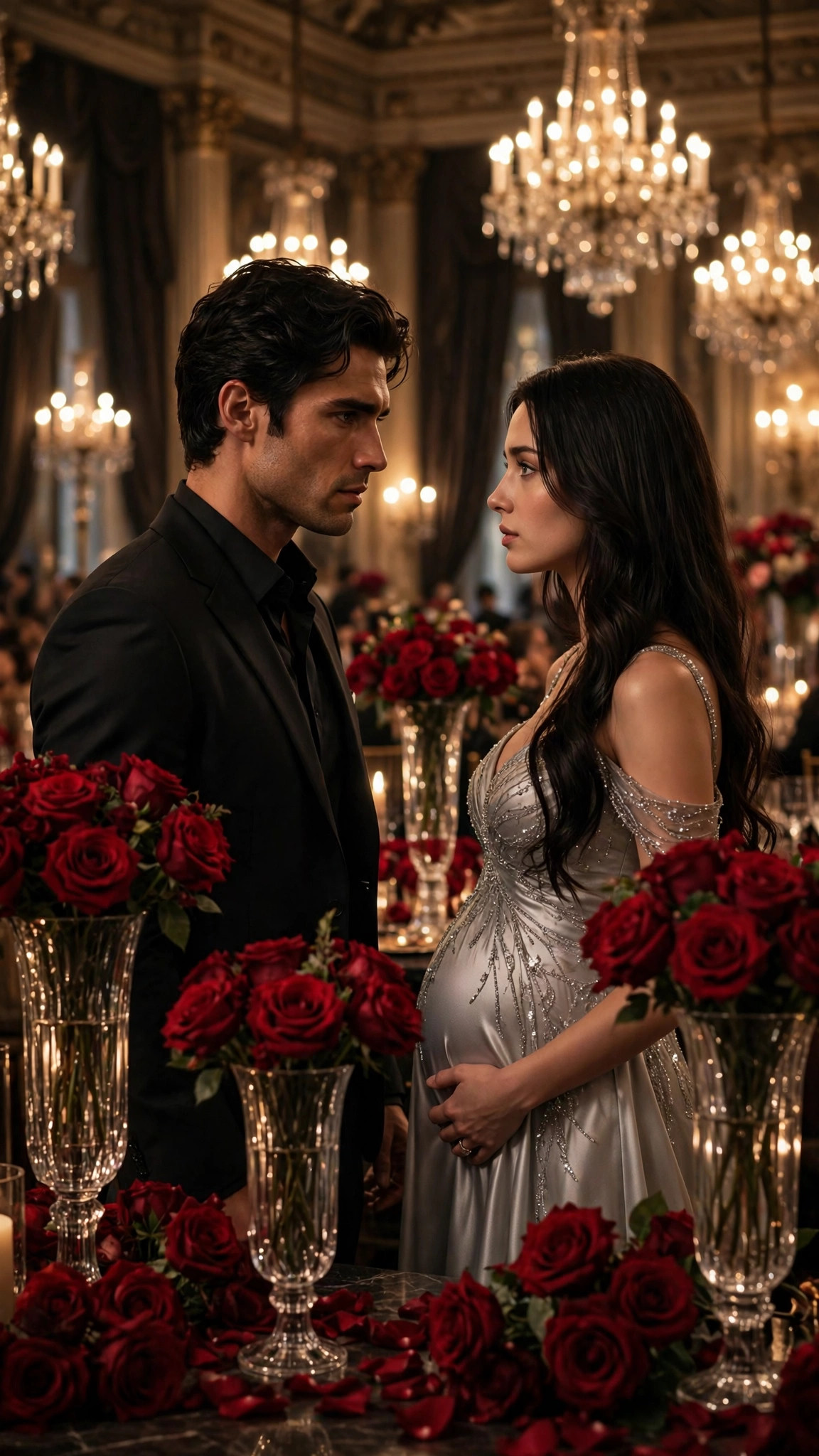
She did not know then that the fire had not been an accident. She did not know that someone had wanted that plane to burn. She did not know that the roses she would one day arrange at a charity gala in Chicago would remember the blood that had been spilled on a runway three years earlier, and that they would bring her face to face with the man she had buried in her heart, and that the truth, when it finally came, would be more terrible and more hopeful than anything she had imagined.
She knew only that she was alive, and that her son was alive, and that the scar on her throat was the price of both those things, and that she would wear it the way other women wore jewelry: quietly, and without apology, and without ever letting anyone forget what it cost her to survive.