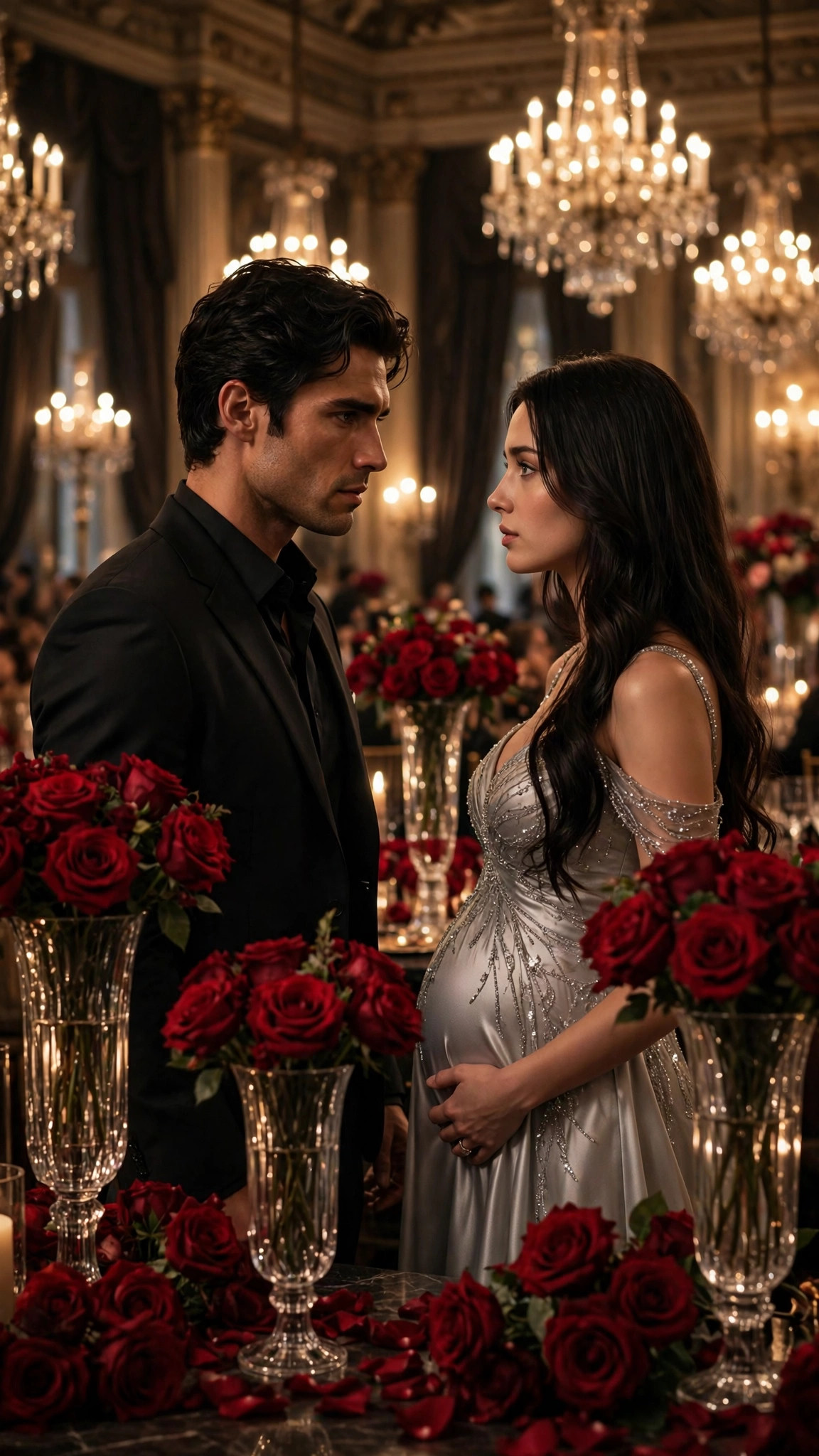
The terrace was cold, and the city glittered below them, and Vincent stood in the doorway with his hands at his sides, watching the woman he had buried dance with a stranger, and he felt the way he had felt on the runway three years ago: like a man watching his life burn and being unable to move.
Anna finished the dance, and she turned, and she saw him standing there, and for a moment neither of them moved. The quartet played on behind them. The ballroom hummed with voices. And then Anna said something to the man beside her — her husband, the word still ringing in Vincent's ears like a bell — and the man nodded, and he stepped back inside, and Anna walked toward Vincent across the terrace, slowly, her silver gown catching the light from the ballroom doors, her hand resting lightly on her belly, and she stopped three feet away from him, and she looked at him, and she said, "You followed me."
"I followed you," Vincent said, and his voice sounded like a stranger's voice, rough and broken. "Anna. My God. Anna."
"Don't," she said, and her voice was steady, but her hands were shaking, and he could see it, and he wanted to take those hands in his and hold them still, the way he had a thousand times before, and he did not dare. "Don't say my name like that. You don't get to say my name like that. Not after what you did."
"I thought you were dead," Vincent said. "Anna, I buried you. I stood at your grave. I laid roses on your stone every Sunday for three years. I thought you were dead, and you were alive, and you let me believe — "
"I let you believe it because you earned it," Anna said, and now her voice was shaking too, and the calm was cracking, and underneath it was the fury she had carried for three years, the fury that had kept her alive in the hospital and in the car to New York and in the long nights above the flower shop. "You chose her, Vincent. You chose Sophia. You stood in a burning plane with your pregnant wife screaming your name, and you chose your first love, and you carried her out, and you left me there. You left me. And then you buried me, and you grieved so beautifully, and everyone in Chicago wept for you, and do you know what I was doing while you were grieving so beautifully? I was in a hospital bed with a scar on my throat and a baby in a neonatal unit two floors below me, learning how to breathe again. I was learning how to be alive. And I decided — I decided — that the man who made that choice did not deserve to know I had survived it."
Vincent stared at her, and the words hit him the way the explosion had hit the plane, and he understood, with a terrible clarity, that everything he had believed about himself for three years — that he was a grieving widower, that he was a broken man, that he was the victim of a tragedy — was a lie he had told himself to survive the truth. The truth was simpler and uglier: he had chosen. And his choice had a name. And the name was not hers.
"The baby," he said, and his voice broke. "Anna, the baby. Our baby. You said — at the gala, you said — "
"Our son is alive," Anna said, and the words fell between them like stones into still water. "His name is Matteo. He is three years old. He has my eyes and your dark hair, and he laughs like you used to laugh, before — before everything. He was born by emergency surgery while I was in a coma, and I woke up to a flat stomach and a scar and a nurse telling me my son was alive, and I have raised him for three years, Vincent, three years, in Brooklyn, above a flower shop, and you have never once held him, because you were too busy grieving for a wife who was not dead."
Vincent put a hand against the terrace wall to steady himself, because the world was tilting, and he thought he might fall, and he had not fallen in three years, not once, not through the funeral or the empty house or the endless nights, but now, hearing that he had a son — a living son, three years old, with his dark hair — he felt his knees go weak, and he understood that grief had been, in its terrible way, easier than this. Grief had been a closed door. This was a door thrown open, and behind it was everything he had lost, alive and breathing and furious with him.
"Where is he?" Vincent whispered. "Anna, where is my son?"
"He's in New York," Anna said. "With my sister. He doesn't know about you. He doesn't know about the plane, or the fire, or any of it. He thinks his father is far away. And Daniel — Daniel is the man who has been there. Daniel is the man who taught him to ride a bicycle. Daniel is the man who reads to him at night. Daniel is his father in every way that counts, Vincent, and you are a stranger. A stranger who shares his blood."
"Daniel," Vincent said, and the name tasted like ash. "Your husband."
"My husband," Anna said, and she lifted her chin, and there was pride in her voice, and defiance, and something else — something that looked almost like sorrow. "He married me knowing everything. He knew about you. He knew about the crash. He knew about Matteo. He married me anyway, because he loved me, and because he loved Matteo, and because he is a good man, Vincent, a good man in a way that — " She stopped. She looked away, toward the city lights, and when she spoke again, her voice was quieter. "In a way that I needed. After what happened, I needed a good man. And Daniel is one."
Vincent stood in the cold, and he listened, and he felt the last three years rearrange themselves in his mind, and he saw, for the first time, the shape of the life Anna had built without him: the flower shop, the apartment, the sister, the kind husband, the son with dark curls, the new baby on the way. A whole life. A real life. A life that had gone on while he laid roses on an empty grave and told himself that love meant never letting go.
"I was coming back for you," he said, and the words came out hoarse, desperate, the words he had said to himself a thousand times in the rose garden, the words he had said to her gravestone every Sunday. "Anna, I swear to you, I was coming back. Sophia grabbed my arm, and I — I hesitated for one second, and then the smoke — and then the door blew out, and I thought — I thought you were right behind me. I thought you were coming out the rear door. I didn't know. I didn't know you were still inside."
"I know," Anna said, and her voice was soft now, and tired, and that was worse than her anger, because her anger had been something he could fight, and her tiredness was something he could only witness. "I know you think that. I know you've told yourself that for three years. But Vincent — you hesitated. You looked at her, and then you looked at me, and then you looked at her again, and you chose. And the baby I was carrying — the baby you say you were coming back for — I was standing there, seven months pregnant, screaming your name, and you did not turn back. You did not turn back, Vincent. That is the truth. And I have lived with that truth for three years, and I have built a life on it, and I am not going to let you walk back into it now and ask me to pretend it didn't happen."
"I don't want you to pretend," Vincent said. "I want you to let me meet my son. Anna, please. I have a son. I have a three-year-old son, and I have never held him, and I have never heard his voice, and I have never once been his father. Let me meet him. That's all I'm asking. Let me meet Matteo."
Anna looked at him for a long time, and in her gray eyes he saw the war she was fighting: the wife she had been, and the woman she had become, and the mother who would protect her son from anything, including his own father. And then, slowly, she nodded.
"Tomorrow," she said. "Nine o'clock. The hotel lobby. Daniel and I are staying at the Drake. You can come, and you can meet him — Grace is bringing him on the morning flight, because I called her from the ballroom, because — because he should know. He should know his father is alive. Even if his father is a stranger. He should know."
"Thank you," Vincent said, and his voice broke on the words. "Anna, thank you."
"Don't thank me," she said. "I'm not doing it for you. I'm doing it for him." She turned toward the ballroom doors, and then she stopped, and she looked back at him, and her hand moved to her belly, to the small swell beneath the silver gown, and she said, "And Vincent — the baby I'm carrying now. He's Daniel's. Not yours. I need you to understand that. What makes you think this is your child? Nothing about this baby is yours. He's Daniel's son. And Matteo is your son. And those are two different things, and you need to know the difference."
She walked back into the ballroom, into the light and the music and the roses, and Vincent stood alone on the terrace, in the cold, with the city glittering below him, and he thought about the son he had never met, and the baby who was not his, and the wife who had a husband who was not him, and he understood that the truth was more complicated than grief, and more painful, and more hopeful, all at the same time.
He went back to his penthouse that night, and he did not sleep, and at dawn he drove to the cemetery, and he stood at the empty grave, and he looked at the stone with Anna's name on it, and he said, out loud, to the cold morning air, "She's alive. Anna's alive. And I have a son."
And then he went to the Drake Hotel, at nine o'clock in the morning, in his best suit, with his hands shaking, and he walked into the lobby, and he saw Grace Bennett sitting on a sofa with a small boy on her lap, a boy with dark curls and gray eyes, holding a plastic watering can, and Anna standing beside them, and Daniel standing beside her, and the boy looked up, and he looked at Vincent, and he said, in a clear, fearless little voice, "Are you my papa?"
Vincent knelt down on the hotel carpet, in front of his son, in front of the whole lobby, and he said, "Yes. Yes, Matteo. I'm your papa. I'm so sorry it took me so long to find you."
And Matteo, who was three years old and had never met his father, looked at him for a long moment, and then he held out his plastic watering can, and he said, "You can help me water the roses. Mama says roses need water every day, or they forget."
Vincent took the watering can with hands that shook, and he looked up at Anna, and she was crying, silently, without making a sound, and Daniel was standing beside her with his hand on her shoulder, and Grace was smiling through her own tears, and Vincent understood, in that moment, that he had been given something he did not deserve and could never repay: a second chance. Not a clean one. Not an easy one. But a chance.
They had breakfast together the next morning, the five of them, in the hotel's sunlit dining room, and it was the strangest and most ordinary morning of Vincent's life. Matteo sat in a high chair that was too small for him, kicking his legs, eating pancakes with his hands, syrup on his chin and his cheeks, talking nonstop about his watering can and the roses at home and the airplane he had flown on with Auntie Gray, and Vincent sat across from him and listened to every word as if it were scripture, and he answered every question — yes, the roses need water every day; yes, airplanes fly very high; yes, Papa would help him water the roses, every single day, forever — and Anna watched them from across the table, her hands wrapped around a cup of tea, and Daniel watched Anna watching them, and Grace watched all of them, and nobody said what everyone was thinking: that this was what a family looked like, and that it had taken three years and a burning plane and a miracle to bring it to this table.
After breakfast, Matteo took Vincent by the hand and led him to the hotel's small garden, where a few rose bushes grew against the brick wall, and he showed his father, very seriously, how to water roses properly — not too much, not too little, right at the roots, never on the leaves — and Vincent knelt in the dirt in his suit, and he listened, and he nodded, and he did exactly what his three-year-old son told him to do, because for the first time in his life, Vincent Moretti was not the most powerful man in the room. He was a student. And his teacher was three years old, and covered in syrup, and perfect.
"You're doing it wrong, Papa," Matteo said, giggling, and he put his small hands over Vincent's big ones, guiding the watering can, and Vincent looked up at Anna, who was standing in the garden doorway with tears in her eyes and a smile on her face, and he understood, in that moment, that he would spend the rest of his life learning from this boy, and that there was no better education in the world.
And as he knelt in the garden dirt with his son's small hands guiding his, Vincent swore to himself that he would not waste this second chance. Not this time. Not ever again.