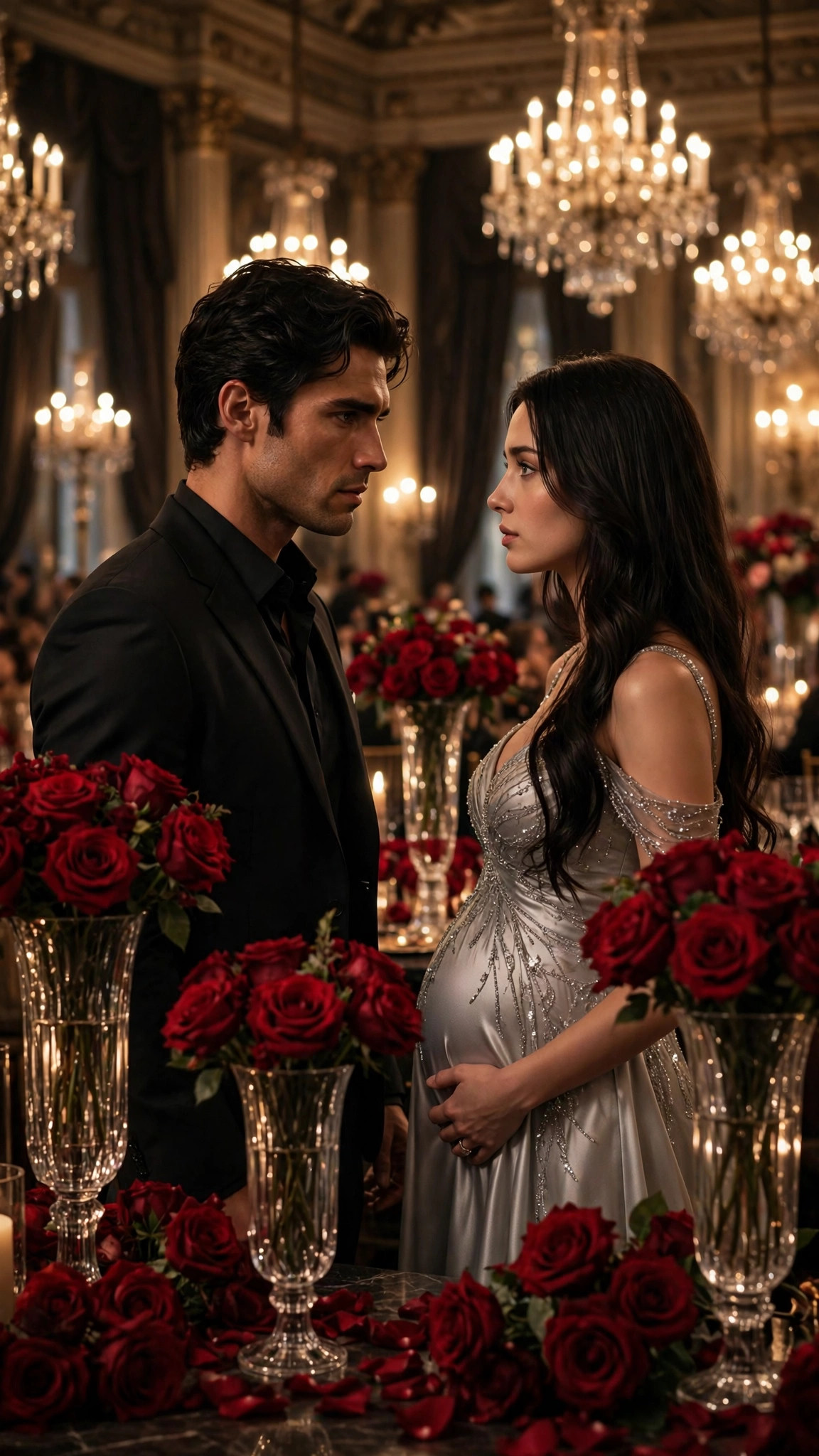
For three years, Vincent Moretti laid red roses on an empty grave.
Every Sunday morning, without fail, he drove to Rosehill Cemetery before the city woke up, and he walked through the iron gates with a bouquet wrapped in brown paper, and he knelt in the grass beside the stone that bore his wife's name, and he laid the roses down gently, the way a man lays down something fragile, and he stayed there until the cold seeped through his coat and into his bones, and then he went home and began another week of being the most feared man in Chicago.
He had not remarried. He had not so much as looked at another woman, not in any way that mattered, because the memory of Anna's voice calling his name in the burning plane was louder than any living voice, and because Sophia Carter — the woman he had carried out of the fire — had left Chicago within two months of the crash, quietly and without a forwarding address, and he had not tried to find her. He had nothing to say to her. She had been the reason his wife died, or so he believed, and the guilt of that belief sat on his chest like a second stone beside the first one.
He threw himself into the family business with a coldness that frightened even his own men. He took the Moretti organization — the shipping, the import company, the restaurants, the real estate — and he made it larger and harder and more disciplined than it had ever been under his father, and he did it without joy, without triumph, without any of the pleasure he had once taken in winning. Winning meant nothing now. Money meant nothing. Power meant nothing. The only thing that meant anything was the rose garden at the estate, the one Anna had planted the first spring they were married, and he tended it himself, on his knees in the dirt, pruning and watering and weeding, because it was the last living thing she had touched, and because the roses, in their stubborn red blooming, were the only part of her that had not left him.
"She would have liked how they came in this year," his housekeeper, Rosa, said to him once, standing at the garden gate with a basket of cut stems, and Vincent nodded, because Rosa had known Anna, and Rosa understood, and there was nothing else to say.
His mother called him every week and begged him to live again, to eat properly, to see a doctor about the weight he had lost, to consider the future, and he listened politely and changed the subject, because the future was a country he had no interest in visiting. His future had died on a runway at Midway, and the man who walked around in his body now was only keeping the seat warm.
At night, he dreamed about the plane. Always the plane. The smoke, the heat, Sophia's hand on his arm, Anna's voice screaming his name, and then the terrible moment of the choice, replayed over and over, the way a film loops in a dark theater, and every time he dreamed it, he tried to turn back. Every time, in the dream, he turned back. Every time, he woke up before he reached her, with her name on his lips and his sheets soaked with sweat, and the empty side of the bed cold beside him.
He did not know that three hundred miles away, in Brooklyn, New York, his wife was dreaming about the plane too, and that in her dreams she was the one who turned away.
Anna Bennett woke most mornings before dawn, because Matteo woke most mornings before dawn, and the small apartment above the flower shop was cold in the winter and hot in the summer, and the radiators clanged, and the traffic on the street below never really stopped, and it was the most ordinary life she had ever lived, and she loved it with a fierceness that surprised her.
The flower shop was called Bloom & Bennett, and it was hers — hers in a way nothing had ever been hers before, not the penthouse on Lake Shore Drive, not the estate with its rose garden, not the life she had lived as Vincent Moretti's wife, where everything had been beautiful and expensive and, she understood now, borrowed. The shop was small and bright, with a bell over the door and buckets of flowers on the sidewalk in the good weather, and Anna worked there six days a week, her hands in the stems and the water, building bouquets and centerpieces and wedding arrangements, and the work was honest and tiring and hers, and at the end of the day she went upstairs to the apartment, and she cooked dinner, and she read to Matteo, and she fell asleep with her son's small warm body curled against her side, and she thought: this is enough. This is a life. This is mine.
Grace had helped her start the shop, lending her the money for the first year's rent, and Grace had been right about everything, as older sisters usually are: that Anna needed work, that she needed a reason to get up in the morning, that she needed something that was hers and no one else's. The shop gave her all of that, and it gave her something else too: the roses. She worked with red roses every day, the same roses she had planted at the estate, the same roses Vincent laid on her grave every Sunday — though she did not know that, and would not know it for three years — and the scent of them, which she had once associated with love and with home, slowly became associated with something else: with survival. With the simple fact that she was still here, still breathing, still arranging flowers, still alive.
Matteo grew the way children grow when they are loved: fast and loud and fearless. He had dark curls and gray eyes like his mother, and a laugh that could fill the whole shop, and a habit of following Anna everywhere with a small plastic watering can, solemnly watering the buckets on the sidewalk whether they needed it or not. He called Grace "Auntie Gray," because he could not say Grace properly when he was two, and the name stuck, and Grace pretended to hate it and secretly loved it. He asked about his father exactly once, when he was two and a half, pointing at a photograph of a man in a magazine and asking, "Papa?" and Anna had frozen, and then she had said, gently, "Your papa is far away, sweetheart. But he loved you very much," and Matteo had accepted this with the easy grace of a child, and he had gone back to his watering can, and Anna had gone into the back room and cried quietly for ten minutes, and then she had washed her face and gone back to work, because that was what mothers did.
Daniel Whitmore came into the shop on a rainy Tuesday in October, two years after the crash, looking for flowers for his late wife's grave. He was thirty-six, a widower, an art-gallery owner with kind brown eyes and graying temples and a sadness that matched Anna's own in a way that made her feel, for the first time in years, less alone. He bought white lilies, and he came back the next week for more, and the week after that, and slowly, carefully, the way two people who have both been broken learn to trust each other, they became friends. He met Matteo. He fixed the shop's broken sign. He brought soup when Anna was sick. He never asked about her past, and she never offered it, and for a long time that was enough.
When he finally asked her to marry him, a year later, on a cold evening in the shop with the smell of roses all around them, he did it the way he did everything: plainly and honestly. "I know there's a part of you that belongs to someone else," he said. "I know there's a story you haven't told me, and a man I haven't met, and a life you left behind. I'm not asking you to forget any of that. I'm asking you to let me stand beside you while you carry it. Matteo needs a father. You need someone who will never leave you in a burning plane. And I need — " He stopped then, and smiled, a little embarrassed. "I need someone to come home to. That's all. Just someone to come home to."
Anna said yes. Not because she loved him the way she had loved Vincent — she did not, and she told him so, honestly, because Daniel deserved honesty — but because she loved him the way a person loves a harbor after a storm: with gratitude, and with trust, and with the quiet knowledge that he would keep her safe. They married in a small ceremony at City Hall, with Grace and Matteo as the only witnesses, and Daniel moved into the apartment above the shop, and he became, in every way that mattered, Matteo's father. He taught him to ride a bicycle. He read to him at night. He carried him on his shoulders through the Brooklyn streets, and Matteo called him "Dada," and Anna's heart ached every time she heard it, because it was not the name that should have been there, and because it was the name that was there, and both of those things were true at the same time.
And then, in the spring of the third year, Anna discovered she was pregnant again.
She told Daniel first, in the kitchen, with her hand on her stomach the way she had once held it on the morning of the flight, and Daniel had wept, quietly and happily, and he had held her, and he had said, "A baby. Our baby. Anna, a baby," and for a moment, for one shining moment, Anna had believed that the past was finally, truly behind her, and that the future was a warm and ordinary thing, and that she would never have to go back to Chicago, or to Vincent Moretti, or to the fire.
Three weeks later, the invitation arrived.
It was a thick cream envelope, hand-addressed, and it invited Bloom & Bennett — Anna's little flower shop, which had somehow, through a chain of referrals Anna could not quite trace, become known among a certain set of wealthy clients — to design the floral arrangements for a charity gala at the Drake Hotel in Chicago. A children's hospital benefit. The fee was enormous. The exposure would change the shop's future. And the date was in ten days.
Anna stared at the invitation for a long time, and Grace, who had come over for dinner, watched her face, and said, "You don't have to go. I can go. Or we can turn it down. Anna, you don't owe Chicago anything."
"I know," Anna said. "I know I don't. But it's a children's hospital, Grace. And the money — the money would pay off the shop's loan. And it's only one night. One night, in a ballroom, arranging flowers. Vincent Moretti doesn't go to charity galas. He hates them. He hasn't been to one in years. Everyone knows that."
Everyone knew that. Vincent Moretti had not attended a public event in three years, not since the funeral. He sent checks. He sent representatives. He did not go himself. Anna knew this the way she knew everything about the man she had once been married to, and she told herself that it was safe, that one night in a ballroom full of strangers, arranging roses, was safe, and that she needed the money, and that Matteo would stay with Grace, and that Daniel would be beside her, and that nothing could possibly go wrong.
She was wrong. But she did not know it yet.
She spent the week before the gala working late in the shop, designing the arrangements: tall crystal vases, white roses and red roses together, the red ones the color of blood and the white ones the color of forgiveness, and she did not think about why she had chosen those two colors, or about the rose garden at the estate, or about the man who laid red roses on her grave every Sunday. She thought about stems and water and wire and the way the light would fall through the crystal, and she told herself that flowers were only flowers, and that the past was only the past, and that she was Anna Bennett now, a florist from Brooklyn, a wife and a mother, and that no one in Chicago would recognize her.
On the morning of the gala, she stood in front of the mirror in the hotel room in Chicago, in the silver evening gown Daniel had bought her — elegant, simple, the color of moonlight — and she looked at herself for a long time. She looked at the scar across the middle of her neck, pale against her skin, and she touched it with one fingertip, and she thought about the woman she had been three years ago, standing at the top of a private jet's stairs with her hand on her stomach, believing that her husband would choose her. And she thought about the woman she was now, seven months pregnant — no, five months, five months pregnant with Daniel's child, her hand resting lightly on the small swell of her belly — and she thought: I survived. Whatever happens tonight, I survived. And no one can take that away from me.
Daniel came up behind her and put his hands on her shoulders, and he said, "You look beautiful," and she smiled, and they went downstairs together, into the ballroom, into the music and the light and the scent of a thousand red roses, and Anna Bennett Moretti walked into the room where her husband — her first husband, her real husband, the man she had buried in her heart — was standing by the stage, talking to a reporter, with a glass of water in his hand and grief in his eyes, and she did not see him at first, because she was looking at the flowers, at her flowers, at the roses she had arranged with her own hands, and the roses were beautiful, and the room was beautiful, and for one moment, everything was fine.
And then Vincent Moretti turned his head, and the scent of the roses reached him across the room, and he saw her, and the world stopped.