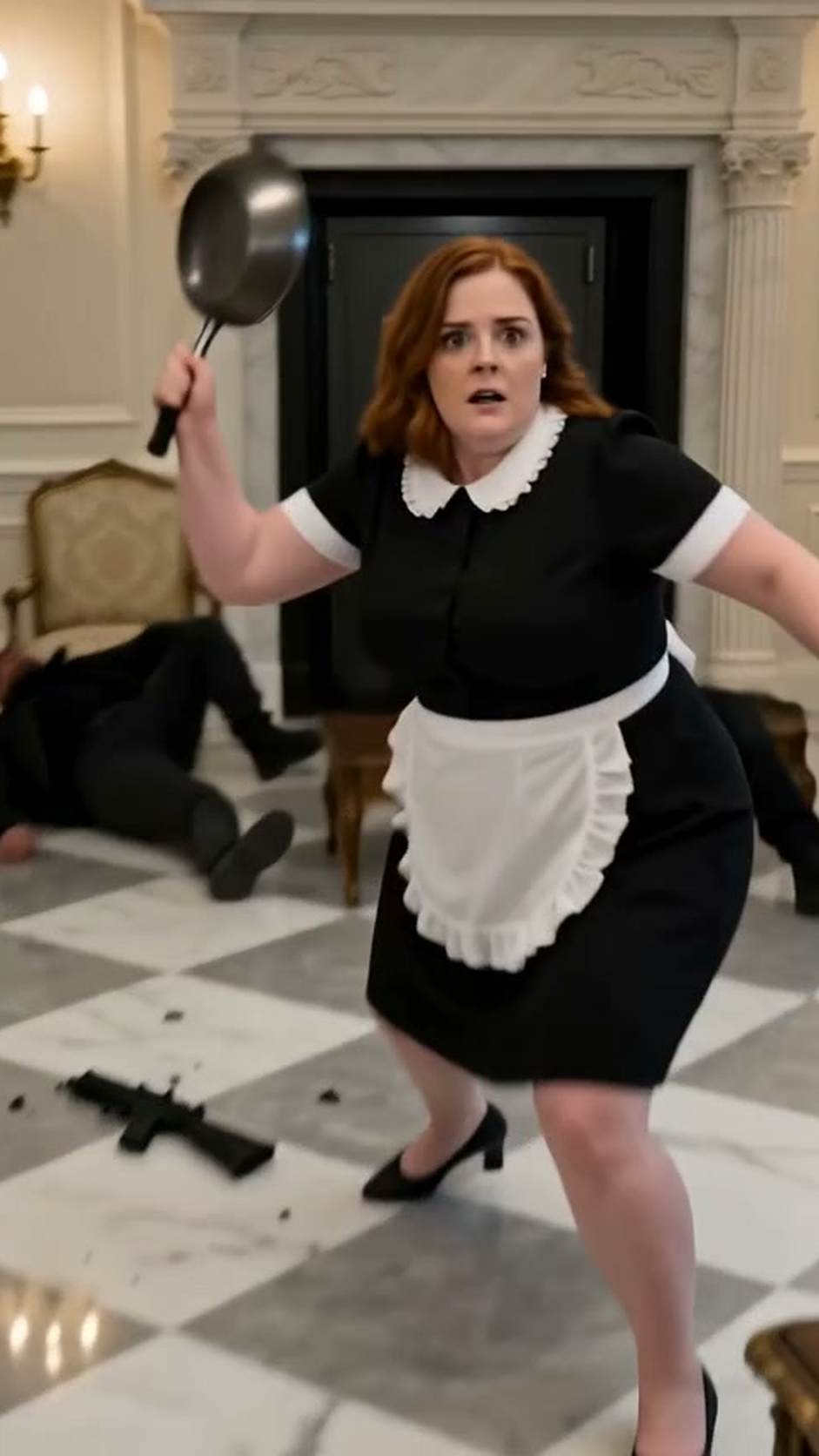
Danny found the light. Danny, who had been a soldier before he was a Caldwell man, had the soldier's habit of checking the quiet systems after the loud ones, and he came into the dining room at a run with his face set, and Ethan was on his feet before Danny finished the sentence.
They took the study the way men take a room they expect to die in, and Maggie went with them — nobody told her to stay, which told her everything about how the week had rearranged the world — and the painting was off the wall, and the safe door stood open three inches on its great hinges, and Victor Sorren was on his knees in front of it with his hands flat on the marble in the posture of a man who has been found by professionals and has done the arithmetic.
He had not gotten it open. That was the first thing. The safe had a mechanism older than the house's electricity, a thing of tumblers and patience, and Victor had been three minutes into a twenty-minute job when the shot went wrong in the dining room and the house woke up, and by then it was too late to be anywhere but where he was.
"Victor," Ethan said, with a gentleness that made Maggie's skin tighten. "Tell me about your ring."
They took him to the cellar, because some conversations belong underground, and Maggie was not invited, and she went anyway, and nobody stopped her. She stood in the doorway with her arms folded and her bandage showing and listened to nine years of loyalty come apart in under an hour — not under torture, because Ethan, whatever else he was, had never needed it. He simply sat across from his lieutenant in the lamplit cellar and asked questions in that pleasant, terrible voice, and let the silences do the work that other men do with their hands.
Raymond. It had always been Raymond.
Raymond had paid off Victor's brother's debts in 2016 — gambling debts, the kind with interest denominated in bones — and had held the paper ever since like a leash in a drawer. Raymond, who had smiled at Ethan across eleven years of Sunday dinners and told the world that Patrick Doyle froze. Raymond, who believed — truly believed, with the whole force of a man who has mistaken an inheritance for an identity — that Ethan was dismantling the family piece by piece, selling the ports, cleaning the clubs, turning smugglers' grandsons into landlords, and that the Compass Ledger was the one weapon that could reverse it all: the book of every old debt, every old name, every old obligation, with which a man could call the old empire back out of retirement like an army out of a graveyard.
The three men in the study had been sent for the book. The sniper at the boathouse had been the insurance, in case the book's theft was discovered too soon — a dead Ethan, a house in chaos, a nephew mourned beautifully by his uncle at a funeral where the eulogy would be a masterpiece.
"And the mark?" Ethan asked. "The compass. On the wrist of the man she put through my coffee table. Whose idea was that?"
Victor's laugh was a terrible sound. "His. Raymond's. He had them done special, the three of them, when he hired them. Said it would—" he swallowed, "—said it would frighten you. Said you'd see it and know the old days were coming back for you. He wanted you afraid before you were dead, Ethan. He was always—" Victor looked, for the first time, directly at Maggie in the doorway. "He didn't know about her. I want that said. He knew the name from the file, he laughed about it, the driver's girl, scrubbing floors, he said the family had a sense of humor after all. He did not know about her. Nobody knew about her."
"I did," Ethan said quietly. "I just didn't know I knew."
He stood up then, and what happened to Victor Sorren was this: he was given his coat, and his phone, and until dawn to be out of the state, with the understanding — delivered by Danny, in the drive, in the rain — that the compass points at the family, and Victor was not family anymore, and if the family ever saw him again it would be the last thing he saw. It was more mercy than the cellar had expected, and Maggie understood it before Victor did: Ethan had not spared the traitor. He had spared the nine years. There is a difference, and it is the whole difference between the man Ethan Caldwell was raised to be and the man he was trying to become.
Before they took him up, Maggie asked one question. She had waited twenty-six years to ask it, and she asked it standing in the cellar doorway in her maid's uniform, and Victor Sorren — who had faced Ethan's silences without flinching — could not hold her eyes when he answered it.
"The route," she said. "Route 17. The night my father died. The route was changed at the last hour. Who changed it?"
"Raymond." Victor's voice was hoarse. "Nine o'clock that night. He called it in himself. There was a log — the dispatcher kept a log, Raymond burned the page, but the dispatcher was my wife's uncle, and on his deathbed he told her the page had existed. Raymond changed the route, and the men were waiting on the new one inside the hour, and Henry Caldwell drove into it with your father at the wheel and the boy in the back." He looked up at her then, with an expression that might, in a better man, have been shame arriving twenty-six years late to its own appointment. "For what it's worth — and I know what it's worth — Doyle never froze. Everybody in the old crews knew it by the end of that week. The car was hit twice and burning and he got the boy out through the rear door with three rounds in him. Raymond's story was for the boy. A Caldwell who owed his life to a servant's courage would have asked questions. Raymond couldn't afford the questions."
"No," Maggie said quietly. "He couldn't."
At four in the morning, with the house locked and guarded and the rain gone thin, Ethan took Maggie into the study and opened the safe.
He had never opened it in front of another living person. She understood the weight of that the way she understood most things about him now — completely, and without being told. The tumblers went over one by one under his tattooed hands, and the great door swung, and inside there was no money and no gold, only paper: ledgers, deeds, a flat tin box, and the book itself, the Compass Ledger, bound in black oilcloth gone soft as skin, with a compass stamped in fading gilt on its cover, in a circle.
Ethan did not touch the book. He took out the tin box, and he opened it, and he stood for a long time looking down into it before he stepped aside and let her see.
A photograph: the same one Danny had found, but the original, unfaded — Henry laughing, Patrick Doyle with his arm around a boy. A folded sheet of heavy paper, sealed once, opened long ago, read many times. And a driver's gloves, cracked with age, that Maggie recognized the way you recognize your own hands.
"My father kept your father's gloves," Ethan said. "I never asked why. I was raised not to ask." He picked up the letter with a care that had nothing of the cellar in it. "He wrote this the year before he died. To me. To be given to me when I was twenty-five, by a lawyer who died before I was. It's been in that box my whole adult life, Maggie. Danny found the copy in the files. I read the original tonight for the first time."
He gave it to her. Her hands were not steady, and neither, she noticed, were his.
The handwriting was a dead man's, upright and unhurried. Henry Caldwell, writing to a son he would not live to see grown, in the plain language of a man dictating his own autopsy:
If you are reading this, Ethan, then the thing I have feared has happened, and I am not there to say it to your face, so I will say it here, where lies cannot follow. Patrick Doyle is the finest man I have ever known, and if I die on a road somewhere, he will die beside me trying to prevent it, and whatever you are told afterward — and you will be told things, by people who smile — weigh the teller before you weigh the tale. I have enemies inside my own blood. I have not yet proved which one. The compass points at the family, son. It always points at the family. Trust the man who stood between you and the fire. Trust his blood after him. Your father, H.C.
Maggie read it twice. Then she put one hand flat on the desk, the desk she had come over in the dark with a skillet in her fist, and she cried — not theatrically, not even audibly, just the way a dam gives up, all at once and after years.
"He knew," she said. "He knew it would be Raymond and he couldn't prove it and he died anyway."
"He knew," Ethan said. "And I spent twenty-six years believing the lie because the liar fed me and taught me to shave and stood at the grave and held my shoulder. Maggie." She looked up. His face, that controlled and frightening face, was doing something it had clearly never practiced. "I had his daughter in my house for fourteen months. I passed her on the stairs. I owe your father my life twice — once on the road, and once on Tuesday — and I paid the debt by not knowing her name."
"You know it now," Maggie said.
At dawn Raymond Caldwell came up the drive in a black car with two more behind it, bringing the old captains to a family meeting he had called himself, in a house he believed was leaderless and grieving — because the report that had reached him in the night said only that a shot had been fired at the Caldwell table and the house had gone dark, and Raymond, who had been waiting twenty-six years to inherit the world, could not resist coming to view the body.
There was no body. There was Ethan, at the head of his own table, in the cream polo, unmarked, pouring coffee. There was the Compass Ledger lying open on the white cloth where the decanter had stood. There was a letter in a dead man's hand, and a photograph of a laughing Irishman, and six old men who had served Henry Caldwell reading both of them in a silence that deepened like water.
Raymond read the room the way he had read rooms for sixty years, and Maggie — standing at the sideboard in her uniform, invisible, furniture, exactly where he had never once thought to look — watched the great warm smile go out of his face like a lamp being carried into another room.
"You fed me the lie when I was nineteen," Ethan said, pleasantly, at last. "You stood at his grave and held my shoulder and told me his driver froze. You set the route that night, Uncle. You changed it at the last hour, and the men were waiting at the new one, and the only man who died doing his duty was the man you smeared to cover it. I can't prove the road. I've stopped needing to. The book can — the book and Victor, who sends his regards from the state line — but I find I don't want a trial. I want these men—" his hand moved, gently, along the table, along the captains who had carried his father's coffin, "—to decide what the compass means now. That's the old law, isn't it? You taught it to me."
The old men decided. It took eleven minutes. It was not loud.
What happened to Raymond Caldwell was not death, because Ethan had learned at least one thing from the man he was trying not to become: he was stripped — of the ports, of the clubs, of the name's protection, of every door in three states that had opened to it for sixty years — and he was put in his black car by men who had once carried his photograph in their wallets, and he was driven out of the family the way a splinter is driven out of a hand: completely, and without ceremony, and with the understanding that the wound would be watched.
He did not look back. But at the door he stopped, and he looked — not at Ethan. At Maggie. At the maid at the sideboard, with the coffee pot in her hand and her bandaged arm, whom he had laughed about, the driver's girl, the family's little joke.
"You," Raymond Caldwell said, with the air of a man finally solving an equation that had ruined him, "are exactly like him."
"Yes," Maggie said. "I am."
And the door closed, and the house was quiet, and it was morning.