Lauren Corvino came home from her charity meeting at four o'clock in the afternoon, and Vincent was waiting for her in the study.
He had chosen the study deliberately. It was his room, the room where he did business, the room where men came to report to him and to ask for his decisions. It had a desk, two chairs, and a window that looked out over the garden. It was a room for truth, or at least for the kind of truth that men told each other when there was nowhere left to hide.
Lauren stood in the doorway for a moment, holding her purse in both hands, and Vincent saw her the way he had seen her that first night at the gala, in the red silk dress, arguing about martinis. She was still beautiful. She was still the woman who had climbed onto the back of his motorcycle and laughed at the city lights. But she was thinner now, and there were lines around her eyes that had not been there six months ago, and she held herself the way people hold themselves when they are expecting bad news.
"Sit down," Vincent said.
Lauren sat. She put her purse on the floor beside her chair, very carefully, the way a woman puts down something fragile.
Vincent placed the plain white envelope on the desk between them. He did not open it. He did not need to. He had memorized everything inside it.
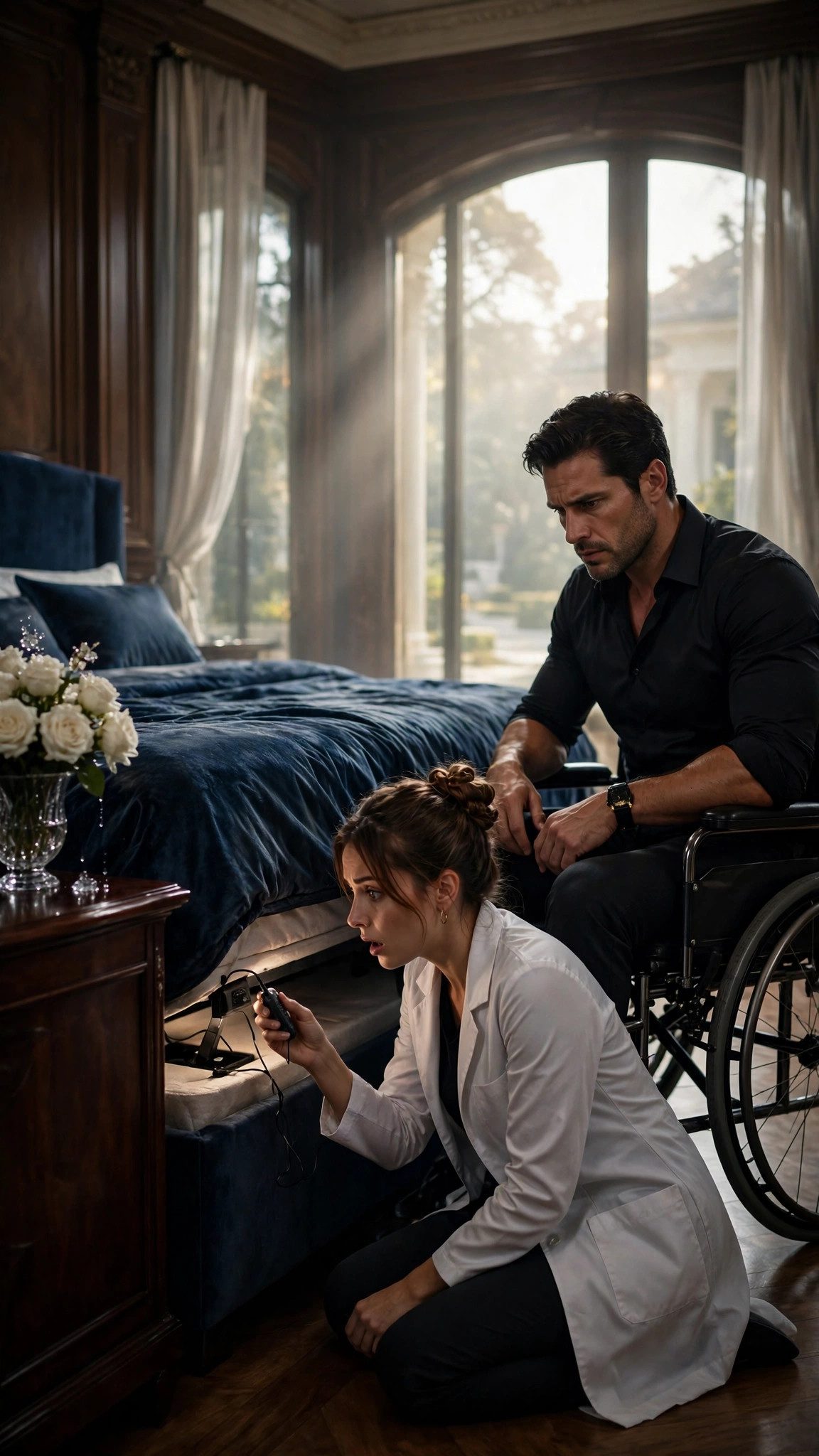
"Tessa found something under the mattress this morning," he said.
Lauren's face did not change. Not at first. Then, very slowly, the color left her cheeks, and her hands, which had been resting calmly in her lap, began to tremble.
"Under the mattress," she repeated. Her voice was very quiet.
"A listening device," Vincent said. "A photograph of me outside the restaurant, moments before I was shot. A receipt for fifty thousand dollars with your signature on it. And a photograph of a woman from my trial, with a note that says, 'She didn't hire the shooter. Ask her who did.'"
Lauren closed her eyes. For a long moment, she did not speak. The study was silent except for the ticking of the clock on the wall and the soft sound of the garden outside the window.
Then she opened her eyes, and she looked at Vincent, and the look on her face was not guilt. It was relief. It was the look of a woman who had been carrying something too heavy for too long and had finally been allowed to put it down.
"I was wondering when you would find it," she said.
Vincent stared at her.
"You knew it was there?"
"I put it there," Lauren said. "All of it. The device, the photograph, the receipt, the third photograph. I put them under the mattress three weeks ago."
"Why?" Vincent asked. His voice was very steady. He had promised himself he would not shout. He had promised Tessa he would not do this angry.
"Because I didn't know where else to put them," Lauren said. "And because I was afraid."
She told him everything then, and she told it the way a woman tells a story she has rehearsed a hundred times in her head but never said out loud. She told it slowly, stopping sometimes to breathe, sometimes to wipe her eyes, sometimes to look at the window because looking at Vincent was too hard.
It had started two months ago, she said. She had been in the bedroom, straightening the pillows, when she noticed something strange about the lamp on the nightstand. The cord was loose. Not broken, just loose, as if someone had pulled it out and pushed it back in a hurry. She reached behind the lamp to fix it, and her fingers brushed something small and hard taped to the back of the nightstand.
A listening device. Just like the one Tessa had found under the mattress.
Lauren had stared at it for a long time. She had not touched it. She had not removed it. She had simply stood there, in her own bedroom, understanding for the first time that someone had been listening to her sleep, listening to her talk to her husband, listening to her cry in the dark when she thought no one could hear.
"I was terrified," she said. "Not for me. For you. If someone was listening to us, then someone was watching us. And if someone was watching us, then the shooting wasn't an accident. It wasn't a robbery. It was planned. And if it was planned once, it could be planned again."
She had not told Vincent. She had wanted to. She had stood outside his door a dozen times, her hand on the knob, ready to walk in and tell him everything. But every time, she stopped herself.
"Because you were in that chair," she said, her voice breaking. "Because you had already lost so much. Because I didn't want to be the person who told you that the nightmare wasn't over. I wanted to protect you. I know how that sounds. I know it sounds stupid. But I wanted to protect you, and I didn't know how."
So she had done what she could. She had hired a private investigator. His name was Cole Ramsey, a former Chicago detective who had left the force after twenty years and now worked for people who needed answers the police could not give.
"I paid him fifty thousand dollars," Lauren said. "That was his fee. He was expensive because he was good, and because he was discreet, and because I told him I needed to know who was watching my husband and I needed to know it without anyone finding out I had asked."
Cole Ramsey had gone to work. He had swept the house for listening devices and found three: one behind the nightstand, one under the mattress, and one in the study, hidden inside a hollowed-out book on the shelf. He had traced the devices to a supplier in Nevada who sold them to a man named Silas Kane, a fixer who worked for anyone with enough money.
Cole had followed Silas Kane. He had photographed him meeting with a woman in a black dress, in a small café on the South Side, on a Tuesday afternoon. The woman was Elena Marchetti.
"I didn't believe it at first," Lauren said. "A fifty-eight-year-old seamstress. What did she want with us? What had we ever done to her?"
Cole had found out. He had gone through the court records from Vincent's trial. He had found Elena Marchetti's name on the witness list, in the gallery, every day, for eleven weeks. He had found Frank Marchetti's death certificate. He had found the fire report. He had put the pieces together the way a detective puts pieces together, slowly, carefully, until the picture was clear.
"She believes you killed her husband," Lauren said. "She has believed it for six years. And someone — Silas Kane, or someone who hired Silas Kane — found her grief and used it. They gave her a plan. They gave her a shooter. They gave her a way to finally have her revenge."
"And the photograph?" Vincent asked. "The one of me outside the restaurant?"
"Cole found it," Lauren said. "It was in Silas Kane's car. He took it the night you were shot. He was across the street, in a parked car, watching you. He took the photograph to prove to Elena that the job was done. Or to prove to whoever paid him."
"And the third photograph? The woman from the courtroom?"
"Cole took that one too," Lauren said. "He followed Elena for a week. He photographed her outside her house, outside the church, outside the café where she met Silas Kane. He cut off her face in that photograph because he didn't want to frighten me. He said, 'You don't need to see her face. You need to know she exists.'"
"And the note?" Vincent asked. "The note that says you didn't hire the shooter?"
Lauren looked down at her hands.
"Cole wrote it," she said. "He left it with the third photograph. He said, 'If Vincent ever finds these things, he needs to know the truth right away. He needs to know you didn't do this. He needs to know before he does something he can't take back.'"
Vincent sat in silence for a long time. He thought about the white roses, replaced every three days. He thought about the way Lauren had stopped speaking to him. He thought about the vial, and the broken phone, and the disconnected call.
"The vial," he said.
Lauren nodded.
"It was my sleeping pills," she said. "I hadn't slept properly in weeks. I was taking them every night, and they weren't working. That morning, my hand froze because I was so tired I could barely hold anything. I dropped the vial. It didn't break. I lied and said I'd broken a phone because I didn't want you to know how bad it was. I didn't want you to know I was falling apart."
"And the phone?" Vincent asked.
"The disconnected call from my watch," Lauren said. "That was Marcus. The coffee guy. He was in the hallway, and I caught him listening at the door. I told him to leave. He grabbed my wrist and cut the call. He said, 'It's just the coffee guy,' and he smiled at me, and I knew then that he was one of them. He was Silas Kane's man, planted in our house to watch us."
Vincent's hands curled into fists on the armrests of his wheelchair.
"Marcus Hale," he said. "Tessa found out who he is. He's not staff. He's not anyone. He appeared three months ago, after the old maintenance man retired. He said he was sent by an agency. There is no agency."
Lauren reached across the desk and took Vincent's hand. Her fingers were cold, but her grip was strong.
"I'm sorry," she said. "I'm sorry I didn't tell you. I'm sorry I hid it. I'm sorry I let you think I didn't love you anymore. I do love you. I've always loved you. I was just scared, and I didn't know what else to do."
Vincent looked at her hand in his, and he thought about the woman in the red silk dress, laughing at the city lights, and he thought about the woman in front of him now, tired and frightened and brave enough to tell the truth.
"You're not the one who should be sorry," he said. "I should be sorry. I spent six months thinking you had given up on me. I spent six months feeling sorry for myself. I never once asked you how you were doing. I never once asked you what you were carrying."
He squeezed her hand.
"We're going to fix this," he said. "Together. Not with fear. Not with hiding. Together."
Lauren nodded, and for the first time in six months, she smiled. It was a small smile, tired and fragile, but it was real.
"What do we do?" she asked.
Vincent wheeled himself to the window and looked out at the garden. The late afternoon light was soft and golden, and the roses were blooming along the fence.
"We find Silas Kane," he said. "We find Elena Marchetti. And we make them come to us. We give them exactly what they want — a chance to finish what they started. And when they come, we will be ready."
Lauren stood up and came to stand beside his wheelchair. She put her hand on his shoulder, the way she used to, before the bullet, before the silence, before the fear.
"Together," she said.
"Together," Vincent said.
And in the study, in the house that had been listening to them for months, they began to plan.
Later that evening, after Vincent had gone to bed, Lauren sat alone in the study and thought about the day she had hired Cole Ramsey. It had been a Tuesday, three weeks earlier, raining hard, and she had driven herself to a small office on the West Side, above a dry cleaner, with a sign on the door that said "Ramsey Investigations" in plain black letters.
Cole had been sitting behind a desk covered in files, drinking coffee from a chipped mug, and he had looked up at her with eyes that had seen too much to be surprised by anything.
"You want me to find out who is watching your husband," he had said. It was not a question.
"Yes," Lauren had said. "And I want you to do it without anyone knowing. Not my husband. Not his men. No one."
"That's the hardest kind," Cole had said. "And the most expensive."
"Fifty thousand dollars," Lauren had said. She had taken the checkbook out of her purse and written the number without hesitating. It was almost everything she had in her personal account, money her grandmother had left her, money Vincent had never touched and never asked about.
Cole had looked at the check for a long time.
"You're sure?" he had asked.
"I'm sure," Lauren had said. "My husband was shot six months ago, and everyone told me it was a robbery. But I don't believe it was a robbery. I believe someone planned it. And I believe someone is still watching us. And I would rather spend every penny I have than sit in that house and wait for them to finish what they started."
Cole had taken the check. He had shaken her hand. And he had said, "I'll find them. I promise you that."
He had kept his promise. In three weeks, he had found the listening devices, the supplier, the fixer, and the widow. He had photographed Elena Marchetti outside her house. He had followed Silas Kane to the café. He had done everything Lauren had asked, and he had done it quietly, without anyone knowing.
Lauren had not told Vincent because she was afraid of what he would do. She knew her husband. She knew that if he found out someone had been listening to them, he would tear the house apart. He would call his men. He would find Silas Kane and do something terrible to him. And then the police would come, and the newspapers would come, and the whole terrible story would be public, and Vincent would be back in the headlines for all the wrong reasons.
She had wanted to protect him. She had wanted to handle it quietly, the way a wife handles things, by finding the truth first and then deciding what to do with it.
Now, sitting alone in the study, Lauren understood that she had been wrong to hide it. Not because Vincent was angry — he was not angry, and that surprised her more than anything. He was calm. He was patient. He was the man she had married, the man who had laughed at the gala and ridden a motorcycle along the lakefront with her arms around his waist.
She had spent weeks thinking her husband had given up on her. She had spent weeks thinking he did not love her anymore. But the truth was simpler and sadder than that. They had both been afraid. They had both been hiding. And they had both been waiting for the other one to speak first.
Lauren stood up and walked to the window. The garden was dark, and the roses along the fence were black in the moonlight. Somewhere in the house, a clock ticked. Somewhere outside, a car passed on the street.
She thought about the white roses, replaced every three days. She had started bringing them because she did not know what else to do. She had thought that if she kept the room beautiful, if she kept everything clean and fresh and perfect, then maybe Vincent would get better. Maybe the nightmare would end.
It had not worked. But something else had. The truth had worked. Telling Vincent the truth, all of it, even the parts that made her look foolish and afraid, had worked. Because now they were planning together. Now they were fighting together. Now they were a team again, the way they had been on the motorcycle, all those years ago, with the city lights blurring into gold.
Lauren went upstairs and stood in the doorway of Vincent's bedroom. He was asleep, his breathing slow and even, his strong arms resting on the blanket. She watched him for a long time, and then she whispered, so quietly that only she could hear it, "I'm sorry. And thank you. And I love you."
Then she went to her own room, and for the first time in weeks, she slept through the night.