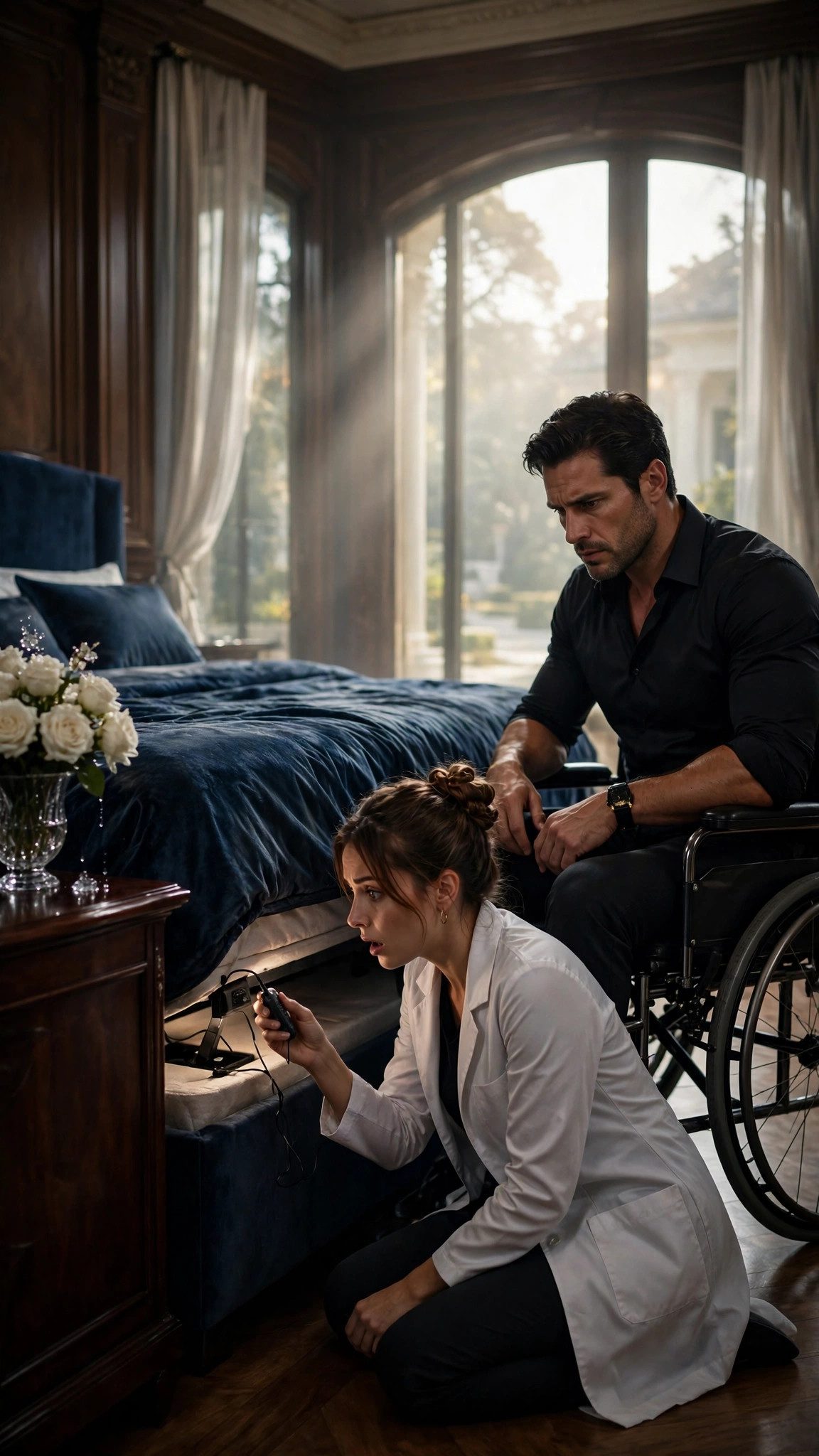
Vincent did not sleep that night.
He lay in the enormous bed in the second-floor master suite, staring at the ceiling, listening to the quiet of the house. Every sound seemed louder now. The ticking of the clock on the wall. The soft hum of the refrigerator downstairs. The distant sound of a car passing on the street outside. The house had always made these sounds. He had never listened to them before.
Now he listened to everything, because everything might be a threat.
Beside the bed, on the nightstand, was a plain white envelope. Inside it were the listening device, the photograph of him beneath the restaurant awning, the receipt for fifty thousand dollars with Lauren's signature, and the photograph of the woman from the courtroom with the note on the back.
"SHE DIDN'T HIRE THE SHOOTER. ASK HER WHO DID."
Vincent had read the note a dozen times. Each time, he noticed something new. The handwriting was small and neat, but the pressure on the pen had been hard enough to leave indentations in the paper. Whoever had written it had been angry. Or afraid. Or both.
He thought about the woman in the photograph. The face was cut off, cropped just below the eyes, but Vincent remembered her anyway. He remembered the black dress. He remembered the gray hair pulled back into a tight knot. He remembered the way she sat in the third row of the gallery, her hands folded in her lap, watching him the way a farmer watches the sky before a storm.
Elena Marchetti. Frank Marchetti's widow.
Vincent had not thought about her in six years. He had not thought about the trial in six years. He had put it behind him, the way he put everything behind him, by refusing to look at it.
But now he looked at it. He looked at it the way a man looks at a wound he has been ignoring, and he saw that it had never healed.
The fire had been an accident. He knew that. The investigators knew that. The jury knew that. But Elena Marchetti did not know that, or did not believe it, and belief was stronger than evidence. Vincent understood that better than anyone. His entire empire was built on belief. Men believed he was untouchable, and so he was. Men believed he was dangerous, and so he was.
Elena Marchetti believed he had killed her husband. And a woman who believes that for six years does not forget. She waits.
In the morning, Vincent called his lawyer. Not the young men who handled his contracts now, but the old man who had defended him at the trial. Daniel Hart. Seventy-one years old, retired, living in a house by the lake with a garden he tended himself.
"Daniel," Vincent said, when the old man answered the phone. "I need to ask you about the trial."
There was a long pause on the other end of the line.
"Vincent," Daniel said. "It has been six years. Why are you asking about the trial now?"
"Because someone shot me six months ago," Vincent said. "And I think it might be connected."
Another pause. Longer this time.
"Come to my house," Daniel said. "Not on the phone. Come to my house."
Vincent went that afternoon, in the black van with the lift that his driver used to take him anywhere he needed to go. The van was new, fitted with everything he needed, and Vincent hated it with a passion that surprised even him. He hated the ramp. He hated the way people looked at him when the lift lowered him to the sidewalk. He hated the way the world had rearranged itself around his chair.
But he went. Because he needed answers, and Daniel Hart was the only man who had all of them.
Daniel's house was small and quiet, with a garden full of tomatoes and a porch that faced the lake. The old lawyer met Vincent at the door, shook his hand, and wheeled him into the study himself, past shelves of law books that had not been opened in years.
"You look tired, Vincent," Daniel said.
"I am tired," Vincent said. "I have been tired for six months. Tell me about Elena Marchetti."
Daniel sat down slowly, the way old men do, and folded his hands on the desk.
"Elena Marchetti," he said. "Fifty-eight years old now. Her husband Frank died in the warehouse fire. She has two children, a son and a daughter, both grown now. She lives in a small house on the South Side, the same house she has lived in for thirty years. She works as a seamstress. She goes to church every Sunday. She has never remarried."
"Did she ever threaten me?" Vincent asked.
"No," Daniel said. "Not in any way the law would recognize. She never wrote a letter. She never made a phone call. She never came to your office. She simply came to the trial every day and watched you. And after the trial, she went home, and she was quiet."
"Quiet," Vincent repeated.
"Quiet is not innocent, Vincent," Daniel said. "You know that better than anyone. The quiet ones are the ones you have to watch."
Vincent told Daniel about the listening device, the photograph, the receipt, and the third photograph with the note. He did not tell him about Lauren. Not yet. He was not ready to say his wife's name in connection with any of this, even to a man he trusted.
Daniel listened without interrupting, the way he had listened in the courtroom, and when Vincent finished, the old lawyer was silent for a long time.
"The note is the most important thing," Daniel said finally. "Whoever wrote it wants you to ask your wife a question. That means whoever wrote it believes your wife knows something. And it means whoever wrote it does not want to tell you themselves. They want you to find out from her."
"Why?" Vincent asked.
"Because the truth is always more powerful when it comes from the person you love," Daniel said. "Or because the person who wrote the note is afraid of what will happen if they tell you directly."
Vincent thought about that. He thought about the small, neat handwriting, and the hard pressure on the pen.
"There's something else," Daniel said. "The woman in the photograph. The face is cut off. That is deliberate. Whoever took that photograph wanted you to recognize her without seeing her face. They wanted you to remember the courtroom. They wanted you to connect the shooting to the trial."
"So the shooter was hired by Elena Marchetti," Vincent said. It was not a question.
"That is the obvious conclusion," Daniel said carefully. "But obvious conclusions are not always correct. Elena Marchetti is a fifty-eight-year-old seamstress. She does not know how to hire a professional shooter. She does not know where to find one. She does not have the money. A professional hit costs fifty thousand dollars, Vincent. Does that number sound familiar?"
Vincent felt the floor shift under his chair again. Fifty thousand dollars. The receipt. Lauren's signature.
"Someone gave Elena the money," Daniel said. "Or someone hired the shooter on her behalf. Someone with money, and connections, and a reason to want you dead that has nothing to do with a warehouse fire."
"Who?" Vincent asked.
Daniel shook his head.
"I don't know. But I know where to look. The shooter was a professional. He knew where you would be. He knew when you would be there. He knew you would be standing under the awning, alone, checking your phone. That kind of information does not come from a seamstress on the South Side. It comes from inside. From someone who knew your schedule. From someone who was in the restaurant that night."
Vincent thought about that night. Lauren had been inside, already seated, already ordering a drink. His driver had been outside with the car. His bodyguard had been at the bar. The restaurant had been full of people.
"Marcus," Vincent said suddenly.
"Who?" Daniel asked.
"The man by the elevator. The coffee guy." Vincent's voice was low. "Tessa told me about him. He was in the hallway the morning Lauren's hand froze on the vial. He said he was just the coffee guy. But I never hired a coffee guy. We have a kitchen. We have staff. There is no coffee guy."
Daniel's eyes narrowed.
"Find him," he said. "Quietly. Don't scare him. Just find out who he is and who he works for."
Vincent went home that evening and called Tessa to his study. He told her what Daniel had said, and he watched her face as she listened. Tessa did not flinch. She did not gasp. She simply nodded, the way she always did when a patient told her something she already suspected.
"I'll find him," she said. "I know the staff better than you do. I know who talks to whom. I'll ask the housekeeper. She notices everything."
"Be careful," Vincent said.
"I am always careful," Tessa said. "It's my job."
That night, Vincent sat in his study and went through the trial in his mind, piece by piece. The warehouse supervisor who had lied. The lock that had never existed. The fire that had been an accident. The jury that had found him not guilty. And Elena Marchetti, in the third row, in the black dress, watching.
He had been acquitted. But acquittal was not the same as innocence, not in the eyes of a widow. Vincent understood that now. He had spent six years believing that the trial was over. It had never been over. It had simply been waiting.
And somewhere in Chicago, a fifty-eight-year-old seamstress had spent six years saving money, making contacts, and waiting for the right moment. Or someone had found her, and used her grief the way a man uses a loaded gun, and pointed her at Vincent.
Either way, the bullet had come from the past. And the past, Vincent was learning, did not stay in the past. It waited. It watched. It listened.
It hid things under mattresses.
Vincent thought about his father then, as he often did when he was afraid, though he would never have admitted to anyone that he was afraid. Antonio Corvino had been a small man with large hands and a voice that could fill a warehouse without shouting. He had built the family business out of nothing but a truck, a warehouse, and a reputation for keeping his word, and he had taught Vincent everything he knew about power.
He had taught him on the docks, when Vincent was sixteen, standing beside him in the rain while a truck driver explained why a shipment was late. Antonio had listened to the whole story without interrupting, and then he had said, very quietly, "A man who lies to me once will lie to me twice. A man who tells me the truth, even when the truth is bad, is a man I can work with." He had paid the driver in full that day, and the driver had never been late again.
He had taught him in the office, when Vincent was nineteen, going over the books with a pencil and a ledger. "Respect is more valuable than money," Antonio had said, tapping the ledger with the pencil. "Money can be stolen. Money can be lost. But if men respect you, they will follow you through a fire. And fear — fear is more reliable than either. A man who fears you will never betray you. A man who loves you might. Remember that."
Vincent had remembered it. He had built his life on it. He had ruled his empire with respect and fear, the way his father had taught him, and it had worked. It had worked for fifteen years.
But his father had died when Vincent was twenty-eight, of a heart attack in the same office where he had taught him about respect and fear, and Vincent had taken over the empire the next morning, without a ceremony, without a pause, because empires do not pause. He had buried his father on a Tuesday. He had been back at his desk on a Wednesday.
He had never once doubted that his father was right. Not until the bullet. Not until the chair. Not until Tessa Morgan told him that angry men miss things.
Now, sitting in his wheelchair in the second-floor master suite, Vincent wondered what his father would have done about the listening device under the mattress. Antonio would have called his men. Antonio would have found the person who planted it and made an example of them. Antonio would have acted with rage and certainty, and the empire would have gone on exactly as before.
But Vincent was not his father. Vincent had a bullet in his spine and a wife who barely spoke to him and a nurse who told the truth. And for the first time in his life, Vincent understood that his father's way had a cost. The cost was that no one ever told Antonio Corvino the truth when the truth was painful. They told him what he wanted to hear. They told him what would keep them safe. And so Antonio had died believing his empire was built on respect, when some of it had been built on fear, and fear, Vincent was learning, was a foundation made of sand.
He would not make the same mistake. He would ask. He would listen. He would find out the truth, whatever it cost him.
Because the truth was the only thing that could set him free. And Vincent Corvino intended to be free.
Before he left Daniel Hart's house that evening, Vincent called his driver, Tony, and asked him a question he had never asked before. "Tony," he said, "on the night I was shot, who was in the restaurant with Lauren?" Tony was quiet for a moment, and then he said, "A waiter I didn't recognize, boss. Young. Nervous. He kept looking at the door. I thought he was new. I didn't think anything of it until now." Vincent thanked him and hung up, and he wrote the waiter's description in a small notebook: young, nervous, always looking at the door. Another piece. Another thread. He would follow them all, one by one, until they led him to the truth.