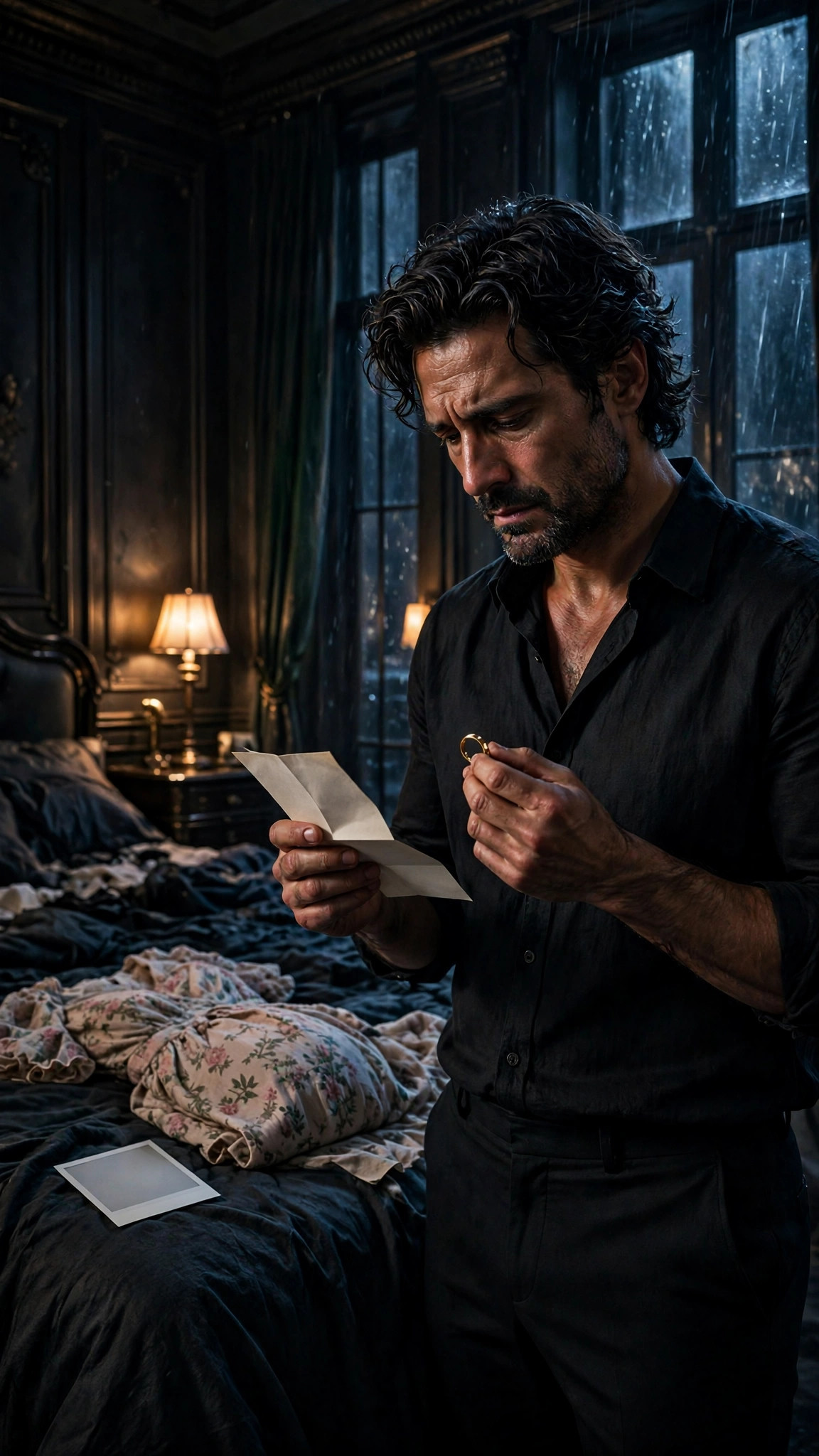
The morning sickness started in the sixth week, and Emily hid it from me for a month.
I know that now because Rosa told me later — Rosa, who had kept our house for nine years, who had watched Emily grow from a young bride into a woman who ran a household the way generals run campaigns, quietly and without asking for credit. Rosa told me that Emily was sick every morning before dawn, and that she would sit on the bathroom floor with a cold cloth on her neck, and then get up, wash her face, put on her makeup, and go downstairs to make breakfast as if nothing had happened.
"She did not want to worry you, Mr. Carter," Rosa said. "She said you had enough to worry about."
I had enough to worry about. I was always worrying about something — a shipment, a route, a man who owed me money, a man I owed money to. I never once worried about the woman in my own house who was vomiting before sunrise and smiling at me over breakfast.
The first ultrasound was on a Thursday. Emily put the appointment card on the refrigerator with a magnet shaped like a lemon, and she circled the time twice in red ink, and she told me three times the night before: "Eleven o'clock, Michael. The clinic on Meridian. It's the first time we'll see the baby."
I did not go. A freighter came in early at the second port, and a customs inspector I had not paid yet decided to do his job properly for once, and I spent the morning on the phone, and by the time I remembered, it was two o'clock, and Emily was already home, sitting in the kitchen with a photograph in her hand — a grainy black-and-white image of something the size of a peanut — and she showed it to me like a child showing a parent a drawing, and she said, "Look. That's our baby. That's his heartbeat, right there."
I looked. I said it was wonderful. I asked her what the doctor had said, and she told me, and I nodded, and I went back to my study, and I did not think about it again until the second ultrasound, which I also missed, because Vanessa called that morning and said her father wanted to see me in Chicago, and I went, and the contract that did not exist took four hours to discuss, and the penthouse took the rest of the night.
There were three ultrasounds in total. I missed all three. Emily went alone to all three, and she came home alone from all three, and she put the photographs in a drawer in the nursery, one on top of the other, like pages in a book nobody would ever read to the child they were about.
The sixth call came on a Tuesday afternoon. I was in a meeting about the third casino, and my phone buzzed, and I saw Emily's name, and I let it go to voicemail. It buzzed again. And again. Six times in total, and when I finally listened to the messages that evening, her voice was shaking with excitement, and she said, "Michael, it's a boy. We're having a boy. Call me back. I want to tell you his name — I want us to choose it together."
I called her back two hours later, from the car, on my way to the airport. I told her to choose the name herself. I told her she had better taste than I did. I told her I loved her, and I meant it, and then I got on a plane to Chicago, and I did not think about the name again for three weeks.
She chose Noah. She told me over dinner, the way she told me everything in those days — quietly, without ceremony, as if she were afraid that if she made it important, I would find a reason to leave the room. "Noah," she said. "It means rest. Comfort. I thought — after everything — that he should have a name that means rest."
I said it was a beautiful name. It was. I did not ask her what "after everything" meant. I already knew. I just did not want to hear her say it.
The nursery took her six weeks. She painted the walls herself, a soft blue that she mixed three times before she was satisfied, and she hung paper stars from the ceiling on fishing line, and she built the crib with her own hands because the instructions were in Swedish and she refused to wait for me to translate them. She sewed the curtains. She washed the tiny clothes — the smallest clothes I had ever seen, white and blue, soft as clouds — and folded them into the drawers, and she put a rocking chair in the corner, by the window, where the afternoon light came in.
One evening I came home at nine o'clock, which was early for me, and I found her standing in the middle of that room with her hands on her belly, looking at what she had made. The room was finished. Every star was hung. Every drawer was full. The crib was made up with a blanket she had knitted herself, white, with a border of tiny blue anchors, because she said our son should have anchors, because his father spent his life on the water and never learned how to stay in one place.
She turned when she heard me, and she did not smile. She just looked at me, and she said, very quietly, "I don't want your money, Michael. I want my husband."
I had nothing to say to that. There was nothing to say. So I said nothing, and I went to my study, and I poured a drink, and I told myself I would fix it tomorrow.
But the truth — the truth I did not know then, and would not know until much later — was that something else was already wrong in that house, something that had nothing to do with Vanessa and everything to do with the slow, quiet way a woman can be hurt without anyone noticing.
Emily had started feeling ill in a way that was not morning sickness. She told Rosa first, because she told Rosa everything she did not tell me. She was dizzy in the afternoons. She was tired in a way that sleep did not fix. She had lost weight in her face, and her hands shook sometimes when she held a cup, and once she fainted in the pantry and woke up on the floor with Rosa kneeling over her, pressing a cold cloth to her forehead.
"I'm fine," she said, every time. "It's the pregnancy. The doctor says it's normal."
The doctor did not say it was normal. The doctor had not been told. Emily did not tell the doctor, because she was afraid — not of being sick, but of being told to rest, of being told to stop, of being told that something was wrong with the baby. So she kept going. She kept painting stars and folding tiny clothes and waiting for dinner, and she kept drinking the tea Rosa brought her every evening, the special tea, the one Rosa said was good for the baby, the one with honey and lemon, the one Emily drank because she trusted the woman who made it.
I did not know about the tea. I did not know about the dizziness, or the fainting, or the weight falling off her face. I did not know, because I was not there. I was in Chicago, in a penthouse on the fortieth floor, with a woman who laughed at my jokes and told me I was the most interesting man she had ever met, and I believed her, because it was easier to believe her than to come home and see what I was doing to my wife.
Vanessa, meanwhile, was growing impatient. That was the other thing I did not see, or did not want to see. She had begun as a diversion — a laugh, a dance, a kiss I should never have given her — and she had become something else: a woman with expectations. She wanted me to leave Emily. She said it plainly, one night in the penthouse, lying in the dark with her head on my chest.
"She knows, Michael. She has to know. A woman always knows. Leave her. Marry me. My father would make you a king."
I told her I could not. I told her Emily was my wife, and the mother of my child, and that some lines I would not cross. She laughed, and she kissed my shoulder, and she said, "You already crossed them, darling. You crossed them the night you danced with me."
She was right. She was right about that, too.
Two months before Emily was due, she confronted me. She did not shout. She did not throw anything. She stood in the doorway of my study with her arms folded over her belly, and she said, "I know, Michael. I have known for months. I was waiting to see if you would tell me yourself."
I did not deny anything. There was nothing left to deny. And when she said, "Nobody stole you from me. You walked away," I turned my back on her. I turned my back, and I walked to the window, and I stood there looking out at the city I owned, and I listened to her footsteps going down the hall, and I told myself I would fix it tomorrow.
That night, for the first time in fourteen years, Emily did not wait for dinner. She ate alone in the kitchen, and she went to bed alone, and when I came to the bedroom at two in the morning, she was lying on her side of the bed with her back to me, and she was awake — I could tell by her breathing — and she did not turn around, and she did not speak, and I lay down beside her in the dark, and I stared at the ceiling, and I understood, finally, that I had already lost her. Not all at once. Not in a single moment. But slowly, the way a tide goes out, one small wave at a time, until one day you look down and the shore is bare, and you cannot remember when the water left.
I should have gotten up. I should have put my arms around her. I should have said the words that had been sitting in my chest for months, the words I had been too much of a coward to say: I am sorry. I was wrong. I will end it. I will come home. I will be your husband again.
I said none of them. I fell asleep, and in the morning she was gone from the bed before I woke, and the house was quiet, and Rosa was in the kitchen making tea, and the day went on as if nothing had happened.
But something had happened. Something had broken, quietly, in the dark, and neither of us knew how to fix it. And in the weeks that followed, while Emily's body grew heavier and her face grew thinner, and while the dizziness came more often and the tea kept coming every evening, I kept going to Chicago, and I kept telling myself that I would fix it tomorrow.
I should have known something else was wrong, and the shame of it is that I did know — I just refused to see it.
One evening, about a month before the birth, Emily and I had dinner together. It was one of the rare nights I was home, and Rosa had made roast chicken, and Emily was sitting across from me, and I noticed her hands shaking when she reached for her glass. Just a little. Just enough to make the water tremble. I asked her if she was all right, and she said, "I'm fine. It's the pregnancy. The doctor says it's normal." And I believed her, because it was easier to believe her than to ask another question, and because I had a meeting in the morning, and because I had already decided that everything in my house was fine.
It was not fine. Nothing in my house was fine. But I had trained myself, over ten months, not to look too closely at anything, because looking too closely would have meant seeing what I was doing, and I was not ready to see it.
Emily's mother had died when Emily was sixteen, of an illness that came on slowly and then all at once, the way illnesses do. Emily had told me about her once, early in our marriage, on a night when we were lying in bed in the small apartment, and she had said, "My mother used to say that a woman's job is to make a home, but a home is not a place, Michael. A home is a person who comes back." She had a cottage on a lake, two states away, a small white house with blue shutters that her mother had left her, and Emily went there once a year, alone, to clean it and open the windows and sit on the dock and remember. She had asked me to go with her, once, in our second year of marriage, and I had said I was too busy, and she had never asked me again.
I think about that cottage now, and I think about the fact that I had never been there, and I think about the fact that my wife had a whole life — a whole place, a whole history — that I had never bothered to see, because I was too busy building an empire to notice that the woman beside me had a world of her own.
The night before the birth, Emily sat in the nursery for a long time, in the rocking chair by the window, with her hands on her belly, and she talked to our son. Rosa heard her, from the hallway. She was telling him about the lake. She was telling him about his grandmother. She was telling him that his name meant rest, and that she would make sure he had it, no matter what it cost her.
Rosa did not tell me that until much later. She told me because she thought I should know that my wife had not left me in anger. She had left me the way a mother leaves a burning house with her child in her arms — not because she wanted to go, but because staying would have killed them both.
Tomorrow never came. The baby came instead.