The first contraction came at 9:40 in the evening, while Emily was folding laundry in the bedroom, and she did not call me.
I know this because she told me later — not in person, but in the letter she left behind, and in the things Rosa told me, and in the things Daniel told me, and in the pieces I put together afterward, the way a man puts together a puzzle after the picture is already gone.
She was folding the tiny clothes — the white ones, the blue ones, soft as clouds — and her belly tightened, and she stood very still, with a small white sock in her hand, and she waited. It passed. She put the sock in the drawer. She went downstairs and made herself tea, and she drank it slowly, standing at the kitchen window, looking out at the garden in the dark.
The second contraction came at 10:15. Stronger. She timed it on the kitchen clock. Seven minutes. She called Rosa, who was already in bed, and Rosa came downstairs in her robe and her slippers, and she took one look at Emily's face and said, "It's time."
Emily shook her head. "It's twelve days early. It's too early."
"Babies don't read calendars," Rosa said. "Call your husband."
Emily picked up her phone. She called me. Once. My phone was on the nightstand in Vanessa's penthouse, on silent, because I had put it on silent when I walked in the door, the way I always did, so that nothing could interrupt us. I did not hear it. I was asleep. Vanessa was asleep beside me, her hair spread across the pillow, her hand on my chest, and the city was forty floors below us, and the night was quiet, and I was exactly where I had chosen to be.
The third contraction came at 10:40. Emily called me again. Then again. Five times in total, and with each call she sent a message, and the messages grew more desperate, the way a person drowns slowly, one inch at a time.
"I'm having contractions."
"I'm going to the hospital."
"I'm scared."
Rosa drove her. Rosa, who was sixty-one years old and had never driven faster than the speed limit in her life, drove Emily to the hospital with both hands on the wheel and her foot flat on the floor, running red lights, praying out loud in Spanish, while Emily sat in the passenger seat with her hands on her belly, breathing the way the classes had taught her, in through the nose, out through the mouth, in through the nose, out through the mouth.
At the hospital, the nurses took her upstairs, and the doctor came — Dr. Whitfield, her obstetrician, a man in his late fifties with grey hair and glasses, who had delivered a thousand babies and who still, after all those years, treated every birth like it was the first one. He examined her, and he said, "You're in labor, Mrs. Carter. Your son is coming tonight. Where is your husband?"
Emily looked at him, and she said, "He's not coming."
Dr. Whitfield did not ask again. He had been a doctor for thirty years, and he knew the look on a woman's face when she had stopped expecting the man she loved to walk through the door.
The labor lasted two hours and thirty-seven minutes. Emily did not scream. Rosa told me that later, with tears in her eyes. She said Emily gripped the bed rail so hard her knuckles went white, and she breathed, and she pushed, and she did not scream, because she had decided, somewhere in the middle of that night, that she would not give this night any more of herself than it had already taken.
At 1:17 in the morning, our son was born.
He weighed six pounds, four ounces. He was twelve days early, and small, and perfect, and when the nurse put him on Emily's chest, he opened his eyes — dark eyes, my eyes — and he looked at his mother, and Emily looked at him, and she whispered, "Noah. Your name is Noah. It means rest. And I promise you, my love, you will never have to wait for anyone the way I did."
She held him for one hour. One hour, in the quiet of that hospital room, with the machines beeping softly and the city asleep outside the window, and she counted his fingers and his toes, and she kissed the top of his head, and she memorized his face, the way a woman memorizes the face of someone she is about to lose.
And then she made her decision.
It was not a decision she made in anger. It was not a decision she made in the heat of the moment. It was a decision she had been making for weeks, slowly, the way a river carves a canyon — one small choice at a time, until the shape of it was finished.
Two days before the birth, Rosa had come to her room in tears. Rosa, who had kept our house for nine years, who had made Emily's tea every evening, who had watched her grow thinner and dizzier and more afraid, had finally broken. She had knelt beside Emily's chair, and she had taken her hands, and she had said, "Mrs. Carter, I have to tell you something, and God forgive me for not telling you sooner."
And she had told her. She had told her about the money — the money Vanessa had paid her, every month, in cash, in an envelope left in the mailbox. She had told her about the tea — the special tea, the one with honey and lemon, the one Rosa had been told was full of vitamins, good for the baby. She had told her that the powder she stirred into it was not vitamins at all, but a drug — a slow poison, meant to make Emily sick, meant to make her lose the baby, meant to make her die quietly, in her own house, of what would look like a natural illness, while her husband was forty floors up in another woman's bed.
Rosa had not known. Not at first. She had believed Vanessa when Vanessa told her the powder was medicine. But when Emily started fainting, when her hands started shaking, when the weight fell off her face, Rosa had begun to understand, and she had gone to a clinic across town, and she had shown them the powder, and they had told her what it was, and she had come home and hidden the envelope of money in a drawer, and she had not slept for three nights, and then she had come to Emily's room and told her everything.
Emily listened to all of it. She did not cry. She did not shout. She asked Rosa one question: "How much longer?"
Rosa said, "The woman — Miss Vanessa — she said the doctor told her one more week. She said if you stay one more week, it will be finished."
One more week. Emily did the arithmetic in her head. One more week of the tea, and she would be dead, and Noah would be born into a house where his mother was gone and his father's mistress was waiting to take her place. And Don Arturo Bellini, Vanessa's father, had already prepared the papers — Rosa had heard Vanessa talking about it on the phone — papers that would take Noah away from Michael, papers that said Michael was an unfit father, a criminal, a man who could not be trusted with a child, papers that would send Noah to be raised by the Bellini family, far away, where Michael would never be allowed to see him again.
That was the secret. That was what the doctor would later try to tell me, with trembling hands, in his office. If Emily had stayed even one more day, she would have died, and I would never have been allowed to see my son again.
So Emily made her decision. She would not stay one more day. She would not drink one more cup of tea. She would not give Vanessa one more week.
She called her brother.
Daniel Hart was thirty-eight years old, a former army medic, now a paramedic, a man who had spent his life running toward the things other people ran away from. He lived two states away, and he had not seen his sister in two years, because Michael Carter's world did not have much room in it for a brother-in-law who asked questions. But when his phone rang at two in the morning, and he heard his sister's voice, small and steady, saying, "Danny, I need you. I need you now. Bring the black car. Don't tell anyone," he did not ask why. He got in his car, and he drove through the night, and he arrived at the hospital at 3:30 in the morning, and he walked in through the service entrance, the way Emily had told him to, and he found her sitting in a wheelchair by the back door, holding her newborn son in her arms, with a bag at her feet and Rosa standing beside her, crying.
"Are you sure?" he asked her.
She looked at him, and she said, "If I stay, he dies. If I stay, I die. There is nothing to be sure about. There is only going."
So they went. Daniel helped her into the black car — the same black car the hospital cameras would later catch on film, nine days later, when my men finally obtained the footage — and Rosa kissed Noah's forehead, and she whispered, "Forgive me," and Emily said, "I already have."
But they did not drive straight to the lake. Emily asked Daniel to take her home first — home, to the house where she had lived for fourteen years, to the bedroom where she had waited for dinner a thousand times — because there were things she needed to leave behind, and things she needed to take, and she wanted to do it herself, one last time, in the dark, while her husband was still asleep in another woman's bed.
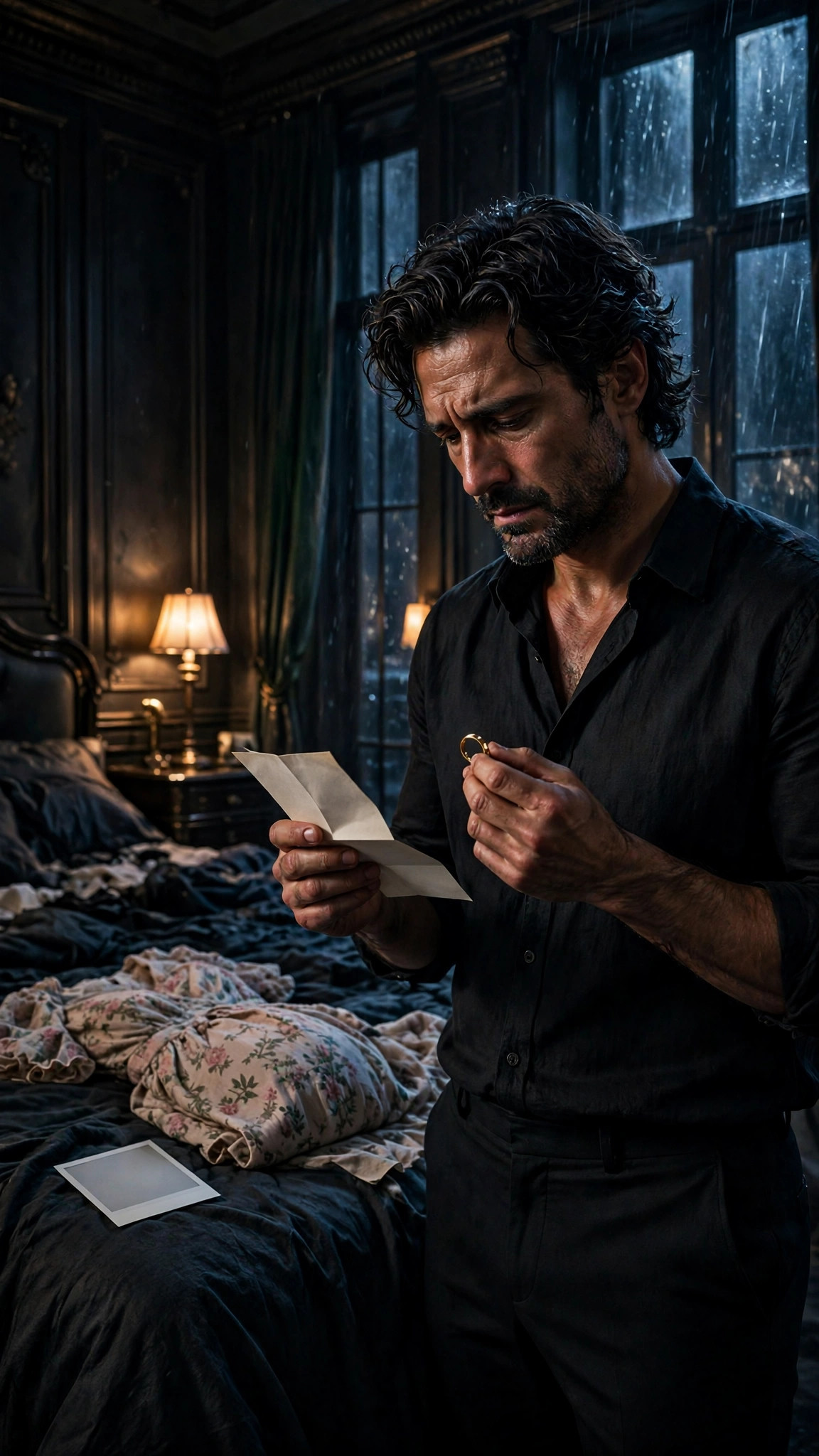
Daniel waited in the car with Noah sleeping in his arms. Emily went inside alone, moving quietly through the house she knew better than her own heartbeat. In the bedroom, she took off her maternity dress — the floral one, the one she had worn to her last appointment — and folded it once, and laid it on the bed. She took off her wedding ring, and she stood it upright on its edge against the pillow, the way she had once stood a coin upright on the dresser when she was a girl, for luck. She took the Polaroid the hospital nurse had snapped — Emily holding Noah, both of them exhausted and alive — and she laid it face down on the mattress.
And then she sat at the kitchen table, in the dark, and she wrote the letter. Not a long letter. She did not have the words for a long letter, and she did not have the time. She wrote about the contractions, and the calls, and the door she had expected him to walk through. She wrote about the tea, and the poison, and the week she had been given to live. She wrote about Noah, and about the name she had chosen, and about the promise she had made him in the hospital room. And at the end, she wrote the seven words that would destroy me more completely than any bullet ever had.
"You were never there when we needed you."
She left the letter on the bed, beside the ring. She took her mother's locket from the jewelry box — a small gold oval with a photograph inside, the only thing of her mother's she had left — and she put it around her neck. She stood in the doorway of the nursery for a long moment, looking at the paper stars and the tiny clothes and the crib she had built with her own hands, and she whispered, "Goodbye," to the room, and to the life she had lived in it, and to the man she had loved in it for fourteen years.
Then she went back out to the car, and Daniel handed her the baby, and the car pulled away from the house into the dark, and by the time the sun came up, they were a hundred miles away, in a cottage on a lake that had belonged to Emily's mother, a place Michael Carter had never been, a place nobody in my world knew existed.
In the back seat, somewhere on the highway, Noah woke up and cried — a thin, new sound, like a kitten — and Emily held him against her chest, and she fed him, and she talked to him softly, the way new mothers do, telling him where they were going, telling him about the lake, telling him about his grandmother, a woman he would never meet, who had once told Emily, when Emily was sixteen and her mother was dying, "Never wait for a man to choose you, my love. Choose yourself, and let him catch up if he can."
Emily had waited fourteen years for Michael to catch up. She was done waiting. But she was not done loving him — not yet, not entirely — because as the car drove north and the city fell away behind them, she looked back once, at the lights on the horizon, and she thought about the man she had married in a courthouse, the man who had held her close and promised her things would change, and she whispered, so quietly that Daniel could not hear her, "Come and find us, Michael. If you can. If you still can."
Daniel heard her anyway. He was her brother. He had known her longer than anyone alive. He looked at her in the rearview mirror, and he said, "He won't, Em. You know he won't."
She looked down at her son, and she said, "Then Noah and I will learn to live without him. But I want him to have the chance to try. Just once. One chance. That's all he gets."
It was more than I deserved. It was more than any man in my position deserved. But she gave it to me anyway, because that was who Emily was — a woman who could leave a man and still leave the door open behind her, just wide enough for him to walk through, if he ever learned how.
At 4:26 in the morning, my helicopter landed on the roof of my mansion, and I came home to an empty house, and I found a ring, and a photograph, and a letter, and I thought my wife had left me because of my affair.
I was wrong. She had left because staying would have killed her, and because the people who wanted her dead were already planning to take my son.
She had not run away from me. She had run to save us both. And I did not know it. I would not know it for nine more days, and when I finally learned it, it would be too late to undo any of it — but not, as it turned out, too late to do something about it.