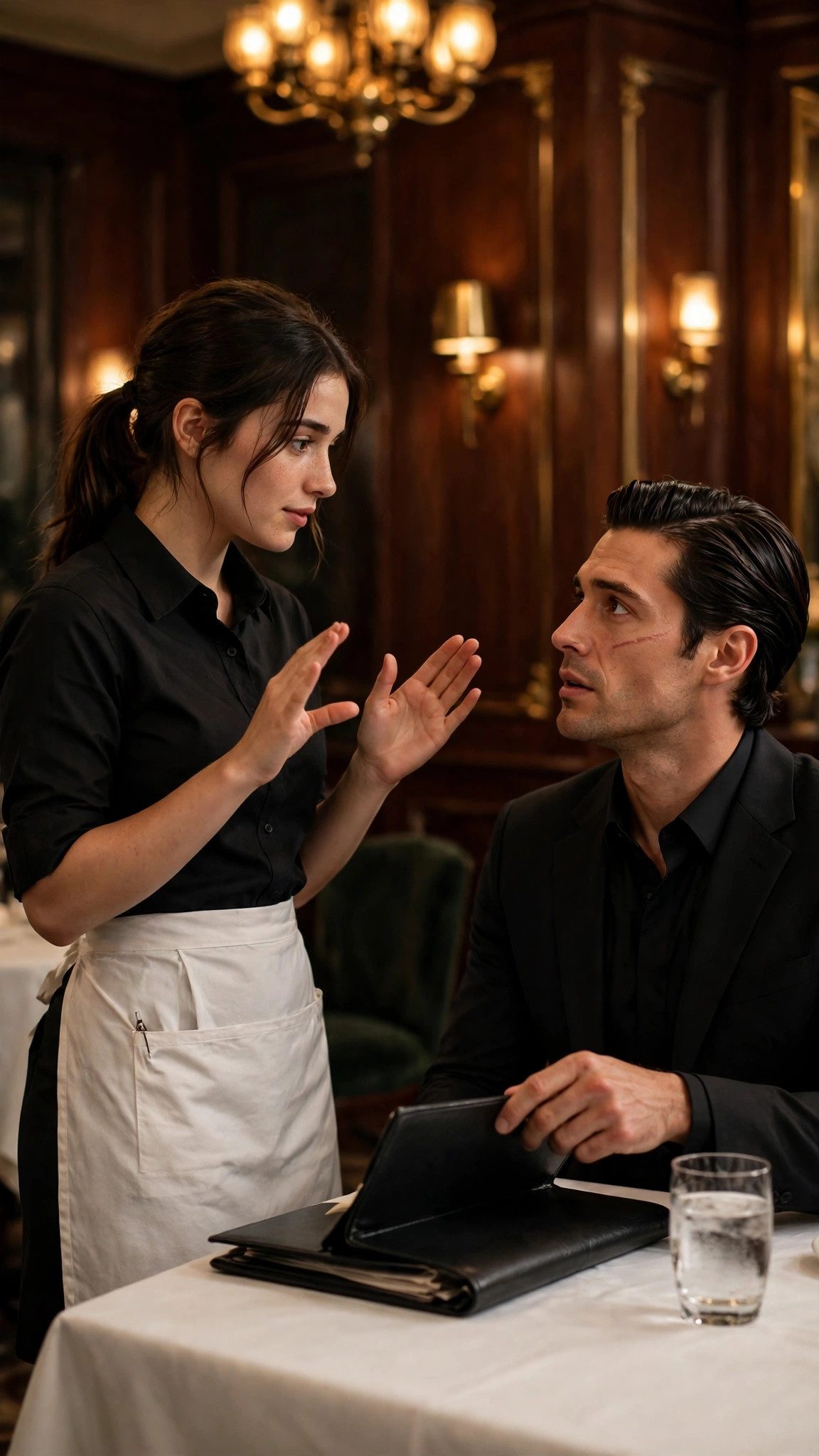
The wedding was not what anyone expected. That was the first thing the newspapers said about it, and it was the only thing they got right.
Salvatore Marquetti, the most feared man in Chicago, did not get married in a cathedral. He did not get married in a hotel ballroom. He did not get married in a room full of politicians and businessmen pretending they were not afraid of him.
He got married in the garden of the Westside Community Center, on a Saturday afternoon in June, under a white canopy that Noah and the children had decorated with paper butterflies. There were forty guests. My parents sat in the front row, my mother crying into a handkerchief, my father holding her hand. Noah stood beside me as my best man, wearing a suit he had picked out himself, his hair combed back, his hands steady. Rocco, Dante, and Marco stood beside Salvatore, three large men in dark suits who looked profoundly uncomfortable in a garden full of children, and who kept glancing at the paper butterflies as if they might be a trap.
The ceremony was short. The officiant was a woman named Mrs. Delgado, who ran the community center and had known me for four years, and who had cried when I told her I was getting married, and who had immediately started planning the garden.
When it came time for the vows, Salvatore did something that made every person in that garden go completely still. He did not speak them aloud. He signed them.
"I, Salvatore Marquetti," he signed, his hands moving slowly and clearly so that everyone could follow, "take you, Tessa Hayes, to be my wife. I promise to listen to you, even when I cannot hear you. I promise to learn your language, the way you learned mine. I promise that you will never sit in a room full of people you love and feel alone again. And I promise that our home will never be silent in the way my home was silent. It will be full of hands, and laughter, and children, and music you can feel through the floor."
I cried. I had not meant to cry. I had told myself I would not cry. But I cried, and Noah handed me a handkerchief, and my mother cried harder, and even Rocco, the largest man I had ever met, wiped his eyes with the back of his hand and pretended he had something in them.
Then it was my turn, and I signed my vows back to him, in front of everyone, my hands steady even though my heart was not.
"I, Tessa Hayes," I signed, "take you, Salvatore Marquetti, to be my husband. I promise to be your ears when you need them, and your voice when you need that, too. I promise to never let anyone use your silence against you. I promise to teach our children to sign before they can speak, so that they will never know a world where hands are quiet. And I promise that the silence between us will never be empty again. It will be full of everything we have to say."
Mrs. Delgado pronounced us married, and Salvatore kissed me, and the children cheered, and the paper butterflies fluttered in the June breeze, and for the first time in my life, I understood what it felt like to be completely, entirely, without reservation, happy.
But the wedding was not the end of the story. It was the beginning of something neither of us had expected.
Three months after the wedding, Salvatore did something that shocked Chicago more than the wedding had. He held a press conference. Not in a hotel. In the community center, in the same garden where we had been married, with the same white canopy and the same paper butterflies. He stood at a podium, and he looked out at a room full of reporters, and he did something no one in his world had ever done before.
He told the truth.
"My name is Salvatore Marquetti," he signed, and an interpreter — me, standing beside him, my hands moving in time with his — translated for the cameras. "Six years ago, a bomb planted by Vincent Castellano killed my father and took my hearing. I have been deaf ever since. I hid it, because in my world, a weakness is a death sentence. I hid it from my uncles, from my cousins, from my rivals, from everyone except three men and one teacher who is no longer with us. I hid it because I was afraid. I am done being afraid."
The room went silent. Reporters stared. Cameras flashed. And then, slowly, a woman in the front row stood up and began to applaud. She was the mother of Maya, the little girl with the hearing aids, and she was crying, and she was clapping, and one by one, the whole room joined her.
That night, the story was on every news channel in Chicago. "Mafia Boss Reveals Deafness." "Marquetti Breaks Silence." "The Most Feared Man in Chicago Speaks With His Hands." Some of the coverage was cruel. Some of it was kind. Most of it was confused. But none of it mattered, because Salvatore had done what he had needed to do, and he had done it in the open, and no one could use it against him anymore.
A week later, he announced the foundation. He called it the Silence Between Us Foundation, and its mission was simple: to teach American Sign Language to the families of deaf children, for free, in every neighborhood in Chicago, and to fund hearing aids, cochlear implants, and speech therapy for children whose families could not afford them. He funded it himself, with money from his legitimate businesses, and he put Noah in charge of it, because Noah was the only person he trusted to run it the way it needed to be run: with patience, and with love, and with the understanding that a deaf child is not a broken child, but a child who speaks a different language.
Noah took to the work the way he had taken to everything that mattered: completely. He hired teachers. He opened classes in five neighborhoods in the first year, and ten in the second. He designed the foundation's logo himself — two hands, open, reaching toward each other, with a butterfly between them. Maya, the little girl who had laughed at the word for "butterfly," was one of the first students. Her mother told me, a year later, that Maya had started talking to everyone, that she had made friends, that she had stopped believing she was stupid. "She thinks she's a butterfly now," her mother said, laughing through tears. "She says butterflies don't need to hear to fly."
Brett Calloway was released from prison after eighteen months. He wrote me a letter. It was short, and it was clumsy, and it said, "I am sorry. I was stupid, not evil. You were right." I never wrote back. I did not need to. Salvatore had forgiven him the night in the private dining room, when he had let him live, and that was enough. Some people do not need your forgiveness. They need your indifference, and the knowledge that you have moved on to a life so full they are no longer a part of it.
Candace and Priya, the two waitresses who had laughed with Brett, both wrote to me as well. They apologized. They asked if they could volunteer at the foundation. I said yes, because I had learned that the best revenge is not punishment, but invitation. They now teach the beginner's class on Tuesday nights, and they are good at it, and they tell every new parent the same thing I told Maya's mother: your child is not broken. Your child is waiting for you to learn their language.
As for Salvatore and me, we live in the house on the lake now, the one he never visited because the silence there was too loud. It is not too loud anymore. We have filled it with sound we can feel: the piano, which he plays every evening, badly and joyfully, his hands finding the chords through the vibration of the wood. The children from the foundation, who come on Sundays to practice their signs in the garden. Noah, who comes for dinner every Friday, and who has started dating a woman named Sofia, a teacher at the foundation, who signs beautifully and laughs at his jokes a second before he finishes them, which is exactly the way love should work.
And one evening, about a year after the wedding, I was standing in the kitchen, making dinner, and Salvatore came up behind me and wrapped his arms around me, and he signed, over my shoulder, where I could see his hands in the reflection of the window, "Do you remember the first night? In the private dining room?"
"Of course," I signed back.
"I thought you were going to humiliate me," he signed. "I thought you were going to laugh at me, the way everyone laughs at the deaf man who can't hear the joke."
"I thought the same thing about you," I signed. "I thought you were going to humiliate me, the way everyone laughs at the quiet waitress who doesn't fit in."
"We were both wrong," he signed.
"We were both right," I signed back. "We were both afraid. And then we weren't."
He turned me around, and he looked at me, and his face did the thing it had done that first night, the thing it had not done in six years before I walked into his room: it relaxed. Completely. The way a person's face relaxes when they come home.
"I love you," he signed. "In every language I know."
"I love you," I signed back. "In every language I know. And in the ones I'm still learning."
Outside, the lake was gray and quiet, and the house was full of the vibration of the piano, and the smell of dinner, and the sound of Noah laughing in the next room, and I thought about the girl I had been at twelve years old, sitting outside her brother's bedroom door, talking to the wood, refusing to let silence win.
She would not have believed this life. She would not have believed that the silence she feared would become the thing that saved her. She would not have believed that a joke meant to humiliate her would lead her to the man who would love her, and to the family she would build, and to the foundation that would teach a thousand children that they were not alone.
But it did. And it was not a joke. It was the beginning of everything.
The silence between us was never empty. It was full of hands, and laughter, and love, and all the things we had to say. It was full of us. And it always will be.
One year after the wedding, on our first anniversary, Salvatore took me back to Bellini House. Not to the private dining room. To the main room, where I had served a thousand dinners, where I had been nobody, where I had carried trays for four years while the world looked straight through me. He had reserved the whole restaurant, every table, and he had invited everyone who mattered: my parents, Noah and Sofia, Rocco and Dante and Marco, Mrs. Delgado and the children from the foundation, Mr. Delgado and the staff who had stayed, and even Candace and Priya, who had learned to sign and who now taught the beginner's class on Tuesday nights.
He stood up in the middle of dinner, and he raised his glass, and he looked at me, and he signed, in front of everyone, "One year ago, I walked into this restaurant and I was a man who ate alone. Tonight, I am a man who eats with his family. Tessa taught me that silence is not the absence of sound. It is the presence of love, waiting to be spoken. And she taught me to speak it."
Everyone applauded. Noah stood up and signed, "To my sister, who learned my language before she knew she would need it. And to Salvatore, who learned it because he loved her. May your silence always be full."
My mother cried. My father cried. Even Mr. Delgado wiped his eyes with a napkin and pretended he had something in them.
After dinner, Salvatore took me out to the terrace, where the city lights stretched out below us, and he held my hands, and he signed, "I have one more thing to tell you."
"What?" I signed back.
He smiled, that small careful smile, the one I had first seen in the private dining room, the one that had transformed his face. "Mrs. Reyes told me, on our last lesson, that one day I would meet someone who spoke my language, and I would not have to hide anymore. She was right. But she didn't tell me the best part."
"What's the best part?" I signed.
"The best part," he signed, "is that you didn't just speak my language. You taught it to a whole city. You taught it to children who thought they were broken. You taught it to mothers who thought they had lost their babies. You taught it to me. And because of you, there are a thousand people in Chicago tonight who are a little less alone than they were a year ago."
I looked at him, and I thought about the girl I had been at twelve, sitting outside her brother's bedroom door, talking to the wood. I thought about Mrs. Whitfield, and her husband, and the loneliest thing in the world. I thought about Maya, and the word for "butterfly," and the way her mother had cried. I thought about Noah, and Sofia, and the foundation, and the piano, and the paper butterflies in the garden.
"I didn't do it alone," I signed. "You did it with me. We did it together. That's how it works. That's how it always worked. Two people, learning each other's language, one hand at a time."
He kissed me then, under the city lights, with the restaurant full of the people we loved behind us, and the lake dark and quiet in the distance, and I understood, finally and completely, what Mrs. Reyes had meant all those years ago, in a room with the curtains drawn.
She had meant that silence is not an ending. It is a beginning. It is the space between two people, waiting to be filled. And the only thing you need to fill it is the willingness to learn.
We learned. And we are still learning. And we always will be.
The End.
THE END