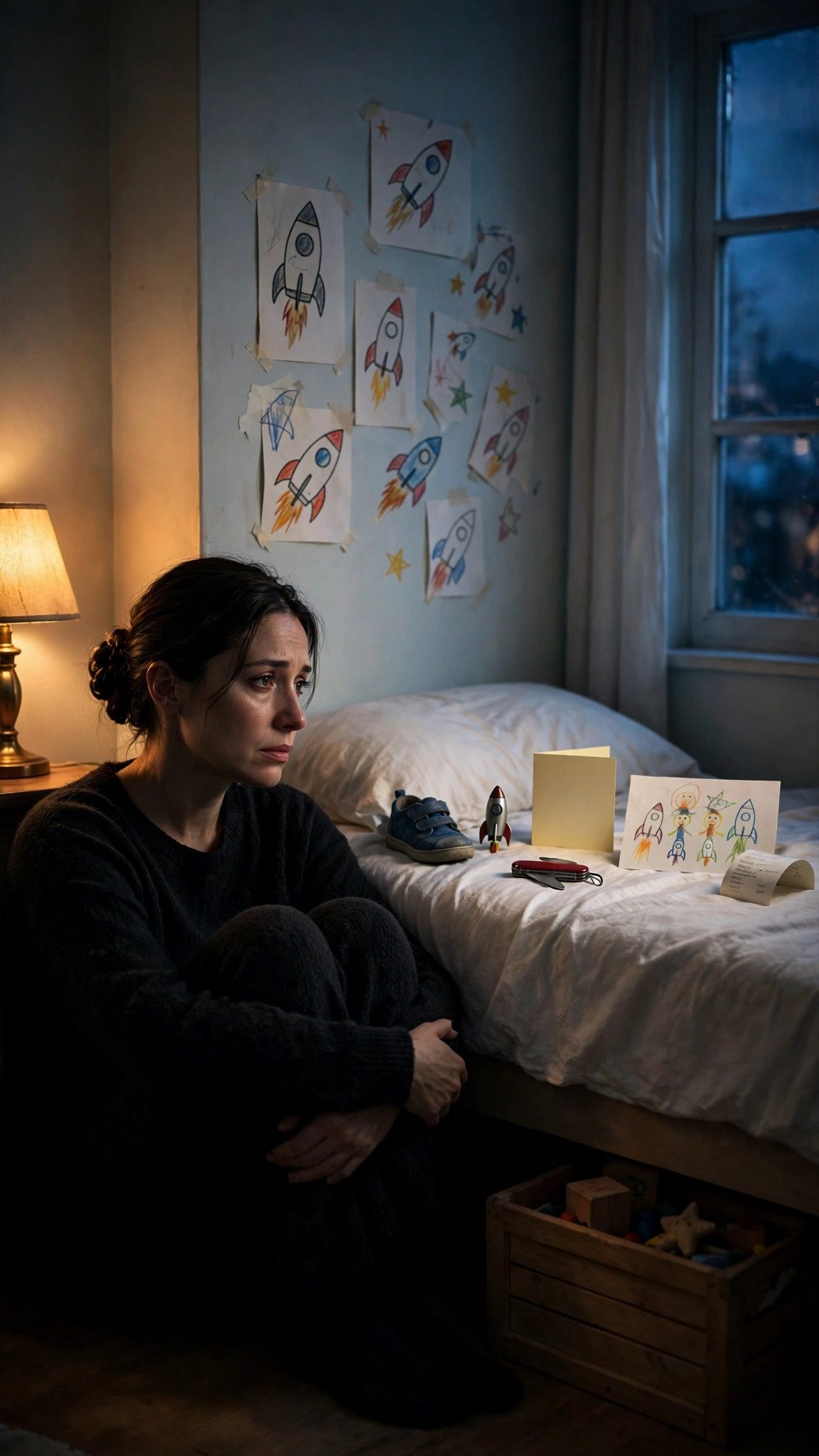
When Marcus finally appeared at home at 10 a.m., fourteen hours after Noah's death, I sat in the corner of Noah's bedroom on the floor. I didn't move. I didn't speak.
He was wearing a wrinkled suit and he smelled of jet fuel. He assured me that he had flown back from Chicago, that he had come as fast as he could, that he was sorry. But when he saw what was on the bed, he stopped.
The six items.
A child's shoe. A small magnet. A Swiss army knife. A birthday card. A crude drawing of the four of us as rocket ships. And a receipt from a Zurich restaurant dated the day Noah died, showing Marcus and Rebecca's dinner for two: 3,680 Swiss francs.
He exploded. "Where is Noah?!" His voice boomed through the entire house. I hadn't seen Marcus in a state like that in a long time. His cold, pallid expression shifted into something I had only seen briefly, the expression of a man from one of the bloodiest crime families in Illinois.
He grabbed the receipt in his hand and crumpled it into a ball, letting out a low scream. He saw the accident had happened before he got home. He couldn't find his child, yet he looked for conflict instead of comfort. All he wanted was to join the war.
"Claire," he said, and his voice was shaking. "Claire, where is my son? Where is Noah? Tell me where he is."
I looked up at him from the floor. I had been sitting there all night, in the corner of the room, with my back against the wall and my knees pulled up to my chest, and I had not moved, and I had not slept, and I had not cried. I had only sat there, listening to the silence of the house, and thinking about the six items on the bed, and about the boy who had once filled this room with noise and drawings and questions about the stars.
"He's gone, Marcus," I said. My voice sounded like it belonged to someone else. "Noah is gone. He died last night, at 8:42. I signed the papers. I held his hand. I was there. You were in Zurich."
Marcus stared at me. His face went white, then grey, then something I had never seen before, something broken, something that looked like a man who had just been told that the ground under his feet had disappeared.
"No," he said. "No. That is not possible. I talked to Dr. Alvarez yesterday. She said he was stable. She said—"
"She called you twice," I said. "She sent six messages. You did not answer. You were at dinner."
He took a step toward me, and then he stopped, because he saw the look on my face, and he understood, finally, that I was not going to comfort him. I was not going to hold him. I was not going to tell him it was all right, because it was not all right, and it was never going to be all right again.
"Claire," he whispered. "Please. Please, tell me what happened. Tell me everything."
So I told him. I told him about the headache, and the fever, and the scan, and the storm in the brain. I told him about the ventilator, and the doctors, and the choice. I told him about the pen, and the paper, and the time on the clock, 8:42 P.M., and the way Noah had squeezed my hand twice, two squeezes for yes, and the way he had asked me not to let him suffocate.
I told him about the six items. I told him that the shoe was the one Noah had worn to the zoo, the one with the mud still on it from the elephant enclosure. I told him that the magnet was the rocket he had brought back from the lake, the one Noah had kept on the refrigerator until the day he got sick. I told him that the Swiss army knife was the one from his own pocket, the one Noah had carried in his wooden box like it was made of gold. I told him that the birthday card was the one Noah had made him last year, with a rocket drawn in crayon and the words "To Daddy, my hero" written in wobbly letters. I told him that the drawing was the four of us as rocket ships, flying to the stars together, the way Noah had always imagined it. And I told him that the receipt was from Zurich, dated the day our son died, for a dinner for two, 3,680 Swiss francs, and that I had gotten it from Frank, who had gotten it from the driver in Zurich, who had been there, who had seen them, who had watched Marcus raise a glass to another year of a marriage he had already abandoned.
Marcus sank down onto the bed, among the six items, and he put his head in his hands, and for the first time in the eleven years I had known him, I saw Marcus Vale cry.
Not the quiet tears of a man who is sad. The terrible, broken sobs of a man who has just understood that he has destroyed the only thing in his life that ever mattered, and that no amount of money, and no amount of power, and no amount of men with guns, can ever bring it back.
"I'm sorry," he said, over and over. "Claire, I'm sorry. I'm so sorry. I didn't know. I swear to you, I didn't know he was that sick. Rebecca told me—"
"Don't," I said. I stood up. My legs were stiff from sitting on the floor all night, but I stood up, and I walked to the door, and I stopped there, and I turned back to look at him, sitting on our dead son's bed, surrounded by the six things he had left behind.
"I can forgive a husband who no longer loves me," I said. "I don't know how to live with a father who would never come home. And I will always remember Noah, who thought his hero would never come, but he never did."
Then I walked out of the house, and I did not look back.
Before I left the house, I went back upstairs, to Noah's room, and I opened his backpack, the one I had packed that morning. Inside, on top of his uniform, there was a drawing I had not seen before. It was a rocket, drawn in blue crayon, with four stick figures standing beside it, holding hands. Underneath, in his wobbly handwriting, it said: "My family. We go to the stars together."
I sat down on the bed, holding that drawing, and I cried, quietly, for the first time since the hospital, because he had drawn it the week before he got sick, when everything was still all right, when he still believed that we would all go to the stars together, and he had put it in his backpack, so he could show it to his teacher, and to his friends, and to anyone who would look.
I folded it carefully, and I put it in my pocket, next to my heart, and I carried it with me when I walked out of the house, because it was the last thing he had made, and it was the truest thing he had ever said.
I went to Grace's house. She opened the door, took one look at my face, and pulled me inside without a word. She made tea I did not drink. She sat with me on her couch while I told her everything, and when I finished, she held me, and for the first time since Noah died, I cried.
I cried for hours. I cried until there were no tears left, and then I cried some more, because grief is not a thing you finish. Grief is a thing you carry, and some days it is heavy, and some days it is heavier, and some days you think you cannot carry it one more step, and then you do, because there is no other choice.
Frank came to Grace's house the next day. He stood on the porch, his cap in his hands, and when Grace opened the door, he said, "I need to see Mrs. Vale. Just for a minute. I need to tell her something."
Grace let him in. He sat at the kitchen table, and he looked at me, and he said, "Mrs. Vale. I went back to the house this morning. Mr. Vale is still there. He has not left Noah's room. He is sitting on the floor, in the corner, the way you were sitting, and he has not moved, and he has not eaten, and he has not slept. I have never seen him like this. In eleven years, I have never seen him like this."
"Good," I said, and my voice was colder than I meant it to be. "Let him sit there. Let him feel what it feels like to be alone in that room."
Frank nodded. "I understand, Mrs. Vale. I do. But there is something else. Castellano's men have been watching the house. Two cars, on the street, since yesterday. They know Mr. Vale is broken. They know the family is weak. And I am afraid, Mrs. Vale, that this is only the beginning."
I looked at him. "What do you want me to do, Frank?"
"I want you to be safe," he said. "I want you to stay here, with Grace, where Castellano's men do not know to look. And I want you to let me watch over you, the way I watched over Noah. Because you are the only family I have left, Mrs. Vale. You and Grace. And I am not going to let anything happen to you."
I nodded. "Thank you, Frank. Thank you for staying."
"I will always stay, Mrs. Vale," he said. "That is what I do. I stay."
After he left, Grace made tea, and we sat at the kitchen table, and she said, "Claire. You need to think about what happens next. Not today. Not tomorrow. But soon. You cannot stay in my spare room forever. You need a plan."
"I have a plan," I said. "I am going to go back to work. I am going to help the sick children. I am going to build something good out of this, because if I do not, then Noah died for nothing, and I will not let that happen. I will not let his life have been spent in vain."
Grace nodded. "Then that is what we will do. Together. One day at a time."
The funeral was three days later, on a Sunday. It rained. Noah would have liked the rain. He used to stand at the window and watch it, and say that the raindrops were racing each other down the glass, and he would pick one and cheer for it like it was a horse.
Marcus was there. He stood at the back, in a black suit, with Frank beside him, and he did not come near me. He did not try to speak to me. He only stood there, in the rain, watching them lower the small white coffin into the ground, and I could see his shoulders shaking, even from across the cemetery.
Afterward, Grace drove me home, to her house, because I could not go back to the big house on the lake, not yet, maybe not ever. I slept in her spare room, in a bed that was too soft, under a blanket that smelled like lavender, and I lay awake every night, listening for a key in a door that was not there, and thinking about the six items on Noah's bed, and about the boy who had once asked if he could connect the dots of the stars to draw a rocket on the ceiling.
Every Sunday after that, I went to the cemetery. I brought white lilies, because Noah had once said they looked like stars that had fallen down to live in the grass. I sat beside his grave, and I told him about my week, and about Grace, and about the hospital, and about the world going on without him, and I told him that I missed him, and that I loved him, and that I would never, ever forget him.
And every Sunday, when I left, I saw the same thing: a black car parked at the far end of the cemetery, with Frank at the wheel, and Marcus sitting in the back seat, watching from a distance, never coming closer, never speaking, only watching, because he knew, finally, that he had no right to stand beside me at our son's grave.
Not yet. Maybe not ever. But he came, every Sunday, and he watched, and he waited, and I told myself it did not matter, because it did not change anything, because nothing could change anything, because Noah was gone, and he was never coming back.
But it did matter. It mattered more than I wanted to admit. Because the man in the car was the same man who had once promised, with his hand on his newborn son's head, that no harm would ever come to him while he was alive to stop it. And the man in the car had broken that promise, and he knew it, and he was sitting in the rain, every Sunday, waiting for a forgiveness he had not earned, and might never earn.
I did not know then that he was going to try to earn it. I did not know then that the next chapter of this story would be about a man who had lost everything trying to become a man who deserved to have something again. I did not know then that Frank would call an FBI agent, or that Marcus would give away his empire, or that Castellano would end up in a cell, or that I would one day stand beside Marcus at our son's grave and feel something other than anger. I knew none of that. I only knew that my son was dead, and my marriage was dead, and I was alive, and I had to figure out how to live with that, one Sunday at a time, one breath at a time, one small step at a time, until the steps added up to a life again.
I only knew that my son was dead, and my marriage was dead, and I was alive, and I had to figure out how to live with that, one Sunday at a time.