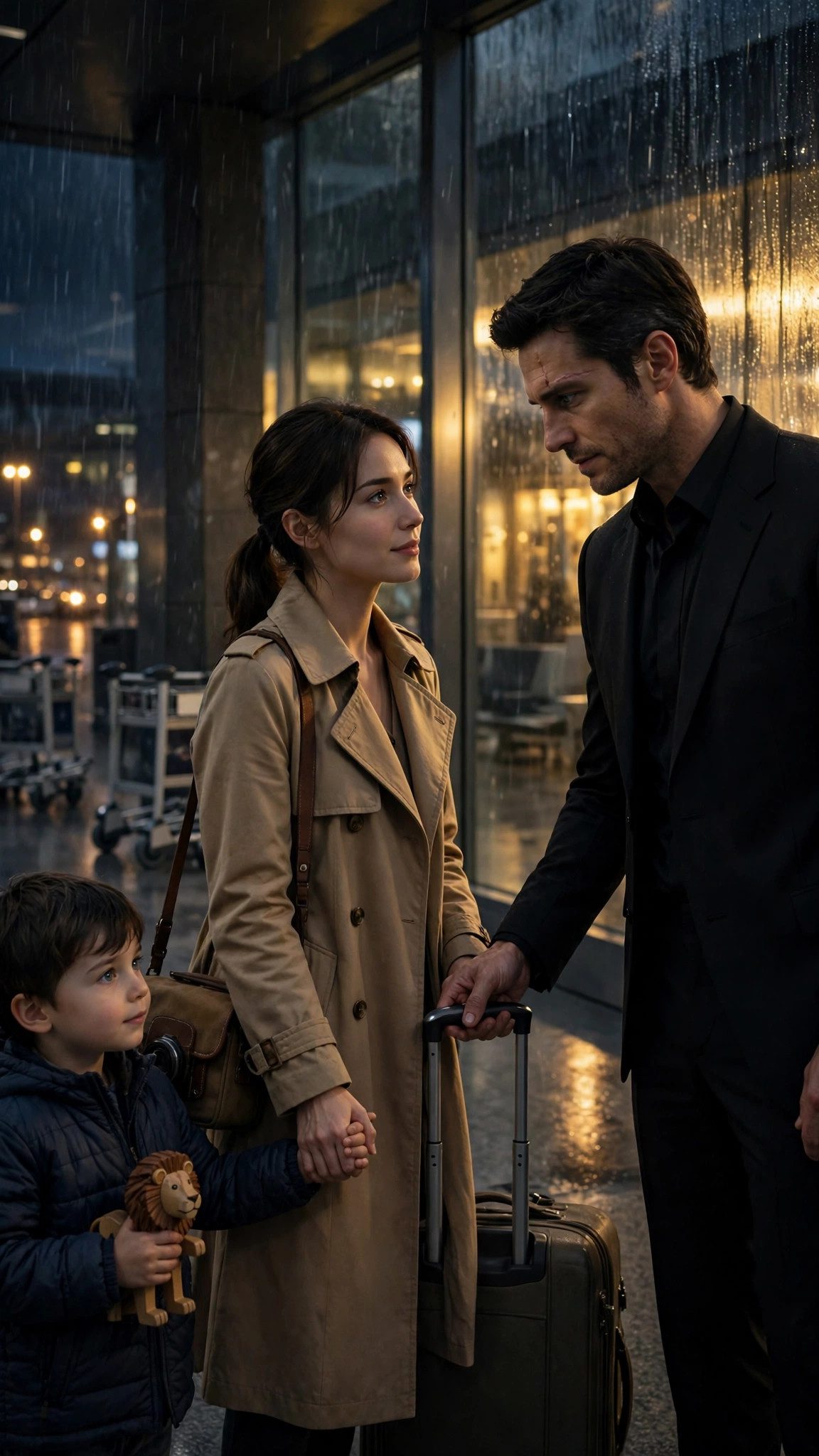
The doctor's office in Geneva was small and white and smelled faintly of antiseptic and snow. I remember the poster on the wall, a diagram of a hand, and the clock above the door, and the way the doctor folded her hands on her desk and looked at me over her glasses and said, in careful English, "You are pregnant, Miss Carter. About six weeks."
Six weeks. I counted backward in my head, and I knew exactly when it had happened, and I knew exactly whose it was, and I sat very still and thought about the last time I had seen Dante, three weeks before the wedding, in the penthouse above the city, with the lights spread out below us and his hand on the back of my neck, and how he had looked at me that night like he already knew he was losing me.
"Are you all right?" the doctor asked.
"Yes," I said, and it was a lie, but it was the only word I had.
I walked out of that clinic into the snow, and I stood on the pavement for a long time, watching my breath turn white in the cold air, and I thought about my mother, who had died four years earlier, and my father, who had passed long before that, and I thought about how alone I was in the world, and then I thought about the small life growing inside me, and for the first time in months, I did not feel alone at all.
I did not call Dante. I did not call Victoria. I did not call anyone. I went home to my little apartment above the bakery on Rue de la Servette, and I sat by the window with a cup of tea going cold in my hands, and I made my decision the way I have always made my decisions: quietly, and all at once.
I would keep the baby. I would raise him alone. I would never tell Dante, because by then he was my sister's husband, and I would not be the woman who destroyed her sister's marriage. I would not be the scandal twice over. I would be a mother, and that would be enough, because it had to be enough.
It was harder than it looked.
The first months were the worst, not because of the sickness, although there was plenty of that, but because of the loneliness. I photographed weddings with a camera that felt heavier every week, and I smiled at brides, and I went home to an empty apartment, and I talked to the small life inside me as if he could hear me, and I told him about Chicago, and about the lake, and about his grandfather, who had built a company with his hands and died at his desk, and about his grandmother, who had kept the books and made soup on Sundays.
I named him Leo in the seventh month, after my father's middle name, because my father had always loved lions, and because I wanted my son to have something of my father in him, something brave. Leo Carter. It sounded right. It sounded like a boy who would grow up strong.
He was born on a rainy night in September, in a hospital with white walls and a view of the rooftops, and when the nurse put him in my arms, wet and furious and perfect, I looked down at his face and I saw Dante. Not in the way I had feared, not as a ghost, but as a fact. The dark hair, already thick. The grey eyes, already watchful. The set of his chin, already stubborn. And then he opened his mouth and cried, and I laughed through my tears, because that cry was entirely his own, and entirely mine.
Marta came into our lives when Leo was four months old. She was sixty-two, a widow from Ticino with silver hair and hands that had raised five children of her own, and she answered my advertisement for a nanny with a single sentence: "I have loved many babies. I will love yours too." She moved into the little room off the kitchen, and she taught me how to hold him, and how to feed him, and how to sleep when he slept, which I never learned, and she became the closest thing to family Leo and I had in Switzerland.
"He has his father's eyes," Marta said to me once, when Leo was a year old, sitting on her lap in the kitchen, staring at the world with that grey, watchful gaze. "And your smile. You must be careful, Elena. A child like this one, everyone will want to know where he comes from."
"I know," I said.
"You have never told me," she said. "And I have never asked. But one day he will ask, and you must have an answer."
"I'll tell him his father loved us," I said, "and that sometimes love isn't enough."
Marta looked at me for a long time, and then she nodded, and she never mentioned it again.
Leo grew the way children do, too fast and all at once. He walked at ten months, talked at fourteen, and by two he was taking apart everything in the apartment to see how it worked. The toaster. The radio. My camera, once, while I was in the shower, which I forgave him for only because the look on his face when I found him, surrounded by lens caps and screws, was so proud that I could not bring myself to be angry.
He was itchy, always moving, always reaching, always asking why. He was incredibly clever and tenacious, but also very spontaneous, the kind of child who would decide at breakfast that he wanted to be a fireman and by lunch had moved on to being a lion tamer, and who meant both completely. He had my smile, the wide one that showed his teeth, and my stubbornness, the set of his jaw when he had decided something, but everything else belonged to Dante. The dark hair that fell across his forehead. The grey eyes that watched the world like it owed him an explanation. The way he held his chin when he was thinking, exactly the way his father did.
At night, I could see myself rocking him while his face grew up, and I wondered if Dante had noticed. I wondered if he had ever stood at his window in Chicago and thought about me, or if the marriage and the empire and the organization had swallowed him whole. I wondered if Victoria had given him children, and if he held them the way he would have held Leo, and I hated myself for wondering, because wondering was just another way of not letting go.
I never told Leo where he came from. That was dangerous, because a child who does not know where he comes from will invent an answer, and Leo was already inventing. When he was two and a half, he pointed at a man on the tram and said, "Is that my papa?" and my heart stopped, and I said, "No, sweetheart, that's just a man," and he said, "Then where is my papa?" and I said, "He lives far away, in a city across the ocean," and Leo thought about this for a moment and said, "Does he have a big house?" and I said, "Yes, a very big house," and Leo said, "Good. When I grow up I will go and find him," and I smiled, and I did not cry until he was asleep.
Leo's first birthday fell on a rainy day in September, and Marta made a cake with one candle, and I took a photograph of him with frosting on his nose, and he laughed, and I laughed, and for a moment the little apartment above the bakery felt like the whole world. Marta gave him a wooden lion, carved by her late husband, and Leo carried it everywhere for a month, until the paint wore off its nose, and I thought about how a child can be happy with so little, a cake, a candle, a wooden lion, and how I had once thought I needed an empire to be happy, and how wrong I had been.
That winter, I photographed a wedding in an old church in the Old Town, a small wedding, just family, and I watched the bride's father walk her down the aisle, his hand shaking on her arm, his eyes wet, and I thought about my own father, who would never walk me down any aisle, and I thought about Leo, who would never know his grandfather, and I went home that night and held my son a little tighter, and I told him about his grandfather, about the company he had built with his hands, and the soup his grandmother made on Sundays, and the way he used to take Victoria and me to the lake to fly kites, and Leo listened with his grey eyes wide, and he said, "Tell me again, Mama," and I did, and then he said, "Tell me about my papa," and I went very still, and I said, "Your papa lives far away, in a city across the ocean," and Leo said, "Is he tall?" and I said, "Very tall," and Leo said, "Is he strong?" and I said, "Very strong," and Leo thought about this for a moment, and then he said, "Good. When I grow up I will be tall and strong like him," and I smiled, and I did not cry until he was asleep, and then I cried for a long time, quietly, so Marta would not hear.
There were things I did not notice in those years, things I only understood later. The man in the grey coat who sat on the bench across from the park every Tuesday, reading the same newspaper, never turning a page. The new family that moved into the apartment below us, quiet, polite, with a little girl Leo's age, who always seemed to be home. The way Marta would sometimes look out the window a little too long before she drew the curtains.
I thought Geneva was safe. I thought the ocean was enough. I was wrong, and I would not understand how wrong I was until the night of June nineteenth, when Dante Moretti stood by the gate at O'Hare with my suitcase in his hand and asked me if the boy was my son, and I realized that the man in the grey coat had not been reading a newspaper at all. He had been watching my son. And he had been reporting back to Chicago every single week.
On Sundays, Leo and I would walk to the lake, Lac Léman, with a bag of bread for the swans, and he would run ahead of me on the path, his little legs pumping, his lion tucked under his arm, and I would call after him to slow down, and he would slow down for exactly three seconds, and then run again, because that is what three-year-olds do. Marta would come with us sometimes, and she would teach Leo words in Italian, her mother tongue, and Leo would repeat them solemnly, "ciao" and "grazie" and "amore," and Marta would laugh, and say, "He has an ear for languages, this one, like his mother," and I would think about how Leo had never heard his father speak Italian, and how he would learn it anyway, because some things are in the blood, and cannot be kept away by an ocean. On the walk home, Leo would always ask for one more story about Chicago, about the big lake and the tall buildings, and I would tell him, and he would listen, and I would wonder if he could feel, the way I could, that the city across the ocean was calling us home.
The reason I came back was my father. His ashes had been in Switzerland with me, in a small wooden box on the shelf above my desk, because when he died I could not bear to leave him in Chicago, and I could not bear to scatter him, either. For three years I had carried that box from apartment to apartment, and for three years I had told myself I would take him home one day, when I was ready, when it was safe, when the pain had dulled enough to do it properly.
In May, Marta found me sitting by the window with the box in my lap, and she sat down beside me, and she said, "Elena. It is time."
"Time for what?" I asked.
"Time to take him home," she said. "A father should rest where his daughters can visit him. And you, my dear, have been running for three years. It is time to stop running."
She was right, and I knew it. I booked the flights for June nineteenth, five days in Chicago, just long enough to move the ashes to the family plot at Graceland Cemetery, to stand by my parents' graves for the first time in three years, and to leave again before anyone who mattered even knew I was home.
I told Leo we were going on an adventure, to the city where Mama grew up, to see the big lake and the tall buildings. He packed his little backpack himself, with his toy lion and his red truck and three books, and he asked me if the city had lions, and I said no, but it had a lake so big it looked like the sea, and he said that was almost as good.
I did not tell Victoria I was coming. I did not tell Dante. I did not tell anyone. I bought the tickets under my own name, because I was too tired to be careful anymore, and I told myself that five days was not enough time for the past to find me.
I was wrong about that, too. The past did not need five days. It needed five minutes, and a gate at O'Hare, and a man in a black suit who had been waiting for me for three years, and who had known about my son for two of them.