One year later, on a bright October morning, I opened the doors of my own café for the very first time.
*The Wrong Coat* sat on a corner in Logan Square, with big windows and warm light and a chalkboard menu that Priya had lettered by hand, and a counter made of reclaimed wood that Ethan had found at a salvage yard and refinished himself, because he insisted that a café should feel like it had always been there. The espresso machine was new. The cups were mismatched on purpose. The first customer through the door was my father, who had driven down from Madison at five in the morning and who immediately asked if I was eating properly.
"Dad," I said, hugging him, "I own a café now. I eat very properly."
Luke was there, too, in a suit that actually fit him, with his hair combed and his shoes shined, looking like the head of logistics he had become. He had brought sunflowers — Marcus's flowers — and he set them on the counter in a mason jar, and he didn't say anything about it, and he didn't have to.
Priya was there, of course, behind the counter with me, in an apron that said *MANAGER* in iron-on letters, because she had insisted on a promotion and I had insisted on giving it to her. Carlos came by at noon with a plant and a card that said *Congratulations, kid. Don't forget the apron is non-negotiable.* I framed the card and hung it by the register.
And Ethan was there. He had been there since six in the morning, helping me set up, carrying boxes, fixing a wobbly table leg, standing in the doorway in his charcoal wool coat with a cup of coffee in his hand, watching the room fill up with people like a man who couldn't quite believe any of it was real.
By four o'clock — four o'clock, always four o'clock — the café was full, and the light was coming through the big windows in long golden bars, and I was behind the counter with flour on my apron and a smile on my face that would not come off, and Ethan walked over to me, and he took my hands in his, and he said, "Come with me."
"Where?" I said. "We're in the middle of the opening."
"Trust me," he said, and his gray eyes were doing that thing they did when he was nervous — the thing I had first seen on a sidewalk on Rush Street, in the rain.
He took me out of the café, into his car, with Rocco driving and Marco riding shotgun, and we drove through Chicago in the golden afternoon light, past the river and the towers and the lake, and I had no idea where we were going until we pulled up outside O'Hare, and my heart stopped.
"Ethan," I said. "What are we doing here?"
"You'll see," he said.
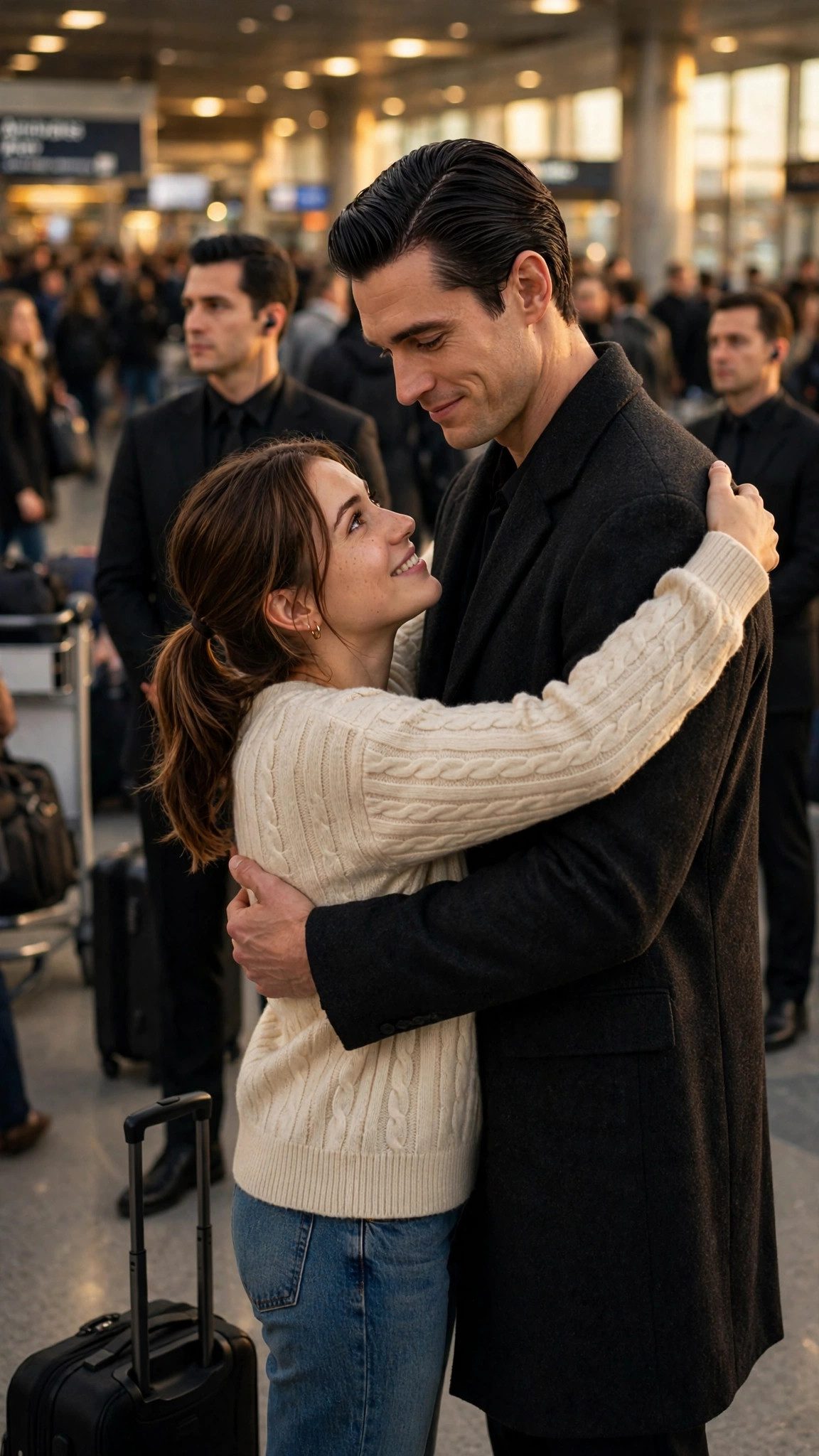
He led me through the terminal — past Gatehouse Coffee, where Carlos waved at us from behind the counter, past the security line, past the travelers with their suitcases — all the way to the arrivals hall, to the exact spot where, one year ago, I had thrown my arms around a complete stranger and whispered that I had missed him so much.
He stopped. He turned to face me. And then, in the middle of the crowded arrivals terminal, with travelers streaming past us and announcements crackling overhead, Ethan Caldwell — the most feared man in Chicago, the man who had dismantled his own empire's rot for the sake of a dead truck driver — got down on one knee.
"Hannah Reed," he said, and his voice was steady, even though his hands were shaking when he opened the small velvet box, and inside it was a ring — a simple gold band with a single sapphire, the color of the October sky. "One year ago, you hugged a stranger in this airport, and you told him you'd missed him. You had never met him. You meant it for someone else. And it was the best thing that ever happened to me."
He looked up at me, and his gray eyes were bright, and the whole terminal seemed to go quiet around us.
"I have spent my life building walls," he said. "Walls around my business, walls around my heart, walls around everything I loved, because I thought walls were the only way to keep things safe. And then you walked into my life wearing an apron and carrying a coffee cup, and you hugged me, and you tore down every single wall without even trying. You saw me, Hannah. Not the name. Not the rumors. Me. And I have never been more grateful for anything in my life."
He took a breath. "I am not a perfect man. I never will be. But I am a man who will spend the rest of his life trying to deserve you. So I am asking you, here, in the place where it all started — will you marry me?"
I stood there in the arrivals terminal, with my flour-dusted apron and my heart hammering, and I looked at the man on one knee in front of me, and I thought about everything — the coat, the hug, the coffee, table twelve, the manifests, the trial, the sunflowers, my father in Madison, my brother laughing again — and I thought about how a wrong hug in an airport had led me here, to this exact moment, to this exact man.
"Yes," I said. And then I said it louder, because the whole terminal deserved to hear it: "Yes! Yes, I'll marry you!"
He stood up, and he put the ring on my finger, and I threw my arms around him — on purpose this time, in front of half of O'Hare, in the exact spot where I had hugged him by accident a year ago — and I whispered, into his chest, where his heart was beating fast and steady, "I missed you so much."
"I know," he said, holding me tight. "You were screaming it at me."
"I wasn't screaming," I said, laughing through my tears. "I was just getting it straight."
Around us, the terminal erupted — travelers clapping, a flight attendant cheering, someone shouting congratulations in three different languages — and Luke appeared out of nowhere with his arms open and a wide grin on his face, and my father was right behind him, wiping his eyes with a handkerchief, and Priya was filming the whole thing on her phone, and Carlos was standing by the Gatehouse counter with his arms crossed and a smile on his face like a proud general.
That night, we celebrated at the Meridian Club — all of us, together: Luke and Priya and Carlos and my father and Rocco and Marco, and Marcus Doyle's parents, who had driven in from Rockford with a casserole and tears in their eyes, and who danced with my father to a song I didn't recognize, and who told me, when they hugged me good night, that Marcus would have loved all of this.
Six months later, we were married in a small church in Logan Square, with sunflowers on the altar and my father walking me down the aisle, and Luke standing beside Ethan as his best man, and Priya catching the bouquet and immediately pretending she hadn't wanted it. Ethan wore the charcoal wool coat. I wore a dress the color of cream. And when the minister asked if anyone objected, Rocco stood up and said, "Only if she hugs any other strangers," and the whole church laughed.
We honeymooned in Madison, in my father's house, where Mom's wild garden still grew along the back fence, and Ethan helped my father fix the leaking faucet, and I cooked breakfast every morning, and we sat on the porch in the evenings and watched the fireflies, and I thought about how strange and wonderful life was.
The wedding itself had been everything I never knew I wanted. Luke's speech made half the church cry and the other half laugh — he told the story of the airport hug, of course, and he told it with all the embellishments of an older brother who had been waiting a year to tell it properly, and he ended it by raising his glass and saying, "To Hannah, who hugged the wrong man and got the right one. And to Marcus, who brought us all here, even though he couldn't stay." Marcus's parents stood up then, and his mother, in her small, steady voice, said, "Our son would have loved this family. Thank you for letting us be part of it." There wasn't a dry eye in the church, including Rocco's, though he would deny it to his dying day.
Priya caught the bouquet and immediately pretended she hadn't wanted it, and then spent the rest of the evening dancing with Marco, the younger bodyguard, who turned out to be an excellent dancer and a terrible liar about it. Carlos danced with my father. The cake was vanilla with strawberries, because Ethan remembered that I had once mentioned, months ago, in passing, that vanilla with strawberries was my favorite, and he had written it down in a notebook he kept in his jacket pocket — a notebook, I later discovered, full of small things about me: my coffee order, my favorite flowers, the way I took my eggs, the name of the violin player upstairs.
One year after the wedding, on the first anniversary of *The Wrong Coat*, Ethan gave me a gift. It was a small wooden frame, and inside it, under glass, was the note he had sent me on my second day at table twelve — the note in the neat, slanted, expensive-looking handwriting.
*Table twelve. Four o'clock. Come alone.*
*— E.C.*
"I kept it," he said, watching my face. "Carlos gave it to me. He found it in your apron pocket the day you left Gatehouse, and he kept it, and he gave it to me on our wedding day, and I have been waiting a year to give it to you."
I hung it on the wall behind the counter, next to Carlos's framed card about the apron, where every customer could see it, and where I could see it every single morning when I opened the café.
People ask me about it all the time. They ask what it means, and I tell them the story — the airport, the coat, the hug, the coffee, the trial, the sunflowers — and they laugh, and they shake their heads, and they say it sounds like something out of a novel.
And I tell them it is. It's my novel. It's my life. And every word of it is true.
*The Wrong Coat* is still open. It does very well. The regulars know my name, and they know Ethan's name, and they know the story of the hug in the airport, because Priya tells it to anyone who will listen, and she tells it better every time. Luke comes by every Sunday with sunflowers for the counter. My father calls every Sunday and asks if I'm eating properly, and I always tell him yes, and it's always true.
And sometimes, on quiet afternoons, when the light comes through the big windows in long golden bars, Ethan sits at the corner table — table twelve, because some things you don't change — with a cup of black coffee, no sugar, and he watches me work, and he smiles the real smile, the one that changes his whole face.
Last month, Luke came by the café with news. He had started a scholarship, in Marcus's name, for the children of truck drivers — one full year of college tuition, every year, paid for by Meridian Freight. "Marcus would have hated the fuss," Luke said, grinning, "and he would have loved the party." The first recipient was a girl named Sofia, nineteen years old, whose father had driven for Meridian for twenty years. She came to the café to thank us in person, and she cried, and Luke cried, and I cried, and Ethan — Ethan, who never cries — had to go outside for a minute and pretend to check on the car.
That is what Marcus's death bought us, in the end. Not revenge. Not a war. A scholarship. A café. A family that was bigger than the one I was born into, because it included a truck driver and a barista and a mafia boss and a retired history teacher and a woman who made the best lattes in Chicago and two bodyguards who danced terribly and loved fiercely.
And I walk over to him, and I put my arms around him, and I whisper, "I missed you so much."
And he says, every single time, "I know. You were screaming it at me."
And I say, "I wasn't screaming. I was just getting it straight."
The pilot who used to call me "kid" found the café last week — he had heard about it from a flight attendant with a red scarf, who had heard about it from Carlos, who tells everyone everything. The pilot ordered a double espresso, looked around at the warm light and the mismatched cups and the framed note on the wall, and said, "Kid, you did good." I gave him the coffee on the house, because some customers are not customers. They are witnesses. They were there at the beginning, when my life was small and ordinary, and they are here now, at the end of the story, when it is anything but.
And he laughs, and he holds me, and I think about the invisible thread that connected us from the very beginning — a dead man and a living one and a barista and a coat and an airport — and I think about how the most humiliating mistake of my life turned out to be the best thing that ever happened to me.
Because sometimes, you hug the wrong stranger in an airport.
And sometimes, he turns out to be exactly right.
The End.
THE END