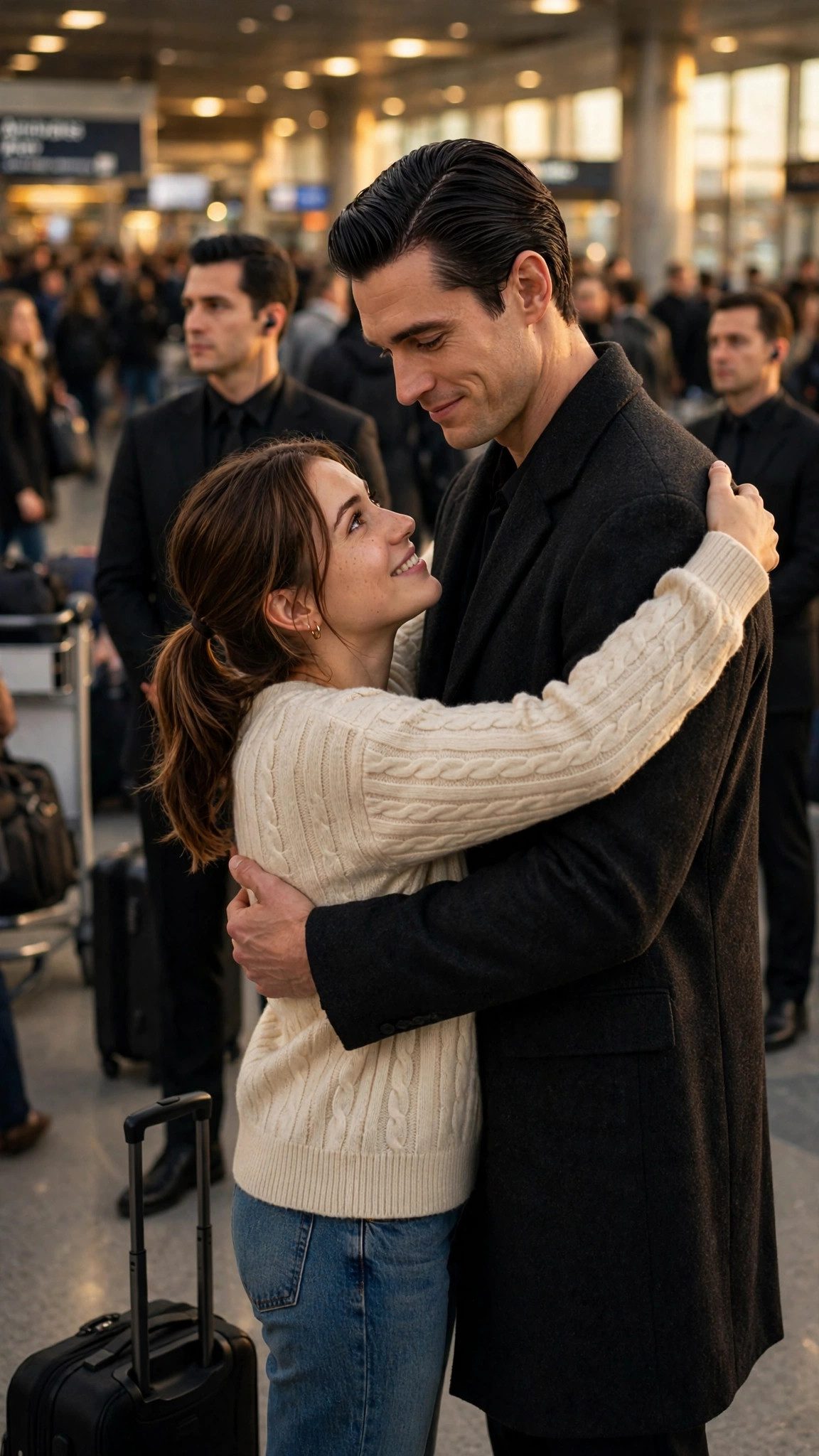
The trial of Dominic Voss took four months.
I know, because I was there for every day of it — sitting in the gallery with Luke, watching the prosecutors lay out the manifests and the ledgers and the bank records, watching Detective Harlan testify about the files he had closed, watching Voss sit at the defense table in a suit that was too expensive for a courtroom, his face getting grayer with every witness.
Marcus Doyle's parents were there, too. His mother, a small woman with Marcus's laugh lines around her eyes, sat in the front row every day with her hands folded in her lap, and on the third day of the trial, during a recess, she came over to Luke and me and she took Luke's hands in hers and she said, "Thank you for not letting them forget him."
Luke cried. He didn't try to hide it. He just stood there in the hallway of the courthouse and cried, and Marcus's mother held his hands, and I held his arm, and for the first time in three years, my brother looked like a man who had finally been allowed to grieve properly.
Voss was convicted on all counts. The judge gave him twenty-two years. The newspapers called it the biggest organized-crime trial in Chicago in a decade, and for about a week, Ethan Caldwell's name was on every television in the city — and then the news cycle moved on, the way it always does, and the city went back to its business.
Ethan's business changed, too. That was the part nobody wrote about in the newspapers, but I saw it happen, day by day, from table twelve.
He closed the gambling rooms. Not all at once — he did it quietly, over three months, settling debts, paying off the staff, turning the properties over to legitimate businesses. He sold the private security firm to a company that did corporate work and kept every single employee on the payroll. He kept the clubs and the shipping companies and the restaurants, and he hired an outside auditing firm — a real one, with real accountants who asked real questions — to go through every book in the organization.
"I'm legitimizing," he told me one afternoon at table twelve, the way a man might tell you he was repainting his kitchen. "It will take years. It will cost a fortune. Half my people think I've lost my mind. But I spent fourteen years building an empire on a foundation with rot in it, and I would rather have a smaller empire on solid ground than a large one that collapses the first time someone looks underneath."
"Why now?" I asked. "Why not years ago?"
He looked at me, and he smiled the real smile, the one that changed his whole face. "Because years ago, nobody hugged me in an airport," he said. "Years ago, I didn't have a reason to be better. Now I do."
Luke got a new job — head of logistics at Meridian Freight, the legitimate side, with an office and a salary and a team of drivers who respected him because he had been one of them. He moved out of the walk-up in Wicker Park and into a better place, and he started sleeping properly for the first time in three years, and he started laughing again — not the big stupid whole-body laugh from when we were kids, not yet, but something close to it, something that was growing back a little more every week.
And me? I kept making coffee. I kept waking up at five-thirty. I kept smiling at the pilot and the flight attendant with the red scarf. But something had changed, and I couldn't pretend it hadn't.
I was in love with Ethan Caldwell.
I knew it the way you know a thing in your bones before your brain catches up — the way I knew it every time he walked into Gatehouse at four o'clock and my heart did something stupid and unprofessional, the way I knew it every time he left a twenty on the table for a four-dollar coffee, the way I knew it every time he looked at me like I was the only person in the room who wasn't afraid of him.
But loving him meant something. It meant loving a man whose name made bartenders lower their voices. It meant loving a man who had bodyguards and enemies and a past that would never fully go away, no matter how many gambling rooms he closed. It meant loving a man who had once been the most feared man in Chicago, and who was trying, day by day, to become something else.
One evening, after closing, I found him waiting outside the coffee shop again. No bodyguards. Just Ethan, standing in the rain with his hands in his coat pockets, looking at me like he had been waiting all day to say something.
"Walk with me," he said.
We walked through Terminal C, past the shuttered shops, and he told me the truth — all of it, the parts he had never told anyone. About his father, Anthony Caldwell, and the empire he had inherited at twenty-four. About the first time he had ordered something done that he regretted, and the second time, and the third, and how each one had been a little easier than the last until he had woken up one morning and realized he had become a man his mother would not have recognized.
"I am not a good man, Hannah," he said quietly. "I have done things I cannot undo. I have hurt people. I have ordered things that I wish, every single day, I could take back. Voss was my responsibility. Marcus Doyle was my responsibility. I didn't order his death, but I built the house where it happened, and I didn't see the rot until it was too late."
He stopped walking and turned to face me, and the rain was coming down around us, and his gray eyes were dark and steady.
"I am not asking you to forgive me for any of that," he said. "I am not asking you to pretend it didn't happen. I am asking you to decide — with your eyes open, knowing everything — whether you can love a man who is trying to be better, even if he can never be good enough to deserve you."
I looked at him for a long time. I thought about Marcus Doyle, and about Luke, and about my mother, who had taught me that kindness was a kind of courage. I thought about the man at table twelve, and the twenty-dollar bills, and the rain, and the way he had said my brother's name like it mattered.
And I thought about the hug. The accident that had started everything. The most humiliating mistake of my life, in the middle of a crowded airport, when I had thrown my arms around a complete stranger and whispered that I had missed him so much.
"Ethan," I said, and my voice was steady, even though my heart was hammering. "I don't need you to be a good man. I need you to be an honest one. And you have been honest with me from the very first day — even when the truth was ugly, even when it would have been easier to lie. That is enough. You are enough. And I love you — not despite who you are, but because of who you are trying to become."
He stared at me. And then, very slowly, he reached out and took my hands in his, and he brought them to his lips, and he kissed my knuckles the way a man kisses something precious, and he said, in a voice so quiet I almost didn't hear it over the rain, "Thank you, Hannah. Thank you for seeing me."
We stood there in the rain in Terminal C, holding hands, and the announcements crackled overhead, and the last flights of the night took off into the dark, and I thought about how strange life was — how a wrong hug in an airport could lead you to the right man, and how a dead truck driver could lead you to the truth, and how the most feared man in Chicago could turn out to be the gentlest man I had ever known.
I had spent my whole life being sensible. But sensible had never felt like this. Sensible had never felt like rain on my face and a man's hand in mine and the certain, wonderful knowledge that I had finally, finally stopped running from my own heart.
On the third anniversary of Marcus Doyle's death, Luke and I went to the cemetery together.
It was a gray October morning, the kind of morning that smelled like rain and fallen leaves, and we stood at Marcus's grave with a bouquet of sunflowers — Marcus's favorite, because he had always said roses were for funerals and sunflowers were for people who had actually lived. Luke set the flowers down carefully, the way you set down something breakable, and he stood there for a long time with his hands in his coat pockets, not saying anything.
"He would have liked this," Luke said at last. "The trial. The conviction. The fact that somebody finally said his name out loud in a courtroom and meant it."
"He would have liked you," I said. "The way you are now. Sleeping properly. Laughing again. Running a whole department."
Luke smiled — the real smile, the big one, the one I hadn't seen since we were kids. "He would have laughed at me," he said. "He would have said, 'Look at you, Mr. Head of Logistics, with an office and everything.' And then he would have stolen my lunch."
We stood there for a while longer, and then Luke put his arm around my shoulders, and we walked back to the car together, and I thought about how grief works — how it doesn't go away, exactly, but how it changes shape, how it gets smaller and quieter until one day you realize you are carrying it instead of it carrying you.
That Sunday, my father called, right on schedule.
"Hannah," he said, "you sound happy. Are you eating properly?"
"I'm eating, Dad," I said, and I laughed, because some things never change, and I was glad of it.
"Is Luke behaving himself?" he asked.
"Luke is wonderful, Dad," I said. "He's running a whole department now. He's sleeping. He's laughing. He's himself again."
There was a pause. "And you?" my father asked. "Are you behaving yourself?"
I took a deep breath. "Dad," I said, "there's someone I want you to meet. His name is Ethan Caldwell, and he's—" I stopped. How do you tell your seventy-one-year-old father, a retired history teacher in Madison, that you are in love with a man whose name makes bartenders lower their voices?
"He's kind," I said at last. "He's honest. He's trying to be better than the life he was born into. And he loves me, Dad. He really loves me."
There was a long silence on the other end of the line. I could hear my father breathing, and I could picture him sitting in the kitchen in Madison, looking out at Mom's wild garden, thinking it over the way he thought over everything — slowly, carefully, like a man grading a paper he wanted to get right.
"Then bring him home," my father said at last. "Bring him to Madison. Let me meet him. Let me look him in the eye and decide for myself."
"Dad—"
"Your mother," he said, "used to say that a man is not his name, and he is not his family, and he is not his past. A man is what he does when nobody is watching. If this Ethan has done right by you and right by your brother, then he has done right by this family. And that is enough for me."
I cried. I didn't mean to — I was standing in my kitchen in Logan Square with the phone in my hand, and I just cried, because my father had just given me the one thing I hadn't known I needed: his blessing, given freely, without conditions, the way he had always given everything.
"Thank you, Dad," I whispered.
"Don't thank me," he said. "Just bring him home. And Hannah — tell him to bring a casserole. It's only polite."
I laughed through my tears, and I hung up, and I stood at my kitchen window looking out at the rain, and I thought about my mother, who had taught me that kindness was a kind of courage, and about my father, who had just proved her right.
And I thought about Ethan Caldwell, and about the café I had been dreaming about for months — a small place of my own, not in an airport, but in Logan Square, with warm light and good coffee and a name that would make people smile. I had been afraid to say it out loud, afraid to want something that big. But that night, standing at my window, I finally let myself want it.
I wanted a café. I wanted a life with Ethan. I wanted Sunday calls with my father and sunflowers on Marcus's grave and Luke laughing again. I wanted all of it, and for the first time in my life, I believed I could have it.
The next morning, at four o'clock, Ethan came to table twelve, and I told him about the café. I told him about the name I had picked out — *The Wrong Coat* — because Priya had said it was perfect and because it was true: everything good in my life had started with the wrong coat in the wrong airport on the wrong day.
Ethan listened, and he smiled the real smile, and he said, "Then let's build it. Together."
And that was the moment I knew, with complete and total certainty, that my small ordinary life was over — and that the life replacing it was going to be so much bigger, and so much better, than anything I had ever dared to imagine.