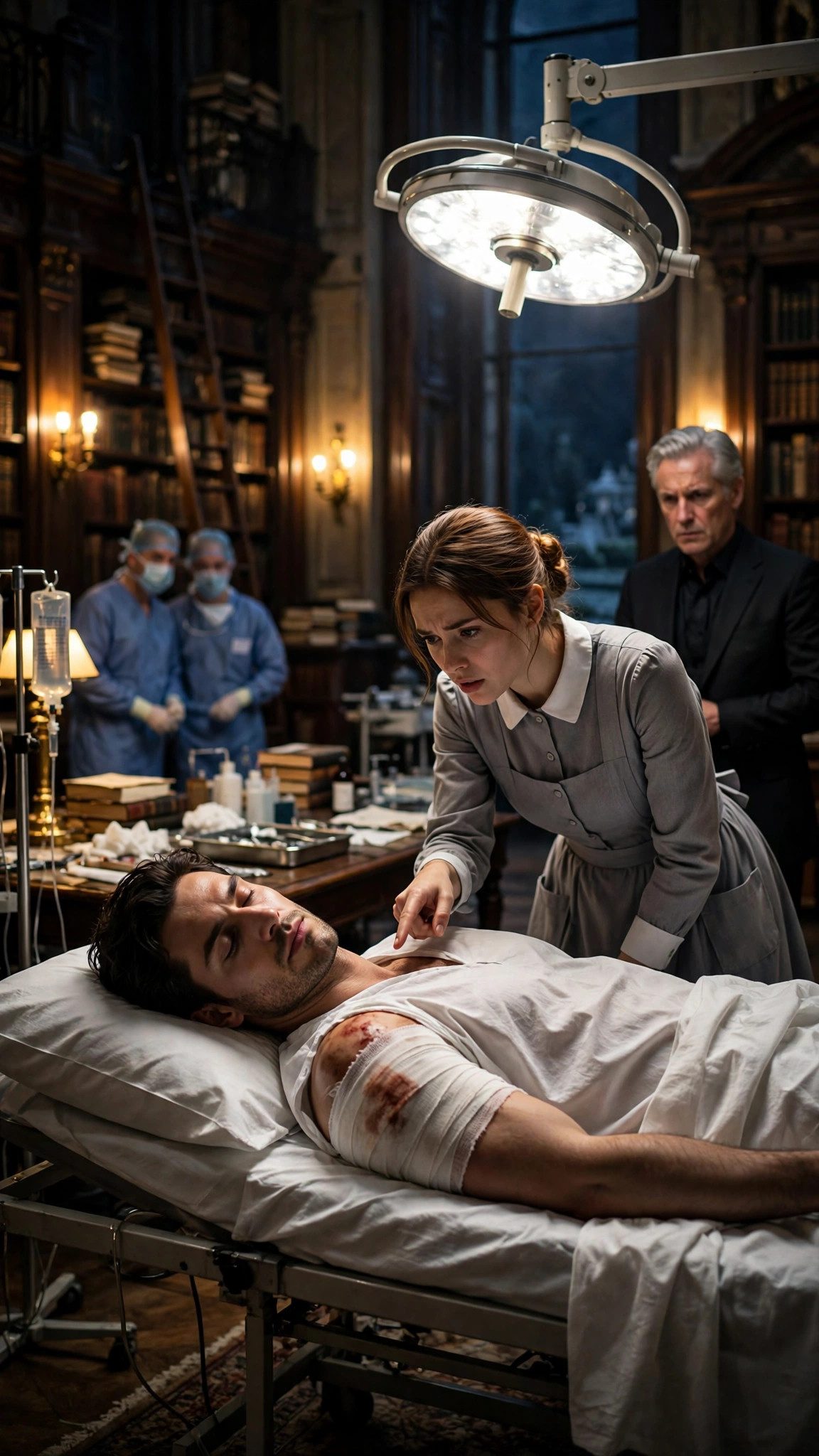
At 2:47 A.M., eighteen surgeons were preparing to amputate the right arm of Baltimore's most feared crime boss, until I spotted a deadly black thread buried inside his shoulder.
My name is Mara Bennett. I am twenty-four years old, and for nine months I have cleaned the mansion of Adrian Vale.
I worked nights because they paid two dollars more an hour. With just thirty-eight dollars in my bank account and my rent due, I could not afford to quit. My landlord had already taped a FINAL NOTICE to my apartment door. The only valuable possession I owned was a pair of gold earrings my mother had left me before she died.
That night, Adrian's mansion had become a private hospital.
Twelve days earlier, someone had shot him outside Warehouse Nine. The bullet had grazed his right shoulder and shattered the window behind him. At first, everyone believed he would recover. Then came the fever, the swelling, and the dark discoloration spreading toward his chest. Antibiotics failed.
Now eighteen specialists surrounded his bed inside the mansion's converted library.
"His blood pressure is dropping again," Dr. Malcolm Pierce announced.
Adrian lay unconscious beneath glaring surgical lights. Even barely alive, the thirty-seven-year-old crime boss seemed more powerful than every living man in the room. His security chief, Daniel Cross, stood beside the bed with his fists clenched.
"He specifically refused amputation."
Dr. Pierce shook his head. "If we don't remove the arm, he could die before morning."
Then Adrian's uncle by marriage, Victor Hale, stepped forward. Victor had been Adrian's mentor for nearly twenty years.
"I promised his father I'd protect him," he said quietly. "Do whatever is necessary."
The doctor reached toward the surgical instruments.
I stood near the library wall holding a yellow trash bag, trying to remain invisible. That was what servants did in this house. We cleaned, listened, and pretended we hadn't heard anything.
Then Dr. Pierce pointed toward the used bandages. "Maid. Clean those up."
I approached the bed. And I smelled something strange.
Beneath the antiseptic was a sharp, bitter chemical odor. My stomach tightened.
My mother had spent her life sewing industrial marine canvas, repairing boat covers and heavy cargo tarps. As a little girl, I had sat beside her while she taught me the difference between ordinary cotton, waxed canvas, and polyester. She always warned me about one particular black cord. Older marine stock sometimes contained chemical coatings harsh enough to irritate or burn skin.
"Don't identify thread by color, Mara," she would say. "Look at the twist."
Standing beside Adrian's bed, I remembered those words.
His wound had been opened for examination. And deep inside the swollen tissue, I noticed several dark knots. They didn't look like ordinary surgical sutures. They were rough. Braided. Almost bristled.
I leaned closer.
Diamond braid.
My heart started pounding. I knew that pattern. I had handled material like it hundreds of times beside my mother. And it had no business being buried inside someone's shoulder.
"Move," Dr. Pierce snapped.
I barely heard him. Because the thread and that bitter smell made me fear Adrian's wound had been deliberately contaminated.
"Mara."
Daniel's voice made me straighten. I looked around. Eighteen doctors. Armed guards. Adrian's uncle. And the unconscious mafia boss they were preparing to permanently disfigure.
Victor frowned. "What is it, girl?"
My hands trembled around the trash bag. I knew speaking could cost me my job. Possibly much more.
But I couldn't stay silent.
I pointed toward Adrian's shoulder. "That thread doesn't belong there."
The room went completely still.
Dr. Pierce slowly turned toward me. His expression hardened. "What did you just say?"
I swallowed, then looked straight at the surgeon who had treated Adrian's original gunshot wound. "I said someone put the wrong kind of cord inside his shoulder, and I think that's why he's getting worse."
Daniel's hand moved toward his gun. Victor stopped breathing. And Dr. Pierce took one slow step toward me.
Because suddenly, the question wasn't just whether Adrian would lose his arm. It was who had put that dangerous material inside his body in the first place.
—
Nine months earlier, I had stood outside the iron gates of the Vale mansion with a borrowed black dress, a pair of sensible shoes, and a lie on my resume.
The lie was small. I had written that I had two years of housekeeping experience in a hotel. The truth was that I had cleaned exactly one place for money in my life: the two-room apartment I shared with my mother until the cancer took her, and then the same apartment alone, scrubbing it after every shift at the diner until my hands were raw. But the agency woman had looked at my hands and my face and my cheap dress and said the mansion needed night staff, and night staff did not get asked many questions.
"Two dollars more an hour than days," she had said. "Eleven to seven. You clean what they tell you to clean and you do not repeat what you hear. Mr. Vale values discretion."
I had nodded like I understood what discretion meant in a house like that. I did not. I understood rent. I understood that my bank balance was thirty-eight dollars and forty-one cents, and that the number had been falling for three weeks, and that the landlord, Mr. Kowalski, had taped a paper to my door that morning with the words FINAL NOTICE in red marker, and that the diner had cut my hours because a new girl could work the breakfast rush for less.
I understood that my mother had died in March, and that the funeral had cost everything she had saved, and that the gold earrings she left me were the only thing in the world that had ever been truly mine, and that I had already stood outside the pawnshop on Eastern Avenue twice and turned around twice, because selling them would feel like burying her a second time.
So I took the night job.
The mansion sat on a hill above the harbor, behind gates and hedges and cameras, a gray stone house with too many windows and a driveway that curved like a question mark. Inside, the floors were marble and the ceilings were high enough to make a person feel small, and everything smelled faintly of lemon polish and old money and, underneath it, something colder, like a gun safe left open.
The housekeeper, Mrs. Delgado, was sixty and had worked for the Vale family for thirty years. She met me in the kitchen on my first night and looked me over the way my mother used to look over fabric, checking the weave.
"You are young," she said. "That is a problem in this house. Young girls talk. Young girls look. Young girls fall in love with the wrong men and then they cry in the pantry and the whole house knows. So listen to me, Mara Bennett. You clean. You do not look. You do not listen. You do not repeat. And you never, ever go into Mr. Vale's study unless I send you."
"Yes, ma'am," I said.
"And you never speak to Mr. Vale unless he speaks to you first."
"Yes, ma'am."
She handed me a gray uniform and a pair of rubber gloves and a bucket, and she showed me the night routine: the library first, then the dining room, then the hallways, then the bathrooms on the ground floor, then the kitchen last, so the morning cook would find it clean. The second floor was off limits at night. The second floor was where Mr. Vale slept, and where his men slept, and where the doors stayed locked.
"Why nights?" I asked, because I was twenty-four and stupid and curious.
"Because the house is quiet at night," Mrs. Delgado said. "Because Mr. Vale does his business at night. Because you are cheaper at night, and the agency sends us whoever will take the hours. Now work."
I worked.
For nine months, I worked. I learned the mansion the way my mother had taught me to learn fabric: by the feel of it under my hands. The library's oak shelves. The dining room's long table that could seat twenty-four men who never smiled. The hallway runner that needed vacuuming twice because of the mud the men tracked in from the docks. The kitchen's copper pots, which Mrs. Delgado polished herself and did not trust to anyone.
And I learned the people, even though I was not supposed to.
I learned Daniel Cross first, because he was always there, standing near doorways with his arms crossed, watching everything the way a dog watches a fence line. He was forty, broad, with a scar through his left eyebrow and hands that looked like they had been broken more than once. He never spoke to me. He nodded at me once, in the hallway, and I counted that as a conversation for a week.
I learned Victor Hale second, because he came to dinner every Tuesday, and on Tuesdays the kitchen had to be spotless by six, and the dining room had to smell of candles and roast beef. Victor was sixty-one, silver-haired, soft-voiced, with the manners of a man who had been to good schools and the eyes of a man who had not used them for anything good in a long time. He called Mrs. Delgado "Rosa" and he called me "girl" and he always asked after Mr. Vale's health, even when Mr. Vale was standing right there.
"How is our boy tonight, Rosa?" he would say, and Mrs. Delgado would say, "He is well, Mr. Hale," and Victor would smile like a man who had just been told his favorite story.
And I learned Adrian Vale last, because he was the hardest to see and the easiest to feel.
I saw him properly for the first time on my third night, when I was dusting the library shelves and the door opened and he walked in with two men I did not know, talking about a shipment and a warehouse and a man named Castellano who wanted the docks. He stopped when he saw me. He was tall, dark-haired, with a face that would have been handsome if it had ever once relaxed, and eyes so dark they looked black in the lamplight. He wore a black suit that fit him like it had been sewn onto him, and his shoes were polished to a shine I could see my own reflection in.
He looked at me for exactly two seconds. Then he looked at the men with him and said, "Finish it in the study," and they left, and the door closed, and I stood there with a dust cloth in my hand and my heart beating so hard I was sure the whole house could hear it.
After that, I saw him in pieces. A shoulder in a hallway. A voice behind a door. A hand on a banister. Once, I found his jacket draped over a chair in the library, and I hung it up, and the fabric was heavy and smelled of cigar smoke and rain, and I thought about how strange it was that a man everyone in Baltimore feared could leave his jacket on a chair like any other person.
Mrs. Delgado caught me once, standing too long near the study door, listening to the low murmur of men's voices.
"Mara," she said, and her voice was not angry, which was worse. "I told you. You do not listen."
"I'm sorry," I said. "I was dusting."
"You were listening," she said. "And listening in this house is how girls get hurt. Mr. Vale is a good man to his people, but he is not a kind man, and his enemies are not kind men either. The less you know, the longer you live. Do you understand?"
"Yes, ma'am," I said, and I meant it, because I had already heard enough to understand that the Vale family was not a family the way my mother and I had been a family. It was a kingdom. And kingdoms had enemies.
The kingdom, I learned in fragments, was shipping and warehouses and freight, and underneath that, the things men did not say out loud: protection money, and routes, and docks, and a man named Vincent Castellano who wanted all of it.
I learned that Adrian's father had built the kingdom from nothing, starting with one truck and a warehouse on the harbor, and that Adrian had inherited it at twenty-nine when his father died of a heart attack in the same library where I now dusted the shelves. I learned that Victor Hale had been his father's best friend, and his mentor, and the man who had taught Adrian everything about the business, and that Victor had been passed over for the leadership because the old man had left it to his son.
I learned these things the way servants learn everything: in pieces, in passing, in the spaces between other people's conversations, while holding a trash bag and trying to remain invisible.
And then, twelve days ago, someone shot Adrian Vale outside Warehouse Nine.
I was not there. I was at home, asleep, because it was a Tuesday afternoon and I did not work days. I heard about it the way everyone in the house heard about it: Mrs. Delgado came into the kitchen that night with her face gray, and she said, "Mr. Vale has been shot," and the whole house went quiet, the way a house goes quiet when the roof might fall in.
The bullet had grazed his right shoulder and shattered the window behind him. The doctors said he would recover. They cleaned the wound, they stitched it, they gave him antibiotics, and they brought him home to the mansion, because Adrian Vale did not stay in hospitals. Hospitals had records. Hospitals had questions.
For a week, he seemed to recover. And then the fever came. And the swelling. And the dark discoloration that spread from the wound toward his chest like ink in water. The antibiotics stopped working. The wound would not close. The skin around it turned hot and tight and angry, and the smell coming from it was wrong in a way I could not name, because I had never smelled a wound like that before.
Dr. Pierce came every day. He was the surgeon who had treated the gunshot wound, a tall, thin man with cold hands and colder eyes, and he stood over Adrian's bed and shook his head and said the words that made Mrs. Delgado cross herself in the kitchen.
"Infection. Resistant. Spreading."
They brought in more doctors. Specialists from Johns Hopkins, from the University of Maryland, from private clinics that did not ask questions. They stood around the bed in the library and argued in low voices about sepsis and necrosis and cultures, and none of them could explain why a grazed shoulder was killing a healthy thirty-seven-year-old man.
On the twelfth night, they converted the library into an operating room. They brought in surgical lights and instruments and eighteen surgeons, and Mrs. Delgado told me to stay out of the way, and to keep the hallways clean, and to hold a yellow trash bag near the wall and not speak to anyone.
I did what she told me. I stood near the wall with my trash bag. I watched Dr. Pierce reach for the instruments. I watched Victor Hale step forward and say, "Do whatever is necessary." I watched Daniel Cross stand beside the bed with his fists clenched, and I watched Adrian Vale lying unconscious beneath the lights, with his right arm laid out on the sheets like something that had already been given away.
And then Dr. Pierce pointed at the used bandages and told me to clean them up, and I walked toward the bed, and I smelled the bitter chemical smell, and I saw the black thread buried in his shoulder, and my mother spoke in my head the way she always did when I was about to do something stupid.
"Don't identify thread by color, Mara," she said. "Look at the twist."
I looked at the twist. And the twist told me everything.
It was diamond braid. It was marine cord. It was the kind of cord my mother had handled a thousand times, sewing boat covers and cargo tarps on the docks of Baltimore, and it had no business being inside a man's shoulder. And the bitter smell was the chemical coating on older marine stock, the kind that burned skin and poisoned wounds, the kind my mother had warned me about since I was small enough to sit on her lap beside the sewing machine.
Someone had put it there. Someone had buried poison inside Adrian Vale's shoulder and then stood back and watched the infection spread, and called it bad luck, and waited for the fever to do what a bullet could not.
And the only person in that room who knew what the thread was, was me.
A twenty-four-year-old maid with thirty-eight dollars in her bank account, a FINAL NOTICE on her door, and a pair of gold earrings she would not sell.
I pointed at his shoulder. My voice shook. But I said it anyway.
"That thread doesn't belong there."