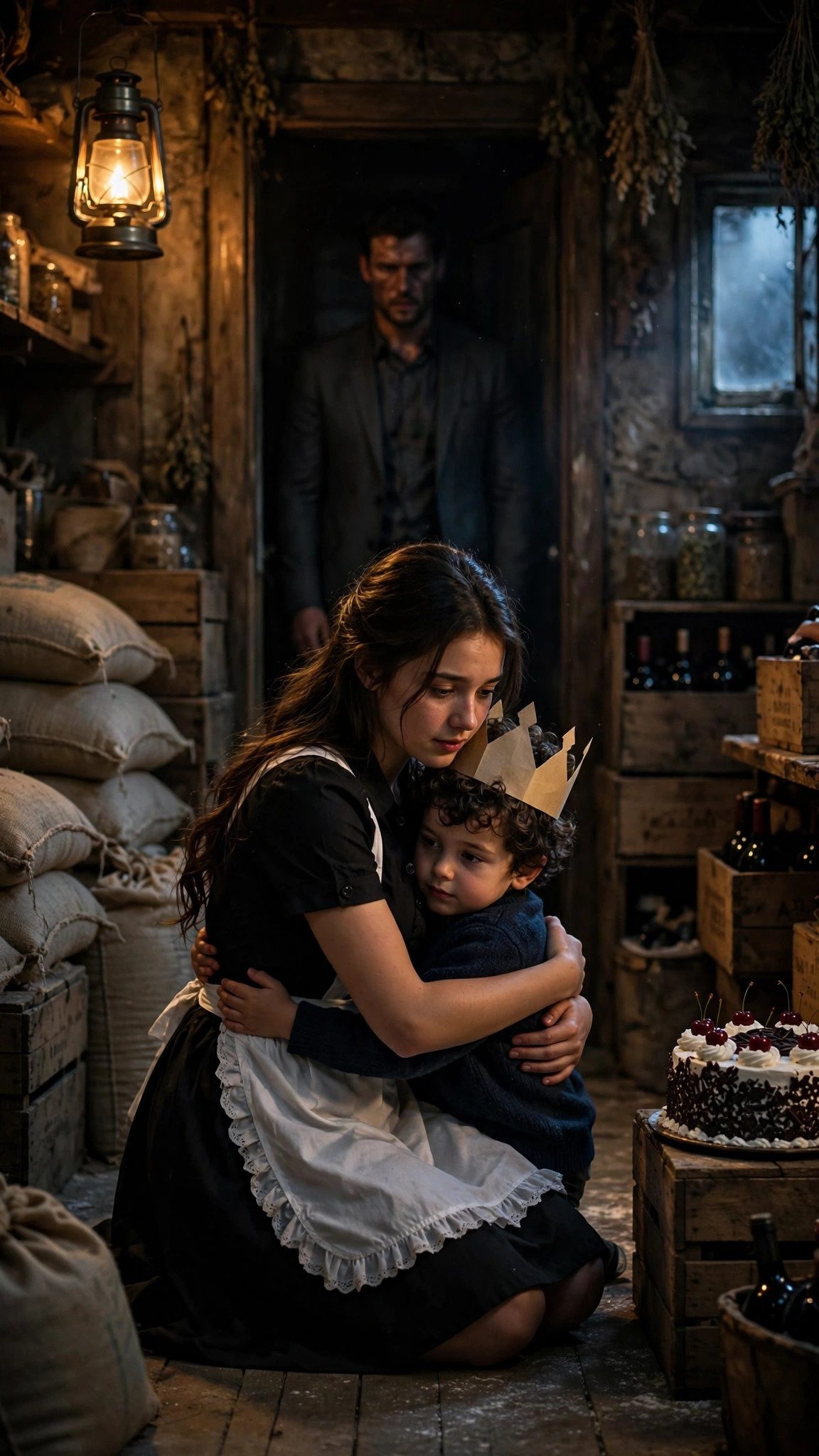
The morning after the party, Kian Moretti did something no one in his world had ever seen him do.
He called the FBI.
I was sitting at the small table by the kitchen door — my table, the one where Zayn and I ate lunch every day at one o'clock — eating toast with a four-year-old boy who had chocolate on his face and a paper crown still crooked on his head, when Kian came in with a man I had never seen before.
The man was in his forties, with gray at his temples and a suit that fit the way honest men's suits fit: a little too loose, a little too practical. He carried a leather folder, and he had the calm eyes of a man who had seen terrible things and decided to do something about them.
"Aurora," Kian said, "this is Special Agent Daniel Reyes. He would like to ask you some questions about Regina, and about Tony Falco, and about Vincent Castellano."
My hands went cold around my coffee cup. Vincent Castellano. The name Tony collected for. The name that had hung over everything Regina had done, like a shadow over a house.
"Am I in trouble?" I asked.
"No," Agent Reyes said, sitting down across from me with the careful movements of a man who knows how to make frightened people feel safe. "You are a witness, Miss Bellini. And from what Mr. Moretti has told me, you may be the most important witness we have."
Kian pulled out a chair and sat beside me, and Zayn climbed into his lap without being asked, and for a moment we looked like a family having breakfast, instead of a maid and a mob boss and a federal agent sitting around a kitchen table talking about crimes.
"Tell him everything," Kian said quietly. "All of it. From the beginning."
So I told him. I told him about my father, and my mother, and the Black Forest cake. I told him about Regina, and the card games, and the fifty thousand dollars. I told him about Tony Falco's men, and the storage room, and the birthday party. I told him about the twenty days of hiding, and Mrs. Alvarez's kitchen, and the cake I had baked at three in the morning.
Agent Reyes wrote it all down, and he asked careful questions, and he never once made me feel like I was the one on trial.
When I finished, he closed his folder and looked at Kian.
"Mr. Moretti," he said, "I am going to be honest with you. I have been building a case against Vincent Castellano for three years. We have wiretaps. We have bank records. We have a driver who will testify. What we have never had is a victim who will stand up in court and say, in plain words, 'This man tried to buy me.'"
"I will testify," I said, before I could think about it, before fear could catch up with me. "I will say it. I will say all of it."
Kian looked at me sharply. "Aurora, you do not have to do this. Testifying against Castellano is dangerous. Men like him do not forget."
"I have been afraid for three years," I said. "I was afraid of Regina. I was afraid of Tony. I was afraid of being sold. I was afraid of losing Zayn. I am tired of being afraid. If my words can put Castellano in prison, then I will say them, as many times as anyone needs to hear them."
Agent Reyes nodded slowly. "Then here is what happens next," he said. "We arrest Tony Falco first, quietly, on an unrelated charge — an old assault warrant he has been dodging for two years. We offer him a deal. He gives us Castellano's ledger, and the names of the men who collect for him, and he serves eight years instead of twenty-five."
"And Regina?" I asked.
"Regina Bellini will be arrested for conspiracy to commit human trafficking," he said. "She tried to sell you, Miss Bellini. That is a federal crime. If she cooperates — if she testifies about Castellano's operation, about the debts, about the buyers — the judge will consider it. If she does not, she will serve a long sentence. That is her choice."
I thought about Regina then, standing in the hallway outside the storage room, in her red dress, with her mouth open, terrified. I thought about the woman who had married my father for his money and had looked at me for twelve years and seen only a problem to solve. I did not feel sorry for her. I did not feel angry, either. I felt something quieter: relief, that the law could do what I never could. It could look at Regina and see the truth, and it could hold her to it.
"And Castellano?" Kian asked.
"Castellano is the prize," Reyes said. "With Miss Bellini's testimony, and Falco's ledger, and Regina's records of the debt, we can charge him with racketeering, conspiracy, and human trafficking. He will not walk away from this one. He has walked away from everything else for twenty years. Not this."
Kian was quiet for a long moment. Zayn was drawing on a napkin with a crayon, a house with a garden and a dog, the same picture he had drawn for his mother's letter.
"There is something else," Kian said finally, and he looked at Agent Reyes the way a man looks at a door he is about to walk through, knowing he can never come back. "I want to make a deal too."
Reyes raised an eyebrow. "What kind of deal, Mr. Moretti?"
"The kind where I give you my ledgers," Kian said. "All of them. The shipping routes. The warehouses. The accounts. Everything my family has done for forty years, including the things I am not proud of. In exchange, I want protection for Aurora and my son, and I want a chance to make my businesses legitimate. No more back rooms. No more side doors. A restaurant. A shipping company. Clean books, clean taxes, clean hands."
Reyes studied him for a long moment. "That is a very large thing to offer, Mr. Moretti."
"It is a very large thing to ask for," Kian said. "But I have a son who thinks love is something you protect with your body, and a woman who stood in a storage room and refused to be sold, and I am tired of being the man criminals are afraid to name too loudly. I would rather be the man my son is not afraid of."
Agent Reyes opened his folder again and took out a pen. "Then let us talk about what the law can do," he said.
The arrests happened over the next three weeks, quietly, the way the law works when it works well. Tony Falco was picked up outside a diner in Queens, eating breakfast, and he did not resist. Regina was arrested at her card game, in a bright room full of women in too much jewelry, and she cried, and she asked for a lawyer, and then she asked for a deal.
She got her deal. She testified. She told the court everything: the debts, the buyers, the men who came to her house with offers for a girl with a bloodline. She served her time, and I never saw her again, and I did not miss her.
Castellano was arrested at dawn, in his house on Long Island, while he was still in his pajamas. The newspapers called it the biggest organized crime takedown in a decade. The television showed his face, gray and furious, being led to a car, and I watched it with Zayn on my lap, and I felt nothing at all — no fear, no triumph, only the quiet knowledge that a door had closed, and that it would never open again.
He was convicted on every count. The judge gave him life without parole, and when the sentence was read, Castellano looked across the courtroom at me, and I looked back at him, and I did not look away.
That was what the law could do. It could take a girl who had been priced at fifty thousand dollars and stand her up in a courtroom and let her name her own worth, in her own words, and it could make the men who had tried to buy her listen.
The trial lasted nine days. I will remember every one of them for the rest of my life.
On the first day, I sat in the hallway outside the courtroom with Kian beside me, and my hands would not stop shaking, and he took my hand — not the way a boss takes an employee's hand, but the way a man takes the hand of a woman he is afraid of losing — and he said, "You do not have to be brave. You only have to be honest. The truth is braver than any of us."
The prosecutor was a woman named ADA Sarah Kim, small and sharp and kind, and she walked me through my testimony the way you walk a child through a dark house: slowly, with a hand on their shoulder, never rushing.
"Tell the court your name," she said.
"Aurora Bellini," I said, and my voice shook, and then it steadied, because a name is a powerful thing when you say it yourself, in your own voice, in a room full of people who are listening.
"Tell the court what happened on the day of Zayn Moretti's fourth birthday."
So I told them. I told them about the cake, and the storage room, and the men, and Regina's voice through the door, and the fifty thousand dollars. I told them about the three years at Bellarosa, and the lunches at one o'clock, and the lullaby, and the night Zayn had a fever and I stayed. I told them everything, and the courtroom was so quiet I could hear the clock on the wall.
When the prosecutor finished, Castellano's lawyer stood up. He was a tall man in an expensive suit, with a voice like oil, and he tried to make me small.
"Miss Bellini," he said, "is it not true that your father was a known criminal?"
"My father is dead," I said. "He has been dead for five years. I am not my father."
"Is it not true that you lied about your name when you took a job at Mr. Moretti's restaurant?"
"I told them my mother's name," I said. "Bell. That is a true name. It is the name of the woman who taught me to bake."
"Is it not true," he said, leaning forward, "that you are only testifying because Mr. Moretti is paying you?"
The courtroom went very still. I looked at the lawyer, and I looked at Castellano, sitting at the defense table in a gray suit, his face like stone, and I thought about the storage room, and the hand on my arm, and the little boy who had stepped between us.
"No," I said, and my voice was clear now, clear as a bell. "Mr. Moretti is not paying me. I am testifying because a woman tried to sell me for fifty thousand dollars, and a man tried to buy me, and if I do not speak, they will do it to someone else. I am testifying because I am not for sale. Not for fifty thousand dollars. Not for any amount. I am a person, and I am here to say so, in my own words."
The lawyer sat down. He had no more questions.
Kian testified the next day. He told the court about his ledgers — all of them, going back forty years — and about the day he had decided to give them to the FBI, and about the night he had typed apologies into his phone and never sent them. He told the court that he had been a coward, and that a four-year-old boy had been braver than he was, and that he intended to spend the rest of his life earning the trust of the two people sitting in the front row.
Regina testified on the seventh day. She wore a gray dress, and no jewelry, and she looked smaller than I remembered, and older, and when the prosecutor asked her about the debt, she cried, and she told the truth — all of it, the card games, the black book, the buyers, the deal. She looked at me once, across the courtroom, and I could not read her face. I do not know if she was sorry. I do not know if she even understood what she had done. I only know that she told the truth, and that the truth was enough.
On the ninth day, the jury came back. Guilty, on every count. Castellano would spend the rest of his life in prison. Tony Falco would serve eight years for testifying. Regina would serve her time, and I never saw her again, and I did not miss her.
I walked out of the courthouse that day with Kian on one side and Zayn on the other, and the sun was shining, and the reporters were shouting questions, and Zayn was holding my hand and asking if we could get ice cream, and I thought: this is what the law can do.
We did get ice cream. Kian bought three cones from a cart on the courthouse steps, and we sat on the stone wall in the sunshine, in our good clothes, eating ice cream like ordinary people on an ordinary day. Zayn had chocolate on his face within seconds, and Kian laughed — really laughed, out loud, in the middle of the street — and I realized it was the first time I had ever heard him laugh like that, free and unguarded, like a man with nothing left to hide.
"Is the bad man gone now?" Zayn asked, licking his cone.
"Yes," I said. "The bad man is gone. He cannot hurt anyone anymore."
"Good," Zayn said, with great satisfaction. "Then can I have another ice cream?"
Kian looked at me, and I looked at him, and we both laughed, and he bought the boy another cone, and we sat there until the sun went down behind the courthouse, three people on a stone wall, eating ice cream, free.
It could not give me back the three years I had lost. It could not give Zayn back his mother. It could not undo the night Kian dismissed me, or the twenty days I spent hiding.
But it could give us a future. And that, I was learning, was enough.