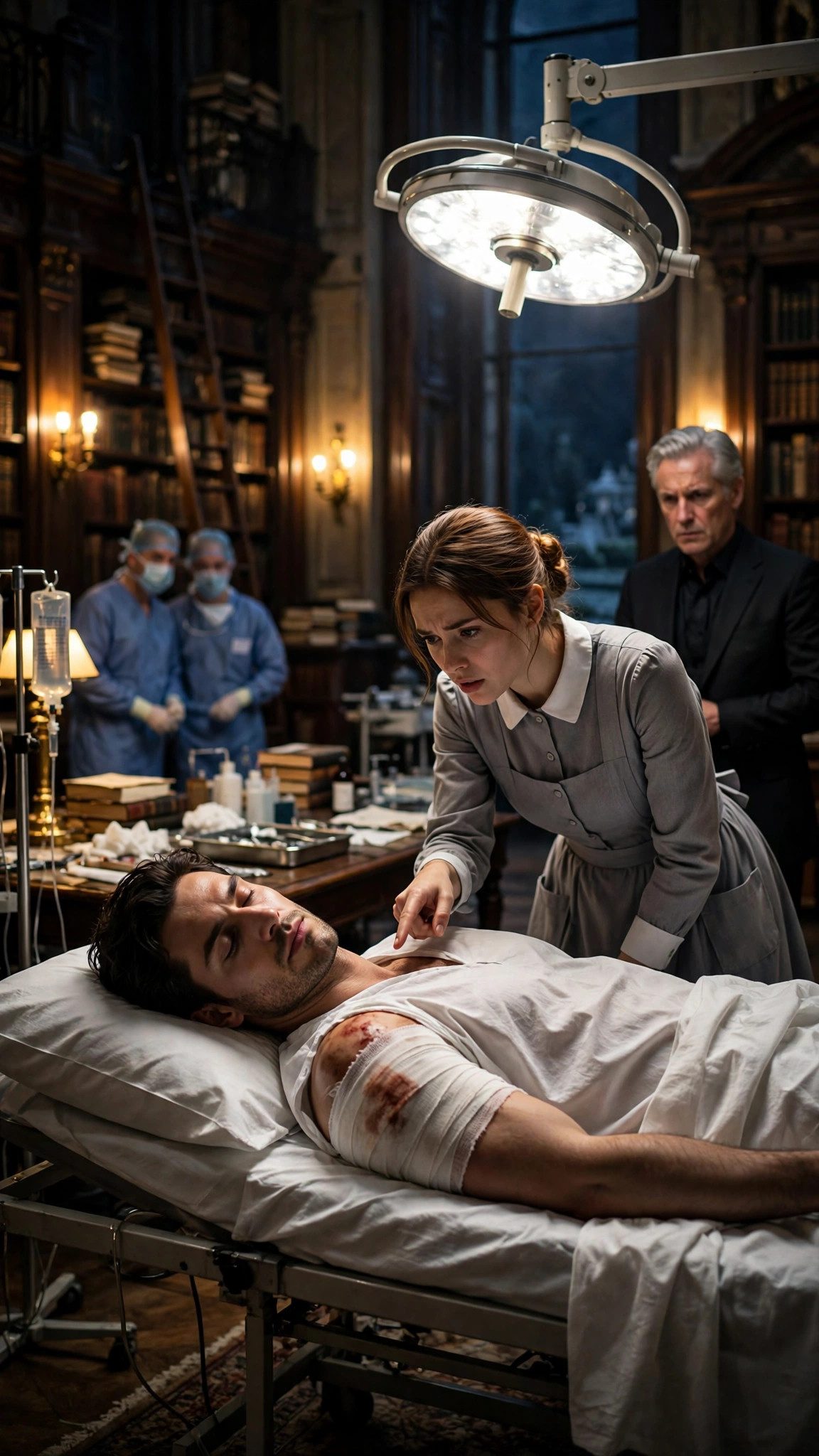
For three seconds after I spoke, nobody in the library moved.
Eighteen surgeons stood frozen around the bed. The armed guards by the door did not breathe. Daniel Cross's hand stayed where it was, halfway to his gun. Victor Hale stared at me with his mouth slightly open, like a man who had just heard a dog speak.
And Dr. Pierce took one slow step toward me, and his face was the face of a man who has been caught doing something he thought no one would ever notice.
"What did you just say?" he asked again. His voice was very quiet. Too quiet.
I swallowed. My throat was dry. My hands were shaking so hard the yellow trash bag rustled. But I had already said it, and there was no taking it back, and my mother had never raised a coward.
"I said that thread doesn't belong there," I said, louder this time, because the whole room needed to hear it. "That is not surgical suture. That is marine cord. Diamond braid. It's coated with chemicals. It burns skin and it poisons wounds. My mother sewed marine canvas for thirty years on the Baltimore docks, and I grew up handling that cord. I know what it looks like. I know what it smells like. And I know it has no business being buried inside a man's shoulder."
Dr. Pierce's eyes narrowed. "You are a maid," he said. "You clean floors. You do not know medicine. You do not know what you are looking at."
"I know thread," I said. "And that is thread. Surgical suture is smooth. It is sterile. It dissolves or it comes out clean. That cord is rough. It is braided in a diamond pattern. It bristles. And it smells —" I stopped, because the smell was right there, sharp and bitter under the antiseptic, and I pointed at the wound. "Smell it. That bitter smell is the chemical coating. Older marine stock. It irritates skin on contact. Inside an open wound, it would burn the tissue and keep it from healing, and no antibiotic in the world would stop it, because it is not an infection. It is poison."
"She's lying," Dr. Pierce said, turning to Victor. "She's a servant. She's trying to make herself important. Or someone put her up to this."
"Nobody put me up to anything," I said. "I was told to clean the bandages. I saw the thread. I spoke."
Daniel Cross moved then, not toward his gun, but toward the bed. He leaned over Adrian's shoulder and looked down at the wound, and his face went very still.
"Pierce," he said. "Show me."
"I beg your pardon?"
"Show me the thread," Daniel said. "Pick it up. Show the room what it is."
Dr. Pierce hesitated. It was only a second, but in that room, in that silence, a second was as loud as a gunshot.
"I will not be ordered around by a bodyguard," he said. "Or lectured by a maid."
"Then I'll do it," said a voice from the far side of the bed.
Everyone turned. A woman in surgical scrubs stepped forward. She was small, dark-haired, perhaps fifty, with tired eyes and a steady voice. I had not noticed her among the eighteen specialists. Her name tag read DR. ELENA RUIZ.
"I am a toxicologist," she said. "I was called in because the antibiotics were failing. I have been standing here for an hour wondering why a superficial graze is behaving like a chemical burn. If this young woman is right, then we have been treating the wrong thing for twelve days."
She picked up a pair of forceps from the instrument tray and leaned over the wound. The room watched her the way a courtroom watches a witness.
With two careful movements, she lifted a short length of black cord out of the swollen tissue and held it up under the surgical light.
It was exactly what I had said it was. Rough. Braided in a diamond pattern. Bristling with tiny fibers. Black as tar.
Dr. Ruiz turned it in the light. Then she held it to her nose, very carefully, and her eyes widened.
"She's right," she said. "This is not suture. This is industrial cord. And it smells of the chemical coating used on older marine stock. I have seen this coating before, in a dockworker's chemical burn case. It causes exactly this kind of tissue damage: swelling, dark discoloration, fever, and complete resistance to antibiotics, because the tissue is being burned from the inside, not infected."
She looked at Dr. Pierce.
"Malcolm," she said. "You treated the original wound. Did you put this in there?"
Dr. Pierce's face went white. "Of course not. I would never —"
"Then who did?" Daniel asked. His voice was flat and cold, and his hand was on his gun now, and he was looking at Dr. Pierce the way he looked at a door he was about to kick down. "You were the only surgeon in the room when the wound was first treated. You stitched it. You dressed it. If that cord is in there, it went in under your hands."
"I did not put it there," Dr. Pierce said. His voice was rising. "I did not — I don't know how it got there. Perhaps it was in the dressing. Perhaps —"
"Perhaps nothing," Dr. Ruiz said. She was already moving, already giving orders, and the room moved with her, because she was the only person in it who was thinking about the patient instead of herself.
"Get that cord out of him," she said to the nearest surgeons. "All of it. Every knot. Every fiber. Debride the wound, irrigate it, and stop the amputation. There will be no amputation tonight."
"No," Victor Hale said.
Everyone turned to look at him.
Victor was standing at the foot of the bed, and his face had gone a strange color, pale under the surgical lights, and his hands were gripping the bed rail so hard his knuckles were white.
"The damage is done," he said. "The arm is lost. The infection has spread too far. You must amputate. I promised his father I would protect him, and I will not let sentiment —"
"The infection is not an infection," Dr. Ruiz said. "It is a chemical burn, and it stops when the chemical is removed. Amputating a man's arm because someone poisoned him would be a crime, Mr. Hale, not a cure."
Victor opened his mouth. Then he closed it. And in that moment, I saw something in his eyes that I had never seen there before, in all the Tuesday dinners and all the soft-spoken questions about Mr. Vale's health.
Fear.
Not grief. Not worry. Fear.
Daniel saw it too. I watched his gaze move from Victor's face to Dr. Pierce's face and back again, and I watched something harden behind his eyes.
"Remove the cord," Daniel said. "All of it. And nobody leaves this room until it's done."
It took forty minutes.
I stood against the wall with my trash bag, forgotten, while the surgeons worked. Dr. Ruiz directed them like a general: forceps, irrigation, suction, more irrigation. They pulled out seven lengths of black cord, some as short as a fingernail, one as long as my thumb, all of them braided in the same diamond pattern, all of them coated in the same bitter chemical. They dropped them into a steel tray, and the tray rang each time, and by the end, the tray looked like a nest of black snakes.
When the last piece was out, Dr. Ruiz leaned over the wound and studied it.
"The tissue is damaged," she said. "But the arm is alive. The blood supply is intact. With the cord gone, and with proper wound care, he has a chance."
"A chance," Victor repeated. His voice sounded strange. "Only a chance."
"A chance is more than he had an hour ago," Dr. Ruiz said. "An hour ago, you were going to cut off his arm."
She turned to the nurses. "New dressings. Clean ones. And I want his blood pressure monitored every fifteen minutes. If the fever breaks by morning, we will know the poison is out."
While the nurses worked, the other surgeons stood around the bed in a loose circle, and none of them would look at me. I understood why. Eighteen specialists had spent twelve days arguing about sepsis and cultures and resistant infections, and a maid with a trash bag had solved it in thirty seconds by looking at a piece of thread. That was not the kind of thing proud men forgave easily, even when it saved a life.
One of them, a young surgeon with red hair, came over to me while Dr. Ruiz was writing orders.
"How did you know?" he asked. He did not sound angry. He sounded genuinely curious, the way a student sounds when a teacher shows him something new.
"My mother sewed marine canvas," I said. "I grew up with that cord. I could have picked it out of a hundred threads blindfolded."
He nodded slowly. "I have been a surgeon for nine years," he said. "I have never once thought about what a thread is made of, beyond whether it is sterile. I look at the wound. I don't look at the thread."
"My mother used to say the thread is the soul of the work," I said. "A bad seam fails at the thread."
He was quiet for a moment. Then he said, "Your mother was right. And I will remember that for the rest of my career."
Dr. Ruiz came back then, carrying the steel tray with the seven lengths of cord, and she held it out to Daniel.
"Bag these," she said. "Each piece separately, labeled with the time and the location it was removed from. And keep the dressings too. If this goes to court, and I believe it will, the defense will say the cord came from a bandage, or from a blanket, or from anywhere except where it actually came from. The dressings prove it was inside the wound."
Daniel took the tray as carefully as if it were made of glass. He had a plastic evidence bag in his pocket — I did not ask why a security chief carried evidence bags — and he sealed each piece of cord inside, and wrote on each bag with a black marker, in neat capital letters.
Mrs. Delgado appeared in the doorway then, with a tray of tea, because Mrs. Delgado always appeared with tea at the exact moment when people needed it most. She poured a cup for Dr. Ruiz, and one for me, and she pressed the warm cup into my hands, and her hands were shaking, but her voice was steady.
"Drink," she said. "You are shaking like a leaf."
"I am fine," I said, and then I took a sip, and I realized I was not fine at all. My hands were trembling so hard the tea sloshed over the rim. My legs felt weak. The fear I had been holding back for the last hour came all at once, now that the danger was over, and I had to sit down on the bottom step of the library stairs before my knees gave out.
Mrs. Delgado sat down beside me. She did not say anything for a while. She just sat there, holding her own cup of tea, looking at the library where eighteen surgeons were packing up their instruments and Adrian Vale was sleeping with his arm still attached to his body.
"You know what your mother would say?" she said at last.
"What?" I asked.
"She would say that you did what she taught you to do. You looked. You saw. And you spoke. And that is all any of us can do."
I nodded, and I drank my tea, and I thought about the tray of black cord, and about the man who had put it there, and about the fact that someone in this house, someone I had served dinner to on Tuesdays, had tried to murder the man in the next room, slowly, patiently, with a piece of thread.
And I thought about Victor Hale's face, and the fear in his eyes, and I wondered what he was afraid of.
I would find out soon enough.
She walked across the library, past eighteen surgeons and two armed guards and Victor Hale, and she stopped in front of me, a small woman in scrubs, and she looked at me for a long moment.
"What is your name?" she asked.
"Mara Bennett, ma'am," I said.
"Miss Bennett," she said, "you just saved this man's arm. And very possibly his life. Do you understand what you did?"
I shook my head, because I did not. I had only pointed at a thread.
"You saw what eighteen specialists missed," she said. "Because you knew something they did not know. Never let anyone tell you that what you know does not matter."
Then she turned to Daniel.
"Mr. Cross," she said, "I would like that cord preserved. Every piece. Bagged and labeled. And I would like to know where it came from, and who had access to this man's wound in the first twelve days. Because someone put poison inside a patient, and that is not a medical error. That is attempted murder."
Daniel nodded. He took the steel tray himself, and he carried it out of the library like it was evidence in a trial, which it was.
Dr. Pierce tried to follow him out. Daniel stopped him with one hand on his chest.
"Not you, Doctor," he said. "You stay."
"I have patients —"
"You have questions to answer," Daniel said. "And you will answer them here, in this house, tonight. Because if that cord went in under your hands, I want to know who paid you to put it there."
"I didn't —" Dr. Pierce began.
"Then you won't mind waiting while we find out," Daniel said, and he gestured to one of the guards, and the guard stepped forward, and Dr. Pierce went very still.
Victor Hale watched all of this from the foot of the bed, and his face had gone from pale to gray, and his hands had come off the bed rail, and he was rubbing them together, slowly, the way a man rubs his hands when he is cold.
"Victor," Daniel said, without looking at him. "You should go home. It's late. And Mr. Vale needs rest."
Victor nodded. He turned toward the door. He stopped. He looked back at Adrian, lying unconscious on the bed, his shoulder now clean and bandaged, his chest rising and falling steadily for the first time in days.
"He's strong," Victor said, softly. "His father was strong too. He will recover."
Then he left, and the library was quiet, and Dr. Ruiz stood beside the bed, watching the monitors, and I stood against the wall with my trash bag, and I thought about my mother, and about thread, and about how a single black cord, no thicker than a shoelace, had almost unraveled a kingdom.
At five in the morning, the fever broke.
I know because Mrs. Delgado told me in the kitchen, when I came down for my break, and she was crying, and she grabbed my hands across the table, and she said, "His fever broke, Mara. Dr. Ruiz says the poison is out. He is going to live."
She looked at me then, really looked at me, the way she had looked at me on my first night, checking the weave.
"Your mother would be proud of you," she said.
I went back to the library to finish cleaning, and I stood in the doorway, and I looked at Adrian Vale sleeping in the converted hospital bed, with his arm still attached to his body, and his chest rising and falling, and I thought about how strange it was that a maid with thirty-eight dollars in her bank account had just saved the life of the most feared man in Baltimore.
And I thought about Victor Hale's face, and the fear in his eyes, and I wondered what he was afraid of.
I would find out soon enough.