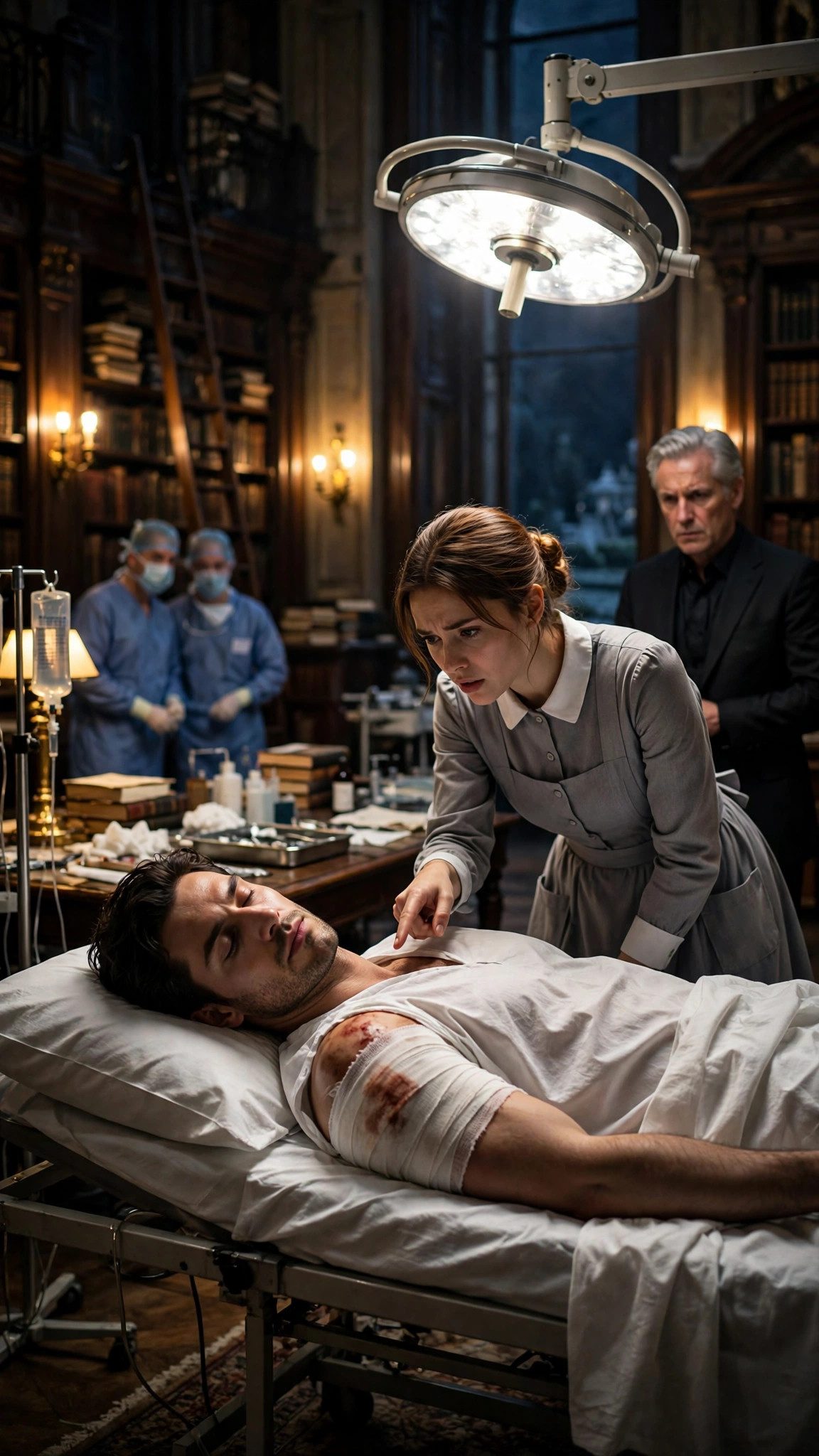
Adrian Vale woke up on the third day after the cord came out.
I was not there. I was asleep in my apartment, because it was daytime and I did not work days, and because Mrs. Delgado had told me to take two days off and rest, and because I had not slept properly in three nights.
When I came back to the mansion on the fourth night, the whole house was different. The surgical lights were gone from the library. The eighteen surgeons were gone. The smell of antiseptic was fading, and the smell of lemon polish was coming back, and Mrs. Delgado was in the kitchen making soup, and she was humming, which I had never heard her do before.
"He woke up," she said, when she saw me. "He asked for water. He asked what day it was. And then he asked who saved his arm."
She looked at me.
"What did you tell him?" I asked.
"I told him the truth," she said. "I told him a maid named Mara Bennett saw a thread that eighteen doctors missed."
I did not know what to say to that. I picked up my bucket and went to work, because that was what I knew how to do.
But the house would not let me just work. Tina cornered me in the laundry room and hugged me so hard I thought my ribs would crack.
"You're a hero," she whispered. "Everyone is talking about you. Daniel Cross is talking about you. He never talks about anyone."
"I'm not a hero," I said. "I just saw a thread."
"You saw a thread that was trying to kill him," Tina said. "That's a hero where I come from."
Upstairs, in the library that was a bedroom again, Adrian Vale was awake, and Daniel Cross was sitting beside his bed, and the two of them were talking in low voices, and I could hear the murmur through the door as I vacuumed the hallway, and I tried not to listen, because Mrs. Delgado had told me a hundred times not to listen.
But this time, the listening came to me.
Daniel came out of the library at midnight, and he found me in the hallway, and he stood in front of me with his arms crossed, and he looked at me for a long moment, the way he had looked at Victor Hale's face the night the cord came out.
"Miss Bennett," he said. "I need to ask you some questions."
"Yes, sir," I said. My heart was beating too fast. "Am I in trouble?"
"No," he said. "You are the opposite of trouble. But I need to understand what happened, and you are the only person in this house who saw it clearly. So tell me everything. From the beginning. How you knew the cord. What your mother taught you. All of it."
So I told him. I told him about the marine canvas, and the diamond braid, and the chemical coating, and the bitter smell, and my mother's warning. I told him about the gold earrings, because I did not know why I was telling him that, except that he was listening to me the way no one had listened to me since my mother died, and the words just came out.
Daniel listened without interrupting. When I finished, he nodded once, slowly.
"Your mother was a smart woman," he said. "And you were paying attention, which is more than I can say for eighteen surgeons."
Then he told me what he had found, and the story he told me was worse than anything I had imagined.
The cord, he said, had been traced. Dr. Ruiz had sent a piece of it to a laboratory, and the laboratory had identified it precisely: diamond-braid marine cord, manufactured by a company in Norfolk, coated with an older chemical preservative that had been banned for most uses because it caused chemical burns. The same cord, in the same batch, was stocked in the warehouse of Hale Shipping — Victor Hale's company.
"Victor's company orders that cord by the spool," Daniel said. "For tying down cargo tarps. Anyone in his warehouse could have taken a length of it. But only one person had a reason to put it inside Mr. Vale."
"Victor?" I whispered. I did not want to say it out loud, because Victor Hale had been kind to me in his way, calling me "girl" and asking after the house, and because the idea that a man could smile at you for years while planning to kill his own nephew made my stomach turn.
"Victor," Daniel said. "Or someone working for Victor. We found the payment too."
He told me about Dr. Pierce. How Daniel's men had gone through the surgeon's finances, quietly, the way the family did things, without police and without warrants, and how they had found a wire transfer of two hundred and fifty thousand dollars, sent twelve days ago, from a shell company called Bellini Holdings, into an offshore account in Dr. Pierce's name.
"Bellini Holdings," Daniel said. "A company that doesn't exist, owned by a man who does. Vincent Castellano. The man who has wanted the Baltimore docks for ten years."
I remembered the name. I had heard it through the study door, in Adrian's low voice, the way other men said the word "cancer."
"Castellano paid Pierce to plant the cord," Daniel said. "And Victor Hale introduced them. Victor has been working with Castellano for two years. Castellano promised him the Baltimore operation once Adrian was gone. Dead, or crippled. Either way, Victor would take over, and Castellano would get the docks."
"But Victor said he promised Adrian's father —"
"Victor promised a lot of things," Daniel said. "He promised to protect Adrian. He promised to be his mentor. And all the time, he was waiting. Eight years, he waited, smiling at the Tuesday dinners, asking after Mr. Vale's health, while Castellano paid him to open the door."
Daniel's hands were clenched at his sides, and for a moment, he did not look like a security chief. He looked like a man who had been betrayed by someone he had trusted.
"Pierce confessed this morning," he said. "Not to the police. To me. In a room downstairs. He cried. He said Victor told him the cord would only slow the healing, that it would keep Adrian weak for a few months, that no one would die. He said he needed the money. His wife is sick. His practice is failing. He said he didn't know it would kill him."
"Did you believe him?" I asked.
"I believe he is a coward," Daniel said. "And I believe he will testify against Victor and Castellano when the time comes, because a coward will always trade the truth for his own skin."
He looked at me then, and his expression changed, and he became, for a moment, almost gentle.
"Mr. Vale wants to see you," he said.
My stomach dropped. "Me? Why?"
"Because you saved his life, and he wants to thank you himself. And because he has questions, and you are the only person who can answer them."
I followed Daniel up the stairs, and my legs felt like they belonged to someone else, and my uniform felt too gray and too plain, and I wished, stupidly, that I had worn something better, and then I remembered that I owned nothing better, and that the man in the library was a crime boss, and that I was a maid, and that none of that mattered, because he was alive and his arm was still attached to his body, and I had done that.
The library was warm and dim. The surgical lights were gone. The bed was still there, pushed against the wall where the reading desk used to be, and Adrian Vale was sitting up in it, propped on pillows, wearing a plain white shirt, with his right shoulder heavily bandaged.
He looked smaller than I remembered. The fever had taken weight off him. His face was thinner, and his eyes were tired, but they were open, and they were looking at me, and they were the same dark eyes I had seen for two seconds on my third night, only now they were not looking through me.
They were looking at me.
"Miss Bennett," he said. His voice was rough from disuse, but it was steady. "Come closer. I don't bite. Not anymore, anyway."
I stepped forward until I was standing beside the bed. My hands were clasped in front of me. I did not know what to do with them.
"Daniel tells me you saved my arm," he said.
"I only pointed at a thread, sir," I said.
"You pointed at a thread that eighteen surgeons missed," he said. "You pointed at a thread that was put there to kill me. That is not 'only.' That is everything."
He was quiet for a moment. Then he said, "Tell me about your mother."
So I told him. I told him about the sewing machine as big as a table, and the workshop on the docks, and the swatches she held up for me to feel, and the black cord, and the warning. I told him about the gold earrings. I told him about the FINAL NOTICE on my door, because by then I was crying a little, and I could not seem to stop the words from coming out.
When I finished, Adrian Vale was looking at me the way Daniel had looked at me in the hallway: like I was a person.
"Your mother taught you to see what other people miss," he said. "That is a rare gift, Miss Bennett. Rarer than money. Rarer than power. My father used to say that a man who cannot see what is in front of him will lose everything he has. I almost lost everything because eighteen clever men could not see a piece of cord. You saw it because your mother taught you to look at the twist."
He shifted in the bed, wincing a little, and Daniel stepped forward, but Adrian waved him back.
"I owe you a debt," Adrian said. "And I pay my debts. So I am going to ask you what you want. Not what you need. What you want. And whatever it is, if it is in my power to give it, I will give it."
I stood there, and I thought about the thirty-eight dollars in my bank account, and the FINAL NOTICE, and the rent, and the pawnshop on Eastern Avenue, and all the things I needed.
But what I wanted was something else. What I wanted was to never be invisible again. What I wanted was for someone to look at me and see a person, not a maid with a trash bag.
"I want to keep my job," I said, because it was the truest thing I could think of. "And I want my mother to be proud of me."
Adrian nodded slowly.
"Then you will keep your job," he said. "And your mother would be proud of you. I can promise you both of those things."
He held out his left hand. I stared at it for a moment, and then I took it, and his hand was warm and strong, and he shook my hand the way a man shakes the hand of an equal.
"Thank you, Mara Bennett," he said. "You saved my arm. You saved my life. And you unraveled something I have been blind to for years."
After I left the library, I stood in the hallway for a long time, with my back against the wall, and I thought about what he had said.
Unraveled.
A single thread, pulled loose, and the whole thing comes apart. That was what my mother used to say about bad seams. Pull one thread, and the whole seam unravels. Pull the right thread, and the whole lie unravels with it.
The next night, Daniel found me in the laundry room, folding sheets, and he set a folder down on the table in front of me.
"The lab report," he said. "On the cord. I thought you should see it. You earned that much."
I opened the folder. Inside was a single page, typed, with a letterhead from a laboratory in Norfolk, and a paragraph of words I mostly did not understand: polymer composition, chemical preservative, dermal toxicity, thermal degradation. But at the bottom, in plain English, it said: "Material identified as diamond-braid marine cord, older stock, coated with a chemical preservative known to cause severe tissue irritation and chemical burns on prolonged contact with open wounds."
Daniel tapped the paragraph with one finger.
"Your mother was right about all of it," he said. "The coating. The burn. The fact that no antibiotic could fix it, because it wasn't an infection. The lab says the cord had been inside him for the full twelve days. Every day it sat there, it burned a little deeper."
"Twelve days," I said. "He suffered for twelve days because of a piece of rope."
"Because of a man," Daniel said. "The rope was only the weapon."
He told me then about Victor and Adrian's father, things he had never told anyone on the staff. How the old Mr. Vale had built the business from a single truck, and how Victor had been his right hand for thirty years, and how, when the old man was dying, he had called Victor to his bedside and told him the business would go to Adrian, not to him, because a son should inherit what a father built.
"Victor smiled," Daniel said. "He smiled and he said, 'Of course. The boy deserves it.' And then he went home, and he poured himself a drink, and he started planning. Eight years of planning. Eight years of smiling at Tuesday dinners."
"Did Adrian know?" I asked.
"Adrian knew Victor wanted the business," Daniel said. "What he didn't know was that Victor wanted it badly enough to kill for it. None of us knew that. Not until you pointed at a thread."
Later that same night, I passed the library door, and it was open a crack, and I saw Adrian sitting up in bed, doing his first physical therapy exercise. Dr. Ruiz had left him a small rubber ball, and he was squeezing it with his right hand, over and over, his face tight with effort, sweat on his forehead. His right arm was still weak, still bandaged, but his hand could close, and his fingers could move, and every squeeze was a small victory.
He saw me in the doorway, and he stopped, and he smiled a little, embarrassed, the way a strong man is embarrassed to be seen struggling with something small.
"Don't stop," I said. "Keep going."
He squeezed the ball again. And again. And I stood in the doorway and watched him, and I thought about how strange it was that the most feared man in Baltimore was sitting in a bed, squeezing a rubber ball, fighting to get his arm back one squeeze at a time, and that the reason he still had an arm to fight for was a maid who had learned about thread from her mother.
Victor Hale had pulled a thread, and it had almost killed Adrian Vale. But I had pulled a different thread, and it was unraveling Victor Hale instead.
And somewhere out there, Vincent Castellano was waiting to see which thread would hold.
I did not know it then, but the unraveling was only beginning.