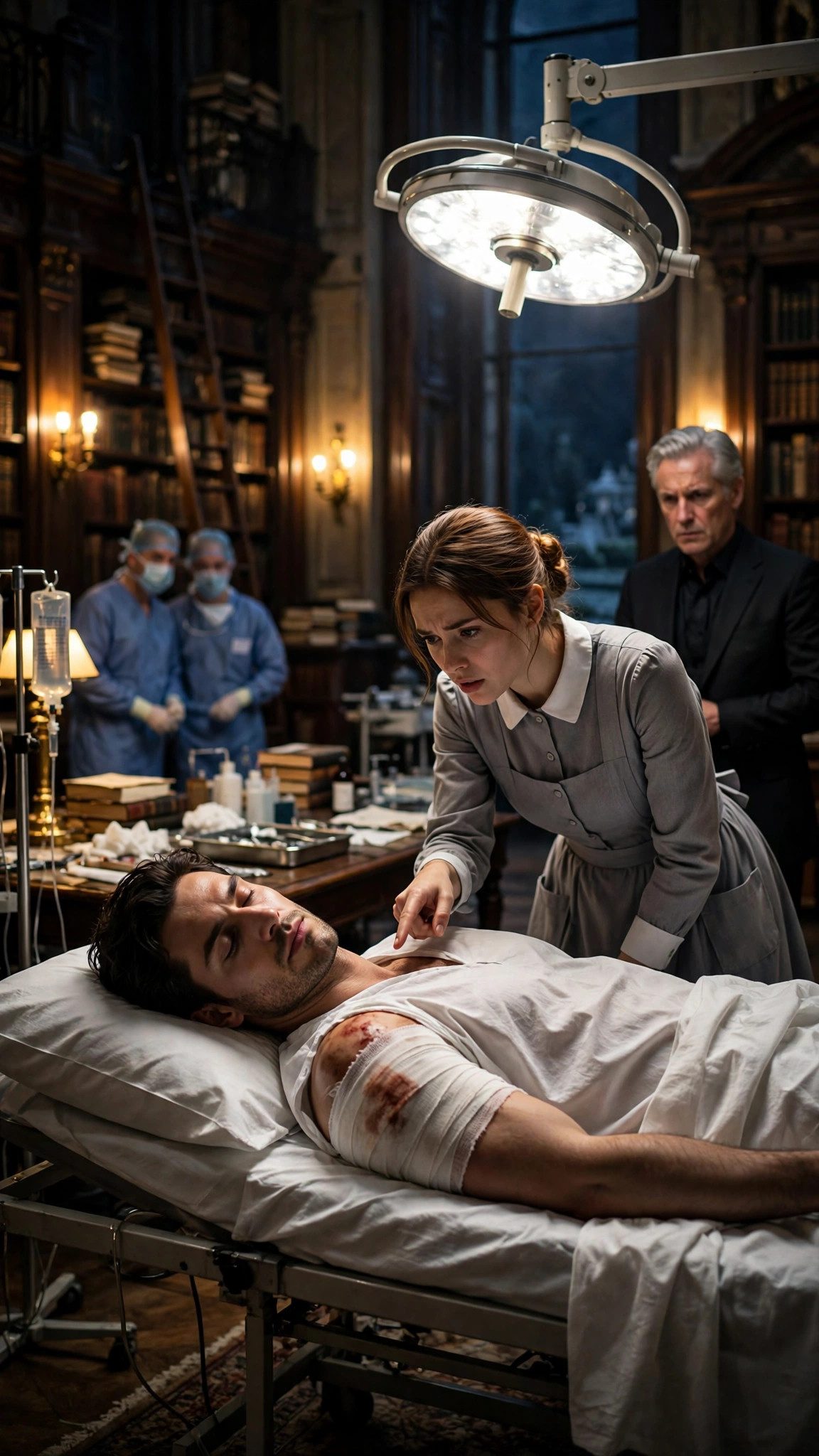
For two weeks, Adrian got better.
The fever stayed down. The wound began to close, pink and clean at the edges, the way a healing wound is supposed to look. Dr. Ruiz came every day, and every day she nodded a little more, and every day she said the same thing: "He is healing. Slowly. But he is healing."
Adrian began to sit up for longer stretches. He began to eat real food instead of soup. He began to argue with Daniel about the warehouse schedules again, which Mrs. Delgado said was the surest sign of recovery she had ever seen.
"He is complaining," she said, in the kitchen, with great satisfaction. "A man who complains is a man who is getting better."
And Victor Hale came to dinner on Tuesday, as he always did, and he smiled, and he asked after Mr. Vale's health, and he called Mrs. Delgado "Rosa," and he called me "girl," and nothing about him seemed different at all.
Except that I was watching him now. And Daniel was watching him too.
Daniel had doubled the guards. He had changed the locks on the medicine cabinet. He had put a man outside Adrian's door around the clock, and another man at the foot of the stairs, and a third man in the garden, watching the windows. He had told the staff that no one was to enter the library without his permission, and that any new face in the house was to be reported to him immediately.
"He knows we know," Daniel told me one night, in the hallway, when we were both working late. "Victor knows Pierce confessed. He knows we traced the cord to his warehouse. He knows Castellano paid for it. And a man like Victor, when he knows the walls are closing in, does not sit quietly and wait for the police. He finishes the job."
"How?" I asked.
"However he can," Daniel said. "And soon. Because every day Adrian gets stronger is a day Victor gets weaker."
Daniel was right. It happened on a Thursday night, at 2:14 A.M., while I was on my shift.
I was in the kitchen, refilling my bucket, when I heard footsteps in the hallway that did not belong to anyone I knew. The mansion at night had a rhythm: Mrs. Delgado's soft shuffle, Daniel's heavy tread, the guards' measured pace. These footsteps were different. They were quick and light and careful, the footsteps of someone trying not to be heard.
I stepped into the hallway and saw a man I had never seen before, wearing a nurse's scrubs and carrying a small medical bag, walking toward the library.
"Excuse me," I said. "Who are you?"
He stopped. He turned. He was young, perhaps twenty-five, with a shaved head and a tattoo on the side of his neck, and a smile that did not reach his eyes.
"I'm the night nurse," he said. "Dr. Ruiz sent me. Mr. Vale needs a new IV bag."
I looked at the bag in his hand. It was an IV bag, clear, full of fluid. But something about it was wrong. I could not say what, at first. And then I smelled it.
Bitter. Sharp. Chemical.
The same smell as the cord.
My heart stopped. My hands went cold. And my mother's voice spoke in my head, clear as a bell.
"If you ever see it where it does not belong, you run, because someone put it there on purpose."
But I did not run. I had not run the first time, and I would not run now.
"Dr. Ruiz doesn't send night nurses," I said. My voice was shaking, but I kept talking, because talking was the only thing I could think to do. "She comes herself. Every day. And the IV bags are kept in the locked cabinet, and Daniel has the key, and no one opens that cabinet without Daniel."
The man's smile faded. His hand moved toward his medical bag, and I saw the shape of something inside it, something that was not a stethoscope.
"Step aside, girl," he said. "This doesn't concern you."
"It concerns me," I said. "Because that bag smells like the poison that almost killed him, and you are not a nurse, and I am going to scream."
He lunged at me.
I did the only thing I could think to do. I threw my bucket at him. The bucket was full of dirty mop water, and it hit him in the chest, and the water went everywhere, and he slipped on the wet marble, and I screamed.
I screamed as loud as I could, the way my mother had taught me to scream if a man ever grabbed me on the docks: from the belly, not the throat, loud enough to wake the dead.
"Daniel! Daniel! In the hall! He has a bag! It smells like the poison!"
The library door flew open. Daniel came out with his gun already in his hand, and behind him, two guards, and behind them, Mrs. Delgado in her nightdress, holding a rolling pin like a weapon.
The man on the floor scrambled to his feet, and he pulled a syringe out of his medical bag, a long syringe filled with clear liquid, and he raised it like a knife.
Daniel did not hesitate. He crossed the hallway in three strides, and he hit the man once, hard, in the jaw, and the man went down, and the syringe skittered across the marble, and Daniel put his knee on the man's chest and his gun to the man's head.
"Who sent you?" Daniel asked. His voice was very calm. Too calm.
The man spat blood onto the marble. "I don't know what you're talking about."
Daniel pressed the gun harder. "You came into this house dressed as a nurse, carrying a bag of poison, to kill a man who is already half dead. Someone sent you. And you are going to tell me who, or I am going to stop asking."
The man looked up at Daniel, and then at me, and then at the syringe on the floor, and something in his face broke.
"Victor," he said. "Victor Hale sent me. He paid me five thousand dollars. He said the boss was weak and it would be easy, that I just had to swap the IV bag and walk out. He said nobody would check. He said the maid was the only one who worked nights and she wouldn't know the difference."
He looked at me then, and his face twisted.
"But she knew," he said. "She smelled it. How did she smell it?"
"Because my mother taught me," I said. And my voice was shaking, but I was standing, and I was alive, and Adrian Vale was alive behind that library door, and that was enough.
Daniel's men took the man away. His name, I learned later, was Eddie Krol. He was twenty-five years old. He had a sick mother in Ohio, and a record for assault, and a tattoo of a snake and a dagger on his wrist, and he had been hired by Victor Hale through a man in a black coat, for five thousand dollars, to kill a man in his sleep.
But I did not learn those things until later. In the moment, all I knew was that the hallway was wet, and my bucket was on its side, and my hands were shaking, and Adrian Vale was standing in the library doorway, looking at me like I was the only solid thing in the house.
Daniel took Krol down to the study, and I could hear his voice through the door, low and steady, asking questions, and Krol's voice answering, first defiant, then frightened, then broken. It took less than twenty minutes. Krol was not a professional. He was a desperate young man with a sick mother and a record, and Daniel Cross was a man who had been asking questions for twenty years, and there was never any doubt about how it would end.
When Daniel came back upstairs, his shirt was damp with sweat, and his knuckles were red, and he looked at me and said, "He told us everything. Victor paid him. Five thousand dollars. Through a middleman. The IV bag was filled with the same chemical that was on the cord. One bag, and Adrian would have been dead by morning, and it would have looked like the infection came back."
He looked at the syringe on the floor, which one of the guards had bagged by then, and he shook his head.
"Victor is running out of time," Daniel said. "And running out of patience. A man who tries twice will try a third time, unless someone stops him."
Dr. Ruiz arrived twenty minutes later, in her coat over her nightclothes, her hair still in a braid from sleep, and she went straight to the library without a word to anyone. She examined Adrian, checked his blood pressure, looked at the wound, and then she picked up the bagged IV bag and held it to the light, the way she had held the cord.
"If this had gone into him," she said quietly, "he would have been dead before morning. The same chemical. A full bag of it, straight into his veins. There would have been nothing I could have done."
She set the bag down and looked at me.
"Miss Bennett," she said, "you have now saved this man's life twice, and both times you did it by smelling something that no one else could smell. I want you to know that what you did tonight took more courage than anything I have done in twenty-five years of medicine. I have never stood in front of a man with a syringe. You did. And you did not move."
"I was terrified," I said.
"Good," she said. "Terrified people who stand their ground anyway are the bravest people there are. Remember that."
That night, I did not go home. Mrs. Delgado made me tea, and she made me sit in the kitchen, and she told me to stay until the sun came up, because she did not want me walking home alone in the dark after what had happened. I sat at the kitchen table with my hands wrapped around the warm cup, and I tried not to think about the syringe, and the man's hand reaching for his bag, and the way his smile had faded when he realized I knew.
But I kept thinking about it. And every time I closed my eyes, I saw the IV bag, and the bitter smell, and the syringe raised like a knife.
At four in the morning, I heard footsteps on the stairs, and Adrian came down to the kitchen.
He was not supposed to be out of bed. Dr. Ruiz had said he needed rest. But he was standing in the kitchen doorway in his white shirt, holding onto the frame with his left hand, and he looked at me sitting at the table, and he said, "I couldn't sleep either."
Mrs. Delgado, without a word, poured him a cup of tea and set it in front of him, and then she left the kitchen, quietly, closing the door behind her, because Mrs. Delgado had worked in that house for thirty years, and she knew when to leave two people alone.
Adrian sat down across from me. He wrapped his left hand around the teacup. His right arm hung at his side, still weak, still healing.
"Tell me about your mother," he said.
It was the second time he had asked me that. And this time, I told him more. I told him about the workshop on the docks, and the sewing machine as big as a table, and the way she would hum while she worked, old songs from the radio, and the way she would hold up a swatch and make me close my eyes and feel it, and guess what it was.
"She sounds like a good woman," Adrian said.
"She was the best woman I ever knew," I said.
He was quiet for a moment. Then he said, "My father was a good man too. Not a kind man, always. But a good man. He built this business from nothing, and he taught me that a man is only as good as his word, and that loyalty is the only currency that matters. And Victor was his best friend. For thirty years. I grew up calling him uncle. I trusted him with my life."
He looked down at his teacup.
"And he tried to kill me with a piece of rope," he said. "Not a bullet. Not a knife. A piece of rope, buried in my shoulder, so slow that no one would notice. That is the part I cannot understand. Not that he wanted the business. I always knew he wanted the business. But that he could smile at my table for eight years, and ask after my health, and call me 'boy,' all while planning to murder me in my sleep."
"Some men can smile and hate at the same time," I said. "My mother used to say that the most dangerous people are the ones who smile while they do it, because you never see them coming."
Adrian nodded slowly. "Your mother was a wise woman."
We sat there until the sun came up, drinking tea, not saying much, just sitting in the quiet kitchen while the house woke up around us. And when the first light came through the kitchen window, Adrian stood up, and he put his left hand on my shoulder, very gently, and he said, "Thank you, Mara. For the second time. I owe you my life twice now, and I do not know how a man repays a debt like that."
"You don't have to repay it," I said. "Just stay alive. That is enough."
He smiled then, a real smile, small and tired, but real. And he went back upstairs, and I went home, and I slept for twelve hours straight, and when I woke up, the sun was setting, and my phone was buzzing, and it was Daniel, and he said, "It's time. We're going to finish this."
I went back to the mansion that night, and I thought about Victor Hale, sitting somewhere in his big house, smiling his soft smile, and I wondered if he was afraid yet.
He should have been. Because Daniel Cross was coming for him. And this time, there would be no Tuesday dinner, and no soft voice, and no smile that could save him.