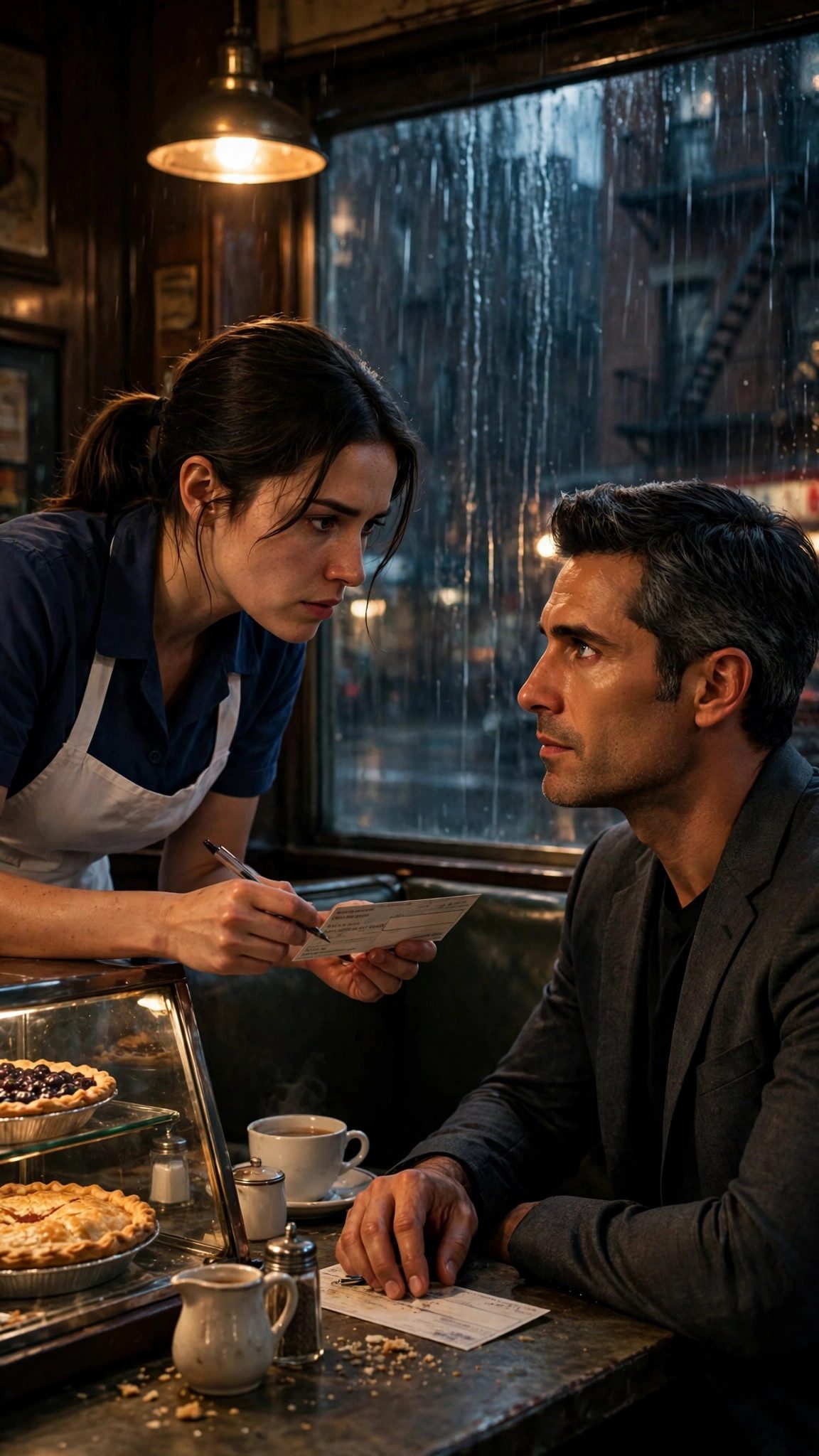
The night I warned Brooklyn's most feared Mafia boss that someone was about to kill him, I didn't whisper a word. I wrote three numbers on his diner bill — 317 — and expected him to think I was crazy.
Instead, Adrian Moretti looked at the receipt, locked eyes with me, and calmly told his men, "Nobody leaves."
My name is Emily Rivers, and until that moment, I had spent three years learning how not to get involved.
I worked nights at the Blue Anchor Diner because nobody asked questions there. You poured coffee. Carried plates. Counted tips. Went home. That was the life I wanted. Small. Quiet. Invisible. The Blue Anchor sat on a corner in Brooklyn with a neon sign that buzzed when it rained, and the rain that night came down in sheets, turning the street outside into a black mirror. The clock over the pie case said 11:47 when the door opened and four men walked in shaking water off their coats.
Everyone in Brooklyn knew the name Adrian Moretti. Officially, his family owned construction companies, shipping businesses, restaurants, and enough real estate to make him a legitimate millionaire. Unofficially, people called him Boss.
I served his table because it was my job. Four coffees. Three steaks. One plate of pasta. Nothing complicated. He sat in the corner booth with his back to the wall, the way men like him always do, and the three men with him arranged themselves around the table like pieces on a board. The oldest of the three, a man with silver at his temples named Enzo, kept his eyes on the door. The big one, Marco, ate like the steak might run away. The youngest, Luca, barely touched his food and checked his phone every thirty seconds.
Adrian himself was the stillest man I had ever served. He was thirty-eight, tall even sitting down, with dark hair going gray at the edges and gray eyes that missed nothing. He wore a charcoal suit that probably cost more than six months of my rent, and he held his coffee cup the way other men hold a weapon — loosely, like he had already decided he would not need it.
"More coffee, Mr. Moretti?" I asked, because the pot was in my hand and it was my job.
"Please," he said. His voice was low and even. "And the check when you're ready. We have a long night."
I went back to the counter and tore the check off the pad. Sixty-three dollars. I was reaching for the pen when I heard a voice near the hallway to the restrooms.
"He's here," a man whispered into his phone. "Four total. Corner booth. Give it twelve minutes."
My entire body went cold.
I did not turn around. Three years of practice kept my face still and my hands steady, but my heart was beating so hard I was sure the whole diner could hear it. I set the coffee pot down on the counter and looked through the front windows, the way you look when you are checking the weather and not when you are checking for killers.
Two men stood across the rain-soaked street pretending to wait for a bus. One kept checking his watch. A dark sedan idled half a block away, its headlights off, its windshield wipers moving in slow, patient sweeps.
Most people would have seen nothing. I had spent three years running from men who made plans exactly like that.
Suddenly I was twenty-three again, watching my brother Danny walk toward a warehouse in Philadelphia while I desperately tried to call him. He ignored the phone. I thought I had another minute. I didn't.
That memory made the decision for me.
When Adrian asked for the check, I carried it over. Beneath the total, I wrote one number. 317.
Danny had taught it to me years earlier. Don't speak. You're being watched. "If you ever see something wrong and can't say it out loud," he had told me, "write 317. Anyone who needs to understand will understand."
I had never used it while he was alive. Now I was using it on a stranger.
Adrian read the bill. His hand stopped. Then his gray eyes lifted toward mine. Recognition.
My stomach dropped. He folded the receipt beneath his palm.
"Nobody leaves," he said.
One of his men frowned. "Adrian?"
"Order dessert."
"What?"
"You heard me." His eyes stayed on me. "Something sweet. We're staying awhile."
I walked back toward the kitchen before my face gave me away. My hands were shaking so badly that Marcus, the night cook, took the coffee pot out of them without a word. Marcus was sixty-two, built like a refrigerator, and he had worked the night shift at the Blue Anchor for twenty years. He had seen me through three years of night shifts and had never once asked me a personal question. That was one of the reasons I stayed.
"You okay, kid?" he asked quietly.
"Fine," I said. "Just tired."
He looked at me for a long moment, then went back to the grill. Marcus knew what tired looked like, and I knew he knew this wasn't it. But he let it go, the way good people in bad places learn to do.
Twenty-five minutes passed. Pie. Cake. More coffee. I served it all with a smile I had practiced in the mirror a hundred times, the smile of a waitress who has seen nothing and knows nothing. Adrian ate his pie slowly, never once looking toward the windows. His men followed his lead. Enzo stopped watching the door and started watching Adrian instead, confused and wary. Marco ordered a second slice of cake. Luca stopped checking his phone.
Then two black Lincolns appeared outside, pulling up to the curb in front of the diner with their headlights cutting through the rain. The men across the street saw them. One cursed. The other started pacing. Seconds later, they disappeared into an alley. The idling sedan pulled away. No gunshots. No screaming. Just a murder plan evaporating into the rain.
Adrian finally stood. At the register, he placed several bills beside the check. Then he pulled a plain white business card from his jacket. One phone number. No name.
"If you see anything unusual tonight," he said, "call."
"I won't."
One corner of his mouth moved. "You probably should."
Then he left. The Lincolns pulled away into the rain, and the diner went back to being just a diner, with its buzzing neon sign and its smell of coffee and grease and rain.
Only after his car disappeared did I look down. Five hundred dollars beside a sixty-three-dollar bill. And the card.
Marcus came up behind me. "What did you write?"
I stared at the number 317 on the receipt. Then at Adrian's card. Because there was one thing I hadn't told anyone. Danny hadn't invented that signal. He had learned it from someone else. And somehow Adrian Moretti knew it too.
I had come to Brooklyn three years ago with one suitcase and a rule I had carved into myself like a scar: do not get involved. Do not notice things. Do not warn anyone. Do not write numbers on bills. The rule had kept me alive. It had also kept me alone, working nights in a diner where nobody asked questions, living in a third-floor walk-up above a laundromat, eating dinner at midnight standing over the sink.
I had learned the rule the night Danny died. He had been twenty-seven, four years older than me, and he had been the only family I had left after our mother died of cancer when I was nineteen. Danny had always been the one who took care of things. He fixed the sink. He paid the rent when I was short. He taught me how to change a tire in a parking lot in the rain and how to spot a man who was lying by the way he touched his watch.
He had also been the one with secrets. He worked for a man in Philadelphia — he never said who, only that the money was good and the work was driving and deliveries and sometimes just sitting in a car all night watching a door. I had asked him once, when I was twenty-one and brave in the way only younger sisters can be, whether the man was dangerous.
"Everybody's dangerous, Em," he had said. "The trick is knowing which dangerous men keep their word."
The night he died, he had left our apartment at nine o'clock in a clean shirt, kissed the top of my head the way he had done since I was small, and said, "Don't wait up." At 9:40 I got a feeling I couldn't explain, the kind of feeling that sits in your stomach like a stone, and I called him. He didn't answer. I called again. Nothing. I watched from our window as he walked toward a warehouse two blocks away, and I called a third time, and I saw him look at his phone, and I saw him put it back in his pocket and keep walking.
I thought I had another minute. I didn't.
The police said it was a robbery. A warehouse break-in gone wrong. They said Danny had been in the wrong place at the wrong time. They said it with the flat voices of men who have already decided what the story is, and I nodded, because I was twenty-three and alone and I didn't know how to argue with a story that had already been written.
But I knew my brother. Danny didn't wander into warehouses by accident. Danny didn't ignore my calls. And Danny didn't die for a robbery, because there was nothing in that warehouse worth stealing except the meeting that was happening inside it — a meeting I only learned about later, in pieces, from the notebook he left behind in our apartment, hidden under the loose floorboard in his closet.
That notebook is the reason I ran. It had names in it. Numbers. Times. And on the first page, in Danny's handwriting, three numbers and a line of instruction: "317. Don't speak. You're being watched. If you ever see something wrong and can't say it out loud, write 317. Anyone who needs to understand will understand."
I never found out who taught it to him. I asked him once, years before he died, and he had just smiled and said, "A man who keeps his word."
Now, standing at the register of the Blue Anchor Diner with five hundred dollars and a blank white card in my hand, I knew one thing for certain. The man who had taught my brother that signal was Adrian Moretti. Or Adrian Moretti had learned it from the same man. Either way, the signal had crossed three years and two cities and landed on a diner bill in Brooklyn, and the most feared man in the borough had looked at it and understood it instantly.
Marcus was still waiting for an answer. "Emily," he said quietly. "What did you write?"
"Nothing," I said. "Just the total."
He didn't believe me. I could see it in his face. But Marcus had worked the night shift for twenty years, and he knew better than to push a woman who had just decided to lie to him. He nodded, picked up a rag, and went back to wiping down the counter.
I folded the receipt and put it in my apron pocket. I folded Adrian's card and put it in my other pocket, as far from the receipt as I could get it, like the two pieces of paper might catch fire if they touched.
The rest of the shift passed in a blur. I poured coffee for a truck driver. I served pie to a nurse coming off a double shift. I mopped the floor by the door and counted my tips twice and got the number wrong both times. At 2 a.m., Joe Barone, the owner, came out of his office to lock up, and he looked at me the way he always did at the end of a shift — like a man checking that his best night waitress was still in one piece.
"Good night, Em," he said.
"Good night, Joe."
I walked home through the rain with my umbrella up and my eyes on the street, the way Danny had taught me. Nobody followed me. The laundromat below my apartment was dark. The stairs to the third floor creaked the way they always did. I locked the door behind me, pushed the chair under the handle the way I always did, and stood in my tiny kitchen with the card and the receipt in my hands.
I should have thrown the card away. That was the rule. Do not get involved. Do not keep the card. Do not call the number. Go to sleep, wake up, pour coffee, carry plates, count tips, go home. Small. Quiet. Invisible.
Instead, I put the card on my kitchen table next to the chipped mug Danny had given me for my twenty-first birthday. I put the receipt beside it. I stared at them for a long time, the way you stare at two pieces of a puzzle you didn't know you were holding.
Three years ago, my brother walked into a warehouse and never walked out. Tonight, a stranger had looked at three numbers and understood them, and the understanding in his eyes had been the same understanding I had seen in Danny's eyes the day he taught me the code at our kitchen table in Philadelphia.
I didn't know what it meant yet. But I knew I wasn't going to throw the card away.
I went to bed at 3 a.m. and didn't sleep. Every time I closed my eyes, I saw the sedan idling half a block away. I saw the man across the street checking his watch. I saw Adrian Moretti folding the receipt beneath his palm and saying, "Nobody leaves," in a voice so calm it sounded like a man ordering dessert.
Somewhere in the city, men who had planned to kill him that night were reporting back to someone. And somewhere in the city, someone was wondering how the plan had failed — and who had warned him.
I had spent three years learning how not to get involved. It had taken one night, one bill, and three numbers to undo all of it.
The rain kept falling outside my window. I lay awake and listened to it, and I thought about Danny, and about the man who had taught him, and about the fact that for the first time in three years, I had done something that mattered — and I had no idea what it was going to cost me.