We were married for the second time on a Saturday in June, in the garden behind the house in Lake Forest, under a sky so blue it hurt to look at it, and this time, it was real.
There were not one hundred and twenty people. There were twelve. Ruth, in a wheelchair of her own, with a blanket over her knees and a flower in her hair, sitting in the front row and smiling at everyone, even the people she did not remember. Marco Santini, who cried twice and pretended he had something in his eye both times. Enzo Falcone, who had retired the week before and who kept saying he had never seen Adrian look so happy, which was true, because no one had ever seen Adrian look happy at all. Daniel Reyes, in a suit that was too warm for June, who had come as a friend, not as an agent, and who danced with Ruth for one whole song, very slowly, while she laughed.
Celeste was there too, in a simple yellow dress, with her hair pulled back and no makeup, and she sat beside Ruth, and she held her hand, and when the music started, she cried, and she did not try to hide it.
And Adrian was there, standing at the end of a path lined with white roses, in a dark suit, on two good legs, waiting for me.
I walked down that path alone, because my father was in prison, and Ruth could not walk that far, and I did not need anyone to give me away. I had given myself away a long time ago, to a life I did not choose, and today, I was taking myself back.
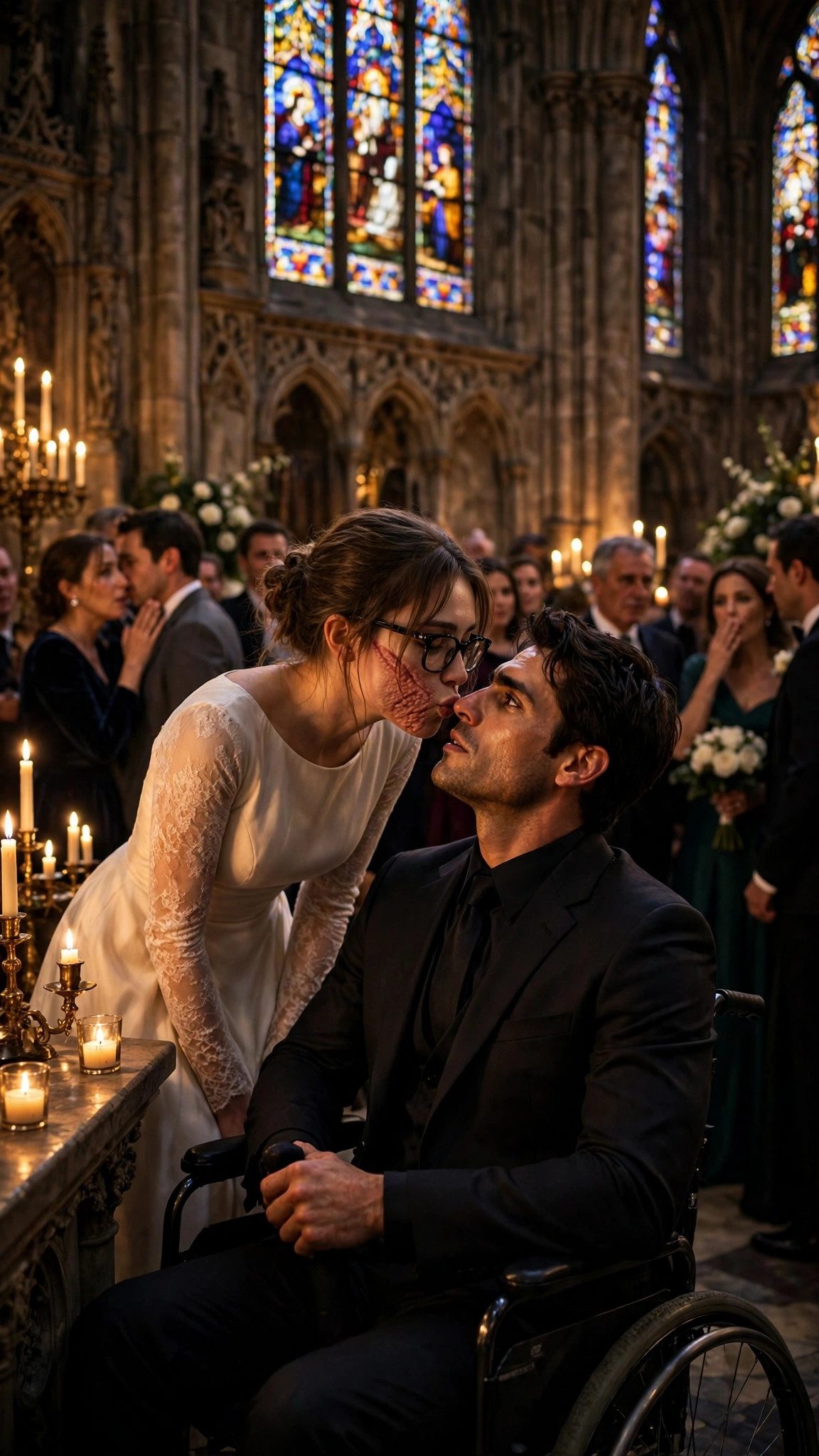
My dress was white, and it was simple, and it fit me, and my hair was dark gold in the sunlight, and my face was my own — no scar, no glasses, no dull brown dye, nothing between me and the world — and when I reached Adrian, he took my hands, and he looked at me the way he had looked at me in the cathedral, as if I were the most interesting thing he had ever seen, and he said:
"You look like yourself."
"I am myself," I said. "Finally."
The ceremony was short. There was a priest, a kind man with a soft voice, who had married us the first time in the cathedral, and who had agreed, when Adrian asked him, to marry us again, properly, in the garden, in front of the people who actually loved us. He asked if I took this man to be my husband, and I said "I do" in a voice that everyone could hear, and Adrian said "I do" in a voice like gravel and smoke, and then he kissed me, standing up, in the sunlight, with white roses all around us, and nobody laughed, and nobody whispered, and nobody looked away.
Afterward, there was cake, and there was dancing, and there was laughter, and Ruth ate two pieces of cake and told everyone, three times, that I looked just like my mother, and each time, I said, "Thank you, Ruth," and each time, she smiled as if she had heard it for the first time.
In the evening, when the guests had gone and the garden was quiet and the lights were coming on in the house, Adrian and I sat on the terrace, with two glasses of wine — real wine, from a bottle he had opened himself, in front of me, so I could see that it was safe — and we watched the sun go down over the lake.
"Do you remember the flower shop?" he asked.
"Of course," I said. "You bought white roses for your mother's grave."
"I came back four times," he said. "I never bought flowers again. I just wanted to see if you were still there."
"Why?" I asked. "Why me? You could have had anyone."
"Because you apologized for existing," he said, "and I had spent my whole life around people who never apologized for anything, and I thought, that woman has been taught to be small, and I want to know who taught her that, and I want to make them sorry."
"And now?" I asked.
"And now," he said, and he took my hand, and his hand was warm, and his grip was steady, "you don't apologize anymore. Not in my house. Not ever again."
He was right. I had not apologized in weeks. Not for taking up space. Not for having opinions. Not for laughing too loudly at dinner, or for asking for a second piece of cake, or for telling Marco Santini that his tie did not match his suit. I had stopped saying "I'm sorry" for existing, and the world had not ended. The world had gotten bigger.
"There is one thing I want to ask you," Adrian said, and he reached into his pocket, and he took out a small box, and he opened it, and inside was a ring — not a diamond, not a showpiece, but a simple gold band, with a single small stone, the color of dark honey.
"My mother wore this ring," he said. "She wore it every day of her life. She told me once that a ring is not a chain. It is a promise. And a promise is only worth something if both people choose it freely."
He held the ring out to me, and he said, "Mara Barone, will you marry me — not because your father sent you, not because of an alliance, not because of a debt, but because you want to?"
I looked at him, standing in the sunlight, on two good legs, with his dark eyes and his broad shoulders and his rough laugh, and I thought about the cathedral, and the scar, and the bottle, and the ten years, and the flower shop, and Ruth, and my mother, who had laughed at everything and died too young, and I thought about what she would have said, if she had been sitting on that terrace with us.
She would have said, "Laugh, Mara. If we stop laughing, they win."
So I laughed. I laughed out loud, in the garden, in the sunlight, with tears in my eyes, and I held out my hand, and Adrian slipped the ring onto my finger, and it fit, and he kissed my hand, and he said:
"Welcome home, Mara."
We live in the house in Lake Forest now, Adrian and I, and Ruth visits every Sunday, and she sits in the garden, and she tells me stories about my mother, and sometimes she remembers my name, and sometimes she calls me by my mother's name, and I never correct her, because it does not matter what she calls me. What matters is that she is here, and she is safe, and she is loved.
Celeste comes to dinner once a month. She is different now — quieter, kinder, still learning how to be a person instead of a performance. She works at the women's shelter, and she tells me about the women she meets, and sometimes she asks me for advice, and sometimes I give it, and sometimes we just sit together and drink tea and do not say anything at all, and that is enough.
My father is in prison. I do not visit him. I do not write to him. I think about him sometimes, late at night, when the house is quiet, and I wonder if he ever thinks about me — not as a tool, not as a lie, not as the other girl, but as his daughter. I hope he does. I hope he thinks about the morning he looked at me over breakfast and said, "Then send the other girl," and I hope he understands, at last, what he lost.
But I do not wait for his apology. I do not need it. I have a husband who loves me, a foster mother who is safe, a sister who is learning to be kind, and a face of my own, and a life of my own, and that is enough. That is more than enough.
Sometimes, in the mornings, I go down to the garden, and I cut white roses, and I put them in a vase on the kitchen table, with the stems all even and the paper folded twice, the way my mother used to do it, the way Ruth taught me, and I think about the girl I used to be — the girl in the flower shop on Division Street, with a fake scar and heavy glasses, who apologized for existing — and I think about how far she has come.
She walked down the aisle of a cathedral in a dress that did not fit, toward a man in a wheelchair, while one hundred and twenty people tried not to laugh. She wore a face that was not hers, and she carried a bottle of poison in her bag, and she thought she had no choices left.
She was wrong. She had one choice left, and it was the only one that mattered. She chose to tell the truth. She chose to stand up straight. She chose to stop apologizing for existing.
And that choice changed everything.
My name is Mara Vitali now. I am twenty-seven years old. I am a wife, and a daughter, and a sister, and a friend, and I am beautiful — not because my face is perfect, but because it is mine, and because I do not hide it anymore, and because the man I love looks at it every day as if it were the most interesting thing he has ever seen.
And every morning, when I wake up beside him, in a house full of light, I say the same thing to myself, the way Ruth taught me, the way my mother would have wanted me to:
Today, I will not be small. Today, I will not apologize for existing. Today, I am free.
The morning of our second wedding, Celeste came to my room to help me get ready, and it was strange and wonderful and a little bit awkward, the way all new things are between sisters who are still learning how to be sisters.
She brushed my hair, slowly, the way Ruth used to brush it when I was small, and she said, "Your hair is beautiful, Mara. It always was. I was jealous of it, you know. Under the dye. I could always tell it was beautiful underneath."
"I was jealous of you too," I said. "You had everything. A house. A name. A father who claimed you."
"A father who owned me," Celeste said, quietly. "There's a difference. I didn't understand that until recently. I thought being claimed was the same as being loved. It isn't."
She pinned a white rose into my hair then, just above my ear, and she stepped back, and she looked at me, and she smiled, and she said, "You look like our mother. I never told you that before, but you do. You have her eyes. And her laugh."
"Thank you," I said, and my voice shook a little, because it was the nicest thing my sister had ever said to me, and because it was true, and because it mattered.
A year later, on our first anniversary, Adrian took me back to the flower shop on Division Street. It was still there, small and bright, with the same bell over the door, and the same smell of roses and earth, and the woman behind the counter was new, young, with tired eyes, and Adrian bought a dozen white roses, and he handed them to me, and he said:
"For your mother's grave. And for Ruth. And for you. For the girl who sold me flowers and apologized for existing, and who turned out to be the bravest person I have ever known."
We put the roses on my mother's grave that afternoon, in a small cemetery on the west side, under an old oak tree, and I stood there with Adrian's hand in mine, and I told my mother, out loud, everything that had happened — the scar, the wedding, the poison, the trial, the garden, the ring — and I told her that I was happy, and that I was free, and that I was not small anymore, and that I hoped she was proud of me.
The wind moved through the oak tree, and the leaves rustled, and it sounded, just for a moment, like laughter. Like a bell. Like a woman laughing at everything, even the hard things, especially the hard things, because if we stop laughing, they win.
And we had not stopped laughing. We had won.
That night, back at the house in Lake Forest, Adrian and I sat on the terrace, and the lake was dark, and the stars were out, and he asked me what I was thinking about, and I said:
"I was thinking about the little bird. The one in Ruth's song. She flew too far from home, and she found her way back by following the stars."
"And did she find her way home?" Adrian asked.
"Yes," I said, and I leaned my head against his shoulder, and I closed my eyes, and I listened to his heartbeat, steady and strong, and I said, "She did. She's home now."
In the spring, I planted a rose garden behind the house, white roses and red ones, side by side, and I tend them myself, in the mornings, with my hands in the earth, and Ruth sits beside me in her wheelchair, in the sun, and tells me stories about my mother, and sometimes she remembers my name, and sometimes she calls me by my mother's name, and I never correct her. The roses bloom all summer, and the house smells like flowers, and every morning, when I cut a dozen white ones for the kitchen table, with the stems all even and the paper folded twice, I think about how far the little bird has flown, and how glad I am that she found her way home.
The End.
THE END
The End.
THE END