Seven months later, my mother walked out of Boston General Hospital on her own two feet.
It was a Tuesday in October, and the leaves were turning gold and red along the river, and my mother — Margaret Hale, fifty-two years old, five feet four inches tall, and sixty-one pounds heavier than the day I had signed the contract — walked out of the front doors of the hospital with a nurse on one side and me on the other, and she stopped on the steps, and she closed her eyes, and she tilted her face up toward the sun.
"Fresh air," she said. "I had forgotten what fresh air smells like."
The doctors had called it a remission. They had used careful words, the way doctors do — "significant reduction," "no detectable disease," "cautious optimism" — but my mother had translated it into her own language, which was simpler and truer: "I am going to live, Evelyn. I am going to live to see my grandchild."
The treatment had continued, paid for in full, without a single phone call from a billing office, without a single threat to discontinue anything. Luca had seen to that personally. He had gone to the hospital himself, in the first week after Aldo's exile, and he had sat down with the hospital's director, and he had established a fund — not just for my mother, but for any patient in the oncology ward who could not pay. He had named it the Margaret Hale Fund, and he had not told me about it until the director sent me a letter, and I had cried when I read it, because my mother had always been the kind of woman who helped other people, and now, because of her, other people would be helped too.
My father came to the hospital to take my mother home. He stood in the lobby, holding her coat, and he looked at me, and for the first time in my life, he looked at me the way a father is supposed to look at his daughter.
"Evelyn," he said, and his voice was rough, and he cleared his throat, and he tried again. "Evelyn. I am sorry. For all of it. For the way I treated you. For the contract. For everything. Your mother told me that you signed that paper to save her life, and I have thought about that every day since, and I want you to know that I know what it cost you. And I want you to know that I am proud of you. I should have told you that a long time ago."
I did not forgive him all at once. Forgiveness is not a door that opens; it is a road that you walk, slowly, one step at a time. But I took his hand, and I said, "Thank you, Dad. That means more than you know."
And that was the first step.
The baby was born on a snowy morning in January, in a private room at Boston General, with Luca holding my hand and my mother sitting in the chair beside the bed, and the doctor saying, "One more push, Evelyn. One more."
She was born at 6:14 in the morning, weighing seven pounds and two ounces, with dark hair like her father's and my mother's gray eyes, and when the nurse placed her in my arms, I looked down at her face, and I understood, finally, what my mother had meant when she said that a woman's worth is not decided by the men who notice her, but by the life she chooses when nobody is watching.
I had chosen this life. Not the contract. Not the year. This life. This man. This child.
Luca bent down, and he kissed the top of our daughter's head, very gently, and he whispered something to her in Italian — a language I did not speak, but whose meaning I understood perfectly, because it was the sound a man makes when he is holding the whole world in his hands.
"What did you say to her?" I asked.
"I told her," Luca said, and his eyes were shining, "that her name is Lucia. After my mother. Lucia Varenna. And I told her that her father waited twelve years to meet her, and that she was worth every single day of the wait."
My mother reached out, and she touched Lucia's tiny hand with one finger, and Lucia curled her fingers around it, and my mother laughed, and she cried, and she said, "Hello, little one. I am your grandmother. I have been waiting for you for a very long time."
Three months later, on a spring evening, Luca took me to the rose garden behind the Varenna mansion — the garden his mother had planted, the garden that had been closed and locked for twelve years, ever since his father had died — and he had unlocked it, and he had filled it with candles, and he stood in the middle of it, in a black suit, with his dark hair combed back and his eyes shining in the candlelight, and he got down on one knee.
"Evelyn Varenna," he said, and he took my hand, and he held up a ring — not the ring from our wedding, which had been chosen by a lawyer, but a new ring, a simple gold band with a single diamond, chosen by him. "I married you with a contract. I want to marry you again, without one. No terms. No conditions. No end date. Just you, and me, and our daughter, and the rest of our lives. Will you marry me? Properly, this time?"
I looked at him — at the man who had once been the most feared name in Boston, and who was now the man who made my daughter laugh by pulling faces at her, and who had unlocked a garden that had been closed for twelve years — and I said, "Yes. Yes, Luca. A thousand times, yes."
We were married again, in the rose garden, with my mother and my father and Lucia in her white christening dress, and Enzo standing beside Luca as his best man, and Rosa crying in the front row, and Joseph the driver playing the violin — badly, but with great feeling — and the whole Varenna family watching, not as a tribunal, but as a family.
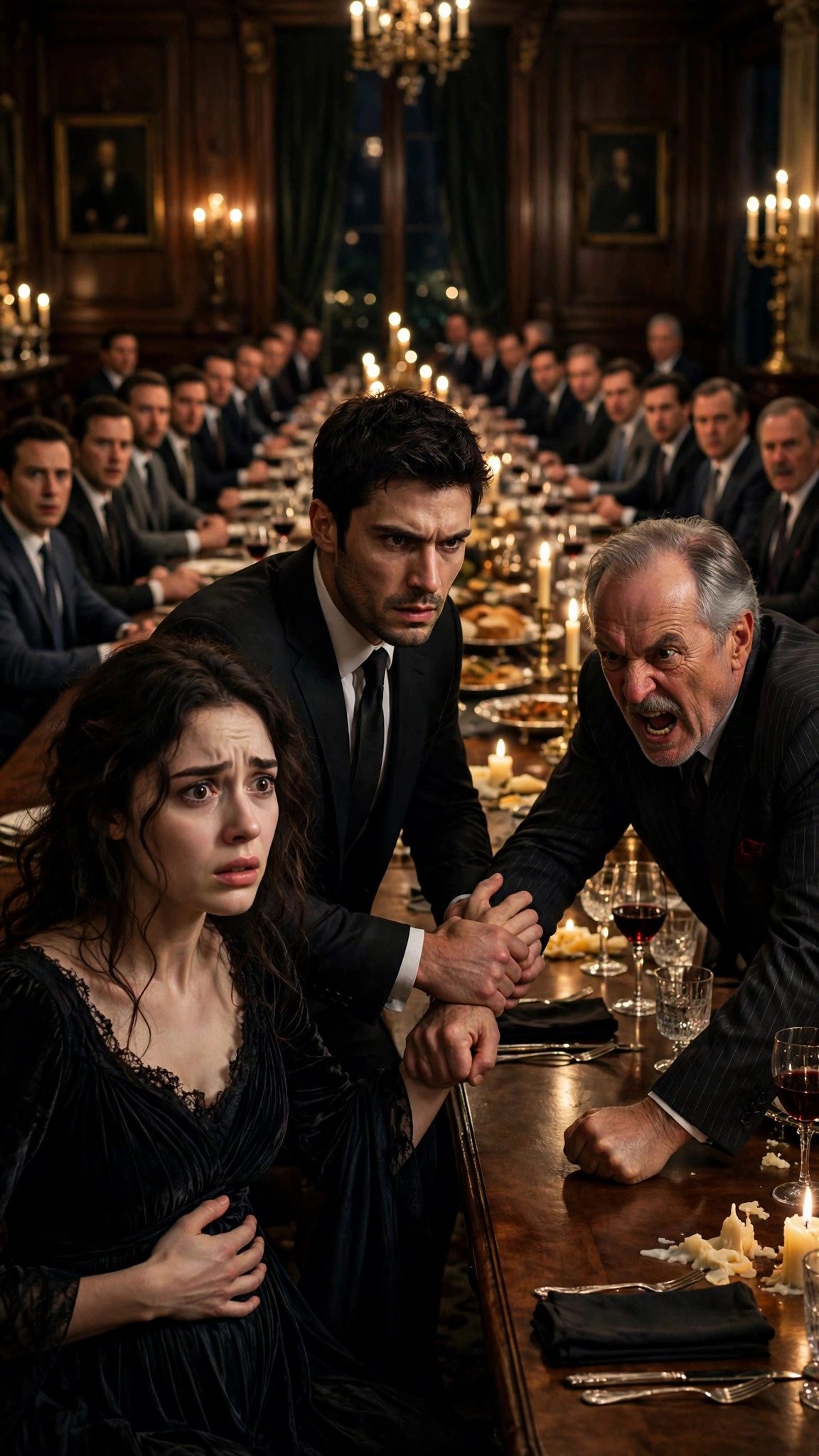
And at the christening dinner that followed, in the great dining room of the mansion, at the same long table where Aldo had once slammed his fist and demanded to know whose baby I was carrying, Luca stood up, and he raised his glass, and he looked around the room at the twenty men who had once judged me, and he said, "Twelve years ago, someone told me that my family line would end with me. Tonight, I am holding my daughter, and I am looking at my wife, and I am telling you that the line does not end. The line begins again. And it begins with love, not with fear. And it begins with truth, not with lies. And it begins here, at this table, with all of you, as my family."
The men raised their glasses. My mother raised hers. My father raised his, and his hand shook, but he raised it high.
And I sat beside my husband, with my daughter in my arms, and I thought about a hospital room, and a contract, and a brown envelope, and two pink lines, and a man who had spent twelve years believing a lie — and I thought about how the most dangerous thing about Luca Varenna had never been his reputation, or his power, or his name.
It was his heart. And his heart had been mine from the beginning, even when neither of us knew it yet.
And sometimes, on quiet evenings, Luca and I sit in the rose garden, and we watch Lucia chase butterflies between the roses, and he holds my hand, and I think about a dinner table, and a slammed fist, and a question that changed everything — "Tell me whose baby that is" — and I think about how the answer to that question was never really about the baby at all.
The first weeks with Lucia were the hardest and the happiest weeks of my life.
She woke every two hours, all night, every night, and I woke with her, and I fed her in the dark, in the rocking chair by the window, with the city lights spread out below us like a field of stars. Luca woke with us, every time, without being asked. He would sit on the edge of the bed, half asleep, and he would watch us, and sometimes he would fall asleep sitting up, and I would wake him gently, and he would say, "I am awake. I am here. Go back to sleep," even though he was the one who needed sleep more.
He learned to change diapers. He learned badly, at first — he put them on backward, twice — and Rosa laughed at him, and I laughed at him, and he laughed at himself, and then he got better, and then he was better at it than I was, which he pointed out at every opportunity.
He learned to hold her. He held her the way a man holds something he is afraid of breaking, and then, slowly, he learned to hold her the way a father holds a daughter — close to his chest, with one hand under her head, humming a song his mother used to sing to him, a song he had not thought about in twenty years, a song that came back to him the first time Lucia cried in his arms.
My mother came to see Lucia every day. She would sit in the rocking chair, with Lucia in her arms, and she would sing to her, the same songs she had sung to me, and she would tell her stories — about the street where I grew up, about the soup she used to make, about the time I fell off my bicycle and broke my wrist and my father said, "Your mother will have to drive you to school now."
"She is going to be strong, this one," my mother said, one afternoon, looking down at Lucia's sleeping face. "She has her father's eyes and her mother's stubbornness. That is a dangerous combination, Evelyn. You are going to have your hands full."
"I know, Mama," I said. "I am counting on it."
The vow renewal took a month to plan. Rosa insisted on cooking everything herself. Joseph insisted on playing the violin, even though everyone knew he could not play the violin. Enzo insisted on standing beside Luca as his best man, and he cried during the ceremony, and he did not apologize for it, and nobody asked him to.
And on the day itself, in the rose garden, with the candles burning and the roses in full bloom, Luca took my hand, and he looked at me, and he said the words he had written himself, without a lawyer, without a contract, without any conditions at all.
"Evelyn," he said, "I married you once because of a piece of paper. I am marrying you again because of who you are. You are the bravest person I have ever met. You are the kindest person I have ever met. You are the mother of my daughter, and you are the love of my life, and I will spend the rest of my days trying to deserve you."
I cried. My mother cried. Rosa cried. Even Joseph, who was supposed to be playing the violin, stopped playing and wiped his eyes with his sleeve.
A month after the wedding, we held the first event for the Margaret Hale Fund, in the ballroom of one of Luca's hotels. My mother stood at the front of the room, in a yellow dress, with Lucia in her arms, and she told the audience — doctors, nurses, donors, families — about the drug that had cost thirty-eight thousand dollars a month, and about the phone call from the billing office, and about the daughter who had signed a contract to save her life.
"I am standing here today," my mother said, "because my daughter loved me enough to give up a year of her life. And I am standing here today to tell you that no mother should have to ask her daughter to do that. No family should have to choose between a life and a bill. And because of this fund, because of my daughter and my son-in-law, fewer families will have to make that choice."
The room stood up and applauded. My mother bowed her head, and Lucia reached for her grandmother's necklace, and Luca put his arm around me, and I thought: this is what a family is. Not a contract. Not a bloodline. Not a name on a building. A family is the people who stand beside you when you are afraid, and who tell the truth when the truth is hard, and who love you even when you are difficult to love.
A year after Lucia was born, on a warm evening in June, we sat in the rose garden as a family — my mother, my father, Enzo, Rosa, Joseph, and the three of us — and Lucia took her first steps on the grass between the rose beds, wobbling from my arms to Luca's, and falling into his hands with a laugh that sounded like a bell.
"She is going to be trouble, that one," my father said, and he was smiling, and for the first time in my life, his smile reached his eyes.
"She is going to be wonderful," my mother said, and she took my hand, and she squeezed it, and she said, very quietly, so that only I could hear, "You did this, Evelyn. You built this. Not the contract. Not the money. You."
It was about the truth. And the truth was that the baby was his, and the lie was twelve years old, and love — real love, the kind that waits, and protects, and tells the truth even when the truth is frightening — love was the thing that finally set us all free.
The End.
THE END