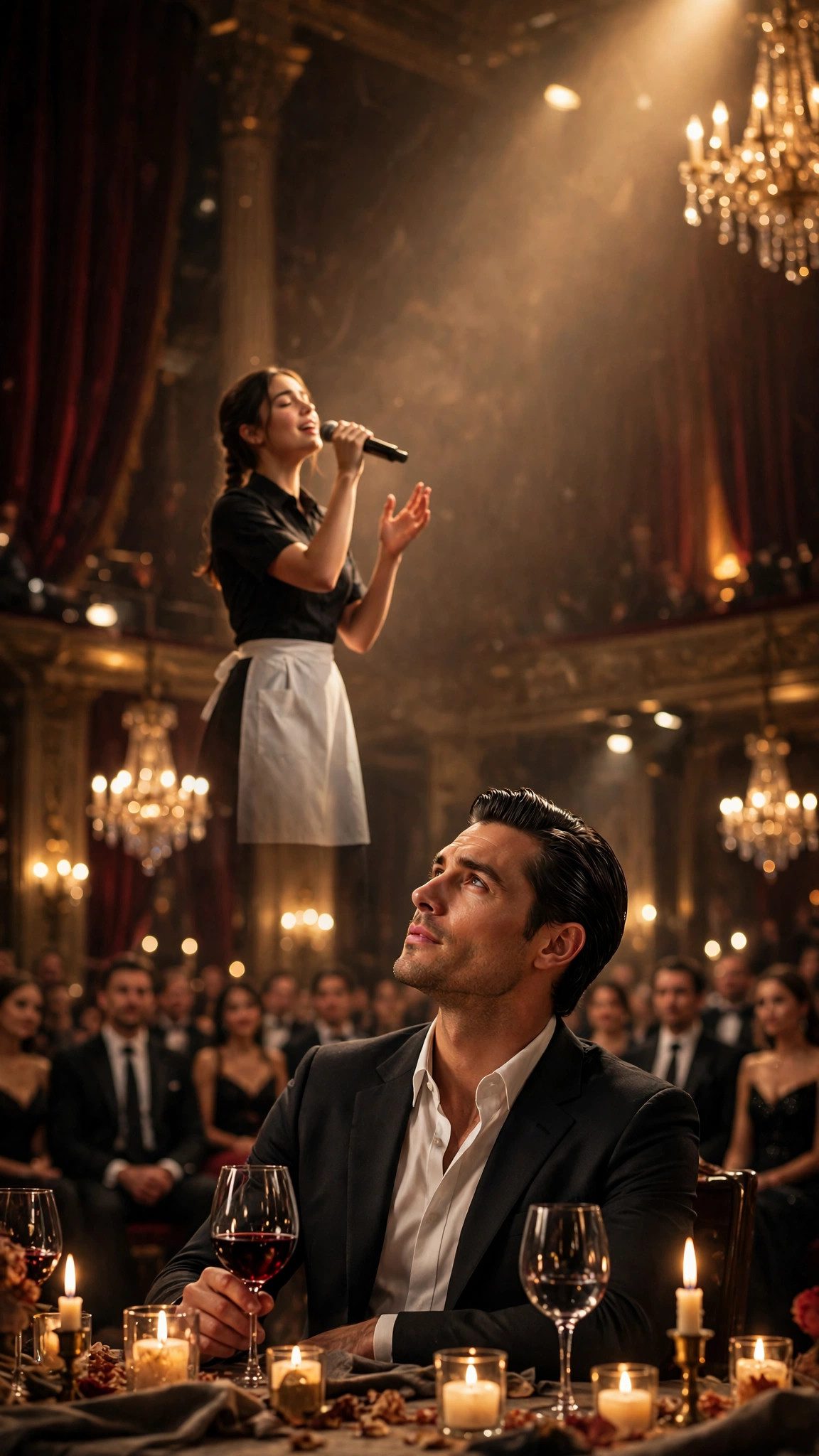
The morning after the gala, my photograph was in the newspapers.
Not a big photograph. A small one, on page six of the society section, under a headline that read, "MYSTERY SINGER STUNS MORETTI GALA." The photograph showed me on the stage with the microphone in my hand, my black uniform and my white apron, my face lifted toward the chandeliers, and underneath it, the caption: "Unidentified waitress brings down the house with Mozart's Queen of the Night. Moretti promises marriage in jest — or was it?"
I read it three times over my morning coffee, sitting at our little kitchen table in Queens while Gabriel ate his cereal and talked about a spelling test, and my hands shook so badly I nearly spilled the coffee on the paper.
"Mamma, why is your face in the newspaper?" Gabriel asked, leaning over my shoulder.
"Because I sang a song last night, tesoro," I said. "For some important people."
"Did you sing the scary lady song?" he asked.
"Yes," I said. "I sang the scary lady song."
"Good," he said, and went back to his cereal, satisfied. "You should sing more."
By noon, the telephone in the restaurant was ringing off the hook. Reporters wanted to know who I was. Opera companies wanted to know where I had trained. A talent agent from Los Angeles left three messages. And Alessandro Moretti sent a car.
Not a note. Not a telephone call. A black car with a driver in a dark suit, waiting outside Lumière at the end of my shift, with instructions to bring me to the Moretti estate in Long Island, where his mother wanted to meet me.
I almost did not go. I stood on the sidewalk outside the restaurant for a full five minutes, looking at that black car, and every instinct I had learned in five years of running screamed at me to turn around, to go home, to pack a bag and disappear again. Black cars had taken me to a warehouse once. Black cars meant men with guns and families who decided who lived and who died.
But then I thought about my mother, and about the old woman upstairs at the gala, weeping when she heard the aria, and I thought about Gabriel, who deserved more than a two-room apartment above a laundromat, and I got into the car.
The Moretti estate was not a house. It was a world. A long driveway lined with oak trees. Gardens that went on for acres. A mansion of gray stone with white columns and windows that glowed gold in the evening light. Inside, the floors were marble, the ceilings were painted with clouds, and the air smelled of beeswax and lilies.
A nurse led me upstairs to a bedroom at the end of a long hall, a beautiful room with tall windows looking out over the gardens, and in a bed by the window lay Isabella Moretti.
She was sixty-seven years old, thin and frail, with white hair spread across the pillow like spun silver and dark eyes that were still sharp and alive in a face that illness had worn down to the bone. There were machines beside the bed, and tubes, and a heart monitor that beeped softly, steadily, and on the nightstand there was a photograph in a silver frame: a young woman in a wedding dress, laughing, with a dark-haired man beside her.
"Sofia's daughter," she said, when she saw me. Her voice was thin, but it was steady. "Come closer, child. Let me look at you."
I went to the bed and I knelt beside it, and she took my hand in hers. Her fingers were cold and light as bird bones.
"You have her eyes," she said. "And her chin. And when you sang last night, I closed my eyes, and for one moment I was twenty-five years old again, standing in a church in Naples, and your mother was singing at my wedding, and the whole world was beautiful. Do you know what your mother said to me that night? She said, 'Isabella, one day your son will need a voice like mine, and when that day comes, you will know it.' I thought she was joking. She was not joking."
Tears filled my eyes. "I did not know she knew you so well."
"We were girls together," Isabella said. "Before the families, before the business, before all of it. Your mother sang. I listened. That was our whole friendship, and it was enough." She squeezed my hand. "My son has searched for five years for a voice like your mother's. He has auditioned every soprano in New York. He has flown singers in from Milan and Vienna and London. None of them could sing it. And then a waitress spills wine on his shirt, and her name is Marchetti, and suddenly my son is laughing again for the first time in three years. Do you know what that means, child?"
"No," I whispered.
"It means God has a sense of humor," she said, and she smiled, a real smile, the first one I had seen on that frail face. "And it means my son is in more trouble than he knows."
After I left Isabella's room, Alessandro was waiting for me in the hall. He led me down to his study, a dark room lined with books and a fire burning in the grate, and he poured two glasses of whiskey, and he handed me one, and he told me about the name he had buried.
Caterina Voss was twenty-six when she died, beautiful and brilliant and laughing, the daughter of a shipping family, and Alessandro had loved her for four years and been engaged to her for one. They were to be married in June. Three months before the wedding, on a rainy night in March, her car went off the West Side Highway and into the river, and by the time they pulled her out, she was gone.
"The police said it was an accident," Alessandro said, staring into the fire. "Rain. Speed. A bad curve. But I have spent three years wondering if it was something else. My family has enemies, Elena. Men like Vincent Castellano would kill a woman to hurt me, and they would call it an accident, and no one would ever prove otherwise."
He turned to look at me then, and his eyes were dark and raw, and for the first time I saw not the King of New York but a man who had lost the only person he ever loved and had never forgiven himself for it.
"At her funeral, I swore her name was buried with her," he said. "I swore I would never marry. Never love. Never give my heart to anyone again, because a heart is a weakness, and I cannot afford a weakness. And then last night, in front of two hundred people, I laughed, and I made a dare, and you threw my own words back in my face, and you sang, and for the first time in three years, I felt something other than anger."
He set his glass down and he looked at me for a long moment.
"I am not asking you to marry me, Elena," he said. "Last night was a joke, a stupid joke, and I am sorry for it. But I am asking you to sing for my mother. She does not have long. The doctors say weeks, maybe days. Her last wish is to hear the Queen of the Night sung live, in this house, by the daughter of the woman who sang it at her wedding. Will you do that?"
I thought about it. I thought about the danger. I thought about the fact that I had spent five years hiding, and that singing for the King of New York was the opposite of hiding. I thought about Gabriel, and about the fact that a woman with a voice like mine did not belong in a black uniform carrying trays for the rest of her life.
"Yes," I said. "I will sing for your mother."
But I did not know then that Vincent Castellano already knew who I was.
Vincent Castellano was sixty years old, fat and smiling, with a face like a kindly grandfather and eyes like a shark, and he wanted the Moretti docks the way a wolf wants a flock of sheep. For ten years he had tried to take them: with bribes, with threats, with arson, with murder. For ten years Alessandro Moretti had held him off.
Castellano had men everywhere. He had a man in the port authority. He had a man in the mayor's office. And he had a man inside Alessandro's own house: Marco Hale, the head of Moretti security, a man Alessandro had trusted for fifteen years, who had been selling him out for two, for money and for promises, feeding Castellano every secret, every schedule, every weakness.
And now Marco Hale had a new secret to sell. The waitress with the voice. The woman from Naples. The runaway wife of Matteo Bellini.
Castellano knew the Bellini family. He knew Don Salvatore Bellini, the old man in Naples, and he knew that the old man had never forgiven his grandson for losing his wife and his heir. And Castellano knew that if Matteo Bellini learned where his wife and his son were, he would come to New York, and there would be a war between the Bellinis and the Morettis, and while the two families tore each other apart, Castellano would walk in and take the docks for himself.
So Castellano made a telephone call to Naples, and he told Matteo Bellini exactly where his runaway wife was: a waitress at Lumière, in Manhattan, with a five-year-old son named Gabriel.
And in Naples, in a dark office above the docks, Matteo Bellini put down the telephone, and he looked at the photograph of his wife and his son that he kept in his desk drawer, and he booked a flight to New York.
He was coming to take back what was his. And he did not know that he was walking into a trap set by a man who wanted them all dead.
I went back to see Isabella two days later, and this time I stayed for hours. She was stronger that day, sitting up in bed with pillows behind her, and she told me stories about my mother that I had never heard before.
"Your mother was the funniest person I ever knew," Isabella said, her thin face bright with memory. "She could imitate the conductor so perfectly that the whole chorus would be in tears. And she was brave. When the theater manager told her she was too old to sing the Queen of the Night anymore, she laughed in his face and sang it better than ever, just to prove him wrong. You have her laugh, you know. I saw it at the gala, when you answered my son. That was Sofia's laugh."
She showed me the music room that afternoon, or rather, she had the nurse wheel her there in her chair, and I pushed her through the wide doors into a beautiful room with tall windows and a grand piano in the center, its lid open, the keys gleaming in the sunlight. On the piano there was a photograph in a silver frame: two young women, laughing, their arms around each other, one dark and one fair, standing in front of a church.
"That is your mother and me," Isabella said, "on my wedding day. She sang the Queen of the Night that night, and the whole church wept, and I have never forgotten it. Play something for me, Elena. Not the aria. Something soft. Something your mother taught you."
I sat at the piano, and I played the opening of The Magic Flute, very simply, the way my father used to play it for me on his violin, and I sang the first gentle melody, Papageno's song, soft and sweet, and Isabella closed her eyes and hummed along, and for a little while, the illness and the machines and the dying did not matter, and we were just two women in a music room, remembering a girl who had sung at a wedding forty years ago.
That night, at home, I told Gabriel about his grandmother Sofia. I showed him the photograph I kept in my drawer, my mother in her chorus dress, young and laughing, and I told him about her voice, and about the aria, and about how she used to sing me to sleep. Gabriel listened very carefully, the way he does, and then he said, "Mamma, was Grandma Sofia a queen?"
"No, tesoro," I said. "She was a singer. But she sang like a queen."
"Then I am the grandson of a queen," Gabriel said proudly, and he puffed out his little chest. "That means I am a prince."
"Yes," I said, and I kissed the top of his head. "You are a prince. And your grandma Sofia would have loved you very much."
Alessandro showed me the family photographs that week too, in his study, late one night after Gabriel was asleep. Photographs of his father, a stern man with Alessandro's dark eyes. Photographs of his sister Rosa as a little girl. And one photograph, in a frame by itself on the desk, of a beautiful young woman with dark hair and laughing eyes, standing on a beach with the wind in her hair.
"Caterina," he said quietly. "Three months before the wedding. She was happy that day. I have never seen anyone so happy."
I looked at the photograph for a long time, and I felt no jealousy, only sorrow, for him and for her, and for all the happiness that had been stolen from them both.
"She would want you to be happy, Alessandro," I said softly. "Dead people do not want the living to be miserable. My mother would not want that. Your Caterina would not want that either."
He did not answer. He just stood there, looking at the photograph, and I stood beside him, and the fire crackled in the grate, and outside the window, the rain began to fall on the gardens of the estate.
That night, after I came home from the estate, I lay awake for a long time, listening to Gabriel breathing in the next room, and thinking about Matteo, somewhere in Naples, packing a bag, booking a flight, coming to take back what he believed was his. I was afraid, but not the way I had been afraid five years ago. Five years ago, fear had made me run. Now fear made me plan. I packed a small bag for Gabriel, just in case: clothes, his rabbit, his favorite book, some money folded into a sock, the way my mother used to hide money in the house in Naples. I put the bag in the back of the closet, where Gabriel would not find it, and I told Mrs. Deluca to watch the street, and to call me if she saw any black cars, any strangers, anyone asking questions. And then I sat by Gabriel's bed until morning, watching him sleep, and I promised him, silently, the way mothers promise their children in the dark, that no one would ever take him from me again.