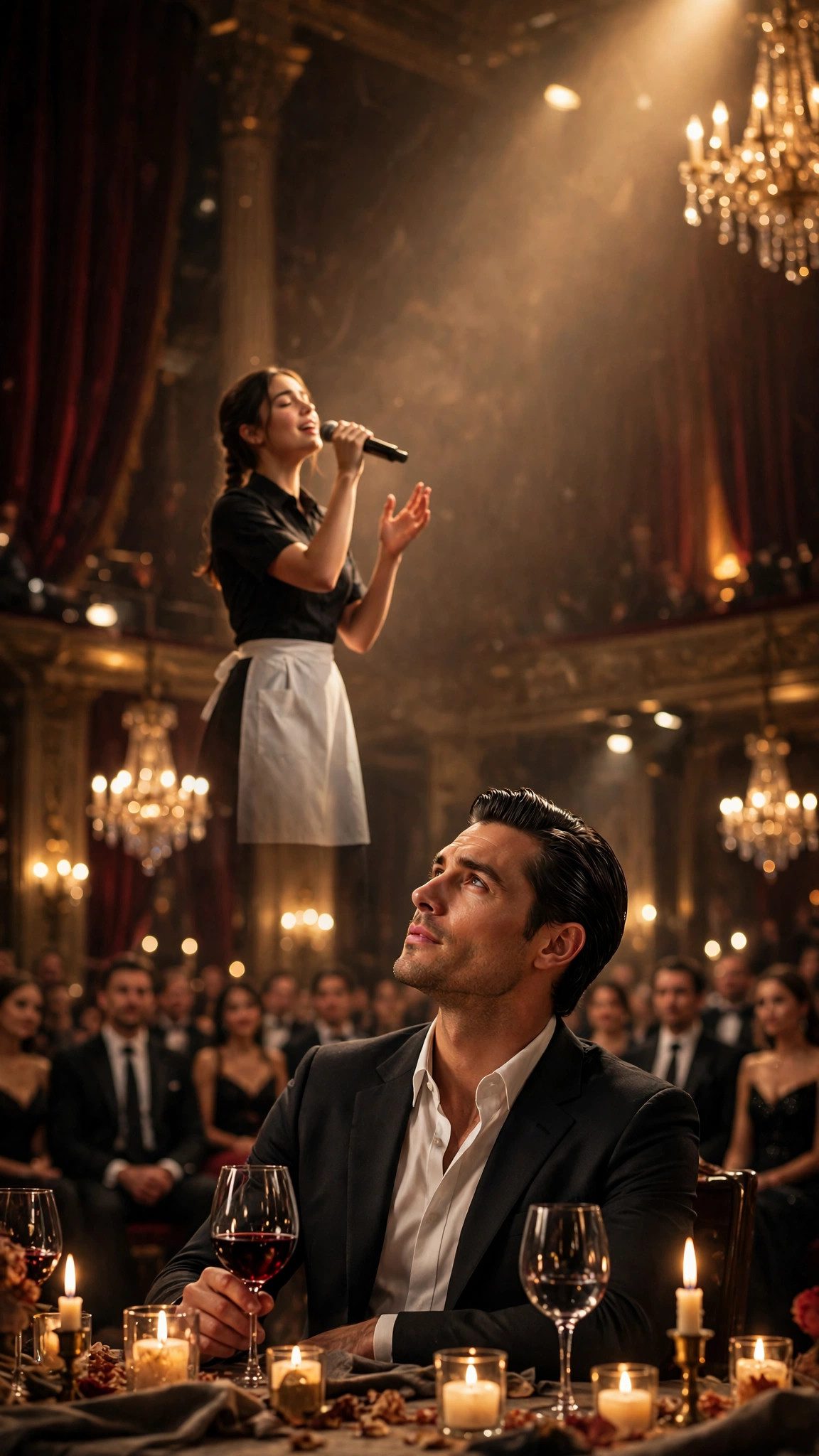
The concert was Alessandro's idea.
Not the gala. Something smaller, and more dangerous: a private concert at the Moretti Foundation hall, one night only, for his mother. Isabella was too weak to leave her bed, so they would bring the concert to her, through speakers and a live video feed, and I would sing the Queen of the Night in the same hall where I had sung it at the gala, for an audience of no one but a dying woman in a bed in Long Island.
"It is what she wants," Alessandro said to me, three days before the concert, when he came to Lumière after closing time and sat at my table while I wiped it down. "She wants to hear it one more time, live, the way your mother sang it at her wedding. After that, whatever happens, happens."
I agreed. Of course I agreed. How could I refuse a dying woman her last wish?
But I was afraid. I had been afraid ever since the gala, ever since my photograph appeared in the newspapers, ever since I understood that my five years of hiding were over and that anyone who wanted to find me could find me now. I was afraid for Gabriel most of all. Gabriel, who went to school every morning with his little backpack and his lunchbox, and who walked home every afternoon past the same streets, at the same time, like clockwork. A boy with a schedule is a boy who can be taken.
I told Alessandro about my fear. I told him about Naples, about the warehouse, about the three men with guns, about Matteo and the Bellini family. I told him everything, sitting at that table in the dark restaurant, and he listened without interrupting, and when I was finished, he took my hand across the table, and he said, "No one will touch your son while I am alive. I swear it on my mother's life."
I believed him. I wanted to believe him. And for three days, I almost did.
On the night of the concert, I left Gabriel with Mrs. Deluca, the old woman who lived downstairs and who had watched him a hundred times before, and I took a car to the concert hall. The hall was empty except for a handful of people: Alessandro, his sister Rosa, two nurses, and a sound engineer. The chandeliers were dimmed. The stage was lit by a single warm light. I wore a simple black dress that Alessandro had sent to my apartment that morning, with a note that said only, "For tonight. You are not a waitress tonight."
I sang. I sang the Queen of the Night for Isabella Moretti, alone in that great empty hall, and my voice filled every corner of it, and when I finished, there was silence, and then, through the speakers, I heard a frail old woman's voice say, "Thank you, Sofia's daughter. Thank you. Now I can go in peace."
I was still standing on the stage, with tears running down my face, when Alessandro's telephone rang.
It was Marco Hale, his head of security. His voice was tight and urgent. "Boss, we have a problem. Two men tried to take the boy from Mrs. Deluca's apartment. They said they were from the school. Mrs. Deluca would not open the door. They are still out there, in a black car across the street."
The world tilted. I do not remember running off the stage. I do not remember getting into the car. I remember Alessandro's hand on my arm, steady and strong, and his voice saying, "Breathe, Elena. Breathe. My men are already there. No one will touch him."
We drove through the night, through streets that blurred past the windows, and Alessandro was on the telephone the whole way, giving orders in a voice I had never heard before, cold and sharp as a blade. "Lock down the building. No one in, no one out. If they move, take them. Do not let them near the boy."
When we arrived in Queens, the street outside my building was full of cars, black cars with dark windows, and men in dark suits standing on the corners with their hands inside their jackets. Mrs. Deluca was waiting in the doorway, her face white, holding Gabriel's hand, and Gabriel was crying, his little face red and wet, his stuffed rabbit clutched to his chest.
"Mamma!" he screamed when he saw me, and he broke free and ran to me, and I swept him up into my arms and held him so tightly I thought I would never let him go.
"They said Papa sent them," he sobbed into my neck. "They said Papa wanted me to come with them. But Papa is only a name, Mamma. You said so. Papa is only a name."
I held him and I rocked him, and I looked over his head at Alessandro, and I saw the fury on his face, the cold, controlled fury of a man who had just watched someone try to steal a child under his protection.
"Take them," Alessandro said quietly, to the men around him. "All of them. I want to know who sent them."
They took two men from the black car across the street. One of them was Enzo Falcone, a Castellano gunman with a scar on his chin and a gun in his coat. The other was a younger man, barely twenty, who started crying the moment they put handcuffs on him and told them everything: Castellano had sent them. Castellano had paid them five thousand dollars each to take the boy and bring him to a warehouse in New Jersey, where Matteo Bellini would be waiting.
Matteo Bellini was already in New York. He had arrived that morning, on a flight from Naples, and he was staying in a hotel on Park Avenue, and he had no idea that Castellano was using him, that the men who had told him where his wife and son were had also planned to take the boy themselves and blame it on him, to start a war between the Bellinis and the Morettis that would leave them both in ruins.
Alessandro found him. Of course he found him. The King of New York could find anyone in his city. He went to the hotel himself, alone, without his men, and he knocked on Matteo Bellini's door, and he told him the truth.
I was not there. I was at home with Gabriel, holding him while he slept, and Alessandro told me about it later, sitting at my kitchen table at three in the morning, with two cups of coffee going cold between us.
"He cried," Alessandro said. "Your husband cried like a boy when I told him what Castellano had planned. He said he came to take his son back, not to start a war. He said he came because Castellano told him you were in danger, and he wanted to protect you, and he did not know that Castellano was the danger."
"Do you believe him?" I asked.
"I believe he is a weak man who finally understands what his weakness cost him," Alessandro said. "And I believe he deserves one chance to prove it."
The chance came the next night.
Castellano, furious that his men had failed, decided to finish the job himself. He sent Enzo Falcone and three more men to the concert hall, where I was rehearsing for a second performance, a public one this time, a charity concert Alessandro had announced to raise money for the foundation. The hall was full of people. Two hundred more, just like the gala. And in the middle of the rehearsal, the doors burst open, and the men came in with guns.
They were not after me. They were after Gabriel, who was sitting in the front row with Mrs. Deluca, watching his mother sing. Enzo Falcone walked straight down the aisle, his gun in his hand, and he reached for my son, and the whole hall screamed.
And then Matteo Bellini stepped out of the shadows at the side of the stage, and he put himself between Enzo Falcone and my son.
Matteo was not a brave man. I knew that. I had known it for five years. He was a weak man, a frightened man, a man who had let his family take his wife and do nothing. But in that moment, in that hall, with a gun pointed at his son, Matteo Bellini found something inside himself that he had never found before.
"Not my son," he said, and his voice shook, but he did not move. "You will not take my son."
Enzo Falcone laughed. He raised his gun. And Matteo Bellini did the bravest thing he had ever done in his life: he lunged forward, and he grabbed Enzo's arm, and the gun went off, and the bullet tore through Matteo's shoulder, and he fell to the floor in a spreading pool of blood, and the hall erupted into chaos.
Alessandro's men were on Enzo in seconds. They took his gun. They took him down. The police came, and the ambulances came, and Matteo was carried out on a stretcher, alive, his shoulder shattered but his heart still beating, and he looked up at me as they carried him past, and he said, very quietly, "I am sorry, Elena. I am so sorry. I should have protected you five years ago. Let me protect him now."
I knelt beside the stretcher and I took his hand, and for the first time in five years, I did not hate him. I saw him clearly, maybe for the first time ever: not a villain, not a monster, just a weak man who had finally, at the very last moment, chosen to be strong.
"Thank you," I whispered. "Thank you for saving our son."
That night, in the hospital, while the doctors worked on Matteo's shoulder, Alessandro sat beside me in the waiting room, and he held my hand, and he said, "Your husband took a bullet for his son. Whatever else he is, Elena, he is a father tonight."
And I knew, sitting in that waiting room with the King of New York holding my hand, that everything had changed, and that nothing would ever be the same again.
The morning after the shooting at the concert hall, Gabriel would not let go of me. He clung to my neck in the kitchen while I made his breakfast, and he followed me from room to room, and when I tried to put him down so I could wash the dishes, he started to cry, great gulping sobs, and he said, "Mamma, the man with the gun is going to come back. I know he is."
I sat down on the kitchen floor with him in my lap, and I held him, and I rocked him, and I told him the truth, the way I had always told him the truth. "The man with the gun is in jail now, tesoro. The police took him away. He cannot come back. And Papa Alessandro has men outside our building, good men, who will watch over us day and night, and nothing bad is going to happen to you. I promise."
"But what if Papa Matteo gets hurt again?" he asked, his voice small. "He bled a lot, Mamma. I saw the blood."
"Papa Matteo is in the hospital, and the doctors are taking care of him, and he is going to be all right," I said. "He was very brave, Gabriel. He stood in front of you, and he did not move, and that is the bravest thing a father can do."
Gabriel thought about that for a long moment, his little forehead wrinkled. "When I grow up," he said finally, "I want to be brave like Papa Matteo. And like Papa Alessandro."
"You already are brave," I told him, and I kissed his wet cheek. "You are the bravest boy I know."
Alessandro stayed that night, sleeping in the armchair in our little living room, his long legs stretched out, his jacket over his face, because he would not leave us alone in the apartment, not after what had happened. In the morning, I found him still there, awake, staring at the ceiling, and he said, "I have not slept in a chair since I was a boy. It is not comfortable. But I would do it a hundred nights in a row if it meant keeping you safe."
The police came that week, and Agent Reyes came, and they asked me questions for hours, sitting at my kitchen table with their notebooks open, about the men, about the car, about what I had seen and heard. Mrs. Deluca told them about the two men who had come to her door, pretending to be from the school, and how she had known at once that they were lying, because Gabriel's school never sent strangers, and because their shoes were too clean for men who claimed to work with children.
"They had the eyes of wolves," Mrs. Deluca said, crossing herself. "I have lived in this city for fifty years, and I know the eyes of wolves. I did not open the door. I called Elena. I called the police. And I held that boy's hand until his mamma came home."
Agent Reyes wrote it all down, and he thanked her, and he told me, very quietly, as he was leaving, "Mrs. Bellini, your neighbor may have saved your son's life. And your husband may have saved it a second time. You have good people around you. Remember that."
In the hospital corridor, while Matteo slept, Alessandro and I sat on a bench outside his room, and I asked him the question that had been burning in my mind since the gun went off.
"What happens now?" I said. "Castellano will try again. He always tries again. How long can we live like this, waiting for the next man with a gun?"
"Not long," Alessandro said. "Agent Reyes has been building a case against Castellano for eleven years, Elena. Eleven years. And now, for the first time, he has witnesses. He has Matteo. He has Enzo. He has the phone records. He has everything he needs, except time. Give him time, and Castellano will spend the rest of his life in a cell. I promise you that."
"And Matteo?" I asked. "What happens to him?"
"Matteo is a victim too," Alessandro said. "He was used, the same way you were used. Agent Reyes knows that. The divorce is yours to decide, Elena, whenever you are ready. No one will rush you. Not me. Not anyone."
I looked at him then, sitting beside me in that cold hospital corridor with his suit rumpled and his eyes tired, and I thought about how different he was from the man I had first seen at Lumière, the cold, still man with the dark eyes. That man had been a king. This man, sitting beside me at three in the morning, holding my hand while my husband slept in a hospital bed down the hall, was something else entirely. He was a man who stayed.