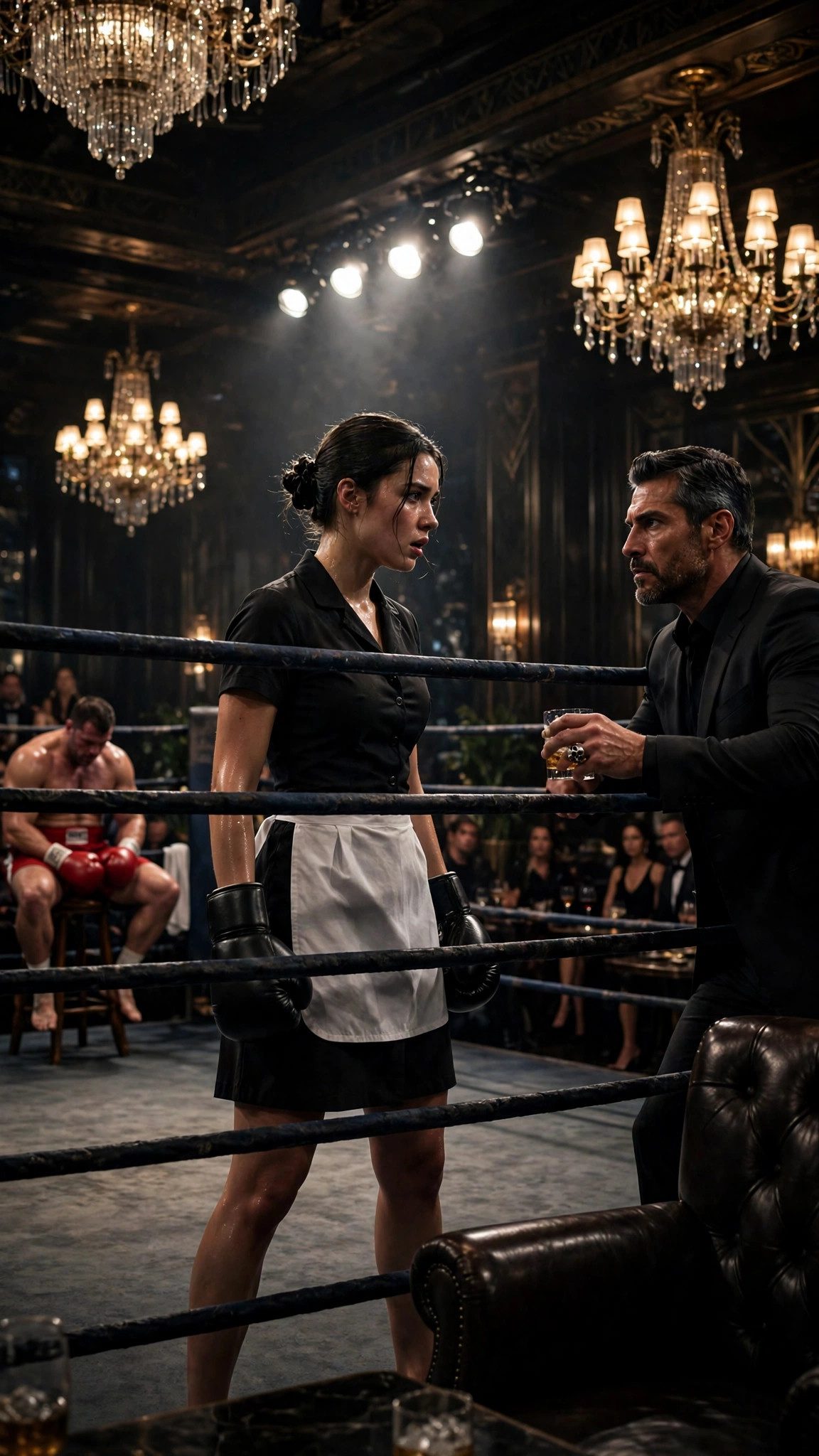
The Velvet Ring smelled of cigar smoke, expensive whiskey, and sweat, and the crowd was on its feet before the bell had even finished ringing.
Three minutes ago I had been pouring wine for my boss's special guest. Now I was standing in the middle of a boxing ring in the heart of Chicago with a pair of borrowed gloves on my hands, and the undefeated champion of Dominic Russo's fight lounge was flat on his back staring up at the chandeliers like he had never seen a ceiling before.
"Her first earned five hundred thousand," a man shouted from the front row, waving a betting slip in the air like a flag. "Five hundred thousand on the waitress!"
"Maybe Tony will retire soon!" another man called out, and the whole room roared with laughter that sounded half drunk and half terrified.
"Hundreds of champion titles," a third voice said, louder than the rest, "destroyed by a waitress."
The voice kept echoing off the walls long after the man stopped talking. Hundreds of champion titles, destroyed by a waitress. I stood in the center of the ring and listened to it bounce around the room, and I thought about my father, and about the first time he put gloves on my hands when I was eight years old, and about the way he used to say that a fight is never won by the strongest person in the room. It is won by the person who knows exactly what to do in the first thirty seconds.
Tony Marino had been the champion of this lounge for three years. He was thirty-five years old, heavily built, with short dark hair and shoulders like a doorway, and he wore red boxing shorts and red gloves that had his name stitched across the knuckles in gold thread. He had never lost a fight inside the Velvet Ring. Men bet on him the way other men bet on the weather in Chicago, which is to say they bet on him because he was the one sure thing they had ever found.
Three minutes ago, Tony had been sitting on his corner stool drinking water and laughing at me. I had been carrying a tray of wine glasses to Dominic Russo's table, and Tony had called out to me across the lounge, loud enough for everyone to hear.
"Hey, sweetheart," he had said. "You look like you could use a workout. How about you step in the ring with me and I teach you what those little hands are for?"
The room had laughed. Rich men in tailored suits laughed. Women in diamonds laughed. The bartender laughed. I did not laugh. I set the tray down on the nearest table, and I looked at Tony, and I said, "Gloves on, champion. Let's see what you've got."
Nobody in the room expected me to climb through the ropes. Nobody expected the waitress in the black uniform dress and the white apron to take off her apron, fold it neatly, hand it to Gabby at the bar, and step into the ring. But I did. And when the bell rang, Tony came at me the way a man comes at someone he does not respect, which is to say he came at me wide open, grinning, his guard down around his waist, his chin up in the air like a gift.
The instant I took off my gloves, no, the instant the bell rang, I delivered a punch to the champion's face. A straight right, right down the middle, the way my father taught me when I was eight years old and barely tall enough to reach the heavy bag. Tony's head snapped back. His grin vanished. And before he could remember that he was supposed to be the champion, I hit him twice more, a left hook to the ribs and a right uppercut that lifted him clean off the canvas for half a second.
A defeated champion's response was a punch that was countered by another two punches. He swung wild, a big looping right that would have taken my head off if it had landed, and I slipped under it the way my father taught me, stepped to the side, and put two more punches into him, one to the body and one to the jaw. Tony went down on one knee. The room gasped. I could hear the gasp like a wave rolling across the lounge, two hundred people sucking in their breath at the exact same moment.
Tony got up. He had to get up. He was the champion, and champions do not stay down in front of a waitress. He came at me again, slower this time, more careful, his gloves up where they belonged, and I let him come. I let him throw three punches, and I blocked all three of them on my gloves and my forearms, and then I stepped inside his reach and hit him with the combination my father had drilled into me ten thousand times in a cold gym on the West Side of Chicago. Jab, cross, left hook. One, two, three. Tony's legs went out from under him like someone had cut the strings holding him up, and he sat down hard on the canvas, and then he lay back, and he stayed there, blinking up at the chandeliers while the referee counted to ten.
Thirty seconds. That was all it took. Thirty seconds to destroy three years of undefeated.
My splendid boxing skills had the whole room gasping. I stood in the center of the ring with my gloves still on, breathing hard, sweat running down the back of my neck, and I looked out at the crowd, and I saw two hundred faces staring back at me, and every single one of them was asking the same question. Who is she? Where did she come from? How does a waitress fight like that?
And then I saw him.
Dominic Russo is a man of few words but great strength who seized the West Side families before he was thirty, and he sat on the high ground, silent, expressionless, watching the game intently, one hand holding a glass of whiskey, the other hand resting on the skull ring on his right hand. He had not moved during the entire fight. He had not cheered. He had not laughed. He had sat in his leather chair at the top of the room like a king watching a play he had already seen a hundred times, and his face had not changed once.
But when I emerged victorious, when the referee raised my gloved hand and the room erupted, Dominic Russo slowly stood up.
His figure was the tallest in the room, and even Tony seemed to shrink when he stood in front of him. Tony was still sitting on the canvas, dazed, blinking, and Dominic walked past him without a glance, the way a man walks past furniture. He came to the edge of the ring and he looked up at me, and the entire room went still, and all eyes were on him, because when Dominic Russo stands up in his own lounge, everyone stops breathing until they find out why.
The big man looked down at the young waitress. His voice was firm, and he addressed me the way a judge addresses a witness, and he said, "What is your name?"
My reply left him stunned. I saw it happen in real time. I saw the color leave his face. I saw his hand tighten around the whiskey glass until his knuckles went white. I saw the skull ring catch the light. It was the first time he had heard the name after twenty years, and I knew it the moment I said it, because his whole body went still in a way I had never seen a body go still before, like someone had pressed a pause button on the entire man.
Sitting back in the shadows, the waitress revealed her name. "Sadie," I said.
"Where did you learn to box like that?" he asked, and his voice was lower now, quieter, the way a man's voice gets when he is afraid of the answer.
The waitress smiled blandly, the way a woman smiles when she has waited a very long time to say a thing. "Twenty years ago," I said, "my father personally taught me."
The man looked at me still, and he did not blink, and he asked, "Where is your father now?"
The answer made Dominic pause. I did not give him the answer in words. I gave it to him the way my father taught me to give answers to men who already knew the truth and were only pretending they did not. I stepped forward and I struck his bicep hard enough to deaden the arm, a short, sharp punch with my gloved fist, right into the muscle, and his arm dropped to his side, numb and useless, and the whiskey glass slipped from his fingers and shattered on the floor.
"Dead," I said. "Twenty years. Murdered in this city, and nobody ever paid for it."
The room was so quiet I could hear the ice melting in the broken glass at Dominic Russo's feet. Two hundred people held their breath. Tony was still sitting on the canvas. Gabby was standing behind the bar with her hand over her mouth. And Dominic Russo, the most feared man on the West Side of Chicago, stood at the edge of the ring with one dead arm hanging at his side, staring up at a twenty-eight-year-old waitress, and for the first time in twenty years, he looked afraid.
That was three minutes ago. That was the end of the fight. But it was not the beginning of the story, and it was not the end of it either. The beginning was six weeks earlier, on a cold Tuesday morning in October, when I got off a bus from Cleveland with a duffel bag, my father's old boxing notebook, and a promise I had made to my mother on her deathbed. The promise was simple. I told her I would find out who killed my father, and I would make them pay. I did not know then that the answer would be standing in front of me in a tailored black suit, holding a glass of whiskey, wearing a skull ring, and looking at me like he had seen a ghost.
I did not know then that the ghost he was seeing was me, the eight-year-old girl he had carried out of a burning gym twenty years ago, the little girl whose name he had not heard since the night her father died. I did not know any of that yet. All I knew, standing in that ring with my gloves on and my heart hammering in my chest, was that I had come to Chicago to find a killer, and the killer's boss was looking up at me like I was the one thing in the world he had never expected to see again.
For a long moment, nobody in the room moved. The silence was so complete that I could hear the ice settling in the broken glass at Dominic's feet, and the soft hum of the chandeliers, and my own breathing, loud in my ears. Two hundred people stood frozen, staring at the ring, staring at the waitress who had just struck the most feared man in Chicago, and waiting to see whether Dominic Russo would kill me where I stood.
He did not kill me. He did not even raise his good arm. He stood at the edge of the ring, staring up at me, and his lips moved, very slightly, and he said my name again, so quietly that only I could hear it.
"Sadie Callahan," he whispered. "Little Sadie Callahan."
It was not the voice of a boss. It was not the voice of a man giving an order. It was the voice of a man who had just seen a ghost, and who was afraid that if he spoke too loudly, the ghost would vanish.
Tony was still sitting on the canvas behind me, and I could hear him groaning, and I could hear the referee saying, "Somebody get him some water, for God's sake," and I could hear Gabby's voice from the bar, sharp and frightened, calling my name. "Sadie! Sadie, get down from there! Sadie, what are you doing?"
I did not get down. I stood in the ring, and I looked at Dominic, and Dominic looked at me, and the whole room waited, and then Dominic did something nobody in that room had ever seen him do. He stepped back from the ring. He turned to Ray Deluca, who was standing by the bar with his mouth hanging open, and he said, in a voice that carried to every corner of the lounge, "The lounge is closed. Everyone out. Now."
The room emptied in less than a minute. Rich men in tailored suits grabbed their coats and their hats and their betting slips, and they filed out through the doors without a word, without a backward glance, because when Dominic Russo tells a room to empty, the room empties. The women in diamonds followed them. The bartender wiped his hands on his apron and left. The security men carried Tony out between them, his head lolling, his red gloves dangling, and Tony, half-conscious, mumbled, "She fights like Callahan. She fights just like old Callahan."
I heard that. I heard Tony say my father's name, and I felt my throat close up, because in six weeks of working in that lounge, in six weeks of carrying trays and listening and watching, nobody had ever said my father's name out loud. And now Tony Marino, the champion I had just knocked flat, had said it without even knowing what he was saying, and the name hung in the air like smoke.
Gabby was the last to leave. She came to the edge of the ring, and she reached up, and she took my hand, and her hand was cold, and she said, "Sadie, I do not know what you just did, but I know that man, and I have worked here for four years, and I have never seen him look at anyone the way he is looking at you. Be careful. Whatever happens next, be careful."
She left. The doors closed. The chandeliers hummed. And Dominic Russo and I were alone in the Velvet Ring, and he was still standing at the edge of the ring, holding his dead arm against his side, looking up at me like I was the one thing in the world he had never expected to see again.
My name is Sadie Callahan. My father was James Callahan, and he was the best boxing trainer on the West Side of Chicago, and twenty years ago somebody murdered him in his own gym. This is the story of what happened when I walked into Dominic Russo's lounge, dropped his champion in thirty seconds flat, and woke up a secret that had been sleeping for twenty years.