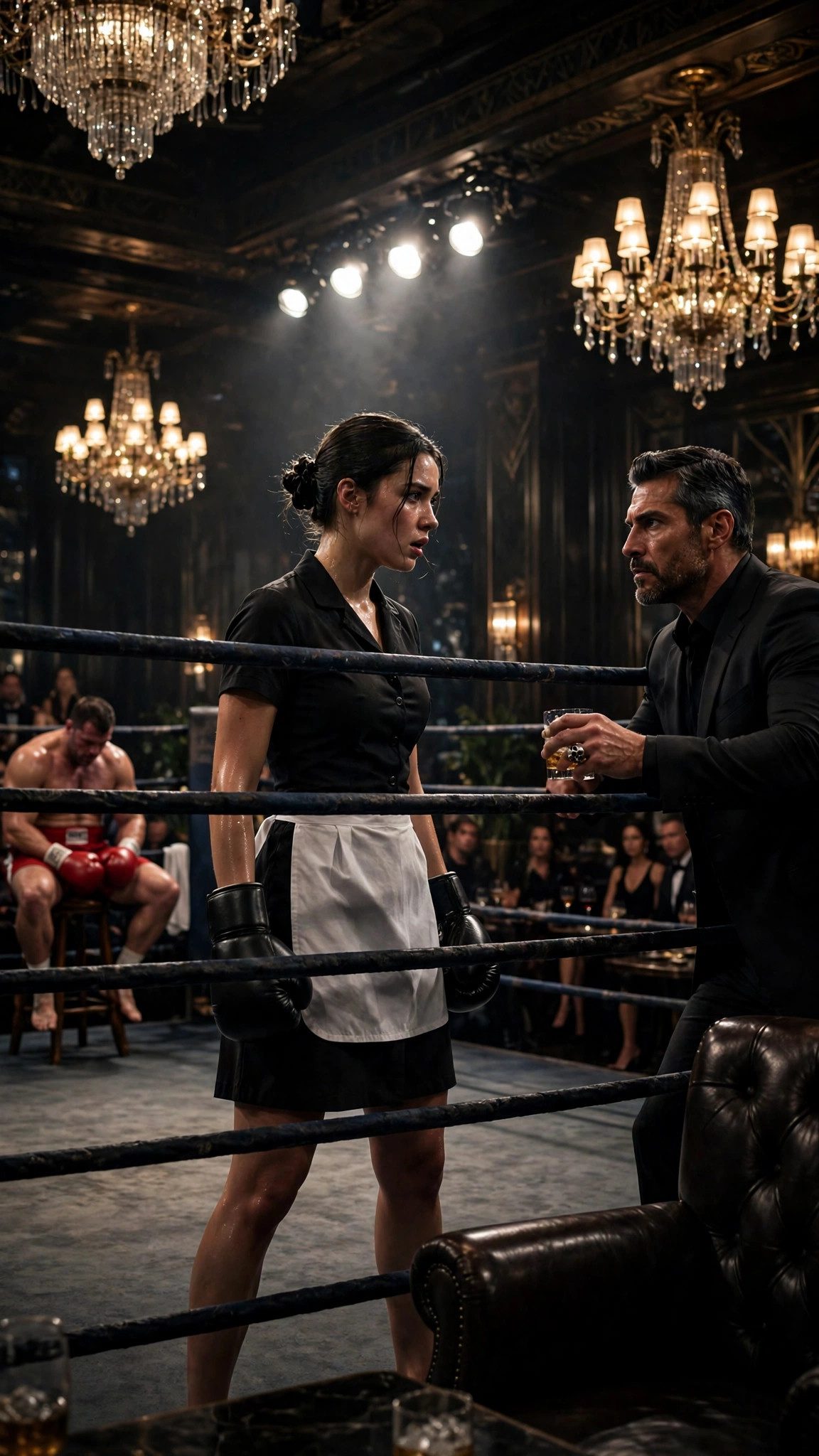
The room did not empty all at once. It emptied the way a room empties when a man like Dominic Russo decides it should be empty, which is to say it emptied fast, and quietly, and without anyone asking why.
Dominic stood at the edge of the ring with his dead arm hanging at his side, and he looked at me for a long moment, and then he turned his head, just slightly, toward Ray Deluca, who was standing by the bar with his mouth open, and Dominic said, "Clear the room."
Ray nodded so fast his head nearly came off his neck. "Everybody out," he called, clapping his hands. "Lounge is closed. Everybody out, please. Mr. Russo would like the room."
The rich men in their tailored suits did not argue. The women in diamonds did not argue. The bartender, the dealers, the security men, all of them moved toward the doors like water running downhill. Tony was still sitting on the canvas, dazed, blinking, and two security men picked him up under his arms and carried him out with the rest. Gabby squeezed my hand as she passed the ring, and she whispered, "Be careful, Sadie. Be very careful."
And then the doors closed, and the Velvet Ring was empty except for me, standing in the boxing ring with my gloves still on, and Dominic Russo, standing at the edge of the ring with a broken whiskey glass at his feet, and the chandeliers humming softly overhead.
He looked at me for a long time. He did not speak. I had never seen a man look at another person the way he looked at me in that moment, like he was looking at someone who had come back from the dead, like he was afraid that if he blinked I would disappear. His face, which had been expressionless all night, was not expressionless now. It was full of something I could not name. Grief, maybe. Guilt, maybe. Fear, certainly. And something else underneath it all, something that looked almost like hope.
"Take your gloves off," he said at last, and his voice was rough, like a man who had not used it in a long time.
I took my gloves off. I set them down on the canvas beside my feet. My hands were shaking, and I did not want him to see it, so I curled them into fists at my sides.
"Your father," Dominic said, and he stopped, and he swallowed, and he tried again. "Your father was James Callahan."
"He was," I said. "He was the best boxing trainer on the West Side, and he taught me to fight, and twenty years ago somebody murdered him in his own gym, and I have come to Chicago to find out who did it."
Dominic nodded slowly, the way a man nods when he has been waiting twenty years to hear a sentence and now that he has heard it he does not know what to do with it. He climbed through the ropes, slowly, favoring his dead arm, and he stood in the ring with me, and he was so tall that I had to tilt my head back to look at him, and his shadow fell across the canvas between us like a wall.
"I knew your father," he said. "He taught me to box when I was sixteen years old. I was a wild boy, and my father did not know what to do with me, and he sent me to James Callahan's gym because he thought the old man would beat the wildness out of me. Your father did not beat the wildness out of me. He taught me to use it. He taught me that a man's fists are the last thing he should reach for, not the first. He was the only man who ever treated me like a son instead of like a weapon."
"Then why is he dead?" I asked, and my voice shook, and I hated that it shook. "If he was so good to you, if he was like a father to you, why did your family kill him?"
Dominic closed his eyes. For a moment he looked like a man in pain, real pain, the kind of pain that has been living inside a person for so long that it has become part of his bones. When he opened his eyes again, they were wet, and I had never seen Dominic Russo cry, and I did not think anyone else in the world had ever seen it either.
"Because my father ordered it," he said. "Because your father refused to throw a fight for my father. The title fight, October fifteenth, twenty years ago. Salvatore Russo had a great deal of money on the other fighter, and your father trained the favorite, and my father went to him and told him to make his boy lose in the third round. Your father said no. He said a fight is a fight, and a man who throws a fight is not a trainer, he is a thief. My father did not like being told no. Nobody told Salvatore Russo no."
"So he had my father killed," I said.
"He sent me," Dominic said, and his voice dropped to a whisper. "He put a gun in my hand, and he told me to go to the gym that night, and he told me to kill James Callahan, and he told me that if I did not do it, he would send someone else, and that someone else would kill your father and your mother and you. I was twenty-two years old, Sadie. I was twenty-two, and I was afraid, and I went to the gym with that gun in my hand."
He stopped. He looked down at his hands, at the skull ring on his right hand, and he turned the ring around his finger, slowly, the way a man turns a wedding band when he is thinking about someone he has lost.
"And then what?" I asked. "What happened in the gym?"
"I walked in, and your father was wrapping the heavy bag, and he looked up, and he saw the gun, and he did not run. He did not beg. He looked at me, and he said, 'Dominic, my boy, put that gun down. You are not a killer. Your father is a killer, but you are not.' And I stood there, and I looked at him, and I looked at the gun, and I put the gun down on the floor of his gym, and I walked out. I walked out, Sadie. I went home, and I told my father I would not do it, and my father hit me so hard I could not see out of my left eye for three days, and he said, 'Then someone else will do it, and his blood will be on your hands for refusing.'"
Dominic's voice broke. He turned away from me, and he walked to the ropes, and he gripped them with his good hand, and he stood there with his back to me, and his shoulders shook once, twice, and then he was still again.
"By morning, your father was dead," he said, without turning around. "I went back to the gym before dawn, because I could not sleep, because I knew what my father would do, and I was too late. Your father was on the floor of his own gym, and you were asleep in the back room, eight years old, curled up under his coat, and I carried you out of that gym, Sadie. I carried you to your mother's house, and I put you in her arms, and I told her to run, to take you and run and never come back to Chicago. And then I went back to the gym, and I stood over your father's body, and I swore that I would find the man who did it, and I would make him pay, and I have been carrying that promise for twenty years, and I have never been able to keep it, because the man who did it was stronger than me, and smarter than me, and he has been hiding behind my own family for twenty years."
I stood in the center of the ring, and I listened to him, and I felt the anger I had been carrying for six weeks, for twenty years, begin to change into something else. It did not go away. It changed. It became something heavier, and sadder, and harder to hold. Because the man standing in front of me was not the man who had killed my father. He was the boy who had put the gun down. He was the boy who had carried me out of the gym. He was the boy who had been trying, for twenty years, to keep a promise he had made over my father's dead body.
"Who did it?" I asked. "Who killed my father, Dominic?"
He turned around. His face was wet, and he did not wipe it, and he looked at me the way a man looks at someone when he is about to tell her the worst thing he knows.
"Vincent Castellano," he said. "My father's right hand. The man who took over the fight circuit after your father died. The man who has been feeding on my family for twenty years, and who wants the Velvet Ring, and the West Side, and everything I have built. He killed your father, Sadie. Not me. Him. And I have known it for twenty years, and I have never been able to prove it, because he covered his tracks, and because my father protected him, and because I was too young and too afraid to stand up to either of them."
I looked at Dominic Russo, and I saw a man who had been carrying a secret for twenty years, and I saw a man who had just handed that secret to me, and I understood, in that moment, that my mother had been wrong about one thing. She had told me to find out who killed my father, and to make them pay. She had not told me that the man I would find standing in front of me would be the boy who had tried to save him. She had not told me that the truth would be more complicated than revenge. She had not told me that I would look at Dominic Russo and see, not a killer, but a man who had been punished for twenty years by his own guilt, and who had never once stopped trying to make it right.
"Then we find the proof," I said. "Together. You and me. We find the proof, and we make Vincent Castellano pay, and we do it the right way, so that nobody else has to die in a gym on the West Side of Chicago."
Dominic looked at me for a long moment. And then, for the first time since I had walked into his lounge six weeks ago, Dominic Russo smiled. It was a small smile, and a sad smile, and it did not reach his eyes, but it was a smile, and it was the first one I had ever seen on his face.
Dominic was quiet for a moment, and then he said, "Your father taught me something else, Sadie, something I have never told anyone. He taught me how to wrap my hands. I was sixteen, and my hands were always bleeding, because I did not know how to make a fist properly, and your father sat me down on a stool in the gym, and he took my hands in his, and he wrapped them, slowly, carefully, the way a man wraps something precious, and he said, 'Dominic, your hands are not weapons. They are tools. A weapon is something you use to hurt people. A tool is something you use to build things. You decide which one your hands are going to be.' I have remembered that every day of my life, Sadie. Every single day. And on the days when I have failed, when I have used my hands the wrong way, I have heard your father's voice in my head, saying those words."
He looked down at his own hands then, at the skull ring, at the knuckles that were scarred from twenty years of fighting, and he said, "Your father was the only man who ever told me I could be something other than what my father wanted me to be. My father wanted a weapon. Your father wanted a man. And for a while, when I was sixteen, and seventeen, and eighteen, I thought I could be a man. I thought I could walk away from my father's world. And then my father sent me to the gym that night, with a gun in my hand, and I understood that walking away was not as simple as I had thought."
"What happened to my mother?" I asked. "After you carried me out of the gym. What happened to her?"
Dominic looked at me, and his expression softened, and he said, "Your mother was waiting at home. I carried you to her house, and I knocked on the door, and she opened it, and she saw me standing there with you asleep in my arms, and she understood immediately. She did not scream. She did not cry. She took you from me, and she held you against her chest, and she looked at me, and she said, 'Is he dead?' And I said, 'Yes.' And she said, 'Then we are leaving tonight, and we are never coming back, and if you ever tell anyone where we went, I will find a way to kill you myself.' And then she closed the door in my face. I stood on her porch for a long time, Sadie. I stood there until the lights went out, and then I stood there a little longer, and then I walked back to my car, and I drove home, and I never saw either of you again. Not until tonight. Not until you climbed into my ring and dropped my champion in thirty seconds flat."
"Your father would be proud of you," he said. "He taught you well, Sadie. He taught you very well."