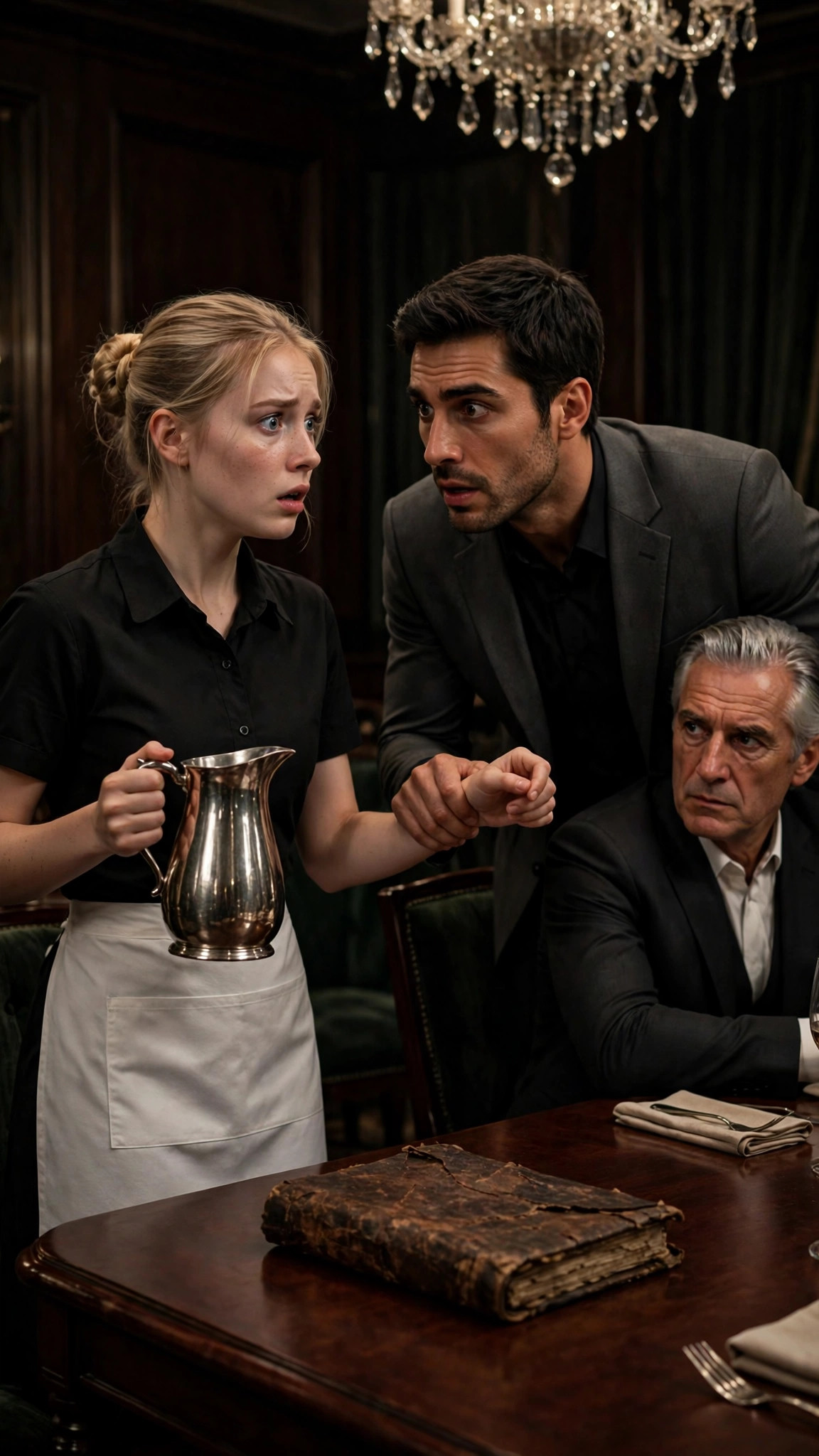
I learned to be invisible the year my mother died. I was thirteen, and the world had just taught me its first real lesson: when people notice you, they want something from you, and when they want something from you, you are never safe.
My father taught me the second lesson. He taught me that languages are doors, and a girl who can open doors nobody else can see will never be trapped in a room she does not want to be in.
Thomas Marsh was not a rich man. He was not a famous man. He was a linguist who had spent thirty years chasing languages that were already dying, and he chased them the way other men chase money, with a stubbornness that looked like madness from the outside and like love from the inside. He spoke fourteen languages, or so he claimed, and he could read twice that many. He had worked, once, for people he never named, doing work he never described, and when I asked him about it he would smile and say, "Your old man translated letters, Ellie. Boring letters. The kind that put generals to sleep."
He lied to me about that, the way good fathers lie to their daughters, to keep them safe. I did not know it then. I know it now.
While other children watched cartoons, I sat at our kitchen table in Queens and learned extinct alphabets. My father would spread photocopies of old manuscripts across the table like other fathers spread baseball cards, and he would point at a line of strange, looping letters and say, "This one is Corsican, Ellie. Not the Corsican they speak in the markets. The old one. The one the shepherds used when they didn't want the tax men to understand them." Then he would teach me the letters, one by one, until the strange shapes stopped being strange and started being a sentence.
He taught me Soviet prison shorthand the summer I turned fifteen, in a rented cottage on the coast of Croatia, where the sea was the color of cold glass and the fishermen mended their nets in silence. "Prisoners had no paper," he told me. "They had to say everything in as few marks as possible. Every dot is a word they couldn't afford to write." He taught me Cold War ciphers in a flat in Budapest, where the radiators clanked all night and the old woman downstairs sang the same song every evening at six. He taught me that a code is not a wall. A code is a door with a keyhole, and if you are patient enough, you can learn the shape of the key just by looking at the lock.
By the time I was eighteen, I spoke eight languages fluently and could decipher several more. I could read a medieval shipping manifest in Venetian dialect and tell you what the captain was smuggling. I could look at a page of Soviet shorthand and tell you which prisoner wrote it and what he was afraid of. I could sit in a room full of men speaking three different languages and understand every word, while they believed I understood none of them.
None of that paid the rent. None of that paid for my father's medicine.
My father got sick the year I turned twenty-one. It started with a cough that would not go away, and it ended, three years later, in a hospital room with white walls and a window that looked out over a parking lot. The bills came in envelopes with windows in them, and each one was worse than the last. Eighty-seven thousand dollars, in the end. Eighty-seven thousand dollars for the privilege of watching the only person who had ever loved me die slowly, in a room that smelled like disinfectant and old coffee.
I sold everything we owned that was worth selling. His books went first, then the furniture, then the little brass compass he had carried in his pocket through half of Europe. I kept one thing: a battered leather notebook, the one he always carried, full of alphabets and ciphers and notes in his cramped, careful handwriting. It was the only thing of his that no one would pay money for, and it was the only thing I would never sell.
After the funeral, I did the math. A girl with a degree in linguistics and eighty-seven thousand dollars of debt has exactly two options: spend ten years paying it off in an office, or find work that pays in cash, quickly, and does not ask questions. The Sterling paid in cash, quickly, and did not ask questions. The Sterling also had private rooms, and private rooms had men who tipped in hundred-dollar bills if you poured their water without spilling it and kept your eyes on the floor.
So I learned a third lesson, the one that mattered most. I learned to be the girl nobody sees.
Plain blonde bun. No makeup. No jewelry. A black uniform and a white apron and a water pitcher and shoes that did not make noise on the marble floor. I learned to move along the edges of rooms, to refill a glass without interrupting a sentence, to become part of the furniture. I learned that powerful men love an audience that does not exist. They say things in front of a waitress they would never say in front of a witness, because to them, a waitress is not a witness. A waitress is a lamp. A waitress is a chair.
I was good at it. For three years, I was very good at it.
My best friend at The Sterling was Rosa Delgado, a waitress ten years older than me, with a laugh like a church bell and a son in Brooklyn who wanted to be a chef. Rosa had worked at The Sterling for eleven years, and she knew everything about everyone, and she told me the rules on my first day.
"Rule one," she said, tying my apron for me because my hands were shaking. "You see nothing. You hear nothing. You remember nothing."
"Rule two?"
"Rule two is the same as rule one, but slower, so the new girls remember it."
"And rule three?"
Rosa grinned. "Rule three is: never, ever draw the short straw for the Sapphire Room."
"The Sapphire Room?"
"The private room at the end of the hall. The one with the blue carpet and the chandelier that costs more than my apartment. The men who book it are not businessmen, Ellie. Businessmen argue about money. These men argue about who gets to live."
I laughed, because I thought she was joking. Rosa did not laugh back.
"I'm serious, niña. The Sterling has four private rooms. The Emerald Room is for politicians. The Gold Room is for bankers. The Ruby Room is for men who want everyone to know they are rich. The Sapphire Room is for men who want everyone to know they are dangerous. If you ever draw the short straw for the Sapphire Room, you pour the water, you keep your eyes down, and you pray to whatever God you believe in that nobody asks you a question."
I did not believe in God. I believed in my father's languages, and in being invisible, and in the eighty-seven thousand dollars that got a little smaller every month I carried plates and poured water and did not exist.
The best example of what I mean happened six months before the Sapphire Room, on a night when I was serving the Emerald Room, where the politicians met.
There were eight of them around the table, men in suits that cost more than my rent, drinking wine that cost more than my car, and they were arguing about a highway contract, and one of them — a senator with silver hair and a smile like a television commercial — leaned across the table and said, very quietly, "The highway goes through Miller's land, or it doesn't go through at all, and Miller knows what that means."
Another man laughed. "Miller will sell. Everyone sells. It is just a question of price."
"And if he doesn't sell?" the senator asked.
"Then the highway goes through his land anyway," the first man said, "and Miller's farm becomes a very unfortunate accident."
They all laughed. They laughed the way powerful men laugh when they are joking about destroying someone, which is to say, they laughed like men who were not joking at all.
I stood three feet away from them, refilling their water glasses, and not one of them looked at me. Not one of them lowered his voice. Not one of them paused. To them, I was a lamp. I was a chair. I was the air in the room, and the air does not testify.
That night, I went home, and I sat at my kitchen table, and I thought about Miller, whoever he was, and his farm, and his highway, and I thought about the fact that I had just heard eight powerful men plan the ruin of a man I had never met, and I had done nothing, because doing something would have meant being seen, and being seen would have meant being in danger, and I had eighty-seven thousand dollars of debt and no one left in the world to protect me.
I hated myself that night. I hated the invisibility I had worked so hard to build. But I also understood, for the first time, what my father had meant when he said that a language only dies when the last person who can speak it decides to stay silent.
I had decided to stay silent. For three years, I had decided to stay silent, every single night, in every single room. And I told myself it was survival. I told myself it was the only choice I had.
It was not the only choice I had. It was simply the safest choice. And on the night I drew the short straw, I was about to learn the difference.
Some nights, after a shift like that one, I would come home and empty my apron pockets onto the kitchen table, and I would count the tips, and I would write the number in a small notebook, next to the number from the night before, and the night before that. It was the only arithmetic that mattered to me. Eighty-seven thousand dollars, minus a little more, every single night. Some nights it was forty dollars. Some nights it was a hundred. Once, a banker in the Gold Room gave me two hundred dollars because I refilled his water without spilling a drop, and I stared at that bill for a long time, because two hundred dollars was two hundred dollars closer to free.
For three years, the short straw never came to me. I watched other girls draw it, and I watched them come back from the Sapphire Room pale and quiet, and I watched them refuse to talk about what they had heard. One of them, a girl named Ana, quit the next day. Another, a girl named Priya, asked to be moved to the lunch shift and never worked another dinner. I told myself it would never be me. I told myself I was too careful, too quiet, too good at being nothing.
Then one Tuesday night in October, Mr. Whitfield, the maître d', held out his hand with five straws in it, and I drew the short one.
Rosa grabbed my arm. "Ellie. Listen to me. Eyes down. Mouth shut. Pour the water and get out. If anyone speaks to you, you say 'Yes, sir' or 'No, sir' and nothing else. Do you understand?"
I nodded. My mouth was dry. My hands were shaking, and I hid them behind my back, the way my father used to hide his hands when he was nervous, tucking them into his pockets so no one would see them tremble.
"Who is in there tonight?" I asked.
Rosa looked down the hall, toward the blue carpet and the closed door, and lowered her voice. "Dominic Russo."
I had heard the name. Everyone in New York had heard the name, the way everyone has heard the name of a storm that might come to their street. Dominic Russo. The head of the Russo family. The most feared crime boss in the city, a man who looked like a CEO and decided, the way other men decide what to have for lunch, who would become rich and who might disappear.
"And the other one?" I asked.
"Constantine. A weapons broker. Eastern European. The kind of man who smiles at you while he is deciding how much you are worth dead."
I picked up my pitcher. I straightened my apron. I pulled my blonde hair back into the plainest bun I knew how to make, and I checked my face in the little mirror by the service door. No makeup. No jewelry. No expression. A girl nobody would remember.
"Stay invisible," I whispered to myself, the way I had whispered it a thousand times before.
Then I walked down the hall, past the blue carpet, past the chandelier light spilling under the door, and I pushed open the door of the Sapphire Dining Room, and I stepped into the room where my life was about to change forever.
I did not know it then. I did not know that the battered leather journal on the table was written in a dead language wearing a dead code like a coat. I did not know that my father had spent the last years of his life trying to keep that code away from men like Constantine. I did not know that the sentence I was about to read aloud would be the most dangerous sentence I had ever spoken.
I knew only one thing. I was the waitress. I was invisible. And in a few minutes, Dominic Russo was going to offer ten million dollars to anyone who could read a single page.
He had no idea that the girl pouring his water could read every word.