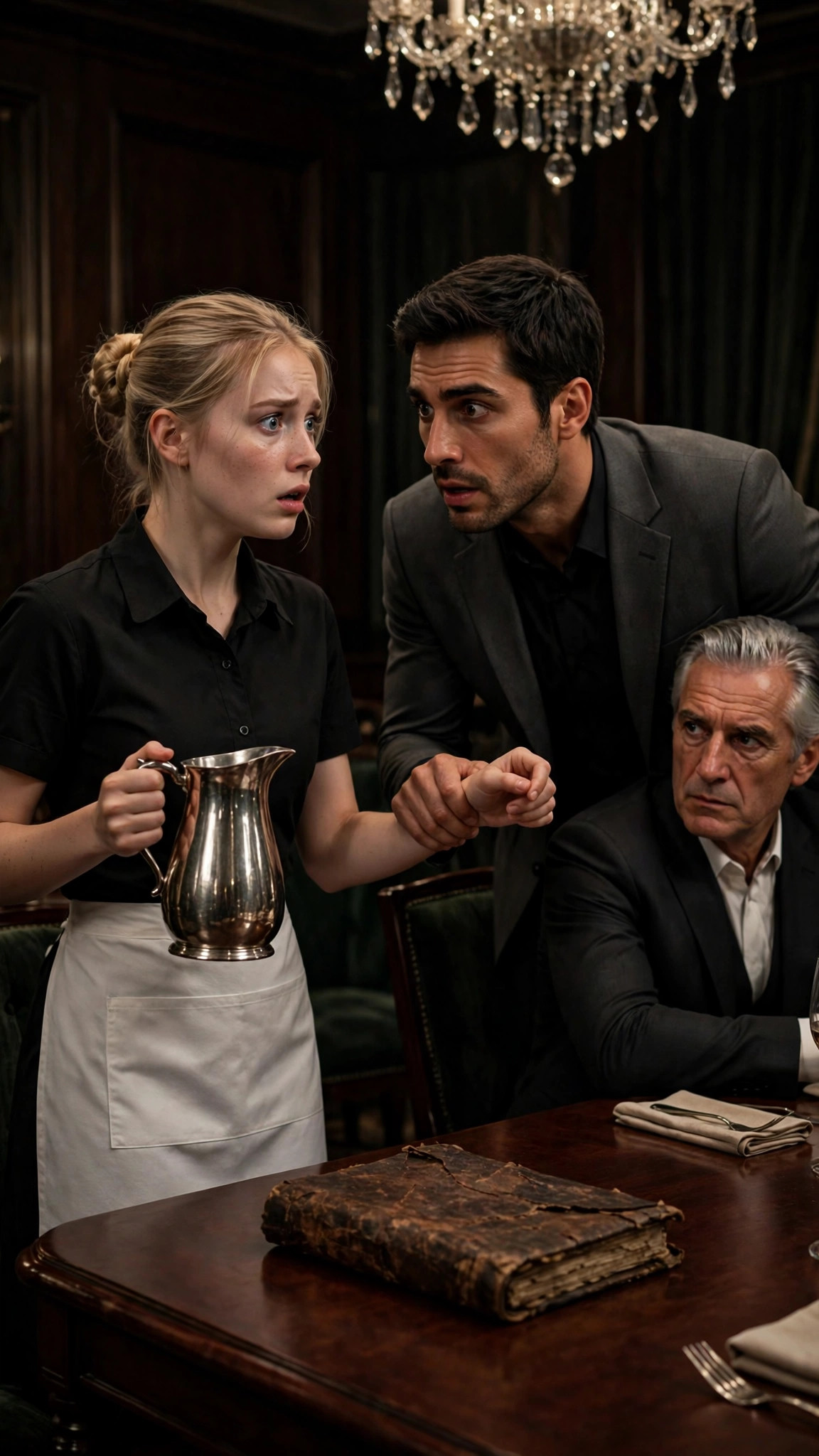
I did not sleep that night. I sat at the desk in the small room down the hall from Dominic's office, with the lamp burning low and the journal open in front of me, and I read until the letters blurred and my eyes burned, and then I read some more, because every page I turned told me something I needed to know, and every page I turned told me something I wished I did not know.
The journal was not just a ledger. It was a confession. Constantine had written everything down, the way arrogant men always write everything down, because they believe no one will ever read it. He had written the names of his buyers, the names of his sellers, the names of the men he had bribed, the names of the men he had betrayed. He had written the date of every shipment, the price of every gun, the route of every truck. And in the margins, in the shorthand, he had written the small, ugly truths that made the big truths make sense.
"Arthur owes the Castellanos forty thousand. Gambling. I pay it. He is mine now."
"Kowalski wants more. Give him seven thousand. The harbor master is worth it."
"The Russo girl — the waitress — she is Marsh's daughter. Find her father's notebook. It is the key to everything."
That last line was dated three weeks ago. Three weeks before the night in the Sapphire Room. Constantine had known about me for three weeks. He had known who my father was. He had known what I could do. He had been looking for my father's notebook, the battered leather notebook I had kept after the funeral, the one full of alphabets and ciphers and notes in my father's cramped, careful handwriting.
He had been looking for it, and he had not found it, because it was in a drawer in my apartment, under a stack of old sweaters, where no one would ever think to look for the most valuable thing in New York.
The next morning, a woman came to the office. She was not a waitress. She was not a soldier. She was a federal agent, and she introduced herself as Agent Dana Cole, and she had the calm, professional manner of a woman who has seen a hundred dangerous men and is not impressed by any of them.
Dominic poured her coffee. Silas stood by the door. Gabriel stood by the window. I sat at the desk with the journal open in front of me, and Agent Cole sat across from me, and she looked at the journal, and then she looked at me, and she said, "So you're the girl who reads dead languages."
"Yes," I said.
"My grandmother spoke Corsican," Agent Cole said, and she smiled, just a little. "The living kind. The kind they speak in the markets. She used to sing me songs in it when I was a little girl. I never learned to read the old kind. My grandmother said the old kind was for shepherds and smugglers, and that a good girl had no business with it."
She leaned forward. "My grandmother was wrong about that, wasn't she?"
"Yes," I said. "She was wrong."
Agent Cole nodded. "I need everything you have, Elena. Every page. Every name. Every shipment. I need it in English, in writing, with your name on it, so that a judge will believe it. Can you do that?"
"I can do that," I said.
"Good. And I need to ask you something else. Your father's notebook. The one Constantine has been looking for. Do you have it?"
I hesitated. The notebook was in a drawer in my apartment, under a stack of old sweaters, where no one would ever think to look for the most valuable thing in New York. It was the only thing of my father's I had kept, the only thing no one would pay money for, and the only thing I would never sell.
"I have it," I said. "It's in my apartment."
Agent Cole nodded. "Then we need to get it. Today. Before Constantine's people think to look for it there. Silas will go with you. He will wait outside while you get it. And then you will bring it here, and we will keep it safe, and you will keep it safe, because it is the key to everything."
That afternoon, Silas drove me to my apartment in Queens. He waited in the car while I went upstairs, and I stood in my small kitchen, and I looked at the envelope on the counter with the window in it, and I looked at the chipped blue mug, and I looked at the shelf above the sink, and I took my father's notebook down, and I held it against my chest, and I thought about the man who had written it, and the daughter he had taught to read the dead, and the night in the Sapphire Room when everything had changed.
When I came back downstairs, Silas was standing by the car, watching the street the way he always watched the street, and he opened the door for me, and he did not say a word, and I understood that his silence was his way of telling me that I was safe, and that I would stay safe, as long as I stayed close to Dominic.
I kept the notebook in my lap all the way back to Midtown. I did not open it. I did not need to open it. I knew every page by heart.
The clock on the wall said three in the morning. I had been reading for six hours, and my eyes burned, and my back ached, and the lamp had gone warm, and the city outside the window had gone quiet, the way New York goes quiet for one hour every night, as if the whole city is holding its breath.
I kept reading. Page thirty. Page forty. Page fifty. The deeper I went, the clearer the picture became. Constantine had built an empire on two things: guns, and information. The guns were the easy part. The information was the valuable part. He knew who was shipping what, and when, and where, because Arthur told him, and Arthur told him because Constantine owned Arthur's debts, and Arthur's debts owned Arthur.
And then, on page sixty-two, I found the entry that changed everything.
It was not a shipment. It was not a payment. It was a plan.
"Thursday. The gala at the Plaza. Russo will be there. His men will be thin — the shipment leaves at midnight, and he will send his best men to the docks. When the speeches begin, my people will take him in the ballroom, in front of everyone. A message. The city will know who owns the night."
Thursday. Two days away. The gala at the Plaza was a charity event, the kind of event where rich men gave money to poor children and took photographs to prove it. Dominic was the guest of honor. He would be there, in a tuxedo, with a glass of champagne in his hand, and his best men would be at the docks, guarding a shipment that Constantine had already sold to his enemies, and Constantine's people would walk into the ballroom and do what men like Constantine's people do.
I ran to Dominic's office. I did not knock. Gabriel opened the door before I reached it, and Silas was already standing, and Dominic was already on his feet, because he had seen my face, and he knew what my face meant by now.
"Thursday," I said. "The gala at the Plaza. Constantine is going to take you in the ballroom, in front of everyone, while your men are at the docks."
Dominic was very still. He looked at Silas. He looked at Gabriel. He looked back at me.
"Show me," he said.
I opened the journal to page sixty-two and I read it aloud, slowly, translating the Corsican and the shorthand and the cipher as I went, and when I finished, the room was silent in a way I had never heard a room be silent before. It was not the silence of a negotiation. It was not the silence of a bomb under the table. It was the silence of a man who has just been told when and where he is going to die, and is deciding what to do about it.
"Arthur," Dominic said quietly. "Bring me Arthur."
Silas left the room without a word. Gabriel closed the door. Dominic walked to the window and looked out over the city, and his hands were clasped behind his back, and his shoulders were very straight, and I understood, watching him, that this was what power looked like when it was frightened and refused to show it.
"How long has he been selling me?" Dominic asked, without turning around.
"Two years," I said. "Five thousand dollars a month. Constantine paid his gambling debts to the Castellanos. Forty thousand dollars. After that, Arthur belonged to him."
"And the schedules?"
"Every one. Every truck, every route, every buyer. For two years."
Dominic nodded, once, slowly. "And my father? Did Arthur sell my father too?"
I did not understand the question. "Your father?"
"My father built this family," Dominic said, still looking out the window. "He died ten years ago, in a car that was supposed to be safe, on a road that was supposed to be clear. I have always believed it was an accident. Tonight, I am wondering if it was an entry in a ledger."
He turned around. His eyes were dark, and his face was very calm, and that calm frightened me more than any anger could have.
"We will find out," he said. "The dead don't lie, Elena. That is what your father taught you, isn't it? The dead don't lie. They only wait for someone who can read them."
The door opened, and Silas came back, and behind him was Arthur.
Arthur looked like a man who had been woken from a nightmare into a worse one. His suit was rumpled. His hair was sticking up. His hands were shaking so badly he had to hold them together to keep them still. He looked at Dominic, and he looked at me, and he looked at the journal on the desk, and he understood, in a single terrible moment, that the two years of secrets were over.
"Arthur," Dominic said, very quietly. "Sit down."
Arthur sat. He did not speak. He stared at the floor.
"Two years," Dominic said. "Five thousand dollars a month. My schedules. My routes. My men. My father." His voice did not rise. It got quieter, and quieter, and quieter, until it was almost a whisper. "Did you sell my father, Arthur?"
Arthur's head came up. His eyes were wet. "No," he said, and his voice cracked. "No, Dominic. I swear to you, on my mother's grave, I did not sell your father. I sold the schedules. I sold the routes. I sold the trucks. I never sold your father. Constantine asked me, once, about the night your father died, and I told him I knew nothing, and he believed me, because it was true. I know nothing about your father. I swear it."
Dominic studied him for a long moment. Then he nodded, once, and he looked at Silas, and Silas stepped forward, and Arthur flinched, and then Silas simply took Arthur's arm, gently, the way a nurse takes a patient's arm, and led him out of the room.
"He will talk," Dominic said, after the door closed. "He will tell Silas everything, and Silas will write it down, and we will know exactly what Constantine knows, and exactly what he plans to do. And then, on Thursday, we will be ready for him."
He looked at me. "You will be there, too. At the gala. With me."
I shook my head. "Mr. Russo, I am a waitress. I do not belong at a gala at the Plaza. I do not own a dress. I do not know how to behave at a gala."
"You will be there," Dominic said, "because you are the only person in this city who can read the book that tells us what Constantine is going to do next. And because Constantine knows that, too. And because if you are not with me, he will find you, and he will not ask you politely."
He walked around the desk and stood in front of me, and he looked at me the way he had looked at me in the Sapphire Room, as if he were seeing me for the first time.
"Elena," he said, and my name in his voice sounded different than it had ever sounded in anyone else's voice. "I know what I am asking. I know you did not choose this. I know you wanted to be invisible, and I know I am the reason you cannot be invisible anymore. But I am asking you to trust me. I am asking you to stand next to me on Thursday night, in a room full of people who want me dead, and read the dead for me, one more time."
I thought about my father. I thought about the kitchen table in Queens. I thought about eighty-seven thousand dollars, and a battered leather notebook, and a man who had spent his life chasing dead languages because he believed that a language only dies when the last person who can speak it decides to stay silent.
"I'll be there," I said.
Dominic nodded. "Good. Now go back to your room and finish the book. Read the last pages. I want to know everything before Thursday."
I went back to my room. I sat at the desk. I opened the journal to page sixty-three, and I kept reading, and the lamp burned low, and the city hummed outside the window, and I read the dead until the dead had nothing left to tell me.
Except for the last page. The last page was different. The last page was not in Constantine's handwriting.
The last page was in my father's.