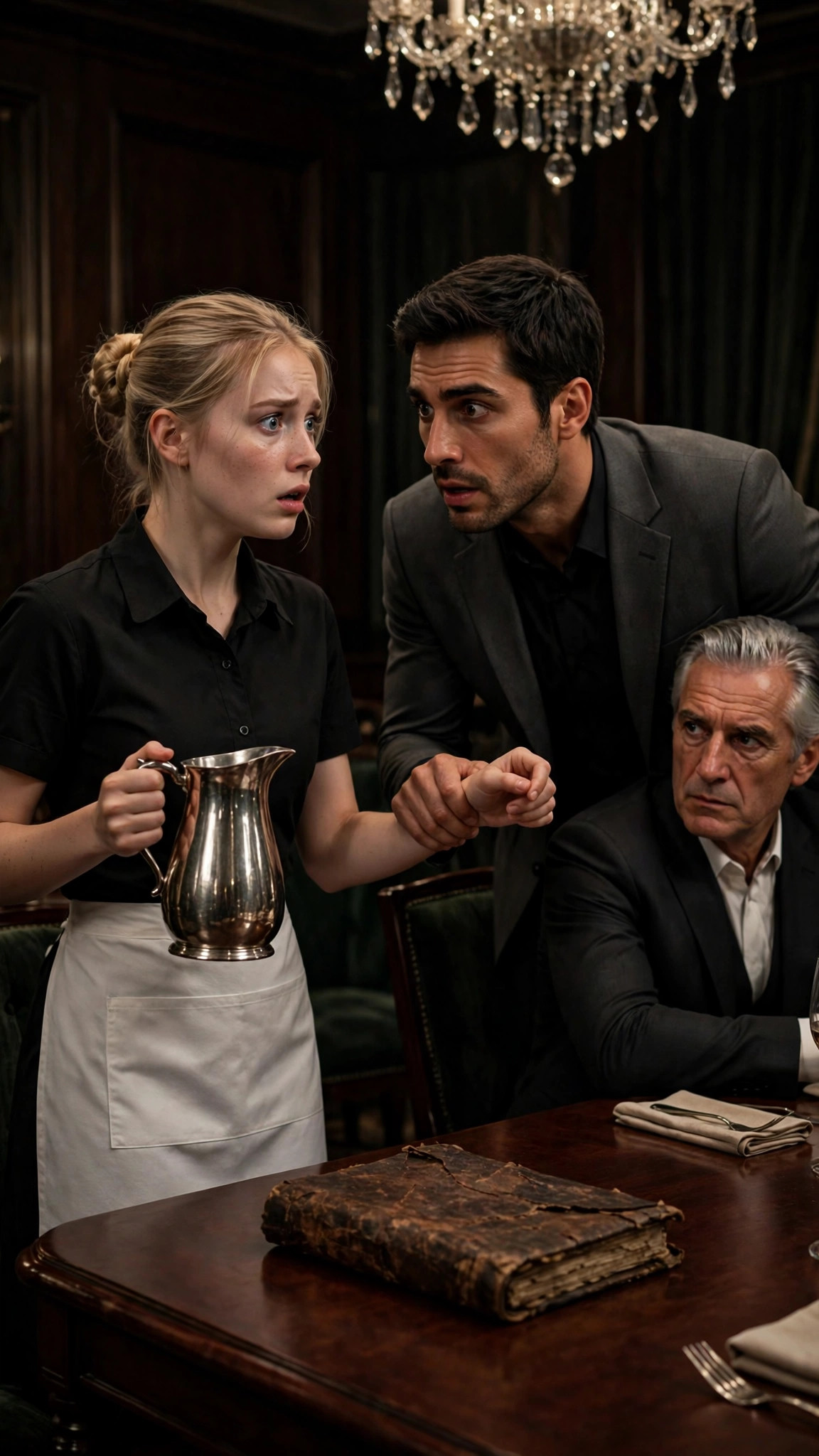
Dominic Russo's office was on the top floor of a building in Midtown that had no name on the door and no sign in the lobby. The elevator opened directly into the office, the way elevators open in movies, and Silas stood in the corner with his arms folded, and Gabriel stood by the window, and I stood in the middle of a room full of dark wood and leather and glass, holding nothing, wearing my waitress uniform, with my pitcher left behind in the Sapphire Room like a piece of evidence.
"Sit," Dominic said.
I sat. The chair was leather, and it was cold, and it smelled faintly of cigar smoke and money. Dominic sat across from me, behind a desk the size of a small car, and he placed the journal on the desk between us, very carefully, the way a man places a bomb he has just defused.
"Read it," he said. "All of it. Every page. I want to know everything Constantine has written in this book."
I looked at the journal. In the bright light of the office, I could see it better than I had seen it in the Sapphire Room. The leather cover was dark brown, almost black, cracked along the spine, with a small brass clasp that had gone green with age. The pages were thick, yellowed, covered edge to edge in the looping Corsican script, with columns of numbers in the margins in Soviet shorthand, and every few pages, a line of cipher that looked like nothing at all, just a string of letters that made no sense unless you knew the key.
"Mr. Russo," I said, and my voice sounded very small in that big room. "I should tell you something first. I am a waitress. I am not a spy, and I am not a soldier. I do not know anything about your business, and I do not want to know anything about your business. I read one sentence because Constantine was smiling, and I am very tired of men like Constantine smiling at men like you while they steal from you."
Dominic leaned back in his chair. He studied me for a long moment, the way a man studies a painting he has just realized might be real.
"Do you know what Constantine is?" he asked.
"A weapons broker."
"He is a thief," Dominic said. "A thief who sells guns to anyone with money, including my enemies, and then charges me a commission for the privilege of being robbed. That journal is his ledger. It is the record of every shipment, every payment, every betrayal, for the last five years. My people have been trying to read it for two years. Arthur has been trying to read it for two years. The best codebreakers money can buy have been trying to read it for two years. And a twenty-four-year-old waitress read the first sentence in ten seconds."
He leaned forward. "So, Elena Marsh, let me be very clear with you. I am not asking you to be a spy. I am not asking you to be a soldier. I am asking you to read a book. And I am going to pay you for it. Not ten million dollars — that was a joke, and we both know it was a joke. But I will pay you enough to make your father's debt disappear. All of it. Every dollar."
My heart stopped. "How do you know about my father's debt?"
"Silas," Dominic said, and he did not even look at the big man in the corner. "Silas knows everything about everyone who walks into a room with me. He knew your name, your address, your job, and your debt before we reached the elevator. That is his job. And right now, his job is to make sure nobody else learns what you can do."
I stared at him. Eighty-seven thousand dollars. Gone. Just like that. A man I had met two hours ago was offering to erase the number that had ruled my life for three years, in exchange for reading a book.
"Why would you do that?" I asked.
"Because," Dominic said, "the woman who can read that book is the most valuable person in New York tonight. And because Constantine knows it, too. And because if I do not protect you, he will find you, and he will not offer you money. He will offer you a choice, and the choice will not be a kind one."
He stood up and walked to the window, and he looked out over the city, and for a moment he did not look like a crime boss. He looked like a tired man, a man who had spent his whole life building walls around himself and was suddenly realizing that a wall is only as strong as the people who guard it.
"My father built this family," he said, quietly, "and my father taught me that there are two kinds of power in this world. The kind you can buy, and the kind you can only earn. Money can buy guns. Money can buy men. Money cannot buy the truth. The truth has to be read, by someone who knows how. Tonight, in that room, you read the truth, Elena. And the truth was that my own partner has been selling my weapons to the family that has been trying to kill me for ten years."
He turned back to me. "So read the book. Read all of it. And when you are finished, I will pay your debt, and you can walk away, and you will never see me again. That is my promise. But while you are reading it, you stay here, in this building, where Silas and Gabriel can keep you safe. Because Constantine is not going to wait for you to finish."
I looked at the journal. I looked at Dominic. I thought about my father's notebook, the one I had kept, full of alphabets and ciphers and notes in his cramped, careful handwriting. I thought about the kitchen table in Queens, and the summer in Croatia, and the flat in Budapest. I thought about eighty-seven thousand dollars, and a man who had spent his life teaching his daughter a dead language because he believed that knowledge was the only thing nobody could steal from you.
"All right," I said. "I'll read it."
Dominic nodded, once, the way a man nods when a deal is made. He picked up the phone on his desk and spoke three words I did not understand, in Italian, and then he hung up, and he looked at me.
"There's a room down the hall," he said. "A bed, a desk, a lamp. Food will be brought to you. Silas will be outside the door. You work when you want, you sleep when you want, and you tell me everything you find. Understood?"
"Understood."
I picked up the journal. It was heavier than it looked. The leather was warm from Dominic's hands. I carried it down the hall to the small room with the bed and the desk and the lamp, and I sat down, and I opened it to the first page, and I began to read.
The first ten pages were what I expected. Shipments. Dates. Prices. The Castellanos, the Morettis, the harbor master at Pier Nine, a man named Kowalski who took five thousand dollars a month to look the other way. Constantine's handwriting was small and neat, the letters precise, the numbers in the margins in Soviet shorthand, the way a careful man writes when he believes no one will ever read what he has written.
The first ten pages were what I expected. Shipments. Dates. Prices. The Castellanos, the Morettis, the harbor master at Pier Nine, a man named Kowalski who took five thousand dollars a month to look the other way. I read about Kowalski twice, and the second time I stopped, because the margin note beside his name was not in shorthand. It was in plain Corsican, written in a hurried hand, and it said, in effect, that Kowalski was greedy, that he had asked for more money three times, and that Constantine had paid him every time, because a harbor master who can be bought is worth more than a harbor master who cannot.
I wrote that down in my own notebook, the small one Dominic had given me, in English, in my own handwriting, so that I would not forget it. Kowalski. Seven thousand a month now, not five. The price of looking the other way had gone up, the way the price of everything goes up when a man knows he is the only one selling what you need.
But on page eleven, the handwriting changed. The Corsican got looser, faster, like a man writing in a hurry. And in the margin, in the shorthand, there was a line that made my blood run cold.
"R. pays A. five thousand a month. A. gives the schedules."
R. was Russo. A. was Arthur.
Arthur, the nervous man in the dark business suit, the man who had spent two years failing to read the journal, had been on Constantine's payroll for two years, feeding him Dominic's shipment schedules for five thousand dollars a month.
I kept reading. Page twelve. Page thirteen. The ledger told a story, the way ledgers always tell a story if you know how to read them. Constantine had not just been selling Dominic's weapons to the Castellanos. He had been selling Dominic's schedules to the Castellanos, so they would know exactly when the Russo trucks would be on the road, and exactly where they would be vulnerable. He had been selling Dominic's routes, Dominic's buyers, Dominic's men. He had been selling Dominic himself, piece by piece, for five years.
The small room down the hall had a narrow bed with a gray blanket, a desk with a lamp that buzzed faintly when it got warm, and a window that looked out over an alley where a single streetlight burned all night. I sat at the desk with the journal open, and the lamp buzzing, and the streetlight burning, and I read until the words on the page stopped being words and started being a map of everything Constantine had ever done.
And then, on page twenty, I found something else. Something that had nothing to do with guns or money or shipments.
It was a name. A name written in the cipher, buried in the middle of a column of numbers, the way a man buries a name when he does not want it to be found.
Thomas Marsh.
My father's name.
My hands started shaking. I put the journal down on the desk, very carefully, and I stared at the wall, and I tried to breathe, and I could not breathe, because my father's name was in a dead language in a weapons broker's ledger, and I did not understand why, and I understood, suddenly, terribly, that I did understand why.
My father had not just been a linguist. My father had been the man who built the code.
I ran back to Dominic's office, the journal clutched to my chest, and Silas stepped aside without a word, and Gabriel opened the door, and Dominic looked up from his desk, and he saw my face, and he stood up.
"What did you find?" he asked.
I told him about Arthur. I told him about the five thousand dollars a month. I told him about the schedules. I told him about the Castellanos and Pier Nine and the midnight shipment.
And then I told him about the name on page twenty.
"Thomas Marsh," I said. "My father's name is in this book."
Dominic was very still for a long moment. Then he walked around his desk, and he stood in front of me, and he looked at me the way he had looked at me in the Sapphire Room, as if he were seeing me for the first time.
"Your father," he said slowly, "was the man who created this cipher. Twenty years ago, he worked for people who needed a code that could not be broken, a code built from dead languages, and he built it for them. And then he walked away, because he did not want his work to be used to move guns. And Constantine has spent twenty years looking for the man who built the code, because without the key, the code is useless, and with the key, it is worth a fortune."
He paused. "Your father is dead, Elena. But you are not. You are the key. You are the only living person who can read what your father wrote. And Constantine knows it now. He knows it because you read one sentence aloud in a restaurant, in front of him, and he heard his own ledger speak in a voice he did not expect."
I thought about my father, sitting at our kitchen table, teaching me letters that no one else in the world could read. I thought about the summer in Croatia, and the flat in Budapest, and the brass compass I had sold. I thought about a man who had spent his life chasing dead languages, and who had taught his daughter to chase them too, not because he wanted her to be a linguist, but because he wanted her to be safe.
"He taught me," I whispered, "so that no one could ever use his work against me."
"Yes," Dominic said. "And now, someone is going to try. So we are going to finish reading this book, Elena. All of it. And then we are going to use it to destroy Constantine, and Arthur, and everyone who has been selling my family for five years. And then, when it is over, I am going to pay your father's debt, and you are going to walk away, and you will never have to be invisible again."
I looked at him. I looked at the journal. And I understood, with a clarity that frightened me more than anything else that night, that the price of one sentence was not ten million dollars.
The price of one sentence was everything.