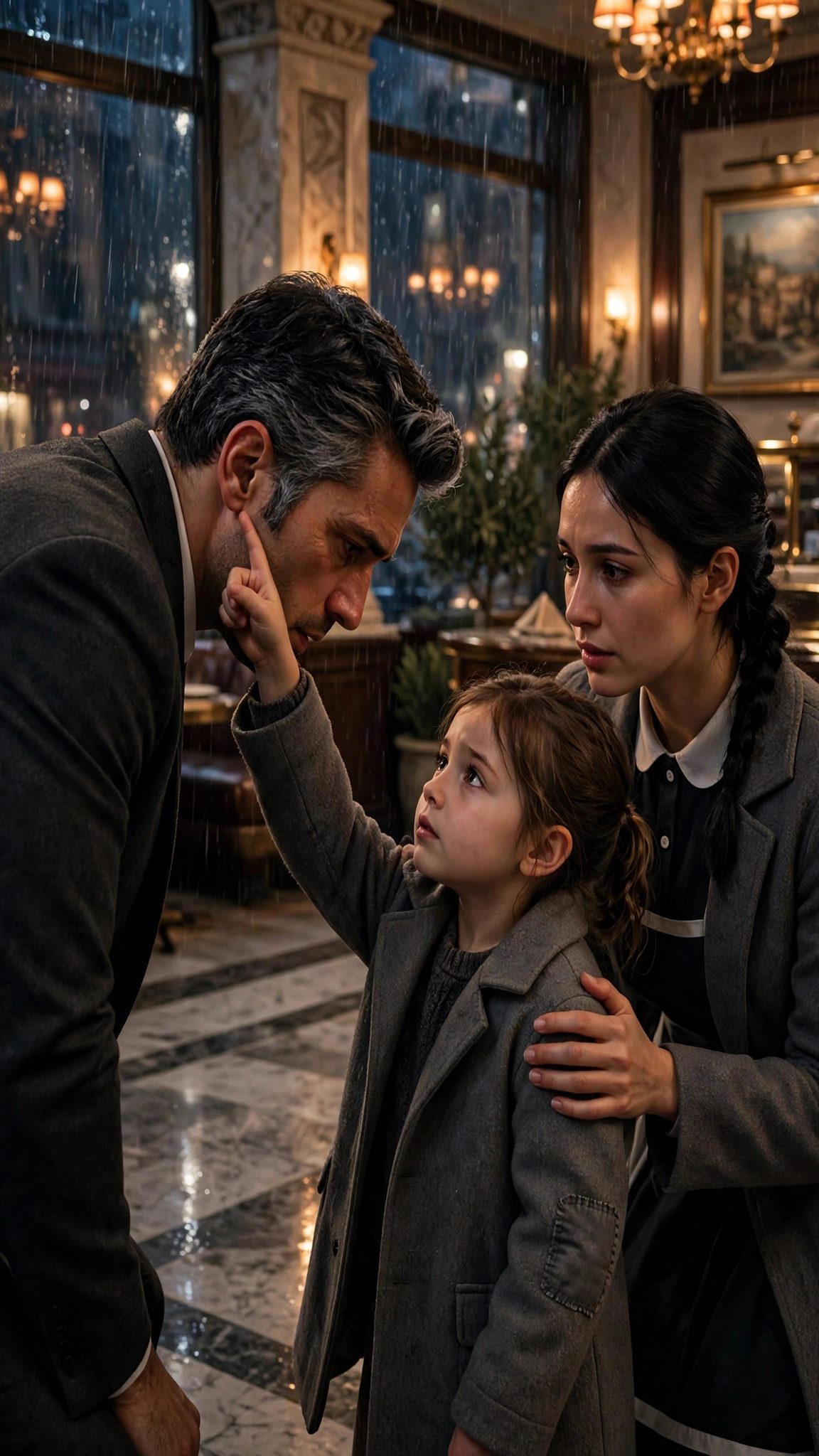
It was raining in the lobby of Valentino's Italian Bistro, and I had just dropped my keys.
That is how it started. Not with a gun. Not with a threat. Not with one of the hundred ways a man like me is supposed to die. It started with rain on marble, with my keys skittering across the floor, and with the sound of a little girl's boots.
I had spent ten years as the man people whispered about when they thought I could not hear them. I ran this state the same way I ran my mansion. I ran it in silence. That was the rule. My father had taught it to me when I was eleven years old, eating dinner at table C in the big dining room while he watched me the way a man watches a dog he is deciding whether to keep.
"Never trust a stranger," he had said, cold as the wine in his glass. "Never let your guard down, son. Never show weakness."
I never forgot those words. I built my whole life on them. I built an empire on them. And then a seven-year-old girl whispered six words into the quiet I had built, and everything I believed shattered like the rain on the marble.
"There's something behind your neck."
She was barely high enough to reach my belt, let alone my neck. She stood beside the door in a gray coat with a patched sleeve, clutching her mother's apron like it was the only solid thing in the world. Her mother pulled her closer, the way a bird pulls a chick under its wing, flinching when the mother's hand tightened on hers. The little girl walked as if she were trying not to be seen by anyone, and yet she had seen the one thing no one else in my life had seen.
I bent down to pick up my keys. That was when she said it, so quietly I almost thought I had imagined it.
"There's something behind your neck."
I froze with my hand halfway to the floor. Behind my neck. The one place I could not see without turning. The one place I never thought about, because who thinks about the back of their own neck?
"Please," her mother said. Her voice was low and tired and afraid, the voice of a woman who had already decided that whatever happened next, she would take the blame for it. "Please, Mr. Moretti. She doesn't mean anything by it. She's just a child."
I looked at the woman then. Really looked at her. Dark hair in a low braid, a gray coat that had been mended at the sleeve with careful, even stitches, hands red from work. She wore the black uniform of my bistro underneath the coat, and the apron the little girl was holding belonged to her. She was one of my maids. I had passed her a hundred times in the halls of Valentino's and never once seen her face.
But I had seen her before. Somewhere older than this lobby. Somewhere I had buried so deep I had forgotten I buried it.
"Let her sit with me," I said. My voice sounded strange in my own ears, rough from disuse, the way a door sounds when it has not been opened in years. "On the couch. Both of you. Please."
The woman hesitated. I could see her weighing it — the risk of sitting down with the most feared man in the state against the risk of refusing him. She chose sitting. She guided the little girl to the couch, and the girl climbed up beside me with her small boots dangling above the floor, and she looked at me with eyes that were far too old for seven years old.
"What is your name?" I asked her.
"Sophie Miller," the woman said, before the girl could answer. "That's my daughter, Anna."
"Anna," I said. "Hello, Anna."
She did not say hello back. She pointed. Her small finger went straight to the spot behind my ear, unerring, the way a compass needle finds north.
"There," she said. "A tiny black dot. Behind your ear. Daddy, why is there a tiny black dot behind your ear?"
She said "Daddy" to no one. To the air. To the habit of a question she must have asked a hundred times to a man who was not there. And then she looked at her mother, and her mother looked at me, and in her mother's eyes I saw something I had not seen in years.
Fear. Not fear of me. Fear for me.
"There's a listening device behind his ear," Sophie Miller said. Her voice was barely a whisper, but it hit me harder than any shout ever had. "Anna found it."
I went very still. I felt the blood leave my face. A listening device. Behind my ear. Someone had been listening to me for months, and I had not known. I had run my empire in silence, and all the while someone had been pressed against the silence, drinking it in.
"How long have you known?" I asked.
Sophie looked down at her hands. "I found the receiver weeks ago," she said. "In a bag that did not belong in the bathroom. I hid it. I hid the tapes too. I didn't know what kind of man you were. Until tonight."
Until tonight. She had been watching me, this maid in the gray coat, deciding what kind of man I was, the way my father had once watched me across a dinner table. And tonight, in a rainy lobby, with my keys on the floor and her daughter beside me, she had decided.
I should tell you how I got here. How a man becomes the kind of man people whisper about. How a boy who was tested at eleven years old becomes a king who cannot hear the whisper behind his own neck.
My name is Dante Moretti. I am thirty-eight years old, and I am the head of the Moretti family. My father, Salvatore Moretti, built this empire with his hands and his silence, and when he died ten years ago, I inherited both. The silence most of all.
My mother, Rosa Moretti, died when I was nineteen. She wore a gold necklace with a small locket, and when she died, my father put it in a velvet box in his desk drawer and never spoke of it again. I took it when he died. It has sat in my own desk drawer for ten years, waiting for a reason to come out.
My wife, Isabella, died eight years ago. A car crash on a wet road outside the city, the kind of crash the police call an accident and the family calls a message. I never found out which it was. I stopped asking. I stopped speaking, mostly. I gave orders in a voice so quiet my men had to lean in to hear them, and I discovered that a man who whispers is more terrifying than a man who shouts, because a man who shouts is a man you can predict, and a man who says nothing is a man who might do anything.
That was the rule. Silence. And it worked. For ten years, it worked. My rivals feared me. My men obeyed me. My enemies could not read me, because there was nothing to read. I was a locked door in a house with no windows.
But a locked door has a weakness my father never taught me about. A locked door cannot hear the man picking the lock from the other side.
Three months ago, I went to my barber. Enzo Falcone has cut my hair for fifteen years, since I was twenty-three and still learning how to be feared. He is fifty-four years old, with steady hands and a shop that smells of bay rum and hot towels, and he has always been the one hour in my month when I could sit still and let someone stand behind me. Behind me. Where I could not see.
I remember that haircut. I remember the cold touch of the clippers at the back of my neck, and Enzo saying, "Hold still, boss, you have a spot here," and his thumb pressing something small and warm against the skin behind my ear. I thought nothing of it. Why would I? A man does not think about the back of his own neck.
That was three months ago. Three months of meetings. Three months of phone calls. Three months of whispered orders in rooms I believed were safe, while a tiny black dot behind my ear carried every word to someone else.
Anna Miller found it in thirty seconds. A seven-year-old girl with small boots and old eyes, standing in a rainy lobby, saw what my security, my men, my money, and my silence had all missed.
I sat on that couch with her small hand in mine, and I felt something I had not felt in ten years. Not fear. Something worse than fear. Something like waking up.
"Anna," I said, very quietly, "can you tell me exactly what you saw?"
She nodded. "The man with the scissors," she said. "He touched your neck. I saw him. He thought I wasn't looking, but I was looking."
The man with the scissors. Enzo. My barber of fifteen years.
Sophie Miller's hand tightened on her daughter's shoulder. "She's seen what he did," she said. "She remembers everything she sees. That is her gift. And her curse."
I looked at Sophie then, really looked at her, and I understood two things at once. The first was that this woman had been carrying a secret for weeks, maybe longer, a secret heavy enough to break her back, and she had carried it alone because she did not know whether I was the kind of man who would thank her or kill her for it. The second was that I knew her face. I had known it eight years ago, in the Moretti mansion, when she was twenty-one years old and wore a maid's uniform and laughed in the kitchen when she thought no one could hear her.
I had been the first to hear her daughter's voice. But I had heard Sophie's voice first, eight years ago, in a house full of grief, on a night I had tried very hard to forget.
"Stay here," I said. "I'll be right back."
I stood up and walked to the door of the bistro, and I looked out at the rain coming down on the street, and I thought about my father's rule. Never trust a stranger. Never let your guard down. Never show weakness.
A little girl had just shown me my weakness. It was the size of a black dot, and it sat behind my ear, and it had been listening to me for months.
When I came back to the couch, Anna looked up at me with those old eyes, and she said, "Please, Dad, get me the first one," not knowing she was asking me for something she had already given me before I ever knew her name.
She had given me the truth. And the truth was this: someone had been listening to me for months. And the only person who had tried to warn me was a maid in a gray coat and her seven-year-old daughter, two people my empire had never once bothered to see.
That evening, I invited Sophie to join me on the terrace under the lights. I reached into my pocket, and I placed my mother's necklace on her daughter's neck. Not Sophie's neck. Anna's. Because Anna was the one who had saved me.
"You saved me," I said. "Twice."
But that is the end of the story. This is the beginning. And the beginning starts eight years earlier, in a mansion full of grief, with a young maid who laughed in the kitchen, and a man who had just buried his wife and did not know how to be alive anymore.
I did not know it then. But the whisper behind my neck had started long before the device was ever planted. It started the night I stopped listening to my own heart.
That morning, before the rain and the keys and the little girl, I had sat in my office above the docks and listened to my head of security tell me that everything was fine.
Marcus Hale is forty-five years old, broad as a door, with a scar through his left eyebrow from a knife fight in his twenties and a voice like gravel in a bucket. He has run my security for nine years. He checks the rooms. He sweeps for devices. He stands outside my door while I make my calls, and he tells me every morning that the house is clean.
"The house is clean, boss," he had said that morning, the way he says it every morning. "Swept the office twice. Nothing."
I had believed him. Why would I not believe him? Marcus had been with my father before he was with me. He had carried my father's coffin. He had stood at my wife's funeral with his head bowed and his hands folded, and I had trusted him the way you trust a man who has stood beside you at the worst moments of your life.
But trust is a strange thing. It grows in the dark, like a plant in a cellar, and you do not notice how pale and twisted it has become until you bring it into the light.
That morning, Marcus had lingered a moment too long by my desk. He had asked about the dock contracts, about the meeting with the port authority on Thursday, about whether I would be at Valentino's that evening. Small questions. Ordinary questions. The kind of questions a head of security is supposed to ask.
I answered them all. I told him about Thursday. I told him about the contracts. I told him I would be at the bistro at six, because I always ate at the bistro on Thursdays, and because routine is the armor of a man who has nothing else to hide behind.
I remember the way he nodded. Slow. Careful. Like a man memorizing something.
Then he left, and I sat alone in my office, and I looked out at the rain beginning to fall over the docks, and I thought about how quiet the room was. How quiet everything was. I had built my life out of quiet, and I was proud of it. Silence was my father's gift to me, and I had polished it until it shone.
What I did not know, sitting in that quiet room, was that the quiet had been stolen from me months ago. That every word I had spoken in that office had traveled through a tiny black dot behind my ear, down a wire I could not see, into the hands of a man who wanted everything I had.
My driver, Paolo, drove me to the bistro that evening. Paolo is sixty-one, with white hair and hands that have held a steering wheel for forty years, and he is the only man alive who has ever heard me laugh. He heard it once, eight years ago, in the kitchen of the mansion, on a night I have tried to forget. He never mentioned it again.
"Rain tonight, boss," Paolo said, as he opened the car door for me. "Bad night for walking."
"I don't mind the rain," I told him.
He looked at me then, the way old men look at you when they know something you don't. "You never did," he said. "Your mother loved the rain too."
My mother. Rosa Moretti. She used to stand at the kitchen window when it rained and press her hand against the glass, watching the drops run down like tears. She wore her gold necklace every day of her life, and when she laughed, the whole house laughed with her. After she died, the house stopped laughing. After Isabella died, the house stopped speaking. After my father died, the house stopped breathing, and I was the only thing left inside it, walking its halls in silence.
I walked into Valentino's that evening with rain on my shoulders and my keys in my hand, and I dropped them. A small thing. An ordinary thing. A man drops his keys a hundred times in his life and thinks nothing of it.
But this time, when I bent down, a little girl was standing beside the door. And she was looking at the back of my neck. And she whispered six words that broke ten years of silence.
"There's something behind your neck."
I did not know it yet. But the rain, the keys, the little girl, the gray coat, the patched sleeve — all of it was the beginning of the end of the silence. And the beginning of everything else.