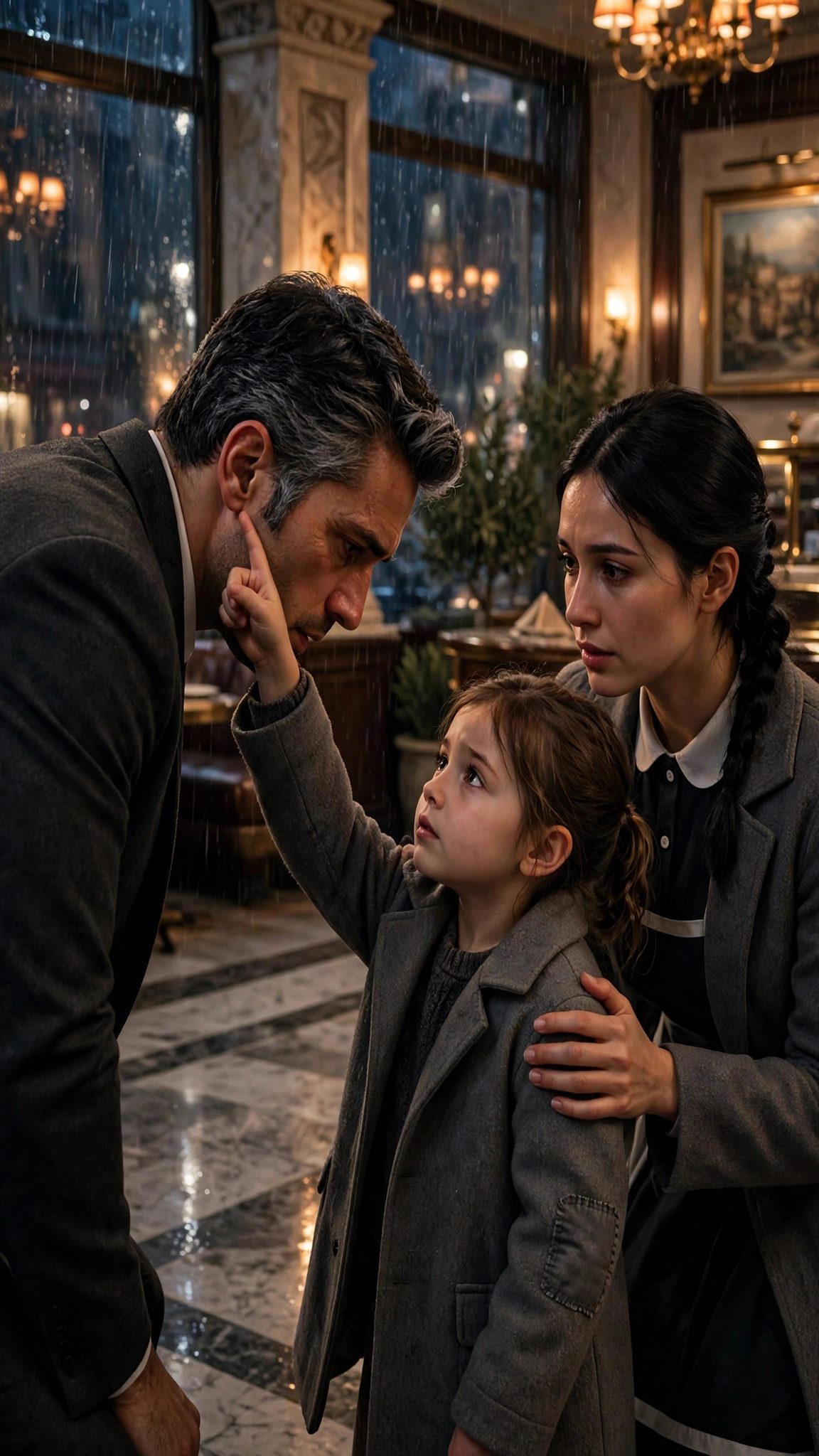
Sophie Miller had been invisible for eight years, and she had chosen it that way.
She woke every morning at five, in a two-room flat above a laundry on the east side of the city, where the pipes knocked all night and the heat came and went as it pleased. She made oatmeal for Anna, braided her daughter's hair, checked the patch on the sleeve of her gray coat — the coat she had owned since she was twenty, mended so many times the mends had mends — and walked the forty minutes to Valentino's Italian Bistro, because the bus cost money and money was for Anna's shoes and Anna's books and the doctor when Anna coughed in the winter.
At the bistro she put on her black uniform and her white apron, and she became nobody. That was the job. A maid in a fine restaurant is furniture that moves. She cleared plates. She wiped tables. She carried trays that weighed more than her daughter. She smiled at men who did not see her and women who looked through her, and she went home with aching feet and tips folded small in her pocket, and she told herself that this was enough. That invisibility was safety. That if no one saw her, no one could hurt her.
But invisibility has a price. The price is that when you finally need to be seen — when you are carrying a secret that could save a man's life — you have no practice in being heard.
Sophie had not always been invisible. Eight years ago, she had been twenty-one years old, and she had worked in the Moretti mansion, and she had laughed in the kitchen.
She remembered that kitchen the way other people remember a childhood home. The big stove. The copper pots hanging in a row. The smell of garlic and basil and fresh bread. Rosa Moretti had been dead for two years by then, but the kitchen still felt like hers — warm, and full of light, and the kind of place where a girl could laugh without being afraid of who heard it.
Sophie had come to the mansion because her own mother had died, and her father had drunk himself into an early grave, and the mansion paid better than anywhere else in the city, and a girl with no family takes the work she can get. She was hired to clean the rooms on the second floor, to change the sheets, to dust the portraits of dead Morettis who stared down from the walls with painted eyes.
And then Isabella Moretti died.
It was a wet road outside the city, and a car that lost its grip, and a phone call at three in the morning that woke the whole house. Sophie remembered standing in the hallway in her nightdress, watching Dante Moretti come down the stairs in his suit, already dressed, already silent, walking out into the rain like a man going to meet something he had known was coming for a long time. He did not cry. He did not shout. He did not break anything. He simply went quiet, and the quiet spread through the mansion like water through a cracked wall, filling every room.
For three weeks after the funeral, Dante did not speak to anyone except in single words. Yes. No. Leave it. He ate alone in his study. He slept — if he slept — in the room he had shared with his wife, with the door locked and the lights off. The staff whispered about him in the kitchen, the way staff always whisper about the family they serve, and the whisper was always the same: the boss is broken, and broken men are dangerous, because they have nothing left to lose.
Sophie did not whisper. She watched. She had a gift for watching — for seeing what other people missed. She saw that Dante took his coffee black and left it untouched on his desk. She saw that he stood at his wife's portrait for a long time each evening, with his hand flat against the frame, as if he could feel her through the wood. She saw that he flinched when the phone rang, the way a man flinches when he expects bad news.
And one night, six weeks after the funeral, she found him in the kitchen.
It was past midnight. She had come down for a glass of water, barefoot on the cold tile, and there he was — the most feared man in the state, sitting at the kitchen table in his shirtsleeves, with a bottle of whiskey and two glasses, staring at the empty chair across from him.
"Sit down," he said, without looking up. "Please. I don't want to drink alone tonight."
She should have said no. She should have gone back upstairs. She was a maid. He was the boss. There were rules about such things, rules written not in any book but in the air of the house itself, rules as old as the mansion.
But she sat down. Because his voice was not the voice of a boss. It was the voice of a man who had just buried his wife and did not know how to be alive anymore. And because she was twenty-one years old, and kind, and lonely, and she knew what grief looked like, because she had worn it herself.
They talked until dawn. Not about the family. Not about business. About small things. About his mother, who had loved the rain. About her mother, who had sung while she cooked. About the copper pots on the wall, and the smell of basil, and the way the light came through the kitchen window in the morning. He laughed once — a short, startled sound, like a man surprised by his own voice — and Paolo, the driver, heard it from the hallway and never mentioned it again.
And then morning came, and the sun came up, and the rules came back, and Dante Moretti stood up from the kitchen table, put on his jacket, and became the silent king again. He did not look at her. He did not thank her. He walked out of the kitchen, and Sophie understood that the night had been a crack in a wall, and the wall had closed again.
Three weeks later, she learned she was pregnant.
She sat on the edge of her narrow bed in the staff quarters and held the test in her shaking hands, and she thought about the rule his father had taught him. Never show weakness. A child would be weakness. A child with a maid would be a scandal, and a scandal would be leverage, and leverage in Dante Moretti's world was a weapon other men would use to cut his throat.
She thought about leaving. She thought about staying. She thought about telling him, and then she thought about what would happen if she told him — about the men who would learn of it, about Castellano, about the rivals who circled the family like wolves, about a baby who would grow up with a target on its back before it could walk.
So she left. She packed one bag in the middle of the night, left a note on the kitchen table that said only "Thank you for the work. I am sorry to go so suddenly," and she walked out of the mansion and out of Dante Moretti's life, carrying the one secret she would keep for seven years.
Anna was born on a cold morning in March, in a charity hospital, with a midwife who held Sophie's hand and told her she was brave. Sophie named her Anna, after her own mother, and she looked down at the tiny red face and made a promise: no one would ever use this child. No one would ever know whose child she was. She would be invisible, and her daughter would be safe, and that was worth any price.
She found work at Valentino's because it was Dante's restaurant and she knew the kitchens, and because the pay was steady, and because — though she would never admit it, even to herself — it let her see him sometimes. From a distance. Across a crowded dining room. The silent king, eating alone at his table, with his men around him and his silence around him like armor. She watched him, and she wondered if he ever thought about that night in the kitchen, and she told herself it did not matter, because Anna was hers, and Anna was safe, and that was enough.
It was enough for seven years. Until the day Anna came home from the bistro with her and said, "Mama, the man with the scissors touched Mr. Moretti's neck, and I saw a tiny black dot, and I think someone is listening to him."
Sophie had not believed her at first. Anna was seven. Seven-year-olds imagine things. But Anna did not imagine things. Anna remembered everything she saw. That was her gift, and her curse — she remembered the color of a stranger's coat, the shape of a scar, the exact words a man had said three weeks ago. She remembered the barber's thumb pressing against Dante's skin. She remembered the way the barber had looked around first, quick, like a man checking whether anyone was watching.
And Sophie, who had spent seven years being invisible, had looked at the bag the barber left in the bathroom — the bag with the receiver inside it, and the tapes, and the careful notes in a hand she did not recognize — and she had understood.
Someone had been listening to Dante Moretti for months. Someone inside his own house. And the only people who knew were a maid in a gray coat and her seven-year-old daughter, two people the empire had never once bothered to see.
She hid the black box under the bathroom tiles that night, while Anna slept. She pried up the loose tile with a kitchen knife, set the box in the hollow beneath it, and pressed the tile back down, and she sat on the bathroom floor with her back against the door and her heart hammering, and she thought about the man she had once sat with in a kitchen at midnight, and she thought about the daughter sleeping in the next room, and she thought about what kind of man Dante Moretti was now.
She did not know. She had not known for seven years. She only knew that tonight, in a rainy lobby, she would find out.
Because Anna had whispered. And a whisper, Sophie was about to learn, can break ten years of silence.
Anna had always remembered everything. Sophie learned that when Anna was three years old and recited, word for word, a conversation between two women on a bus that Sophie herself had forgotten by the next stop. At four, Anna could tell you what color shirt the postman had worn on Tuesday, and what the woman at the bakery had said about her husband, and which of the neighbors' dogs had barked first and which had barked second. At five, her teacher called Sophie in and said, gently, that Anna was very bright, but that she frightened the other children sometimes, because she remembered things they had said when they thought no one was listening, and she repeated them at exactly the wrong moment.
Sophie understood. She had the same gift, dulled by years of forcing herself not to use it. In the mansion, she had learned to see without seeming to see, to hear without seeming to hear. It was how a maid survived. But Anna had never learned to hide it. Anna saw everything, and she said what she saw, and the world did not know what to do with a child like that.
On the evening Anna first mentioned the barber, they were walking home from the bistro in the rain, sharing Sophie's gray coat between them, Anna's small hand in hers.
"Mama," Anna said, "the man with the scissors touched Mr. Moretti's neck today."
Sophie did not stop walking. "The barber, sweetheart. Mr. Enzo. He cuts Mr. Moretti's hair."
"He put something there," Anna said. "Behind his ear. A tiny black dot. Like a little beetle. He pressed it with his thumb, and he looked around first, like this." Anna turned her head quickly, left, then right, mimicking the glance. "Like he didn't want anyone to see."
Sophie's steps slowed. "Are you sure, Anna?"
"I saw it," Anna said, with the flat certainty of a child who has never been wrong about what she saw. "He did it when Mr. Moretti was looking at his phone. And then Mr. Moretti didn't notice. He never notices the back of his neck. Nobody does."
Sophie stopped in the middle of the wet pavement, rain running down her face, and looked at her daughter. Anna looked back at her, small and wet and absolutely sure, and Sophie felt the floor of her life tilt under her feet.
Because she had seen the bag. Two days earlier, in the mansion bathroom — she still cleaned the mansion twice a week, a quiet arrangement through the bistro, the same halls she had walked eight years ago — she had found a leather bag tucked behind the towels in the cabinet, a bag that did not belong to any of the staff. Inside it, wrapped in a cloth, was a small black receiver, blinking a slow green light. And beside it, a stack of tapes, labeled in a careful hand with dates. And a notebook, with times written in it — times that matched Dante Moretti's meetings, his phone calls, his whispered orders.
She had stood there with the bag in her hands, her heart hammering so hard she thought the whole house could hear it, and she had understood in one cold flash what it meant. Someone was listening to Dante Moretti. Someone had been listening for months. Someone inside his own house, someone he trusted, was carrying his words to his enemies.
And she had done the only thing she could think of. She had taken the bag, hidden it in her cleaning cart, carried it out of the mansion under a stack of towels, and that night, while Anna slept, she had pried up the loose tile in their bathroom and hidden the black box beneath it.
She had not told anyone. She had not known who to tell. The man being listened to was the most feared man in the state, and the people listening to him were inside his own house, and a maid in a gray coat who came forward with a story like that might not live to finish telling it.
But now her daughter had seen the barber's thumb. And her daughter had whispered in a rainy lobby. And there was no more hiding.
That night, after Anna fell asleep, Sophie sat at the kitchen table with the loose tile in her mind and the black box under her bathroom floor, and she thought about the night in the mansion kitchen eight years ago, and the man who had laughed once and then gone silent for a decade, and she thought about the promise she had made to herself the morning Anna was born.
No one would ever use this child.
But Anna had already been used — not by Sophie's choice, but by the simple fact of having eyes that saw what adults missed. And now the only way to keep her safe was the thing Sophie had feared for seven years: to be seen. To speak. To walk up to the most dangerous man in the state and tell him the truth.
She did not sleep that night. She sat by the window and watched the rain, and she practiced the words in her head, over and over, the way you practice a speech you are afraid to give.
"Mr. Moretti. There's something behind your neck. Someone has been listening to you for months. I can prove it."
And underneath those words, the other words. The ones she had carried for seven years, heavier than the black box, heavier than the tapes, heavier than anything.
"Anna is your daughter."
She did not know if she would ever say them. She only knew that the whisper had already started, and whispers, once spoken, do not stop.