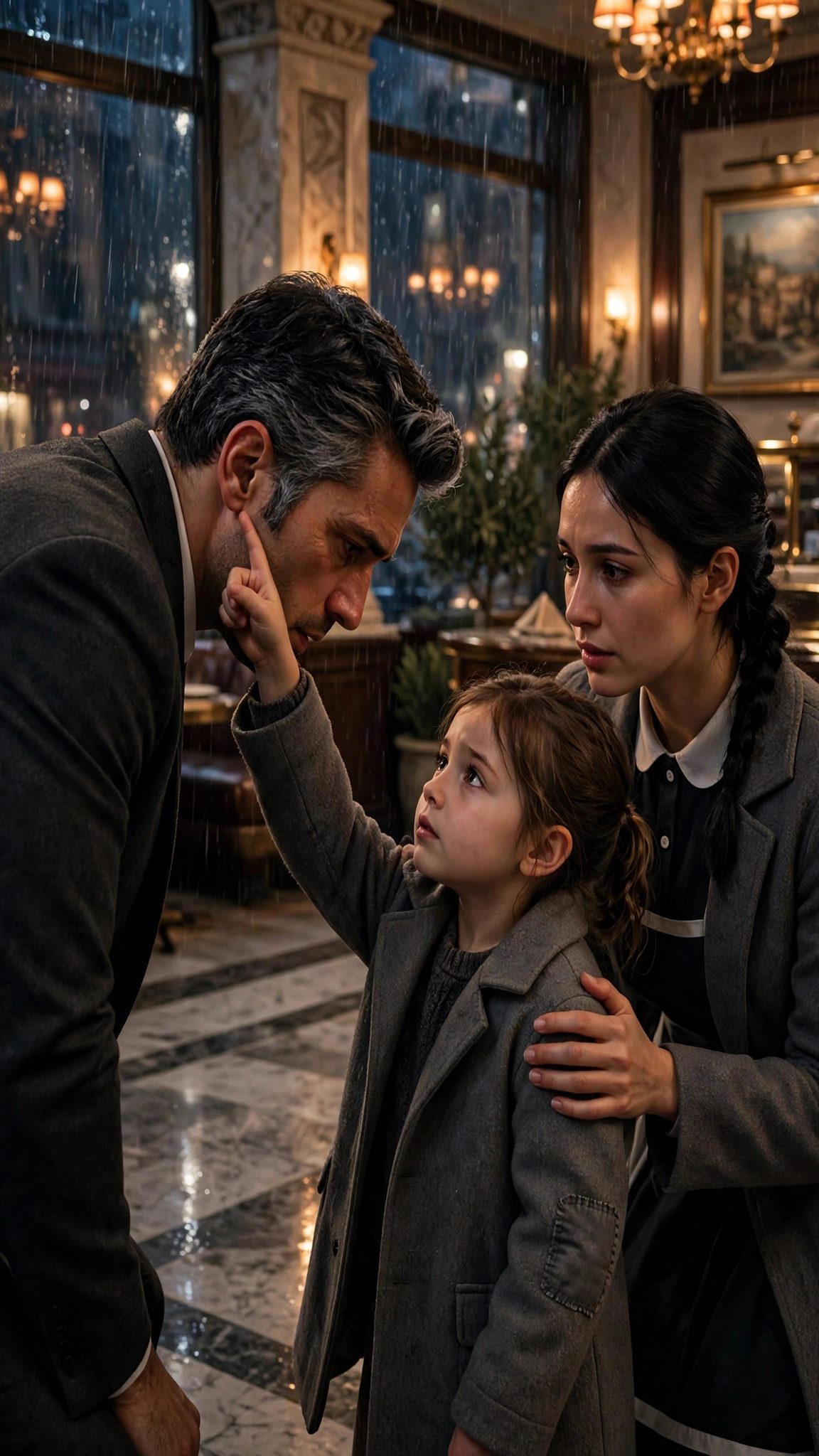
The mansion had not changed in eight years. That was the first thing Sophie thought every time she walked through its side door on her cleaning days, her cart rattling over the marble, her gray coat hung on the same hook in the same narrow staff room. The same portraits stared down from the walls. The same copper pots hung in the kitchen. The same clock ticked in the hallway, loud in the silence, marking hours that belonged to a dead woman and a silent man.
Sophie cleaned the mansion twice a week. It was a quiet arrangement, made through the bistro, and no one asked why a bistro maid also cleaned the big house on the hill. The staff had turned over in eight years — new faces, younger faces, faces that did not know her — and that suited Sophie. She was furniture that moved. She dusted the portraits. She changed the sheets in rooms no one slept in. She polished the silver that no one used. And she kept her eyes down, and her mouth shut, and her daughter's name out of every conversation.
But she saw things. She had always seen things. It was her gift, and her curse, and the mansion was full of things to see if you knew how to look.
She saw that Dante Moretti's study was swept every morning by Marcus Hale himself, and that Marcus locked the door behind him when he did it, and that no maid was allowed inside until Marcus had finished. She saw that the barber, Enzo Falcone, came to the mansion once a month with his leather bag, and that he always asked for the bathroom before he left, and that he always stayed a little too long in it. She saw that the phone in the hallway — the old black phone that no one used anymore — had dust on its receiver, except for a clean circle where a hand had gripped it recently, and often.
She saw these things, and she filed them away, the way she had filed away everything in the mansion for eight years, in the quiet drawer of her mind labeled not my business.
Until the Tuesday she opened the bathroom cabinet and found the bag.
It was a Tuesday in October, rain against the windows, the house empty except for the staff. Dante was at the docks. Marcus was with him. Enzo had come that morning for the monthly haircut, and he had gone, and Sophie was cleaning the bathroom the way she always did — wiping the mirror, folding the towels, checking the cabinet for fresh soap.
The bag was behind the towels. Black leather, scuffed at the corners, the kind of bag a man carries for years without thinking about it. She would not have touched it, except that it was in the wrong place. Bags did not live in bathroom cabinets. Bags lived in hallways, on hooks, in cars. A bag in a bathroom cabinet was a bag someone had hidden in a hurry.
She opened it.
Inside, wrapped in a gray cloth, was a small black receiver, no bigger than a matchbox, with a slow green light blinking on its face. Beside it, a stack of tapes — the old kind, cassette tapes, each one labeled in a careful hand with a date. And a notebook, bound in black leather, filled with times. Meeting times. Call times. Times that matched, to the minute, the times Dante Moretti sat in his study and spoke in his quiet voice to men who leaned in to hear him.
Sophie stood in the bathroom with the bag in her hands, and the blood drained out of her face, and the room tilted around her.
She understood. She understood all at once, the way you understand a thing you have been circling for weeks without knowing it. The clean circle on the old phone. The barber's long visits to the bathroom. Marcus locking the study door. The haircut, three months ago, when Enzo had pressed his thumb against the back of Dante's neck and said, "Hold still, boss, you have a spot here."
Someone had been listening to Dante Moretti for months. Someone had planted a device on his body, and someone was recording everything he said, and someone was carrying those recordings to someone else. And the someone doing it was inside his own house, walking his own halls, standing behind his own chair.
She thought about putting the bag back. She thought about closing the cabinet and finishing the towels and going home and never thinking about it again. It was not her business. She was furniture that moved. Furniture does not open bags. Furniture does not get involved in the wars of kings.
But then she thought about Anna. Anna, who was seven years old and remembered everything she saw. Anna, who had been at the bistro that morning, carrying a tray of bread to the back table, and who had looked up at exactly the wrong moment and seen the barber's thumb press against the back of a king's neck.
Anna had seen it. Anna had said so, in the rain, on the walk home, with the flat certainty of a child who has never been wrong about what she saw.
And if Anna had seen it, then Anna was in danger. Because the men who planted listening devices on kings did not leave witnesses. Not even seven-year-old witnesses. Not even witnesses who did not understand what they had seen.
Sophie closed the bag. She wrapped it in the towels from her cart, the way she had once wrapped Anna in a blanket on the morning she was born, and she carried it out of the mansion under a stack of clean linen, her heart hammering so hard she was certain the guard at the gate could hear it. The guard did not look at her. Guards never look at maids. That was the thing about being invisible: no one ever checked what you were carrying.
That night, while Anna slept, Sophie pried up the loose tile in their bathroom with a kitchen knife. The tile had been loose since they moved in, rocking slightly underfoot, and she had meant to fix it a hundred times and never had. Now she was glad. She set the black box in the hollow beneath the tile — the receiver, the tapes, the notebook, all of it — and she pressed the tile back down, and she sat on the bathroom floor with her back against the door, and she listened to her daughter breathing in the next room, and she tried to think.
The tapes were labeled with dates going back four months. Four months of Dante Moretti's words, carried out of his house on small black ribbons. What had he said in four months? Orders. Names. Routes. The dock contracts. The meeting with the port authority. Things that could get men killed, things that could lose an empire, things that Castellano — because it had to be Castellano, who else would want to hear everything Dante said? — would pay a fortune to know.
And the notebook. The notebook was worse than the tapes, because the notebook had times in it, and times meant someone had been sitting somewhere, listening live, writing down what the king said as he said it. Someone close. Someone trusted. Someone who stood outside the study door while Dante spoke inside it.
Marcus. It had to be Marcus. Marcus, who swept the study every morning. Marcus, who locked the door behind him. Marcus, who asked about Thursday, and the contracts, and the bistro.
Sophie pressed her hands against her face and tried to breathe. She had spent seven years being invisible, and now she was holding the proof that the most feared man in the state was being betrayed by his own men, and she had no idea what to do with it.
She could go to the police. But the police in this city belonged to someone — either to Dante, or to Castellano, or to men whose names she did not know — and a maid with a black box under her bathroom tile would not survive telling the wrong policeman the right story.
She could go to Dante. But Dante was a silent king who did not speak to maids, and the men around him were the very men betraying him, and how would she get past them? How would a woman in a gray coat with a patched sleeve get an audience with Dante Moretti, and live to tell about it?
She could do nothing. She could leave the box under the tile and hope the men never learned that Anna had seen the barber's thumb. She could keep being invisible, and keep Anna invisible, and pray that invisibility was enough.
But invisibility had never been enough. It had only ever been a delay.
The next morning, Anna came into the kitchen while Sophie was making oatmeal, and she climbed onto the chair beside her, and she said, "Mama, why does Mr. Moretti never talk?"
Sophie looked at her daughter — small, serious, with her father's gray eyes, though Sophie had never told her that — and she said, "Because he is sad, sweetheart. He lost someone he loved, a long time ago, and he never learned how to talk about it."
"Is that why he is quiet?" Anna asked.
"Yes," Sophie said. "That is why he is quiet."
Anna thought about this, stirring her oatmeal in slow circles. "I think he should talk," she said. "I think if he talked, the sad would come out, and then he wouldn't have to carry it anymore."
Sophie stared at her daughter. Seven years old, and she had said the truest thing anyone had said about Dante Moretti in a decade.
"Maybe," Sophie said. "Maybe you should tell him that someday."
Anna nodded, as if this were a perfectly reasonable plan. "I will," she said. "I will tell him there is something behind his neck, and I will tell him he should talk."
Sophie felt her heart stop. "Anna," she said, very carefully, "did you tell anyone else about what you saw? About the barber? About the black dot?"
Anna shook her head. "Only you, Mama. I only told you. Because you told me that when you see something strange, you tell Mama first."
"Good," Sophie said, and she pulled her daughter close, and she held her tighter than she had ever held her, because she understood now what she had to do. "Good girl. You did the right thing. And Mama is going to do the right thing too."
That evening, Sophie went to the bistro early. She put on her uniform and her apron, and she worked her shift, clearing plates and wiping tables, and she watched the door. At six o'clock, Dante Moretti walked in, the way he always did on Thursdays, with his men around him and his silence around him like armor. And Sophie watched him sit at his table, and she watched the rain begin to fall outside the windows, and she watched him drop his keys.
She did not plan it. She did not decide it. She simply stood up from the table she was wiping, and she took Anna's hand, and she walked toward the door, toward the man with the keys on the floor and the tiny black dot behind his ear.
And Anna, who remembered everything and said what she saw, looked up at the most feared man in the state and whispered the six words that broke ten years of silence.
"There's something behind your neck."
And Sophie Miller, who had been invisible for eight years, finally let herself be seen.
The notebook haunted her more than the tapes. The tapes were proof, but the notebook was a confession written in someone else's hand, and Sophie could not stop thinking about it in the days after she hid the box.
She had read only a few pages, standing in the bathroom with the door locked and her hands shaking, but the pages she read were enough. The handwriting was small and careful, the handwriting of a man who was used to being precise. Dates. Times. Short notes, in a kind of shorthand she had to sound out slowly.
"Thursday, 2 p.m. Docks. Port authority. Thursday meeting confirmed."
"Friday, 9 a.m. Phone call. Castellano's name mentioned. D. angry."
"Tuesday, 11 p.m. Study. D. spoke of the Geneva account. Only three men present."
Only three men present. Sophie had read that line three times, and each time it had felt colder. The Geneva account was the family's money, the money no one spoke about, the money that had been in the family for generations. If Castellano knew about the Geneva account, then Castellano knew everything. And if only three men had been present when Dante spoke of it, then the traitor was one of three men, and one of them was Marcus Hale.
She had closed the notebook then, and put it back in the bag, and hidden the bag under the tile, and she had told herself she would not open it again. But that night, lying awake in the dark while Anna slept, she found herself turning the pages over in her mind, the way you turn over a stone in your hand, looking for the sharp edge.
Who were the three men? Marcus, certainly. Marcus was always there. The second was probably Enzo — no, Enzo was the barber, he was not in the study at eleven at night. The second might have been Paolo, the driver, but Paolo was sixty-one and had served Dante's mother, and Sophie could not believe Paolo would betray the family that had fed him for forty years. The third might have been the lawyer, Charles DeLuca, who came on Tuesdays with his briefcase and his quiet voice.
She did not know. And not knowing was worse than knowing, because not knowing meant she could not warn Dante about a specific man. She could only warn him that someone was listening, and hope he was clever enough to find out who.
Two days after she hid the box, Marcus came to the mansion while she was cleaning the second floor.
She heard his boots on the stairs before she saw him — heavy, unhurried, the walk of a man who owned every room he entered. She was dusting the portraits in the hallway, and she froze with the cloth in her hand, and she watched him come up the stairs and stop at the top and look at her.
"Morning, Sophie," he said. His voice was gravel in a bucket, and his eyes were flat and dark, and he looked at her the way a man looks at a piece of furniture he is deciding whether to move.
"Morning, Mr. Hale," she said. She kept her eyes down. She kept dusting. She did not let her hands shake, though it took everything she had.
"You clean the bathroom on this floor?" he asked.
"Yes, sir. Tuesdays and Fridays."
"And the cabinet? You clean inside the cabinet?"
Sophie's heart stopped. The cabinet. The bag had been in the cabinet. Had he seen her take it? Had he come back for it and found it gone?
"I wipe the shelves, sir," she said, and her voice sounded steady, which surprised her, because nothing else about her was steady. "And I check the soap."
He looked at her for a long moment. A very long moment. Long enough for her to see the scar through his eyebrow, and the way his hand rested near his jacket, and the way his eyes moved — not over her face, but over her hands, her apron, her cart, looking for something.
"Good," he said at last. "Keep it clean. The boss likes things clean."
And he walked past her, down the hallway, into Dante's study, and closed the door behind him.
Sophie stood in the hallway with the dust cloth in her hand, and she did not move for a full minute. Then she finished the portraits, and she finished the hallway, and she went down the stairs with her cart, and she walked out of the mansion into the October afternoon, and she did not look back.
But she knew, as she walked to the bus with her gray coat pulled tight around her, that Marcus Hale had been looking for the bag. And that meant Marcus Hale knew it was gone. And that meant the men who had been listening to Dante Moretti now knew that someone had found them.
She had to tell Dante. Not next week. Not when it was safe. Now. Before Marcus found the box under her bathroom tile. Before the men who listened decided that a maid and her daughter were a problem to be solved.
That was the day she decided. That was the day invisibility stopped being safety, and started being a slow way to die.
She would go to the bistro on Thursday evening. She would take Anna with her, because she would not leave Anna alone, not now, not ever again. And she would wait for the moment — for the rain, for the keys, for the small, ordinary accident that would put her in the path of the most feared man in the state.
She did not know the moment would come in the lobby, with keys skittering across the marble. She only knew that it would come, and that when it did, she would have to be brave enough to be seen.
And Anna, who remembered everything and said what she saw, would have to be brave enough to whisper.