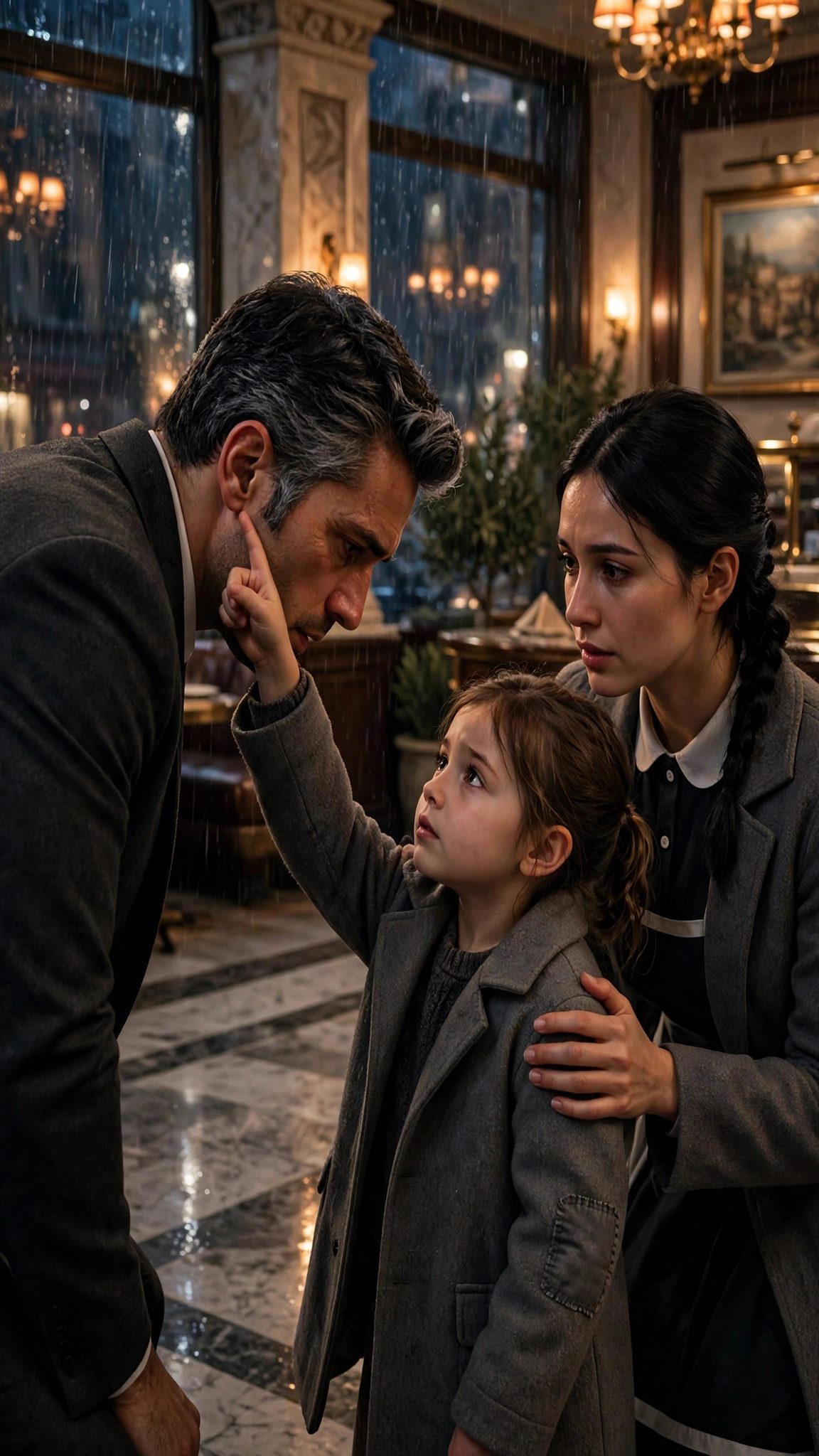
Three months later, on a warm evening in June, Dante Moretti invited Sophie Miller to join him on the terrace under the lights.
The terrace was at the back of the mansion, overlooking the garden, and it was strung with small golden lights that glowed like fireflies in the dusk. The roses were in bloom. The fountain was running. The air smelled of jasmine and rain that had fallen earlier in the day, and the sky was the color of a bruise healing — purple fading into gold, the last light of the day holding on.
Anna was already on the terrace, in a white dress Sophie had made for her, with a ribbon in her hair, chasing the fireflies between the potted plants. She was laughing. She laughed all the time now, the way children are supposed to laugh, and the sound of it filled the garden and rose up to the terrace like music.
Dante stood at the edge of the terrace, in a dark suit, with his hands in his pockets, watching his daughter chase the fireflies. He had changed in three months. Not all at once — change does not come all at once, not for a man who has been silent for ten years — but slowly, the way spring comes, a little more light every day.
He talked now. Not all the time, and not loudly, but he talked. He talked to his men in the morning, in a voice they could hear without leaning in. He talked to Paolo on the drive, about the weather, and the docks, and the foundation he had started for the families of men who had died in the family's wars. He talked to Sophie in the evenings, on the terrace, about small things — about the roses, and the fountain, and the way the light came through the kitchen window in the morning.
And he talked to Anna. He talked to her every day, about everything and nothing, about school, and books, and fireflies, and why the sky changed color at dusk. He had missed seven years of her life, and he was trying to make up for it one conversation at a time, and Anna — who remembered everything and said what she saw — told him, very seriously, that he was doing a good job, but that he still needed practice, because sometimes he went quiet in the middle of a sentence, and she had to remind him to keep going.
"You are doing better, Daddy," she had said to him that morning, over breakfast, and Dante had stopped with his coffee halfway to his mouth, because she had called him Daddy, and it was the first time she had said it to his face, and it had sounded like the most natural thing in the world.
"Daddy," she said again now, running up the terrace steps, out of breath, her white dress glowing in the lights. "Daddy, I caught a firefly, but I let it go, because Mama says you should not keep things that are meant to fly."
"Your mother is right," Dante said. He knelt down, the way he always knelt down now when he spoke to her, so that his eyes were level with hers. "And do you know what else your mother is right about?"
"What?" Anna asked.
"That you saved me," Dante said. "Twice."
Anna tilted her head. "Twice? I only whispered once."
"You whispered once," Dante said. "And that saved my life. But you did something else, Anna. Something bigger. You gave me a reason to talk again. You gave me a reason to be alive again. You gave me a daughter. And that saved me a second time."
Anna thought about this, the way she thought about everything — seriously, with her old eyes. Then she nodded, as if this were a perfectly reasonable thing to say. "Good," she said. "I am glad I saved you twice. Does that mean I get two presents?"
Dante laughed. It was a real laugh now, not the short startled sound from the office, but a full laugh, the kind that comes from deep in the chest, the kind that makes the whole house laugh with it. Sophie, standing in the doorway of the terrace, heard it, and she smiled, because she had waited eight years to hear that laugh, and it had been worth every day.
"Yes," Dante said. "It means you get two presents. But the first present is not a toy. The first present is something much older than you, and much more important."
He reached into his pocket. He took out a small velvet box, old and worn at the corners, the box that had sat in his desk drawer for ten years. He opened it, and inside, shining in the terrace lights, was his mother's gold necklace, with its small locket, the necklace Rosa Moretti had worn every day of her life.
Anna stared at it. Her eyes went wide. "It is beautiful," she whispered.
"It belonged to my mother," Dante said. "Her name was Rosa. She wore it every day. She used to say that a necklace is not jewelry. A necklace is a promise. You give it to the person you would protect with your life."
He lifted the necklace out of the box. He stood up, and he placed it gently around Anna's neck, and he fastened the clasp, and the gold caught the light, and Anna stood very still, the way you stand when something precious has just been placed on you and you are afraid to move in case it breaks.
"There," Dante said. His voice was quiet, but it was not the quiet of silence. It was the quiet of a man saying something he means with his whole heart. "Now you are wearing my mother's promise. And my promise is this: I will protect you with my life, Anna. For the rest of my life. No one will ever hurt you. No one will ever listen to you without your permission. No one will ever make you invisible again."
Anna reached up and touched the locket with one small finger. "What is inside it?" she asked.
Dante smiled. "Open it," he said.
Anna opened the locket. Inside, on one side, was a tiny photograph of Rosa Moretti, young and laughing, with her hand pressed against a rainy window. On the other side, there was nothing — an empty space, waiting.
"That side is for you," Dante said. "For your photograph. So that my mother and my daughter can be together, in the same locket, forever."
Anna looked at the photograph of her grandmother — the grandmother she had never met, who had loved the rain, who had laughed in the kitchen — and then she looked up at Dante, and her old eyes were shining, and she said, "Thank you, Daddy. I will keep it safe. I promise."
"I know you will," Dante said. "You keep everything safe, Anna. That is your gift."
And then he turned to Sophie, who was standing in the doorway with tears on her face, and he held out his hand, and Sophie took it, and he led her to the center of the terrace, under the lights, with the roses below and the fireflies around them, and he knelt down in front of her — the most feared man in the state, on his knees in front of a maid in a gray coat, for the second time in his life — and he took a small box out of his other pocket, and he opened it, and inside was a ring. A simple gold ring, with a single small diamond, the kind of ring a man gives to a woman he wants to spend the rest of his life with.
"Sophie Miller," Dante said, and his voice was steady, and clear, and it carried across the terrace and down into the garden, because Dante Moretti did not whisper anymore. "Eight years ago, you sat with me in a kitchen at midnight, and you listened to me, and you did not judge me, and you gave me the first kind thing I had been given since my wife died. Then you left, and you kept our daughter safe, and you kept her hidden, and you did it because you loved her more than you loved your own safety. And three months ago, you walked into a rainy lobby, and you let your daughter whisper, and you saved my life. You saved me twice, too, Sophie. Once in the kitchen, and once in the lobby. And I am asking you now, in front of our daughter, under these lights, with my mother's necklace on her neck — will you marry me? Will you let me spend the rest of my life making up for the seven years I missed? Will you let me be the man you believed I could be, that night in the kitchen, when you sat across from me and listened?"
Sophie looked at him. She looked at Anna, in her white dress, with the gold necklace shining on her neck. She looked at the terrace, and the lights, and the roses, and the fireflies. And she thought about the two-room flat above the laundry, and the forty-minute walks, and the gray coat with the patched sleeve, and the black box under the bathroom tile, and the seven years of invisibility.
And she said, "Yes."
It was one word. But it was the loudest word Sophie Miller had ever spoken. And Anna cheered, and the fireflies rose up around them like sparks, and Dante Moretti stood up, and he put the ring on Sophie's finger, and he kissed her, there on the terrace, under the lights, with his daughter watching, and the whole mansion — the portraits, the copper pots, the clock in the hallway — seemed to breathe again, for the first time in ten years.
They were married a month later, in the garden, under the oak tree, with Anna as the flower girl, scattering rose petals down the aisle, wearing her mother's necklace and her white dress. Paolo gave Sophie away, because Sophie had no family left, and Paolo had been family to the Morettis for forty years, and he cried through the whole ceremony, and he did not apologize for it. Agent Reyes came, with his wife, and he danced with Anna, and he told Dante that Castellano had been sentenced to life, and Marcus to life, and Enzo to five years suspended, and that the case was closed, and that the Moretti family was free.
And Dante Moretti, who had run his empire in silence for ten years, stood in his garden, with his wife on his arm and his daughter at his side, and he looked out at the people he loved, and he spoke — not in a whisper, but in a voice everyone could hear.
"I spent ten years believing that silence was strength," he said. "I believed that if I said nothing, no one could hurt me. I was wrong. Silence nearly killed me. What saved me was a whisper — a little girl's whisper, in a rainy lobby, telling me the truth I could not see. So I have learned something, and I will teach it to my daughter, and I will live it for the rest of my life: the strongest thing a man can do is not to stay silent. It is to listen. To the smallest voice in the room. To the voice everyone else has been ignoring. Because sometimes, the smallest voice is the one telling the truth."
And Anna, who remembered everything and said what she saw, tugged on his sleeve, and said, "Daddy, you are talking a lot. That is good. Keep talking."
And Dante laughed, and Sophie laughed, and the whole garden laughed with them, and the sun went down, and the lights came on, and the fireflies rose up, and the Moretti mansion — the house that had been silent for ten years — was full of voices again.
The whisper behind the mafia king's neck had broken the silence. And the silence, once broken, never came back.
One year later, on a rainy evening in October — exactly one year after the night Anna whispered in the lobby of Valentino's — Dante Moretti stood in the kitchen of the mansion, in his shirtsleeves, with an apron around his waist, making dinner.
It was a small thing. An ordinary thing. But in the Moretti mansion, it was a revolution. The silent king, in an apron, chopping garlic, with the copper pots hanging above him and the smell of basil in the air, and his daughter sitting on the counter beside him, swinging her legs, telling him about her day at school.
"And then Mrs. Alvarez asked us what we want to be when we grow up," Anna said, "and I said I want to be someone who notices things. And she said, 'Anna, that is not a job.' And I said, 'Yes it is. It is the most important job. Because if no one notices things, then bad things happen and no one knows.' And Mrs. Alvarez was quiet for a moment, and then she said, 'Anna, you are right. That is the most important job.'"
Dante smiled, and he kept chopping, and he said, "Your teacher is a wise woman, Anna. And you are right. Noticing things is the most important job in the world. It is the job that saved my life."
Sophie came into the kitchen then, in her gray coat — the same gray coat, though the patched sleeve had been mended again, more carefully this time, with gold thread, because Sophie had decided that the patch was not something to hide anymore, but something to be proud of, a mark of everything she had survived — and she kissed Dante on the cheek, and she set the table, and she called Anna down from the counter, and the three of them sat down to dinner together, in the kitchen where it had all started eight years ago.
After dinner, Dante took Anna up to her room — the room that had once been a guest room, and was now painted yellow, with bookshelves full of books and a window that looked out over the garden — and he tucked her into bed, and he sat on the edge of the mattress, the way fathers do, and Anna looked up at him with her old eyes, and she said, "Daddy, tell me the story."
"Which story?" Dante asked, though he knew.
"The story of the whisper," Anna said. "Tell me the story of the night I whispered."
So Dante told it. He told it the way he had told it a hundred times now, because Anna asked for it every night, and he never grew tired of telling it. He told her about the rain in the lobby, and the keys on the floor, and the little girl in the gray coat, and the six words that broke ten years of silence. He told her about the black box under the tile, and the tapes, and the notebook, and the barber with the steady hands, and the man who had listened for months and never been heard. He told her about the night in the office, and the library door, and the FBI, and the dawn raid, and the courtroom, and the necklace on the terrace under the lights.
And when he finished, Anna was quiet for a moment, and then she said, "Daddy, do you think Mama was scared, that night in the lobby? When she let me whisper?"
"Yes," Dante said. "I think she was terrified. I think she was the bravest person in the world that night, because she was terrified and she did it anyway."
Anna thought about this. "I think bravery is doing the thing even when you are scared," she said. "Mrs. Alvarez says that too. She says bravery is not the absence of fear. Bravery is fear that has said its prayers."
Dante laughed. "Your teacher is a very wise woman," he said. "And you are a very wise girl. Now go to sleep, Anna. Tomorrow is a school day, and you have noticing to do."
Anna closed her eyes. Dante kissed her forehead. He stood up, and he turned off the light, and he stood in the doorway for a moment, looking at his daughter asleep in the yellow room, with her mother's necklace on the bedside table and her father's ring on her mother's finger downstairs, and he thought about the boy he had been at eleven years old, eating dinner at table C, listening to his father say, "Never trust a stranger. Never let your guard down, son. Never show weakness."
His father had been wrong. Not about everything — about much, his father had been right. But about this, he had been wrong. Trust was not weakness. Trust was the bravest thing a man could do. Letting your guard down was not weakness. It was how you let the light in. And showing weakness — showing the world that you could be hurt, that you could be afraid, that you needed help — that was not weakness at all. That was strength. The only strength that mattered.
Downstairs, Sophie was waiting for him in the kitchen, with two glasses of whiskey on the table, and the rain on the windows, and the copper pots shining in the lamplight. She smiled when he came in, and she pushed one glass toward him, and he sat down across from her, in the same chair he had sat in eight years ago, on the night they had talked until dawn.
"To whispers," Sophie said, raising her glass.
"To whispers," Dante said, raising his. "And to the little girl who whispered them. And to the woman who let her."
They drank. The rain fell. The house was quiet — but it was a different quiet now. Not the quiet of silence. The quiet of peace. The quiet of a house full of people who loved each other, and who were not afraid to say so.
And outside, in the garden, the fireflies rose up in the dark, one by one, like small golden lights, like whispers, like promises kept.
The End.
THE END