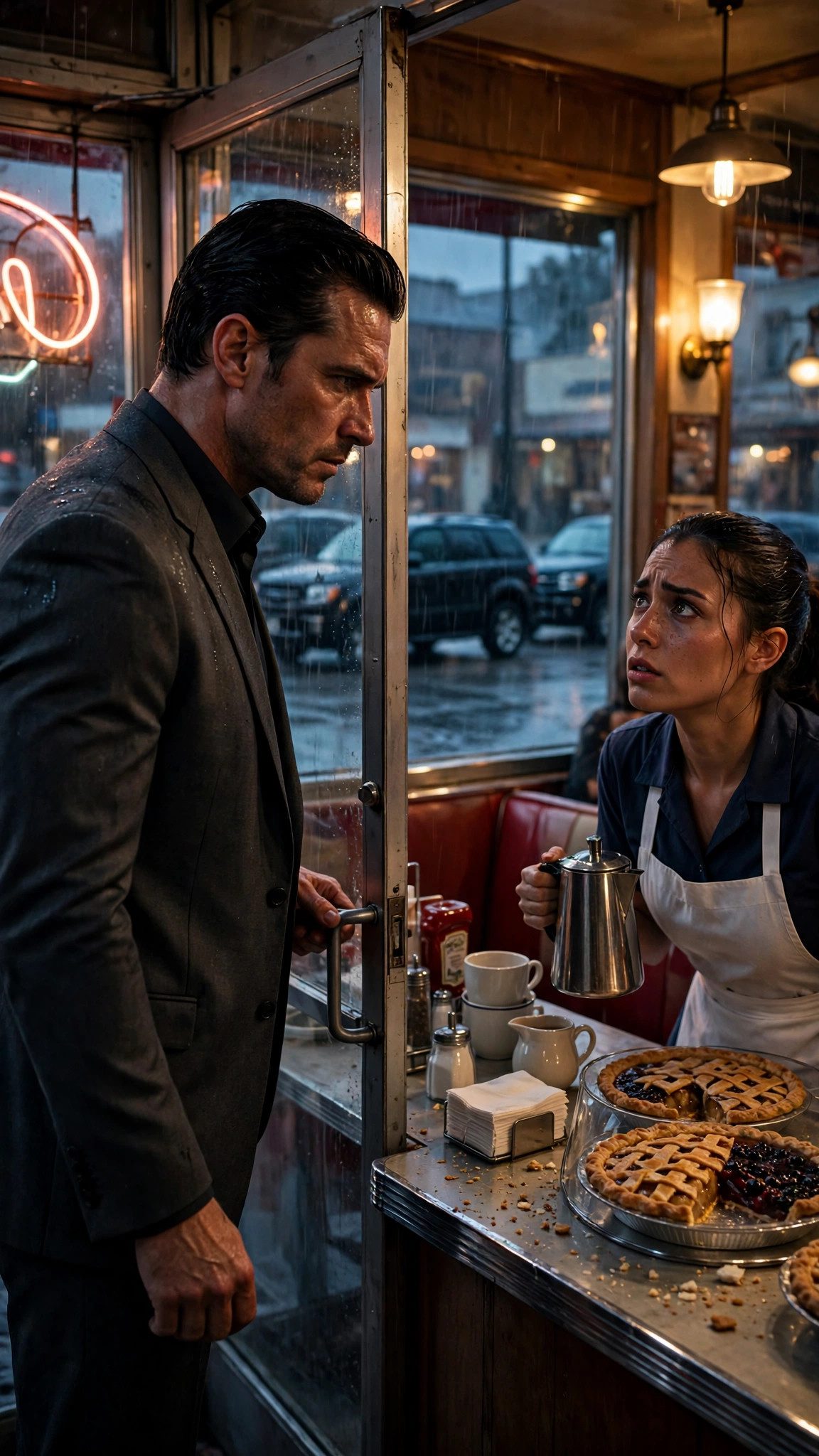
"My name is Dominic Salvatore," he said. "And I am here because I owe you a debt I can never repay."
The diner was so quiet I could hear the neon sign buzzing in the window. Old Mr. Peterson had his crossword frozen halfway to his mouth. Eddie Kowalski had stopped chewing. Marco stood in the kitchen doorway with a dish towel in his hands, and his face was white, and I understood, in that moment, that every person in Rosie's Diner knew exactly who Dominic Salvatore was, and I was the only one who did not.
I had heard the name, of course. Everyone in the city had heard the name. Dominic Salvatore was the man the newspapers called the most powerful crime boss in New York, the man the prosecutors had spent years trying to put behind bars, the man whose name made strong men lower their voices. I had read about him the way you read about a hurricane in another state: with a distant sort of interest, and the comfortable certainty that it would never touch your life.
And now he was standing in my diner, three feet away from me, saying that he owed me a debt.
"I don't understand," I said. My voice sounded very far away. "I just… I pulled you out of a car. Anyone would have done the same."
"No," he said. "Anyone would not have done the same. Most people drove past. I know. My people checked. Seventeen cars passed that stretch of highway in the ten minutes before you stopped, Miss Hart. Seventeen. You were the only one who stopped."
He took one step closer, and I could see his face properly now in the fluorescent light of the diner, and it was not the face I had seen on the highway. That face had been bloody and unconscious. This face was alive, and it was handsome in a hard, carved way, with dark eyes that did not blink often enough, and a scar that ran through his left eyebrow, and a mouth that looked like it had forgotten how to smile a long time ago.
"Three weeks ago, someone tried to kill me," he said, and his voice was low, and he did not seem to care that the whole diner could hear him. "A truck ran me off the road on purpose. The driver was paid to make sure I did not walk away from that crash. If you had not stopped, if you had driven past like the other seventeen, I would have burned to death in that car, and no one would have known it was murder. You saved my life, Emma Hart. In my world, that is a debt. And a debt like that can never truly be repaid. But I intend to spend the rest of my life trying."
I stared at him. My hands were gripping the edge of the counter so hard my knuckles had gone white.
"I don't want anything," I said. "I didn't do it for a reward. I did it because you were hurt and I was there. That is all."
"I know," he said. "That is why it matters. If you had done it for money, I could pay you and we would be finished. But you did it for nothing, and so I owe you everything."
One of his men bent down and whispered something in his ear, too low for me to hear, and Dominic nodded once, and then he looked back at me, and his eyes went to my left hand, to the plain gold band on my finger, and something changed in his face.
"Your husband," he said quietly. "Daniel Hart. A firefighter. He died six years ago in a warehouse fire on the West Side. You were twenty-three years old, and your daughter was one."
The blood left my face. "How do you know that?"
"Your daughter is Lily," he went on, as if I had not spoken. "She is seven years old. She is in the second grade at St. Mary's. She is going to be a sunflower in the school play next month, and she needs a costume."
"Stop it," I said. My voice was shaking now. "Stop it. How do you know all of this? Have you been watching me? Have you been following my daughter?"
"I have been making sure you are safe," he said. "There is a difference. The people who tried to kill me know that a woman pulled me from that car. They do not know your name yet, but they will find out, and when they do, they will come for you, because in their world, a witness is a problem. My men have been watching your apartment and your diner since I woke up in the hospital. Not to frighten you. To protect you."
He reached into his jacket, slowly, the way a man does when he does not want to frighten anyone, and he pulled out a small silver key. It was on a fine silver chain, and it caught the light of the diner, and it was the most beautiful thing I had ever seen, and I did not understand what it was.
"I was hoping you would wear it again," he said, and he held it out to me.
I did not take it. "What is it? What is this key for?"
"It is the key to a house," he said. "A small yellow house on Maple Street, three blocks from your daughter's school. It has a garden in the back and a radiator that works in every room, and it is yours, Emma. Not rented. Yours. The papers are already signed. All you have to do is take the key."
The diner was still silent. Old Mr. Peterson had put his crossword down. Eddie Kowalski was staring at me like I had grown a second head. I could feel every eye in the room, and I could feel the key shining in Dominic's hand, and I could feel my heart hammering against my ribs so hard it hurt.
"I can't take a house from you," I said. "I can't take anything from you. I don't know you. You are a stranger, and you are… you are a criminal. Everyone knows who you are. The newspapers, the prosecutors. I am a waitress. I have a daughter. I cannot be involved in your world."
"I am not asking you to be involved in my world," he said. "I am asking you to let me keep you safe in yours. The house is not a payment. A life cannot be bought. The house is a beginning. A place where your daughter can have a garden. A place where your rent does not go up to three thousand dollars in January."
My breath caught. "How do you know about the rent?"
"Your landlord is raising your rent to three thousand dollars," he said. "I know, because I asked. I ask about everything that touches you, Emma. That is what a man does when he owes a debt like mine."
He set the key down on the counter between us, gently, like it was something fragile, and he stepped back.
"Do you like Sunday?" he asked.
"What?"
"Sunday," he said. "Do you like Sunday? My mother makes dinner every Sunday at her house, and she has been asking me to bring a guest for three weeks, ever since I told her about the woman who pulled me from the fire. Come on Sunday. Bring Lily. No promises. No obligations. Just dinner. And if you decide you never want to see me again after that, I will respect it, and the house will still be yours, and my men will still watch over you, because that is what I owe you, whether you want it or not."
I looked down at the key on the counter. It was small and silver and it shone under the fluorescent lights, and it was the key to a house with a garden, and my daughter needed a costume for a school play, and my rent was going up to three thousand dollars, and a detective had told me not to accept anything from anyone, and the whole diner was watching me, and Dominic Salvatore was standing three feet away from me, waiting.
I looked at the key, and I looked at Dominic, and I thought about everything I knew and everything I did not know. I knew that he was a criminal, and that the newspapers had called him dangerous, and that a detective had warned me not to accept anything from anyone. I also knew that he had been bleeding and unconscious in a burning car, and that I had dragged him out with my own hands, and that he had come to my diner not with threats, but with gratitude, and that he had looked at my wedding ring and known my husband's name, and that he had asked me about Sunday dinner the way a shy boy might ask a girl to a dance. I thought about Lily, and about the rent, and about the sunflower costume hanging in her closet, and I thought about how tired I was of doing everything alone, and how frightening it was to admit that, even to myself.
"I need to think," I said.
"Think," he said. "Take all the time you need. The key will be here when you are ready." He turned to go, and then he stopped at the door, and he looked back at me, and for the first time since he had walked in, something almost like a smile crossed his face. "Your daughter needs a costume for a school play," he said. "A sunflower. I hope she is the brightest one on the stage."
And then he was gone, and his men were gone, and the SUVs pulled away from the curb one by one, and the diner was just a diner again, with its cracked vinyl and its buzzing neon sign, and I stood behind the counter staring at a small silver key, and my hands were shaking, and I did not know whether I was terrified or angry or something else entirely, something I did not have a name for yet.
Marco came out of the kitchen and stood beside me, and he looked at the key, and then he looked at me, and he shook his head slowly.
"Emma," he said, "in forty years in this city, I have never seen Dominic Salvatore walk into a place and leave something behind. Men like him take things. They do not give them."
"Maybe he is different," I said, but my voice did not sound convinced, even to me.
"Maybe," Marco said. "Or maybe you are different, and he knows it. Be careful, Emma. A man like that does not come into a woman's life by accident. And a house is never just a house."
Al called that night from his sickbed, his voice thin over the phone, because Eddie Kowalski had already called him, and Eddie Kowalski had told him everything.
"Emma, my girl," Al said, "are you all right? Did he hurt you? Did anyone hurt you?"
"No, Al," I said. "He was polite. He was… he was a gentleman, if you can believe that. He left me a key and invited me to Sunday dinner."
There was a long silence on the other end of the line. "A key to what?"
"A house," I said. "On Maple Street. He says it is mine."
"Emma," Al said, and his voice was very serious now, the way it had been the day he hired me, when he had looked at a pregnant widow with no references and said, you start Monday. "Listen to me. I have lived in this city for seventy-one years, and I have seen what men like Dominic Salvatore can do, and I have seen what they can destroy. But I have also seen this: a man who owes his life to someone will move heaven and earth for her. If he says the house is yours, it is yours. The question is not whether you can trust him. The question is whether you can trust yourself to walk away if you need to."
I did not sleep that night. I lay in bed staring at the ceiling, with the silver key on the nightstand beside me, catching the light from the streetlamp outside, and I thought about everything: the burning car, the rain, the detective's card in the drawer, the rent going up to three thousand dollars, Lily's sunflower costume hanging in her closet, Daniel's ring on my finger.
In the morning, Lily found the key on the nightstand and held it up with both hands, and her eyes went wide.
"Mommy, is this a fairy-tale key?" she asked. "Does it open a castle?"
"It opens a house," I said. "A yellow house with a garden. A man gave it to me because I helped him once."
"Is he a prince?" she asked.
"No, baby," I said. "He is not a prince. He is a man who owes me something, and he wants to pay it back."
She considered this, and then she slipped the chain over her head, and the key hung down over her pajamas, and she spun around in a circle, and she said, "I like it. It feels like magic."
I took the key back gently, and I put it in my pocket, and I made her breakfast, and I walked her to school, and all the way there I thought about Sunday dinner, and about a small yellow house on Maple Street, and about a man with dark eyes who had looked at my wedding ring and known my husband's name, and I thought about what Al had said: the question is whether you can trust yourself to walk away if you need to.
I did not know the answer yet. But I knew one thing: I was going to Sunday dinner. Not for the house. Not for the key. I was going because a man had looked me in the eye and told me the truth about what he owed me, and in my life, almost no one had ever done that.