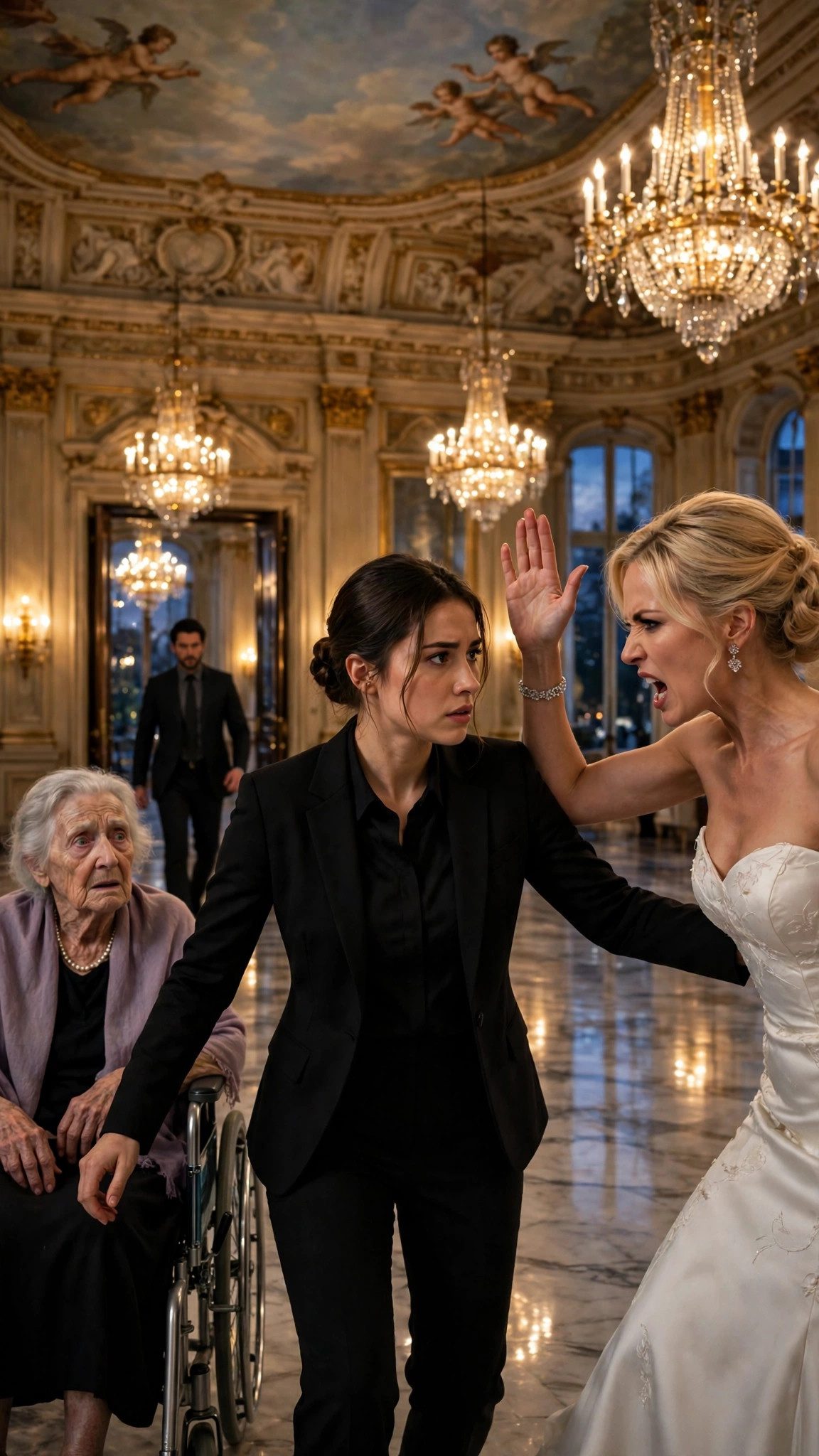
The slap was meant for an eighty-one-year-old woman's face, and I stepped between them before I even had time to think.
One second Vivian Calder's hand was in the air, her diamond ring catching the light of the chandeliers, her mouth twisted into something I had never seen on a bride's face before. The next second the whole ballroom of The Whitmore House seemed to tilt, and my body moved on its own, the way it had moved a hundred times before when a tray was falling or a guest was about to trip on the stairs. I put myself between Vivian and Eleanor Cross, and I heard the sound before I felt it, a crack like a champagne glass breaking on marble, and then the floor came up to meet me.
I was on the marble floor of the grand ballroom while the billionaire crime boss hosting his own engagement party walked in.
My name is Emma Hart, and I ran the large historic hotel in the Hudson Valley where my parents had worked for over two decades. That night, lying on the cold marble with my cheek on fire and three hundred guests staring down at me, I understood something I had spent a year pretending not to know. The house I loved, the house that had raised me, had finally asked me to choose between the man who owned it and the woman who was about to marry him. And I had chosen without thinking at all.
Julian Cross stopped in the doorway. He was thirty-six years old and he controlled shipping interests, private security companies, and enough quiet influence along the Hudson docks to stop whole projects with a single phone call. Powerful men lowered their voices when they said his name. He never needed to shout. That was the frightening part. That night, he did not shout. He looked at his fiancee, at his grandmother trembling in her wheelchair, and at me on the floor, and his voice came out low and flat, the way a river sounds right before it goes over a dam.
"You slapped her."
Vivian's hand was still in the air. She lowered it slowly, as if she had only just remembered it belonged to her.
"You raised your hand to an eighty-one-year-old woman inside my house, at my party."
The ballroom had gone so quiet I could hear the ice melting in the champagne buckets. Three hundred of the richest people in New York stood frozen with their glasses in their hands, and not one of them moved, because everyone in that room knew what Julian Cross did to people who hurt his family. Everyone except, apparently, the woman he was about to marry.
"Is that her?" Vivian said. Her voice was high and bright and completely unaware of the consequences. She pointed at me with one shaking finger. "Is that the girl from the kitchen? The one who just stepped between us and took the hit?"
She laughed then, a short, ugly sound that did not belong in a ballroom.
"Imagine you have a table full of stupid women," she said to the room, as if she were telling a joke at a dinner party. "The girl from the kitchen just stepped between them and took the hit."
I tried to get up. My cheek was burning, and my knees were shaking, and the marble was cold through my dress. Someone's hand closed around my arm and helped me to my feet. It was Rosa Delgado, our head housekeeper, seventy-one years old and steady as a stone wall. She did not say a word. She just held me up and glared at Vivian Calder with all the fury of a woman who had cleaned up after rich people's parties for fifty years and had never once raised her voice.
Vivian turned back to Julian, and her voice went sweet, the way it always went sweet when she wanted something.
"Darling," she said. "She is mine. She works for me now. Tell her to go back to the kitchen where she belongs."
"Help me, Emma," Eleanor whispered. She was sitting in her wheelchair beside the head table, her thin hands gripping the armrests, her silver hair coming loose from its bun. She was eighty-one years old, and she had been the kindest person I had ever known, and she was looking at me the way a drowning woman looks at a rope. "Don't look away, Emma. Don't look away."
Julian walked across the ballroom. He did not hurry. He never hurried. His shoes made no sound on the marble, and the crowd parted for him the way water parts for a ship. He stopped in front of Vivian, and he looked at her for a long moment, and I saw something in his face I had never seen before. Not anger. Something colder than anger. Something final.
"Take off my ring," he said.
Vivian blinked. "What?"
"Take off my ring, Vivian. Give it back to me. Now."
"Julian, you cannot be serious." Her voice rose. "In front of all these people? Over a maid? Over an old woman who called me a scar to my face?"
"She called you what she saw," Julian said. "Take off the ring."
Vivian's hand went to her finger, and for a moment I thought she would refuse, and then she saw his face, and she twisted the diamond off her finger and held it out to him, her hand shaking so hard the stone threw sparks across the ceiling.
"So that's how you got your diamond ring," she said to me, her voice cracking. "You are in another box now, Emma. There was already a diamond there. In your locker. Everyone saw it. Ask anyone. Ask the security men. They found it in your box."
She was talking about the morning. The morning the ring had gone missing, and the morning they had searched my locker, and the morning everything had started to fall apart. But that was later in the story. That night, in the ballroom, with three hundred people watching, Julian Cross took his ring back from his fiancee, and he turned to his grandmother, and he knelt down beside her wheelchair, and he took her thin old hand in both of his, and he said the words that changed everything.
"Grandmother," he said softly. "Tell me what you saw."
And Eleanor Cross, eighty-one years old, looked at the woman who had tried to hit her, and then at me, and then at her grandson, and she smiled, a small, fierce, triumphant smile.
"I saw everything," she said. "And I am going to tell you all of it."
That was the night my life changed. But to understand why a hotel manager would throw herself in front of a slap meant for an old woman, and why a billionaire crime boss would kneel on a ballroom floor in front of three hundred guests, you have to go back to the beginning. You have to go back to the house itself, because the house is where all of it started, and the house is the reason I could never walk away.
The Whitmore House stood on a bluff above the Hudson River, forty miles north of the city, a great white Victorian pile of a building with a wraparound porch and a ballroom with a ceiling painted like a summer sky. It had been a hotel for a hundred and forty years. Presidents had slept there. Movie stars had married there. And for twenty-three years, my parents had worked there, and I had grown up in its kitchens and its gardens and its long, echoing hallways, the way other children grow up in a house with a yard.
My father, Thomas Hart, was the head groundskeeper. He had strong hands, the kind of hands that could lift a fallen tree limb or fix a broken gate hinge or carry my mother up the stairs when her knees gave out. He still kept saying the same thing he had said my whole life, every time someone praised the gardens or the roses or the way the lawn rolled down toward the river like green velvet.
"Let this be about your talent, not us," he would say, and he would duck his head and go back to his roses.
My mother, Ruth Hart, was a housekeeper. She had worked at The Whitmore House since she was nineteen years old, and her job had shaky legs now, the way a table gets when one leg is shorter than the others. Her knees had given out years ago, and she still climbed the stairs every morning with her bucket and her rags, because the house needed her, and because she needed the house, and because neither of them knew how to live without the other.
I lowered my head and answered for them, the way I always did, whenever anyone asked about my parents. I told people they were fine. I told people they were happy. I did not tell people that my mother's knees were getting worse every winter, or that my father's back had started to ache in the mornings, or that the hotel had almost gone bankrupt twice in the last five years, and that we had all been holding our breath, waiting for the day the bank would finally take the keys.
I was six years old the first time my mother carried me into the kitchen of The Whitmore House. I remember the smell of bread baking and the sound of the dishwasher humming and the way the morning light came through the high windows and turned the steam gold. I remember sitting on a flour sack and watching the cooks move around each other like dancers, and thinking that this was the most beautiful place in the whole world. I loved this house for years before I ever heard anyone say a single thing about owning it or running it or losing it. I loved it the way you love a person, quietly and completely, without ever asking for anything back.
By the time I was twenty-eight, I ran the place. Not on paper, not at first. On paper, the hotel belonged to a company in the city, and the company belonged to a bank, and the bank did not care about the roses or the ballroom ceiling or the way the light came through the kitchen windows in the morning. But in practice, in the real life of the house, I was the one who knew which room had the draft and which guest liked extra pillows and which vendor would deliver flowers on a Sunday. I was the one who hired the staff and balanced the books and stood in the doorway of the ballroom on wedding nights and made sure everything was perfect. I owned my father's strong hands, my mother's humor, and the ability to disappear into a room without making a ripple. I would have traded any fortune for an unmade mess and a borrowed laptop, because a mess could be cleaned and a laptop could be returned, but the house could not be replaced.
Then, one year ago, Julian Cross bought The Whitmore House.
I froze when the line arrived. It came in an email from the bank, short and cold and final: the hotel had been sold to Cross Holdings, and the new owner would be visiting on Friday, and I should have the books ready. I read it three times, and then I sat down at my desk in the little office off the kitchen, and I put my head in my hands, because I knew what happened when men like Julian Cross bought places like The Whitmore House. They tore them down. They turned them into condominiums. They fired the staff and sold the furniture and put up a sign that said something new and shiny and soulless.
But Julian Cross did not tear the hotel down. He walked through the front door on a rainy Friday afternoon, tall and dark and quiet, with two men in black suits behind him, and he looked at the ballroom ceiling, and he looked at the gardens, and he looked at my mother struggling up the stairs with her bucket, and he said five words that I did not understand until much later.
"Show me everything," he said. "All of it."
I showed him everything. I showed him the kitchens and the cellars and the ballroom and the gardens and the little office where I kept the books. I showed him the roof that leaked and the boiler that rattled and the staff quarters where my parents had lived for twenty-three years. And at the end of the tour, in the garden, with the rain coming down on the roses, he asked me one question.
"Why is this place still standing?" he said. "The books say it should have died five years ago."
"Because the people who work here love it," I said. "Because my mother climbs those stairs every morning on knees that do not work anymore. Because my father prunes roses nobody pays him to prune. Because I have not taken a day off in three years."
He looked at me for a long time. His eyes were gray, the color of the river on a cloudy day, and they did not give anything away.
"Then you will run it," he said. "You will run it, and I will pay for the roof and the boiler, and no one here loses their job. That is the arrangement. Do you accept?"
I accepted. What else could I do? I signed the papers, and he signed the papers, and The Whitmore House belonged to Julian Cross, and I belonged to The Whitmore House, and for a year, that was enough. For a year, the hotel came back to life. The roof was fixed. The boiler was replaced. The gardens bloomed. My mother got a new cart so she did not have to carry her bucket up the stairs. My father got a boy to help him with the heavy work. And I told myself that Julian Cross was just a landlord, just a name on a piece of paper, just a quiet man in a black suit who came to the hotel once a month and walked through the rooms and never said very much.
I told myself that right up until the day he brought Vivian Calder to the hotel for the first time, and announced that they were engaged, and that the engagement party would be held in our ballroom, and that I would be in charge of all of it.
That was the day everything started to go wrong. And that was the day I started to understand what Eleanor Cross had been trying to tell me for months, in the evenings when I read to her in the library, in the small, fierce voice she used when the fog lifted and her mind came back to her, sharp as a knife.
"Emma," she used to say, holding my hand with her thin, cold fingers. "You are not just a maid. You are the best thing that has ever happened to this house. And one day, my grandson is going to see it. One day, he is going to look at you the way he looks at the river. Like you are the only thing in the world that is real."
I laughed it off, every time. I told her she was being silly. I told her Julian Cross was engaged to a beautiful woman from a rich family, and that I was the hotel manager, and that the two things had nothing to do with each other.
But Eleanor Cross just smiled, the way she smiled that night in the ballroom, and she said, "We will see, Emma. We will see."
And then she would close her eyes, and the fog would come back, and she would forget what she had said, and I would keep reading, and the evening would go on, and I would tell myself that an eighty-one-year-old woman's dreams were just dreams.
I was wrong. About all of it. And the night of the engagement party was the night I found out how wrong I had been.