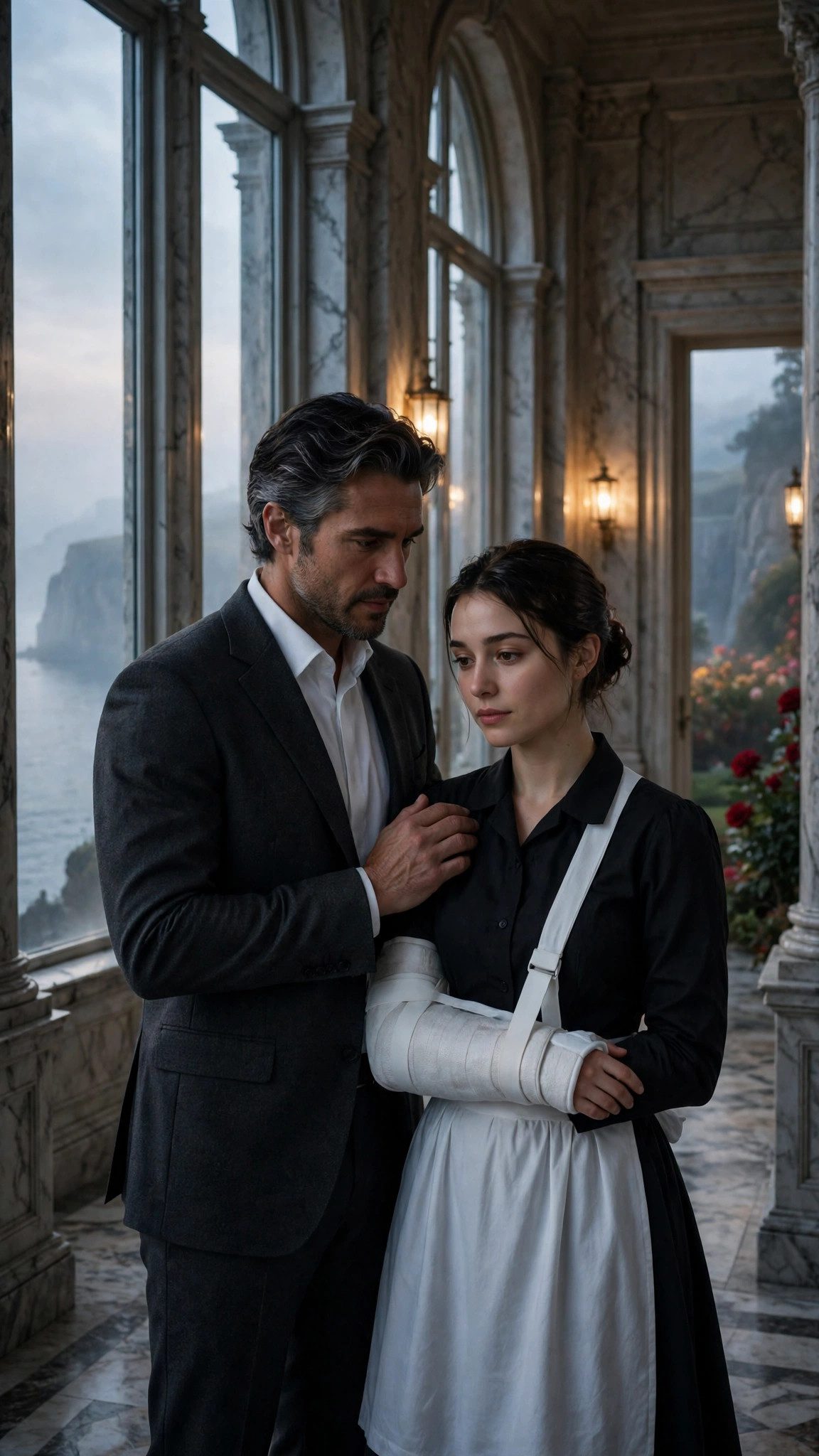
The morning Damon Blackwell noticed the maid's broken arm, fifteen men vanished from his house before sunrise, and nobody in the city of Bayport ever saw them again.
It was a Tuesday in October, and the light coming off the bay was the color of cold pewter. Damon stood at the tall windows of his study on the second floor of the Blackwell estate, a cup of black coffee in his hand, watching the gardeners rake the first fallen leaves off the gravel drive. Below him, the house was waking up the way it always did: the kitchen staff moving through the service corridors, the housekeeper Mrs. Calloway checking the silver in the dining room, the drivers polishing the black cars in the courtyard. The house was a machine, and every person in it had a place, a task, and a name that the house knew.
Every person except one.
She came through the garden door with a bucket and a mop, moving the way people move when they are trying not to be noticed. She was young, twenty-six at most, with dark brown hair pulled back into a low bun and a plain black maid's uniform under a white apron. She carried the bucket in her left hand. Her right arm hung close to her body, stiff and guarded, the sleeve of her uniform pulled down low over her wrist. When she reached for the door handle, she used her left hand. When she set the bucket down, she did it slowly, carefully, as if the weight of a bucket of water might break something inside her.
Damon watched her for a long moment. He had seen men hide injuries before. He had seen soldiers in his father's warehouses hold a broken rib with one hand and lift crates with the other, and he had seen dockworkers tape their fingers together and keep working because a day without pay was a day without food. He knew what a person looked like when they were carrying pain and pretending they were not.
This girl was carrying pain, and she was pretending very hard.
He set his coffee down and went downstairs.
The hallway on the ground floor smelled of lemon polish and fresh bread. The maid was on her knees by the marble floor near the library door, wringing out the mop with one hand. Her right arm stayed tucked against her side. When she heard his footsteps, she looked up, and for a second her face was open and unguarded, and Damon saw what she was: tired, frightened, and very young.
"Good morning," he said.
"Good morning, Mr. Blackwell," she said. Her voice was quiet and steady. She did not stand up. She stayed on her knees, as if standing would make her more visible, and being visible was the last thing she wanted.
"What is your name?" he asked.
She blinked. It was a simple question, and the look on her face said that no one in this house had ever asked it before.
"Kate, sir," she said. "Kate Bennett."
"Kate Bennett," he repeated. "How long have you worked in this house?"
"Three weeks, sir."
"And your arm?" he said. "What happened to your arm?"
Her face closed like a door. "Nothing, sir. I am fine."
"You are favoring it," he said. "You carry everything with your left hand. You have not used your right hand once since I have been watching you."
"I fell, sir," she said quickly. Too quickly. "On the stairs at home. It is only a bruise."
Damon looked at her wrist. The sleeve had ridden up a fraction when she reached for the mop, and he could see the edge of a dark bruise, purple and yellow, spreading up from her wrist toward her elbow. Below the bruise, her wrist was swollen, and there was a faint smell of menthol in the air, the smell of the ointment she had rubbed into it.
A fall on the stairs did not bruise a wrist like that. A hand did. A hand that had grabbed a wrist and twisted it until something inside had given way.
"Show me," he said.
"Sir, I—"
"Show me your arm, Kate."
She hesitated, and then, slowly, she pushed her sleeve up. Her forearm was swollen from the wrist to the middle of the arm, the skin mottled purple and green and yellow, and when she tried to turn her hand over, her face went white and she caught her breath.
"That is broken," Damon said quietly. "That is not a bruise. That is a broken arm, and it has been broken for days, and you have been working with it anyway."
"It will heal, sir," she whispered. "I cannot afford to stop working. Please do not tell Mrs. Calloway. Please. I need this job."
"Who did this to you?" he asked.
"No one," she said. "I fell. I told you, I fell."
She was lying, and they both knew it. But Damon did not press her. He had spent his whole life around people who lied because the truth was more dangerous than the lie, and he knew that pushing a frightened person only made them lie harder.
"Go to the kitchen," he said. "Mrs. Calloway will make you tea. Rest your arm. I will send for a doctor."
"Sir, I cannot—"
"Go," he said, and his voice was not unkind, but it was the voice of a man who was used to being obeyed.
She went, carrying her bucket in her left hand, and Damon stood in the hallway and watched her go, and he thought about the house he had inherited from his father, and the men who moved through it, and the things that happened in it that he did not see because he had trained himself not to look.
His father had built the Blackwell family on shipping and the waterfront and construction, and his father had taught him that a house is only as strong as the people who keep it. But his father had also taught him something else, something Damon had spent the last ten years trying to forget: that there were men in this family who believed that fear was the only tool that worked, and that a person who could not be bought could always be broken.
Damon went back upstairs to his study and made two telephone calls. The first was to a doctor he trusted, a man who asked no questions. The second was to his head of security, a quiet man named Tony, who had worked for the Blackwell family for twenty years and who knew every corridor of the estate, every camera, every door that was supposed to be locked.
"I want to know who hurt the new maid," Damon said. "Her name is Kate Bennett. She has a broken arm, and she is afraid to say who did it. Find out. Do not ask her. Ask the house."
Tony was silent for a moment. "Sir," he said at last, "there are things in this house you have chosen not to see."
"Then it is time I saw them," Damon said.
He hung up and stood at the window again, and he watched the bay, and he thought about his wife, Marla, who had been dead for five years, killed by a car bomb that had been meant for him. Marla had loved this house. She had planted the roses in the garden and chosen the curtains in the library, and she had once told him that a house was not a building, it was a living thing, and that a house learned the names of the people who belonged in it, and forgot the names of the people who did not.
Damon had not understood her then. He was beginning to understand her now.
He thought about his father, too, and about the day his father had died, ten years earlier, sitting in this same study, looking out at this same bay. His father had called him in that morning, and he had taken Damon's hand, and he had said, "This family is yours now, Damon. The ships, the warehouses, the men. All of it. And I want you to remember one thing: a man who does not know what happens in his own house does not own his house. The house owns him."
Damon had nodded, and he had promised, and he had spent ten years believing he had kept that promise. He had gone to the meetings. He had signed the papers. He had shaken the hands. But he had not walked the corridors at night. He had not asked the maids their names. He had not looked at the boathouse after midnight, and he had not wondered why the housekeeper left tea in the library at an hour when no one was supposed to be there.
He had chosen not to see, because seeing would have meant a fight with his uncle, and a fight with his brother, and a war inside his own family, and he had told himself that peace was worth the price of blindness. But the price of blindness had been a girl on her knees in the hallway with a broken arm, and the price had been too high, and he would not pay it anymore.
Downstairs, in the kitchen, Kate sat at the small table with a cup of tea, and Mrs. Calloway stood at the stove, and neither of them spoke, because there was nothing safe to say. Mrs. Calloway kept glancing at Kate's arm, and Kate kept her sleeve pulled down, and the clock on the wall ticked, and the house went about its business, and outside the window, the gardeners raked the leaves, and the bay glittered, cold and grey and beautiful, and neither woman knew that upstairs, in the study, the master of the house had just decided to take his house back.
By noon, Tony came back with the answer, and the answer was worse than Damon had expected.
Three days earlier, Kate had been dusting the library, and she had found a folder on the desk. Inside the folder there had been a diagram of an explosive device, and a black envelope full of money, and a list of names. She had put the folder down and backed away, and she had been turning to leave when his younger brother Daniel had come into the room behind her.
Daniel had grabbed her wrist. He had told her that if she ever spoke about what she had seen, she would disappear, and so would her family. And then he had twisted her arm until the bone cracked, and he had walked out of the room as if nothing had happened, and Kate had gone back to work, because she could not afford to stop.
"Daniel," Damon said.
"Yes, sir," Tony said. "Your brother. On your uncle Victor's orders, as far as I can tell."
Victor Blackwell. Damon's uncle, sixty-two years old, a man who sat on the state parole board and shook hands with judges and gave money to the symphony, and who had been running an arms-dealing operation out of the Blackwell estate for years, using Damon's name and Damon's shipping routes and Damon's house.
"The folder," Damon said. "Where is it now?"
"Gone," Tony said. "Victor's men took it the same night. But I know who they are. Fifteen men, sir. Fifteen men who work for your uncle, not for you. They come and go through the service entrance at night. They use the boathouse. They have been using this house as a warehouse for Russian arms for two years."
Damon was quiet for a long time. Then he said, "Fifteen men."
"Yes, sir."
"By morning," Damon said, "I want fifteen men gone from this house. All of them. I do not want them hurt. I want them gone. Call Agent Vasquez at the FBI. Tell her everything. Give her the names, the routes, the boathouse. And then make sure that when the sun comes up, there is not one of Victor's men left on this estate."
"Sir," Tony said, "your uncle will not forgive this."
"My uncle broke a maid's arm in my house," Damon said. "There is nothing to forgive."
That night, Damon did not sleep. He walked the corridors of his house in the dark, and he listened to the sounds it made, the creak of the old floorboards and the sigh of the wind off the bay, and he thought about the girl on her knees in the hallway, and about his wife Marla, and about the house that had learned the names of the people who belonged in it.
He went down to the kitchen at midnight, and he found Kate sitting at the small table by the window, a cup of tea going cold in front of her, her broken arm resting on a folded towel. Mrs. Calloway had gone to bed. The house was quiet.
"You should be asleep," he said.
"I cannot sleep, sir," she said. "It hurts."
"The doctor will come in the morning," he said. "He will set it properly. You will not work until it heals. You will still be paid."
She looked at him, and her eyes were wide. "Why?" she asked. "Why would you do that for me? I am only the maid."
Damon sat down across from her, and for the first time in five years, he told someone the truth about his house.
"Because this house has forgotten how to be a home," he said. "And because someone broke your arm in my house, and that is my responsibility. And because, Kate Bennett, I intend to learn your name, and I intend to make sure this house learns it too."
She stared at him. Outside the window, the first pale light of dawn was touching the bay, and somewhere in the dark corridors of the estate, fifteen men were quietly, carefully, and completely vanishing.
My name is Kate Bennett. My earliest memory is the smell of bleach in the two-bedroom apartment where my mother cleaned houses for people who had never once asked her name. My mother tended broken people and hidden people for a living, and by the time I was seven, I had learned to clean houses without disturbing whatever violence had happened the night before. Most of that violence belonged to the Blackwell family.
I was twenty-six years old, and I worked at the Blackwell estate, a sprawling mansion that overlooked a bay no one in my neighborhood could ever afford to visit. I made less than a thousand a week. My family's most valuable possession was a small wooden box filled with twenty-one folded dollar bills that my uncle Ray had set aside for emergencies, one dollar for every year of my life when he started it, and I carried that little emergency box with me every single day, in the bottom of my bag, because it was the only thing in the world that was truly mine.
It had nothing to do with Damon Blackwell. He was a man people never approached with the name of their trouble, because trouble around Damon Blackwell had a way of disappearing, or worse.
But on a Tuesday in October, Damon Blackwell saw my broken arm, and by morning, fifteen men had vanished, and my life, which had been small and invisible and carefully quiet, was never quiet again.